
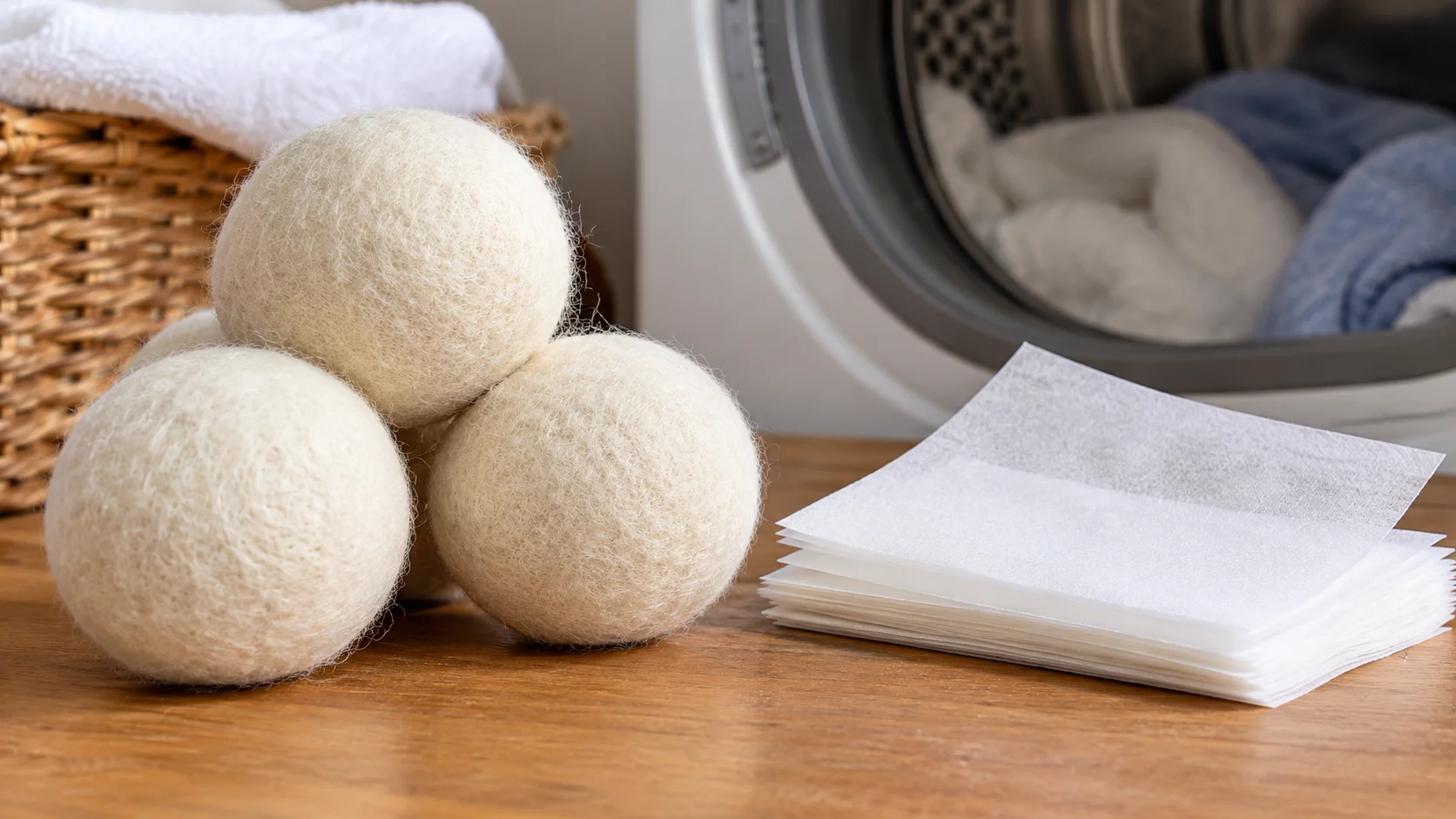
The choice between dryer balls vs dryer sheets depends on what you want from your dryer. Dryer sheets are designed to reduce static, soften fabrics, and add fragrance by transferring conditioning ingredients onto clothing during the drying cycle. Dryer balls work differently: they tumble among the clothes, help separate items, and can improve airflow through the load. Wool dryer balls are also reusable, making them an alternative to single-use dryer sheets.
If fragrance, traditional softening, and strong static control are your priorities, dryer sheets may be more convenient. If you want a reusable option that can help separate laundry and potentially shorten drying time, dryer balls may be preferable. Neither option is automatically better for every fabric or every household. Your laundry type, dryer settings, sensitivity to fragrance, and desired results should determine which one you use.
What Are Dryer Balls?
Dryer balls are reusable objects placed inside the dryer with wet laundry. They are commonly made from wool, rubber, or plastic, although wool dryer balls are especially popular. Their primary physical function is to move through the laundry as the drum rotates, helping prevent clothes from forming tightly packed clumps.
Whirlpool explains that wool dryer balls can separate layers of clothing so warm air can circulate more effectively, potentially reducing drying time.
Dryer balls can also:
- Separate clothes during tumbling.
- Help prevent laundry from clumping.
- Potentially improve airflow.
- Potentially reduce drying time.
- Reduce some wrinkles.
- Provide a small amount of mechanical softening.
- Reduce the need for disposable dryer sheets.
- Be reused for many loads.
- Help with bulky items that tend to bunch together.
- Work without adding fragrance.
Wool dryer balls are particularly attractive to people looking for a reusable laundry accessory rather than a single-use sheet.
What Are Dryer Sheets?
Dryer sheets are disposable fabric-softening products designed to go directly into the dryer with clothing. Heat activates their conditioning ingredients, which transfer onto fabrics during tumbling.
The American Cleaning Institute explains that dryer sheets can reduce static and wrinkles while providing softness, and Whirlpool describes them as products that reduce static, deposit scent, and make laundry feel softer.
A typical dryer sheet may provide:
- Static reduction
- Fabric softening
- Fragrance
- Reduced friction
- A smoother feel
- Some wrinkle reduction
The biggest difference between dryer sheets and dryer balls is therefore how they work. Dryer sheets use conditioning ingredients, while dryer balls primarily work through physical movement and separation.
Dryer Balls vs Dryer Sheets: How They Work Differently
The two products may be used for similar laundry goals, but they achieve them through different mechanisms.
Dryer sheets release softening agents onto fabric during the heated drying cycle. These ingredients can reduce static and make fabrics feel softer.
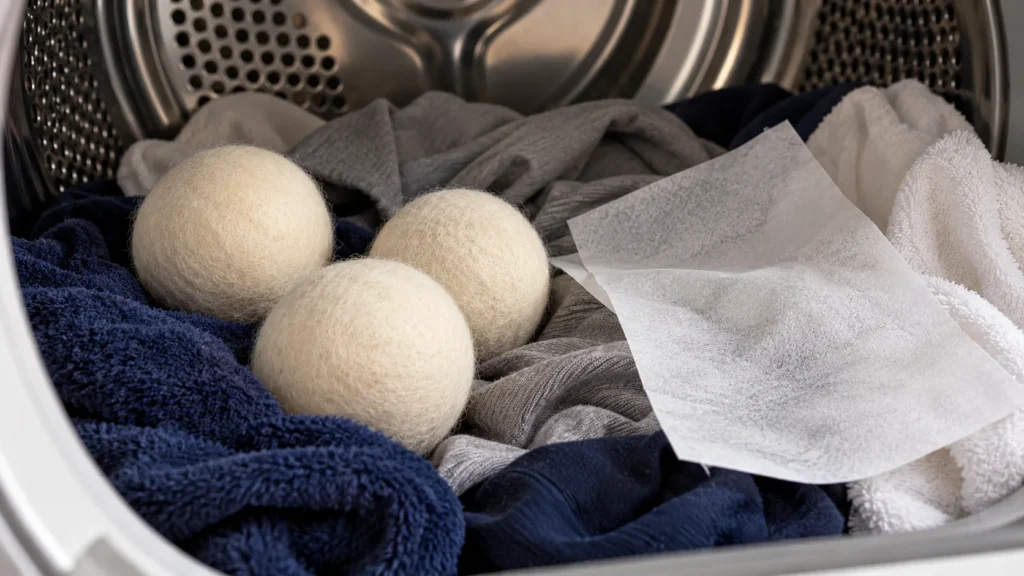
Dryer balls instead move between garments. This physical separation can help laundry tumble more freely and allow warm air to circulate around individual items. Whirlpool says wool dryer balls can help reduce clumping and drying time through this action.
Main Difference
- Dryer sheets: chemical conditioning + fragrance + static control.
- Wool dryer balls: physical separation + reusable laundry accessory.
- Dryer sheets: generally single-use.
- Dryer balls: reusable.
- Dryer sheets: stronger option when fragrance is desired.
- Dryer balls: better suited to households avoiding added fragrance.
- Dryer sheets: coat fabrics with conditioning ingredients.
- Dryer balls: do not provide the same chemical conditioning effect.
Dryer Sheets vs Dryer Balls for Static
Static is one of the biggest reasons people compare dryer sheets vs dryer balls. Static develops when fabrics rub against one another in the dry environment of a dryer. Synthetic materials such as polyester and nylon are particularly prone to static buildup, and overdrying can make the problem worse.
Dryer sheets are specifically formulated to reduce static. ACI recommends dryer sheets as one way to help control static cling during drying.
Wool dryer balls can also help reduce static under some conditions because they can absorb moisture and keep laundry separated. Whirlpool recommends lightly spraying wool dryer balls with water when static becomes a problem.
Winner for predictable static control: Dryer sheets.
Winner for a reusable, no-sheet approach: Wool dryer balls.
Wool Dryer Balls vs Dryer Sheets for Drying Time
One of the main benefits associated with wool dryer balls vs dryer sheets is drying efficiency. Dryer balls can keep clothes from sticking together in large clumps, allowing air to move more freely through the load.
Whirlpool says dryer balls can help clothes dry faster by keeping laundry from clumping together and increasing airflow.
ACI takes a more cautious position, noting that dryer balls may speed drying time but that the benefits are typically negligible compared with the conditioning benefits of fabric softeners.
This means drying-time results can vary based on:
- Load size
- Dryer capacity
- Fabric type
- Moisture level
- Dryer efficiency
- Cycle selection
- Whether clothes are clumped together
- Number of dryer balls
- How full the drum is
Dryer sheets generally are not intended to make laundry dry faster. Whirlpool specifically says dryer sheets may not speed drying, whereas dryer balls can help increase airflow between garments.
Winner for potential drying-time improvement: Dryer balls.
Jump into Other Related Article
- Laundry Dryer Vent Installation
- Does Rayon Shrink?
- How to Remove Coffee Stains
- How to Clean Suede Shoes
- Best Stain Remover for Clothes
- How to Clean Stainless Steel
- How to Clean Carpet Stains
- Oxygen Bleach
- Homemade Laundry Detergent
Wool Dryer Balls vs Dryer Sheets for Softness
If softness is your main goal, the comparison becomes more complicated.
Dryer sheets are specifically formulated with softening ingredients that transfer to fabrics. Dryer balls can make laundry feel somewhat softer through mechanical action, but they do not provide the same conditioning effect as a fabric softener or dryer sheet.
ACI explicitly notes that dryer balls do not provide many of the same benefits as fabric softeners because their action is primarily mechanical rather than conditioning.
Whirlpool describes wool dryer balls as a way to naturally soften clothes, but the effect is different from applying a dedicated softening agent.
Winner for conventional softening: Dryer sheets.
Winner for reducing reliance on softening products: Wool dryer balls.
Dryer Balls vs Dryer Sheets for Wrinkles
Both options may help reduce wrinkles, but they work differently.
Dryer balls can create space between clothes as they tumble, which can reduce clumping and help prevent some wrinkles. Whirlpool says dryer balls can help combat wrinkle formation by creating space between items.
Dryer sheets can also reduce friction and provide conditioning benefits that make fabrics feel smoother. ACI lists wrinkle reduction among the benefits of fabric softeners and dryer sheets.
However, neither product can compensate for heavily overfilled dryers or inappropriate drying temperatures.
To reduce wrinkles:
- Avoid overloading the dryer.
- Choose an appropriate cycle.
- Remove clothes promptly.
- Use a moisture-sensing cycle when available.
- Separate large items from smaller garments when practical.
- Use dryer balls to reduce clumping.
- Follow care labels for heat settings.
Result: Both can help, but dryer balls have the advantage of physically separating clothing.
Dryer Sheets vs Wool Balls for Fragrance
This is one category where the two products are fundamentally different.
Dryer sheets can leave fragrance on laundry because fragrance ingredients are part of many sheet formulations.
Unscented wool dryer balls do not naturally add fragrance.
That makes the choice straightforward:
- Want scented laundry? Dryer sheets.
- Want fragrance-free laundry? Wool dryer balls.
- Sensitive to fragrance? Unscented dryer balls may be preferable.
- Want to add a scent separately? Check that any added product is specifically intended for dryer use and compatible with your laundry.
Whirlpool notes that people with fragrance sensitivities or allergies may prefer dryer balls as an alternative to scented dryer sheets.
Wool Dryer Balls vs Dryer Sheets for Sensitive Skin
For households concerned about fragrance or skin sensitivity, wool dryer balls can offer an important advantage: they can be used without adding fragrance or conditioning chemicals to clothing.
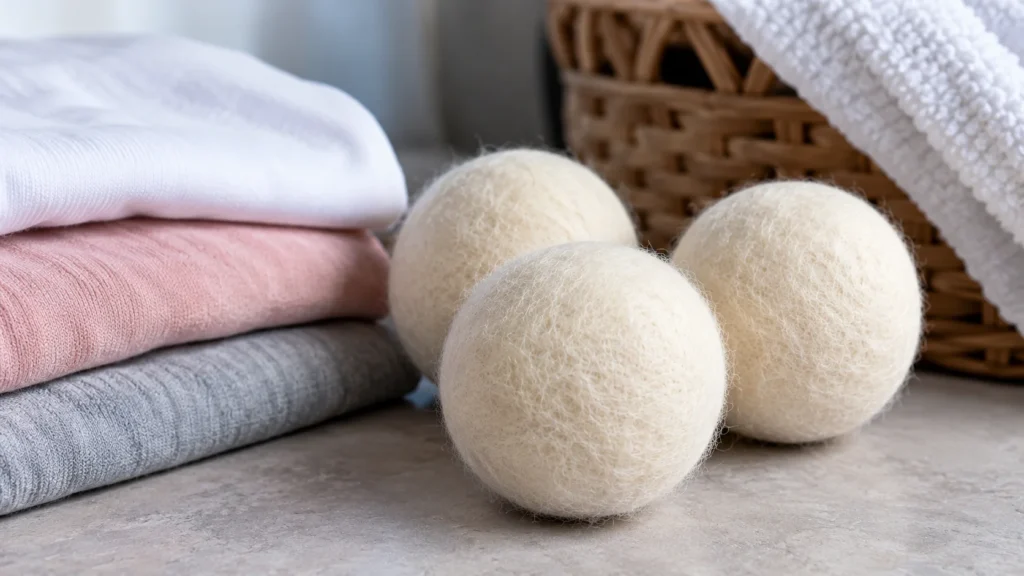
The American Academy of Dermatology recommends fragrance-free laundry products for people with eczema because fragrance can trigger irritation or flares in some individuals.
This does not mean dryer sheets are harmful to everyone with sensitive skin. It means that removing fragranced laundry products can be a reasonable step when trying to identify an irritant.
For sensitive households:
- Choose unscented wool dryer balls.
- Use fragrance-free detergent.
- Avoid unnecessary fabric softeners.
- Follow garment-care instructions.
- Wash bedding regularly.
- Monitor whether irritation changes after removing fragranced products.
Better choice for fragrance-sensitive households: Unscented wool dryer balls.
Dryer Balls vs Dryer Sheets for Towels
Towels require special consideration because their primary job is absorbing water.
Whirlpool advises caution with dryer sheets and fabric softeners on towels because softening products can reduce absorbency.
Dryer balls do not coat towel fibers with traditional fabric-softening ingredients. They can also help towels tumble and separate during drying.
For towels, dryer balls may therefore be the more practical option if absorbency is your priority.
For Better-Tumbling Towels
- Do not overload the dryer.
- Use an appropriate heat setting.
- Add wool dryer balls if desired.
- Avoid excessive fabric softener.
- Skip dryer sheets when maximum absorbency matters.
- Remove towels when adequately dry rather than excessively overdrying them.
Wool Dryer Balls vs Dryer Sheets for Athleticwear
Athleticwear is another situation where dryer sheets may not be the best choice.
Whirlpool recommends avoiding dryer sheets on athleticwear and microfiber because conditioning ingredients can affect moisture-wicking performance.
For sports clothing, a reusable dryer ball can be a better alternative when the garment’s care label allows tumble drying.
Check labels for:
- Maximum drying temperature
- Tumble-dry instructions
- Special performance finishes
- Moisture-wicking requirements
- Manufacturer-specific laundry instructions
Better choice for many technical garments: Dryer balls, provided the garment is approved for tumble drying.
Dryer Balls vs Dryer Sheets for Pet Hair
People often search for dryer balls vs dryer sheets for pet hair, but neither product should be treated as a guaranteed pet-hair remover.
Dryer balls can help separate laundry as it tumbles, potentially making it easier for loose hair and lint to move toward the lint filter. Dryer sheets can reduce static, which may help some loose hair release from fabrics.
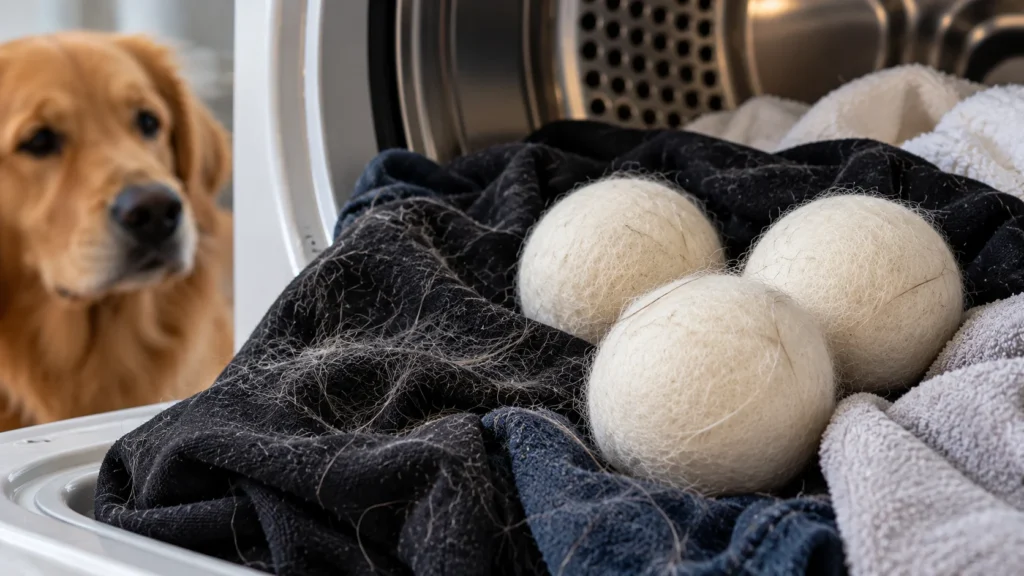
However, actual results depend heavily on the fabric, amount of pet hair, dryer airflow, and load size.
For heavy pet hair:
- Shake clothing outdoors before washing.
- Use the appropriate wash cycle.
- Avoid overloading.
- Clean the lint screen after drying.
- Use dryer balls to keep garments separated.
- Check the care label before adding dryer sheets.
- Use a lint roller for remaining hair.
Result: Neither product is a complete pet-hair solution.
Reusable Dryer Balls vs Dryer Sheets
One of the clearest differences is reusability.
Most dryer sheets are designed for one drying cycle and are then discarded. Dryer balls can be used repeatedly. Whirlpool says wool dryer balls can potentially last for years or around 1,000 loads when properly maintained, although actual lifespan varies by product and use.
This gives reusable dryer balls an advantage for people trying to reduce the number of disposable laundry products they purchase.
Reusable Dryer Ball Advantages
- Used across many loads.
- No single-use sheet required.
- No sheet packaging for every load.
- Can be stored and reused.
- Available in unscented versions.
- Useful for separating laundry.
- May reduce drying time.
- Can help reduce some wrinkles.
Dryer Balls vs Dryer Sheets: Cost Comparison
The actual cost depends on the brand, number of sheets per package, quality of dryer balls, and how long the balls last.
Dryer sheets generally have a low cost per individual use, but they must be replaced regularly.
Dryer balls cost more upfront but can be reused across many loads. Whirlpool says wool dryer balls can last up to five years or about 1,000 loads depending on the product and care.
Which Is Cheaper Long-Term?
A simple calculation is:
Dryer sheet cost per load × number of loads
versus:
Dryer-ball purchase price ÷ estimated usable loads
For example, if a household dries hundreds of loads annually, reusable balls can potentially become less expensive per load over time.
However, do not buy a product solely because it claims to last a certain number of loads. Actual durability depends on construction, laundering habits, and maintenance.
Wool Dryer Balls vs Dryer Sheets: Environmental Differences
Dryer sheets are generally disposable, while dryer balls are reusable. That gives wool dryer balls a straightforward advantage in reducing the number of individual sheets thrown away.
But “reusable” does not automatically mean zero environmental impact. Wool, packaging, transportation, and manufacturing all require resources.
The most reasonable comparison is therefore:
Disposable product: Dryer sheets.
Reusable product: Dryer balls.
Potential waste-reduction advantage: Dryer balls.
If reducing single-use household products is important to you, reusable dryer balls are the more obvious choice.
Dryer Balls vs Dryer Sheets for Static Cling
Static is one area where the comparison depends heavily on your fabrics and drying conditions.
Static becomes more likely when laundry is overdried, when the air is dry, and when synthetic materials such as polyester and nylon are involved.
Dryer sheets directly target static through conditioning ingredients. Wool dryer balls can help by retaining moisture and separating clothing, but their performance can vary.
For stubborn static:
- Avoid overdrying.
- Use a moisture-sensing cycle.
- Separate highly static-prone synthetics.
- Try wool dryer balls.
- Lightly dampen wool dryer balls if appropriate.
- Use a dryer sheet if you need stronger static control.
- Reduce the heat when the care label permits.
Best for strong, predictable static control: Dryer sheets.
Dryer Balls vs Dryer Sheets for Large Loads
Large loads can become tightly packed, reducing airflow. Dryer balls can help create space between garments as the load tumbles.
Whirlpool explains that dryer balls can keep laundry from clumping and improve airflow between items, which may help with drying.
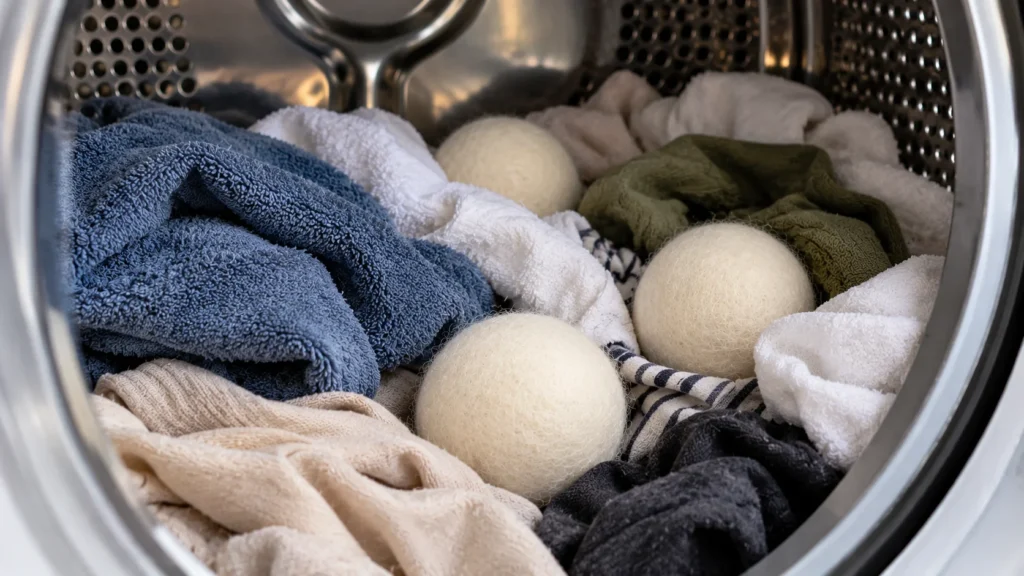
However, adding dryer balls does not make an overloaded dryer efficient. If the drum is too full, clothes may still dry unevenly.
For large loads:
- Follow your dryer’s load recommendations.
- Avoid packing clothes tightly.
- Separate bulky items.
- Use dryer balls if appropriate.
- Do not expect extra balls to fix overloading.
- Clean the lint filter regularly.
How Many Wool Dryer Balls Should You Use?
The number depends on the size of the load and the product. Whirlpool says three dryer balls is a typical amount, although the appropriate number can vary with dryer capacity and load size.
A practical approach is:
- Small load: use the manufacturer’s recommendation.
- Medium load: typically around three balls.
- Large load: follow the product instructions and dryer capacity.
- Bulky load: use enough balls to help separate items without overcrowding the drum.
More is not automatically better.
Can You Use Dryer Balls and Dryer Sheets Together?
Yes, using dryer balls and dryer sheets together is possible if you want the benefits of both.
Whirlpool states that dryer sheets can be used with wool dryer balls, noting that the sheet can provide fragrance while the balls offer their physical separation benefits.
However, using both is not necessary.
Consider combining them when:
- You want some fragrance.
- You need stronger static control.
- You also want the separation benefits of balls.
- Your clothing is compatible with dryer sheets.
Skip the combination when:
- You are trying to reduce disposable products.
- Your towels need maximum absorbency.
- Your athleticwear prohibits softeners.
- Your household avoids fragrance.
Dryer Sheets vs Wool Balls: Pros and Cons
Dryer Sheet Pros
- Strong static reduction.
- Adds fragrance.
- Provides conventional fabric softening.
- Easy to use.
- Convenient for everyday laundry.
- Widely available.
- No special storage or maintenance required.
Dryer Sheet Cons
- Usually single-use.
- Creates recurring waste.
- Can leave conditioning ingredients on fabric.
- May be unsuitable for towels.
- May affect some technical fabrics.
- May be inappropriate for flame-resistant clothing.
- Fragrance may bother sensitive people.
- Can contribute residue on lint screens.
Whirlpool specifically recommends avoiding dryer sheets on athleticwear, microfiber, flame-resistant clothing, and water-repellent fabrics.
Wool Dryer Ball Pros
- Reusable.
- Can separate laundry.
- Can improve airflow.
- May reduce drying time.
- May reduce some wrinkles.
- Can help with static.
- Available without fragrance.
- Can reduce reliance on disposable dryer sheets.
Wool Dryer Ball Cons
- Do not provide the same chemical softening as dryer sheets.
- Static control can vary.
- Drying-time savings are not guaranteed.
- They eventually wear out.
- Wool balls require occasional care.
- They do not add fragrance unless another product is used.
- They cannot solve an overloaded dryer.
ACI specifically notes that dryer balls may provide some drying and wrinkle benefits but do not provide the same conditioning benefits as fabric softeners.
Dryer Balls vs Dryer Sheets: Which Is Better?
There is no single winner for every household.
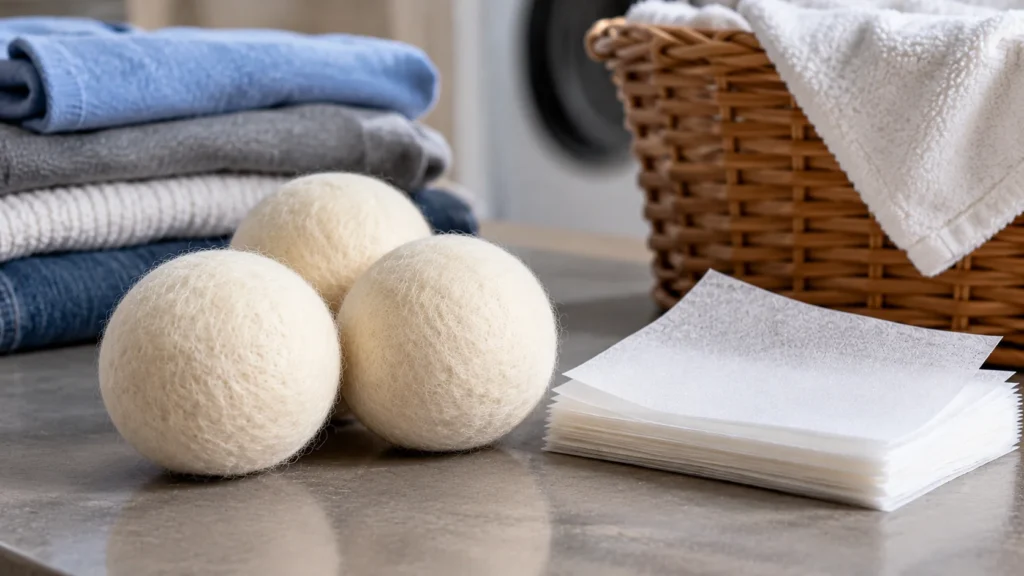
Choose dryer sheets if you want:
- Strong static reduction.
- Traditional fabric softness.
- Fragrance.
- A simple single-use product.
- Familiar results on compatible everyday fabrics.
Choose wool dryer balls if you want:
- A reusable option.
- Less reliance on disposable products.
- Better laundry separation.
- Potentially faster drying.
- Fragrance-free drying.
- A practical alternative for many towels and technical garments.
Use neither when:
- Your garment manufacturer prohibits them.
- You are air-drying the clothing.
- You do not need their specific benefits.
- Your laundry performs better without fabric-conditioning products.
Dryer Balls vs Dryer Sheets Comparison Table
| Feature | Dryer Balls | Dryer Sheets |
| Reusable | Yes | Usually no |
| Static control | Moderate/variable | Strong |
| Fabric softening | Mild mechanical effect | Stronger conditioning effect |
| Fragrance | No by themselves | Usually available |
| Drying-time potential | Yes | Generally no |
| Helps separate clothes | Yes | No |
| Wrinkle reduction | Can help | Can help |
| Towels | Often preferable | Use cautiously |
| Athleticwear | Often preferable | Often avoid |
| Flame-resistant clothes | Check label | Often avoid |
| Fragrance-sensitive users | Unscented options available | Fragrance may be a concern |
| Single-use waste | Low | Higher |
| Initial cost | Higher | Lower |
| Long-term reuse | Yes | No |
| Maintenance | Occasional cleaning/recharging | Dispose after use |
Final Decision | Dryer Sheets or Dryer Balls?
For everyday cotton laundry, dryer sheets remain a convenient option when you want fragrance, softness, and static reduction. For towels, athleticwear, fragrance-sensitive households, and people trying to reduce disposable products, wool dryer balls can make more sense. The American Cleaning Institute recognizes benefits from both approaches but notes that dryer balls do not deliver the same conditioning performance as fabric softeners.
If drying efficiency is your main goal, dryer balls have the stronger case because they can separate clothing and increase airflow. If static and fragrance are your priorities, dryer sheets have an advantage. The most important point is to match the product to the fabric: technical clothing, towels, water-repellent garments, and flame-resistant clothing may require different care than ordinary cotton laundry.
Conclusion
The choice between dryer balls vs dryer sheets ultimately comes down to the type of result you want. Dryer sheets are better at delivering conventional fabric softening, fragrance, and predictable static reduction, while dryer balls provide a reusable physical alternative that can separate laundry, improve airflow, reduce some wrinkles, and potentially shorten drying time. Neither option should automatically be considered the universal winner because different fabrics and households have different requirements.
For most people, the smartest approach is to use each product selectively. Wool dryer balls are a strong choice when you want reusable, fragrance-free laundry support, while dryer sheets can remain useful for compatible everyday clothes when softness, scent, and static control are the priorities. Always check care labels, especially for towels, athleticwear, microfiber, water-repellent fabrics, and flame-resistant clothing, because the wrong conditioning product can interfere with the properties those fabrics are designed to provide.
1. Are wool dryer balls better than dryer sheets?
Neither is universally better. Wool dryer balls are reusable and can help separate laundry, improve airflow, reduce wrinkles, and potentially shorten drying time. Dryer sheets provide stronger conventional softening, fragrance, and static reduction.
2. Do dryer balls work better than dryer sheets for static?
Dryer sheets generally provide more predictable static control because they are specifically formulated to reduce static. Wool dryer balls can also help reduce static by separating clothing and, in some conditions, retaining moisture. Whirlpool recommends lightly moistening wool dryer balls when static becomes a problem.
3. Do wool dryer balls make clothes dry faster than dryer sheets?
They can. Dryer balls help separate garments and increase airflow, which can potentially reduce drying time. Dryer sheets are primarily designed for static reduction, softness, and fragrance rather than faster drying.
4. Can you use dryer balls and dryer sheets together?
Yes. Whirlpool says dryer balls and dryer sheets can be used together. The combination can provide the physical separation of dryer balls with the fragrance or additional static-control benefits of dryer sheets.
5. Are wool dryer balls better for towels than dryer sheets?
They can be a better choice when maintaining towel absorbency is important. Dryer sheets and fabric softeners can reduce absorbency, while dryer balls do not coat towel fibers with traditional softening ingredients.