
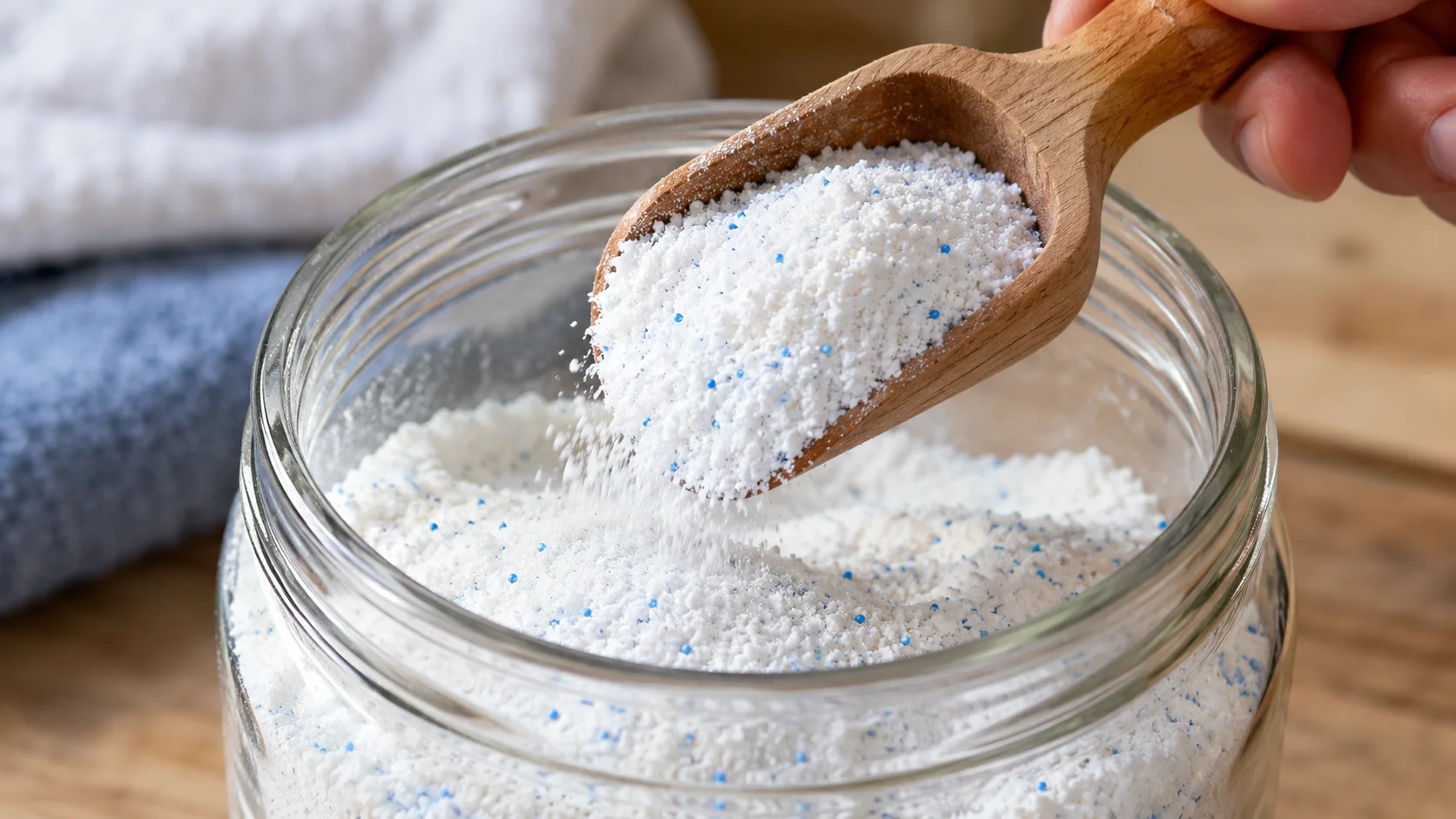
Homemade laundry detergent remains popular because people want to control the ingredients they use, reduce packaging, experiment with inexpensive household ingredients, or simply try a traditional laundry recipe. Common DIY formulas may include washing soda, baking soda, soap flakes, borax, or fragrance ingredients such as essential oils. However, an important distinction is often missed: a homemade mixture is not automatically equivalent to a commercially formulated laundry detergent. Commercial detergents are engineered around surfactants, builders, enzymes, and other ingredients that work together under specific washing conditions. The U.S. Environmental Protection Agency (EPA) notes that homemade cleaning products often do not perform as well as commercially formulated products.
Washer compatibility matters just as much as the recipe itself. Modern high-efficiency (HE) washers are designed for low-sudsing, quick-dispersing HE detergents, and GE specifically says homemade laundry detergent has not been tested and is not recommended for its HE washers. Whirlpool likewise recommends using only HE detergent in its HE machines because excessive suds can contribute to poor rinsing, longer cycles, leaks, or drainage problems. For that reason, this guide explains traditional homemade laundry detergent recipes, borax-free alternatives, liquid and powder approaches, ingredient functions, sensitive-skin considerations, and the limitations you should understand before using any DIY mixture.
1. What Is Homemade Laundry Detergent?
Homemade laundry detergent is a DIY cleaning mixture prepared at home instead of purchased as a finished laundry product. Recipes vary considerably, but many traditional formulas combine a cleaning soap with alkaline builders or washing additives. Some recipes are dry powders, while others are mixed with water to produce a liquid.
The terminology can be confusing because many online recipes use detergent, laundry soap, and laundry powder interchangeably. Chemically, soap and detergent are not identical. A commercial laundry detergent is usually formulated specifically for washing fabrics and may contain surfactants, enzymes, builders, polymers, and other components selected for performance.
Before making a recipe, understand what you are actually creating:
- A soap-based laundry mixture is not necessarily a commercial-style detergent.
- A powder recipe contains little or no water and is usually easier to store.
- A liquid recipe contains water and may have different storage characteristics.
- Baking soda can be used as a laundry additive, but it does not make a complete detergent by itself.
- Washing soda is an alkaline builder commonly used in DIY laundry recipes.
- Borax is found in many traditional recipes but has safety considerations.
- Essential oils add fragrance rather than providing the complete cleaning action of detergent.
- Homemade mixtures are not automatically non-toxic.
- Natural ingredients can still have hazards.
- A homemade formula has not necessarily been tested on your washer.
- Cleaning performance can vary with water hardness, temperature, fabric type, and soil level.
- HE machines have specific detergent requirements.
- Garment care labels still apply when using DIY laundry products.
- A recipe that works for one household may not work equally well in another.
- Storage and labeling are important for any homemade cleaning mixture.
2. Homemade Laundry Detergent Ingredients Explained
Understanding the ingredients is more useful than simply copying a recipe. Different components perform different jobs, and adding more ingredients does not automatically make a formula better. Some ingredients affect water chemistry, some provide alkalinity, some provide cleaning action, and others simply add scent.
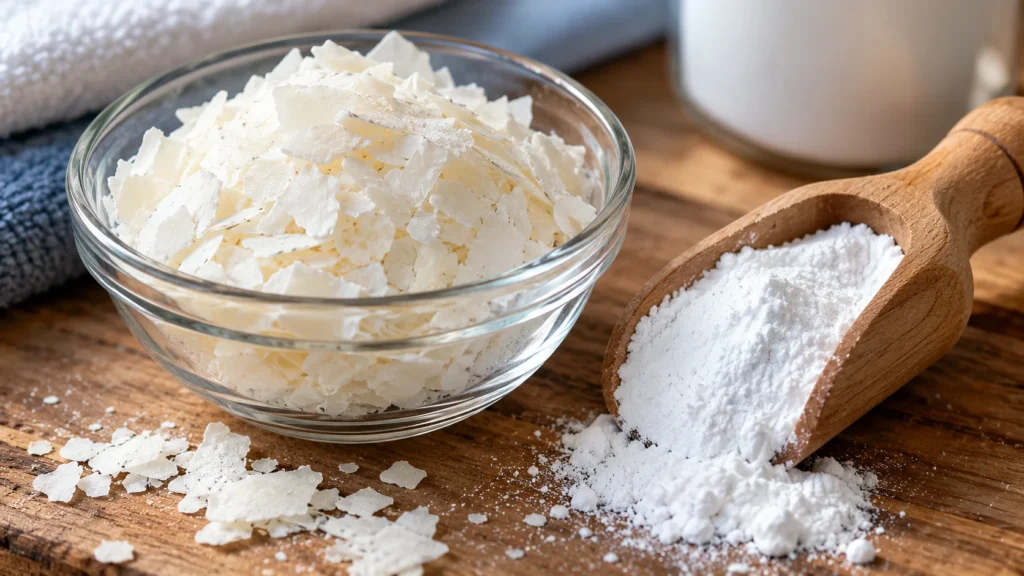
EPA explains that cleaning products rely on functional ingredients such as surfactants, solvents, chelating agents, enzymes, preservatives, fragrances, and other components, with each serving a particular role.
Common homemade laundry detergent ingredients include:
- Washing soda: An alkaline builder used in many traditional laundry formulas.
- Baking soda: Sodium bicarbonate; it can be used as a laundry additive, although it is not a complete detergent.
- Soap flakes: Provide soap-based cleaning action but are chemically different from modern synthetic laundry detergents.
- Borax: Used in traditional recipes as a laundry booster, but it deserves particular safety consideration.
- Essential oils: Primarily provide fragrance rather than serving as the main cleaning ingredient.
- Water: Used in liquid formulas but changes the storage and preservation considerations.
- Oxygen-based laundry products: May be used separately as laundry boosters, depending on the product directions.
- Commercial HE detergent: Not a homemade ingredient, but an important alternative when washer compatibility is the priority.
Do not assume that an ingredient is safe for every fabric, person, washer, or concentration simply because it is commonly mentioned in DIY recipes.
3. A Simple Homemade Laundry Detergent Powder Recipe
If you specifically want a traditional homemade laundry detergent powder, a simple borax-free formula can be made from soap flakes, washing soda, and baking soda. It is best understood as a DIY soap-based laundry powder rather than a scientifically equivalent replacement for a formulated commercial detergent.
Borax-Free Homemade Laundry Powder
Ingredients:
- 1 cup finely grated unscented laundry soap or suitable plain soap flakes
- 1 cup washing soda
- 1 cup baking soda
Method:
- Make sure the soap is finely grated so large pieces do not remain in the mixture.
- Measure the washing soda and baking soda.
- Add all three dry ingredients to a clean, completely dry container.
- Mix thoroughly with a clean, dry utensil.
- Transfer the mixture to an airtight, clearly labeled container.
- Keep the container dry.
- Use only if your washer manufacturer’s instructions allow this type of product.
- Start with a small test load rather than converting every laundry load immediately.
- Check whether the powder dissolves properly.
- Look for residue on fabrics or inside the washer.
- Stop using it if you experience unusual buildup, excessive sudsing, or poor rinsing.
- Do not use this recipe automatically in an HE washer.
- Keep it away from children and pets.
- Do not store it in an unmarked food container.
- Follow fabric-care instructions for every load.
Maytag notes that baking soda can be used in laundry but advises checking the washer’s owner’s manual and avoiding it on delicate fabrics such as wool and silk when appropriate.
Important: This recipe should not be presented as a guaranteed best formula for every washer. GE states that homemade laundry detergent has not been tested and does not recommend it for its HE washers.
4. How to Make Homemade Laundry Detergent Powder
A powder formula is generally simpler to prepare than a liquid because it does not require heating or combining a large volume of water. It is also easier to see whether the ingredients remain evenly distributed. However, powders can have dissolution issues, particularly in cold water or when ingredients are not finely prepared.
Whirlpool notes that powdered detergents can sometimes leave residue when they do not fully dissolve and recommends following the detergent manufacturer’s dosage instructions.
When making homemade laundry detergent powder, follow these principles:
- Use completely dry ingredients.
- Grate soap finely.
- Measure ingredients rather than estimating.
- Mix the dry ingredients thoroughly.
- Avoid introducing water into the container.
- Use a clean scoop.
- Label the container clearly.
- Store it in a dry location.
- Keep the container closed.
- Avoid storing it near food.
- Do not use more simply because a load is heavily soiled.
- Check for residue after washing.
- Test a small load first.
- Stop if the washer develops excessive suds.
- Do not assume a powder is HE-compatible.
The amount used should not be copied blindly from an internet recipe because DIY mixtures vary in concentration, and washers vary in design.
5. Homemade Liquid Laundry Detergent: What to Know
Homemade liquid laundry detergent recipes are popular because users may find liquids convenient for measuring and pretreating. Traditional formulas can involve grated soap dissolved in hot water and combined with other ingredients before being diluted.
However, liquid DIY products require more caution than a simple dry powder. Once water is introduced, the mixture has different storage characteristics, and a homemade formula does not automatically have the preservation system or stability testing of a commercial detergent.
If you are considering a homemade liquid laundry detergent recipe:
- Use a clean container.
- Clearly label the mixture.
- Record the date it was made.
- Do not store it in a food or beverage container.
- Keep it tightly closed.
- Do not mix it with bleach.
- Do not combine it with ammonia.
- Follow the soap manufacturer’s instructions where applicable.
- Avoid assuming that a liquid is automatically HE-safe.
- Watch for separation or changes in appearance.
- Discontinue use if the mixture develops an unusual odor.
- Check your washer manual before use.
- Test compatibility with a small load.
- Avoid using excessive amounts.
- Keep it inaccessible to children and pets.
For modern HE washers, a manufacturer’s approved HE detergent remains the more predictable choice. Samsung states that its washing machines require HE detergent and warns that using too much detergent can contribute to appliance or laundry problems.
6. Homemade Laundry Detergent Without Borax
A homemade laundry detergent without borax may appeal to people who specifically want to avoid borax. A simple approach is to leave borax out and use a soap-and-builder formula such as the borax-free powder described above.
This does not mean that every borax-free recipe is automatically safer, more effective, or suitable for an HE washer. Removing one ingredient changes the formulation, and the resulting mixture still needs to be evaluated for cleaning performance and washer compatibility.
For a borax-free approach:
- Use finely grated unscented soap.
- Combine it with washing soda if appropriate.
- Baking soda can be included as an additional laundry ingredient.
- Avoid adding unnecessary chemicals.
- Avoid fragrance if skin sensitivity is a concern.
- Use a clearly labeled container.
- Keep the mixture dry.
- Start with small loads.
- Check fabrics for residue.
- Check the washer for buildup.
- Do not assume the formula is HE-compatible.
- Avoid using it on delicate fabrics without checking care instructions.
- Do not mix it with bleach.
- Do not mix multiple homemade cleaners together.
- Switch to a tested commercial detergent if performance is inadequate.
7. Is Homemade Laundry Detergent Safe?
The answer depends on the ingredients, concentration, washer, fabrics, and how the mixture is handled. Homemade and natural are not safety certifications.
EPA specifically warns that some common household cleaning chemicals can present hazards and says homemade cleaners typically do not perform as well as commercially available products designed for high performance. EPA also notes specific concerns regarding borax and warns against unsafe combinations such as bleach and ammonia.
Basic safety practices include:
- Read ingredient labels before combining products.
- Never mix bleach with ammonia.
- Do not add bleach to an unknown homemade formula.
- Store cleaning ingredients in their original containers when possible.
- Clearly label any homemade mixture.
- Keep products away from children.
- Keep products away from pets.
- Avoid food containers for chemical storage.
- Wash hands after handling concentrated ingredients.
- Avoid inhaling powders.
- Prevent powders from becoming airborne.
- Use appropriate ventilation when preparing mixtures.
- Follow manufacturer instructions for individual ingredients.
- Stop using a formula that causes unexpected irritation.
- Keep your washer manual available when testing a DIY product.
Jump into Other Related Article
- How to Remove Peanut Butter Stains
- Does Rayon Shrink?
- How to Remove Coffee Stains
- How to Clean Suede Shoes
- Best Stain Remover for Clothes
- How to Clean Stainless Steel
8. Homemade Laundry Detergent With Borax
Borax appears in many older homemade laundry detergent recipes, usually alongside soap and washing soda. However, it should not be treated as an automatically harmless natural ingredient.
EPA’s Safer Choice FAQ specifically identifies borax as an example of a household chemical associated with reproductive, developmental, and neurological hazards.
That does not mean every household exposure produces harm, but it does mean that borax deserves more careful handling than some DIY articles suggest.
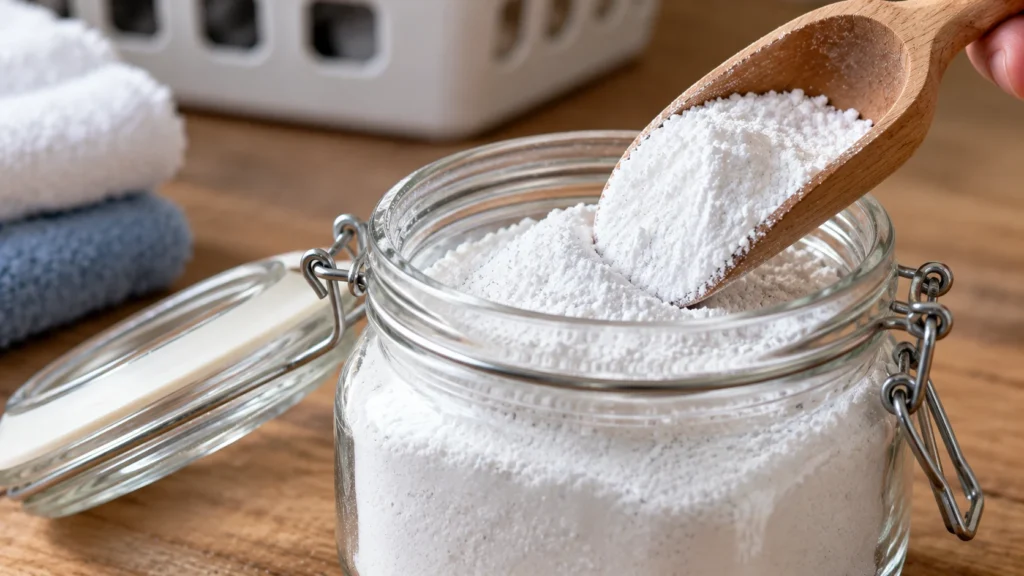
If you are considering homemade laundry detergent with borax:
- Read the product label.
- Follow the manufacturer’s handling instructions.
- Avoid inhaling the powder.
- Keep it away from children.
- Keep it away from pets.
- Do not use it as a casual substitute for every cleaning product.
- Do not assume natural means risk-free.
- Avoid mixing it with other chemicals unnecessarily.
- Consider a borax-free option if that better fits your goals.
- Keep the original packaging or product information available.
For users primarily seeking a lower-hazard cleaning product, an EPA Safer Choice-certified commercial detergent is another option. EPA says certified products undergo ingredient-level review and performance requirements before receiving the label.
9. Homemade Non Toxic Laundry Detergent: What Does Non-Toxic Mean?
The phrase homemade non toxic laundry detergent is common online, but non-toxic can be misleading when it is used without defining the exposure, concentration, ingredients, or evidence.
A homemade mixture cannot simply be called non-toxic because it contains baking soda, soap, essential oils, or other familiar ingredients. Safety depends on the actual formulation and how it is used.
For a more evidence-based approach:
- Identify every ingredient.
- Check the safety information for each ingredient.
- Avoid unnecessary ingredients.
- Avoid concentrated powders becoming airborne.
- Avoid adding fragrance solely for marketing appeal.
- Use fragrance-free ingredients if fragrance sensitivity is a concern.
- Follow garment-care instructions.
- Check washer compatibility.
- Store the mixture safely.
- Avoid mixing unrelated cleaners.
- Consider established third-party safety programs.
- Look for transparent ingredient information.
- Consider EPA Safer Choice products when a tested commercial option is preferred.
- Remember that safer chemistry and cleaning performance both matter.
- Do not make absolute safety claims without evidence.
EPA’s Safer Choice program evaluates ingredients against human-health and environmental criteria and also requires certified products to meet performance requirements.
10. Does Homemade Laundry Detergent Work?
Does homemade laundry detergent work? It can produce acceptable results for some users and some types of laundry, but there is no universal formula that performs equally well in every washer, water condition, and fabric type.
Commercial laundry detergents are formulated for specific cleaning performance. EPA explicitly states that homemade cleaners typically do not perform as well as commercially available products that are specially formulated for high performance.
Performance can vary because of:
- Water hardness
- Water temperature
- Soil level
- Type of stains
- Fabric composition
- Washing-machine design
- Detergent concentration
- Amount of detergent used
- Dissolution of the powder
- Soap residue
- Rinse performance
- Frequency of washing
- Washer water volume
A DIY mixture may seem successful on lightly soiled everyday clothes but perform differently on oily stains, heavily soiled workwear, towels, bedding, or cold-water loads.
11. Is Homemade Laundry Detergent Safe for HE Washers?
This is one of the most important questions in the entire topic.
Is homemade laundry detergent safe for HE washers? You should not assume that it is.
GE says homemade laundry detergent has not been tested and does not recommend it for its HE washers. Whirlpool states that HE washers should use HE detergent and explains that excessive suds can cause longer cycles, poor rinsing, leaks, and drainage issues. Samsung likewise states that its washing machines require HE detergent.
For homemade HE laundry detergent, therefore:
- Check your exact washer manual first.
- Do not assume a recipe labeled HE online is manufacturer-approved.
- Avoid high-sudsing soap mixtures.
- Do not exceed detergent recommendations.
- Watch for residue.
- Watch for excessive suds.
- Watch for poor rinsing.
- Check the dispenser for buildup.
- Stop using the mixture if your washer behaves abnormally.
- Consider a tested HE detergent instead.
This is particularly important for front-load HE washers, which use relatively low water levels and are specifically designed around low-sudsing detergent formulations.
12. Homemade Laundry Detergent for Sensitive Skin
People searching for homemade laundry detergent for sensitive skin often want fewer fragrances, dyes, or unnecessary additives. A DIY formula can give you more control over ingredients, but that does not automatically make it suitable for sensitive skin.
A practical approach is to minimize fragrance rather than simply assuming every natural fragrance is harmless.
For sensitive laundry:
- Choose unscented ingredients.
- Avoid essential oils if fragrance is a concern.
- Avoid unnecessary dyes.
- Use a small test load first.
- Rinse thoroughly.
- Check garments for residue.
- Avoid using excessive product.
- Follow fabric-care instructions.
- Keep the washer clean.
- Wash new DIY-treated fabrics separately at first.
- Stop using a formula if irritation occurs.
- Do not assume natural means hypoallergenic.
- Consider fragrance-free commercial detergents designed for sensitive skin.
- Look for transparent ingredient information.
- Consult a healthcare professional for persistent or significant skin reactions.
Essential oils may make a recipe smell appealing, but they are not necessary for cleaning performance.
13. Homemade Laundry Detergent With Essential Oils
Homemade laundry detergent with essential oils is popular because people want scented laundry without conventional fragrance blends. However, essential oils should be considered primarily a fragrance choice rather than a substitute for the cleaning system.
If you choose to add essential oils:
- Use a modest amount.
- Do not assume more oil means cleaner clothes.
- Avoid adding oil directly to every garment.
- Check whether the oil is appropriate for the intended use.
- Consider fragrance sensitivity.
- Keep essential oils away from children and pets.
- Store them securely.
- Do not mix essential oils with bleach.
- Do not claim an oil disinfects laundry without evidence.
- Avoid using fragrance as a substitute for proper cleaning.
- Consider unscented laundry for sensitive skin.
- Test on a small load.
- Watch for residue or unexpected marks.
- Keep the recipe clearly labeled.
- Remember that fragrance does not equal cleanliness.
14. Homemade Laundry Detergent With Baking Soda
Baking soda is one of the most familiar ingredients in DIY laundry discussions. Maytag states that baking soda can be used in laundry and notes that it can help brighten light-colored fabrics and reduce suds in some circumstances. It also advises checking the washer manual and avoiding baking soda on delicate fabrics such as cashmere, wool, and silk where appropriate.
However, homemade laundry detergent with baking soda should not be confused with a complete detergent formula.
Baking soda can:
- Be used as a laundry additive.
- Provide alkalinity.
- Be incorporated into some DIY powder formulas.
- Help with certain laundry odors.
- Be useful as part of a broader laundry routine.
But baking soda alone:
- Is not a complete commercial detergent.
- Does not provide the full range of detergent functions.
- Is not automatically suitable for every fabric.
- Is not automatically HE detergent.
- Does not replace the need to follow your washer manual.
15. Homemade Laundry Detergent With Castile Soap
Castile soap is another ingredient frequently suggested for DIY laundry. Because it is a soap rather than a modern laundry detergent formulation, its behavior in a washing machine can differ from commercial detergent.
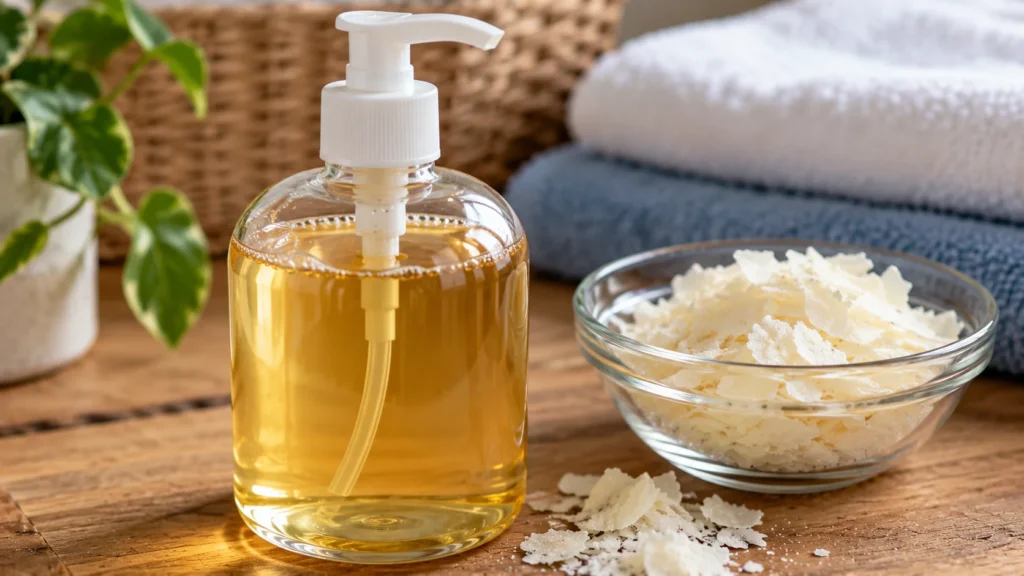
A recipe containing homemade laundry detergent with Castile soap may therefore produce different results depending on water hardness, temperature, washer design, and fabric type.
If you are considering it:
- Use an unscented option if fragrance is a concern.
- Check the soap manufacturer’s intended uses.
- Do not assume Castile soap is HE-compatible.
- Test a small load.
- Check for residue.
- Monitor the dispenser.
- Watch for excessive suds.
- Use the minimum practical amount.
- Avoid combining it with bleach.
- Do not mix it with random cleaning chemicals.
- Check your washer manual.
- Stop if performance deteriorates.
- Wash delicate fabrics according to their care instructions.
- Consider commercial HE detergent for HE machines.
- Do not assume a soap-based formula performs like a detergent.
16. Pros and Cons of Homemade Laundry Detergent
There are legitimate reasons people experiment with DIY laundry products, but the disadvantages should be considered just as carefully.
Potential advantages
- You control the ingredients.
- You can avoid certain fragrances.
- You can make a dry powder with simple components.
- You can customize scent preferences.
- Some recipes use readily available ingredients.
- You may reduce reliance on single-use detergent packaging.
- You can experiment with different laundry routines.
- A simple recipe may be convenient for some households.
- You can avoid ingredients you personally prefer not to use.
- DIY preparation can be educational.
Potential disadvantages
- Cleaning performance can be inconsistent.
- Recipes are not standardized.
- Washer compatibility may be uncertain.
- HE machines may not accept homemade formulas.
- Soap can behave differently from detergent.
- Powders may not fully dissolve.
- Residue can accumulate.
- Water hardness can change results.
- Homemade mixtures are not automatically safer.
- Liquid recipes have different storage considerations.
- Borax requires safety awareness.
- Essential oils can introduce fragrance concerns.
- Recipes can become unnecessarily complicated.
- Commercial detergents undergo formulation and performance testing.
- DIY mixtures can make appliance problems harder to diagnose.
EPA’s guidance is particularly relevant here: homemade cleaners typically do not perform as well as commercial products that are specially formulated for high performance.
17. Best Homemade Laundry Detergent Recipe: How to Choose
There is no objectively universal best homemade laundry detergent recipe because the appropriate formulation depends on the washer, water, fabrics, cleaning requirements, and user’s priorities.
If you are comparing best homemade powder laundry detergent recipes, evaluate them by:
- Number of ingredients
- Ingredient safety
- Washer compatibility
- Sudsing behavior
- Dissolution
- Residue
- Cleaning performance
- Fragrance level
- Storage requirements
- Cost
- Water hardness
- Fabric compatibility
- Ease of preparation
- Ability to measure consistently
- Evidence supporting performance
For someone with an HE washer, the most important factor is not how inexpensive or natural a recipe appears. Manufacturer compatibility comes first.
18. How to Store Homemade Laundry Detergent
Storage is easy to overlook, especially when a recipe looks harmless. Any homemade cleaning product should be clearly identified and kept away from children, pets, food, and moisture.
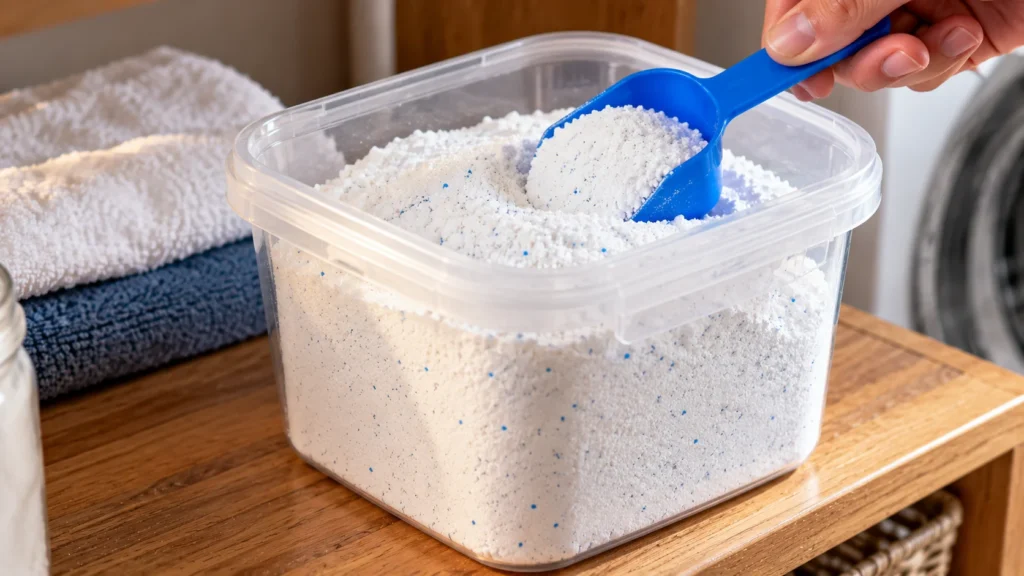
For dry homemade powdered laundry detergent:
- Use a dry, airtight container.
- Label the container with every ingredient.
- Add the date prepared.
- Use a dedicated scoop.
- Keep the scoop dry.
- Store away from food.
- Keep away from children.
- Keep away from pets.
- Avoid storing it under direct moisture.
- Do not transfer it into an unmarked food container.
- Close the container after every use.
- Keep the original ingredient packaging available.
- Do not combine old and new batches without checking them.
- Discard a mixture if contamination occurs.
- Follow any specific storage instructions on individual ingredients.
19. How to Use Homemade Laundry Detergent Responsibly
If your washer manufacturer permits the type of homemade mixture you are considering, responsible use still matters. Begin cautiously rather than assuming an internet recipe is universally appropriate.
A practical testing process is:
- Check the washer owner’s manual.
- Identify whether the washer is HE.
- Check the manufacturer’s detergent requirements.
- Review every ingredient in the recipe.
- Prepare a small batch.
- Test a small laundry load.
- Check whether the mixture dissolves.
- Inspect clothes after washing.
- Check for residue.
- Check the washer dispenser and tub.
- Watch for excessive suds.
- Check rinsing performance.
- Compare cleaning performance with your usual detergent.
- Stop if you notice problems.
- Use a manufacturer-recommended detergent if compatibility remains uncertain.
Whirlpool emphasizes measuring detergent carefully and warns that too much detergent can lead to oversudsing, longer cycles, poor rinsing, and reduced cleaning performance.
20. Homemade Laundry Detergent vs Commercial Detergent
The biggest difference is formulation and testing. A commercial laundry detergent is designed as a complete product rather than simply a combination of familiar household ingredients.
EPA’s Safer Choice program evaluates ingredients according to functional categories and requires certified products to meet safety and performance requirements.
| Feature | Homemade laundry mixture | Commercial laundry detergent |
| Formula | DIY and variable | Professionally formulated |
| Ingredients | User-selected | Selected for specific functions |
| HE compatibility | Must be verified | HE products are specifically labeled |
| Cleaning performance | Can vary | Designed and tested for performance |
| Fragrance | User-controlled | Formulated fragrance or fragrance-free options |
| Storage | User responsible | Manufacturer-established packaging |
| Dosage | Recipe-dependent | Manufacturer specified |
| Water hardness response | Can vary | Formulated for intended conditions |
| Safety information | Depends on ingredients | Manufacturer provides product information |
| Standardization | Low | High |
This does not mean every commercial detergent is perfect or every homemade mixture is useless. It means they should not be treated as equivalent products without evidence.
21. Common Homemade Laundry Detergent Mistakes
Many DIY laundry problems come from using a recipe without considering the washer or the ingredients.
Avoid these mistakes:
- Assuming homemade means non-toxic.
- Assuming natural ingredients are risk-free.
- Using homemade detergent in an HE washer without checking the manual.
- Using too much product.
- Adding multiple ingredients without understanding their purpose.
- Adding essential oils simply to make the recipe smell stronger.
- Mixing bleach with homemade cleaners.
- Using borax without understanding its safety considerations.
- Storing mixtures in food containers.
- Leaving containers unlabeled.
- Using coarse soap flakes that do not dissolve well.
- Ignoring water hardness.
- Ignoring fabric-care labels.
- Continuing to use a mixture that leaves residue.
- Assuming an online recipe is manufacturer-approved.
22. When a Commercial HE Detergent Is the Better Choice
A homemade laundry formula may not be the best fit for every household. If you have a modern HE washer, particularly one with a specialized dispenser or automatic detergent system, a manufacturer-compatible HE detergent provides a more predictable formulation.
GE explicitly states that homemade laundry detergent has not been tested and does not recommend it for its HE washers. Whirlpool and Samsung likewise emphasize the use of HE detergent in their HE washing machines.
A tested commercial detergent may make more sense when:
- You own an HE washer.
- Your washer requires HE detergent.
- You use an automatic bulk dispenser.
- You wash heavily soiled clothes.
- You need consistent stain removal.
- You wash mostly in cold water.
- You have hard water.
- You experience residue with DIY recipes.
- You have recurring odor problems.
- You need predictable dosing.
- You do not want to formulate or store cleaning products.
- You prefer a product with transparent safety information.
- You want to consider EPA Safer Choice-certified options.
Conclusion
Homemade laundry detergent can be an interesting DIY project, especially for people who want to experiment with simple ingredients or reduce fragrance and packaging. Traditional recipes commonly use soap flakes, washing soda, baking soda, borax, or essential oils, but these ingredients do not automatically create a product equivalent to commercial laundry detergent. EPA notes that homemade cleaners typically do not perform as well as specially formulated commercial products, and it also cautions that some common household cleaning ingredients can present hazards. A borax-free powder can be a simpler DIY option, but it should still be treated as a homemade soap-based laundry mixture rather than guaranteed commercial-style detergent.
Washer compatibility is especially important. If you own an HE machine, do not assume that a recipe labeled HE online has actually been tested by your appliance manufacturer. GE says homemade laundry detergent has not been tested and does not recommend it for its HE washers, while Whirlpool and Samsung recommend HE detergent for their HE machines. For households that prioritize predictable cleaning, appliance compatibility, and independently evaluated safer chemistry, an appropriately labeled commercial detergentsuch as an EPA Safer Choice-certified productmay provide a more evidence-based alternative.
1. What is the easiest homemade laundry detergent recipe?
A simple traditional powder can combine finely grated unscented laundry soap, washing soda, and baking soda. However, this should be considered a homemade soap-based laundry mixture rather than a guaranteed equivalent to commercial detergent. Check your washer manual before using it, especially if you have an HE machine.
2. Is homemade laundry detergent safe for HE washers?
Do not assume it is. GE states that homemade laundry detergent has not been tested and does not recommend it for its HE washers. HE machines are designed for low-sudsing, quick-dispersing HE detergent.
3. Can I make homemade laundry detergent without borax?
Yes. A traditional borax-free approach can use finely grated unscented soap, washing soda, and baking soda. However, removing borax does not automatically make the resulting mixture suitable for every washer or fabric, and it does not guarantee commercial-detergent-level cleaning performance.
4. Does homemade laundry detergent actually work?
It can clean some everyday laundry, but results vary significantly. Water hardness, temperature, fabric, soil level, washer type, formulation, and dosage all affect performance. EPA notes that homemade cleaners typically do not perform as well as commercially formulated cleaning products.
5. Is homemade laundry detergent better for sensitive skin?
Not necessarily. A homemade formula can give you control over fragrance and ingredients, but homemade does not automatically mean hypoallergenic or non-irritating. For sensitive skin, a fragrance-free approach and careful ingredient selection are more meaningful than simply choosing a DIY recipe. A persistent skin reaction should be discussed with an appropriate healthcare professional.