
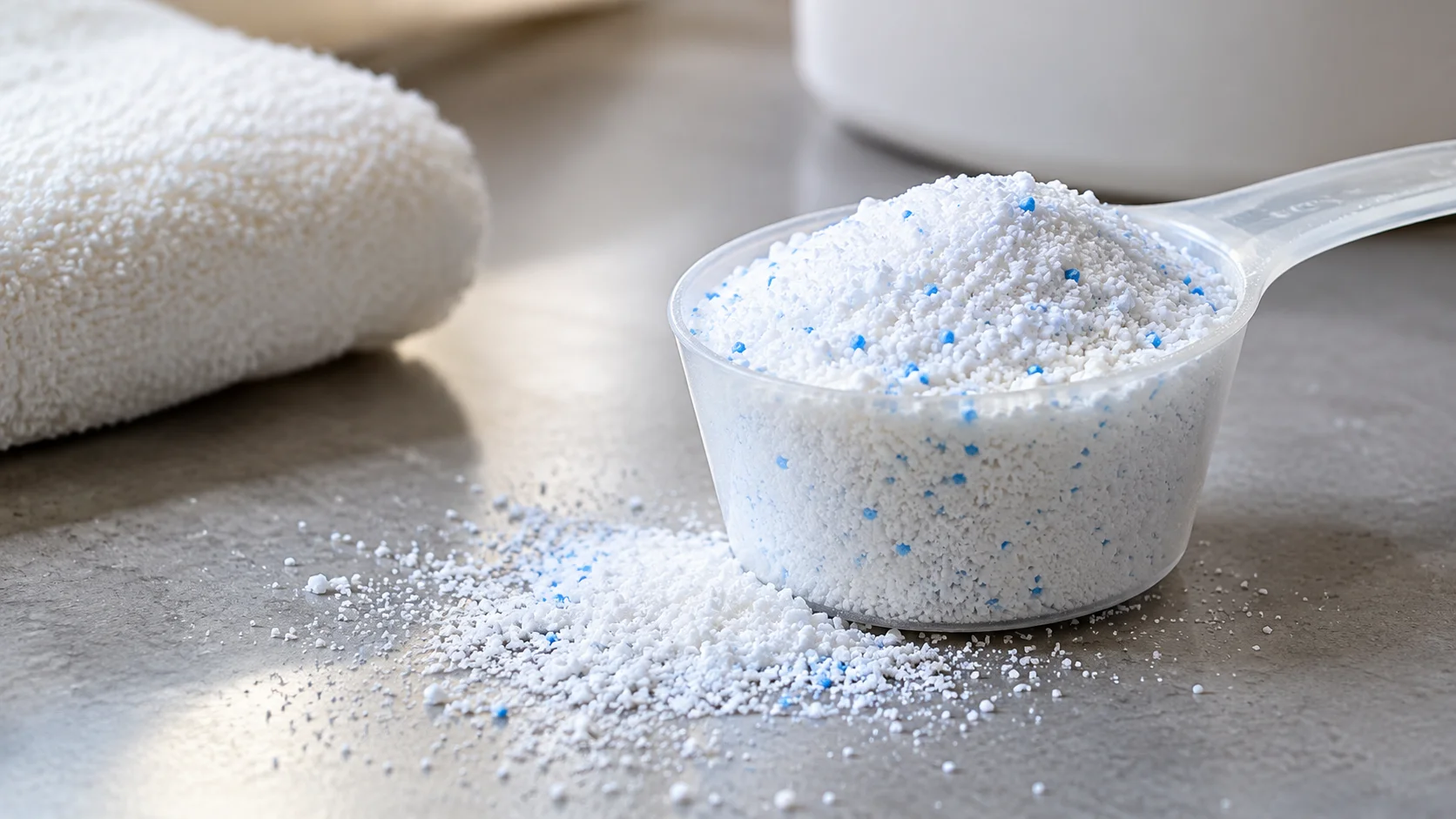
Oxygen bleach is a type of non-chlorine bleach used to brighten fabrics, loosen stains, and boost laundry cleaning without relying on chlorine. Unlike traditional chlorine bleach, which commonly contains sodium hypochlorite, oxygen bleach uses oxygen-releasing compounds such as sodium percarbonate, sodium perborate, or hydrogen peroxide, depending on the product. The American Cleaning Institute (ACI) describes non-chlorine bleach as laundry products containing peroxygen compounds that release active oxygen in wash water and generally provide a gentler bleaching action than chlorine bleach.
You may encounter oxygen bleach as a powder, liquid, laundry booster, stain remover, presoak, or household cleaning product. Products can differ considerably, so oxygen bleach is a category rather than one universal formula. For example, current ingredient disclosures from Church & Dwight identify sodium carbonate peroxide (sodium percarbonate) as the oxygen-bleach ingredient in several OxiClean products. This guide explains what oxygen bleach is, what it contains, how to use it for laundry, whether it is color safe, how it compares with chlorine bleach, and what its limitations are.
What Is Oxygen Bleach?
Oxygen bleach is a non-chlorine bleaching agent that releases oxygen-based bleaching species when activated in water. It is commonly used to help remove stains, brighten laundry, and clean household surfaces.
The term can refer to several different oxygen-releasing chemicals. ACI lists hydrogen peroxide, sodium percarbonate, sodium perborate, potassium monopersulfate, and organic peracids among peroxygen compounds used in non-chlorine bleach products.
In practical laundry products, oxygen bleach is often found in powdered formulations because compounds such as sodium percarbonate can be incorporated into a dry product and activated when water is introduced.
Common characteristics include:
- It does not use chlorine as its bleaching ingredient.
- It can help break down and remove many stains.
- It can brighten fabrics without the same bleaching action as chlorine bleach.
- Many oxygen-bleach products are designed for colored, washable fabrics.
- It is commonly available as powder or liquid.
- The exact ingredients vary by product.
- It should always be used according to its package directions and the garment care label.
Oxygen bleach is therefore best understood as a category of oxygen-releasing bleaching products, rather than one specific chemical.
What Is Oxygen-Based Bleach Made Of?
The ingredients in oxygen-based bleach depend on the formulation. A common active ingredient in powdered oxygen bleach is sodium percarbonate, sometimes called sodium carbonate peroxide.
When dissolved in water, sodium percarbonate supplies hydrogen peroxide while also contributing sodium carbonate to the solution. Commercial formulations may include additional builders, surfactants, enzymes, polymers, brighteners, fragrances, or other ingredients.
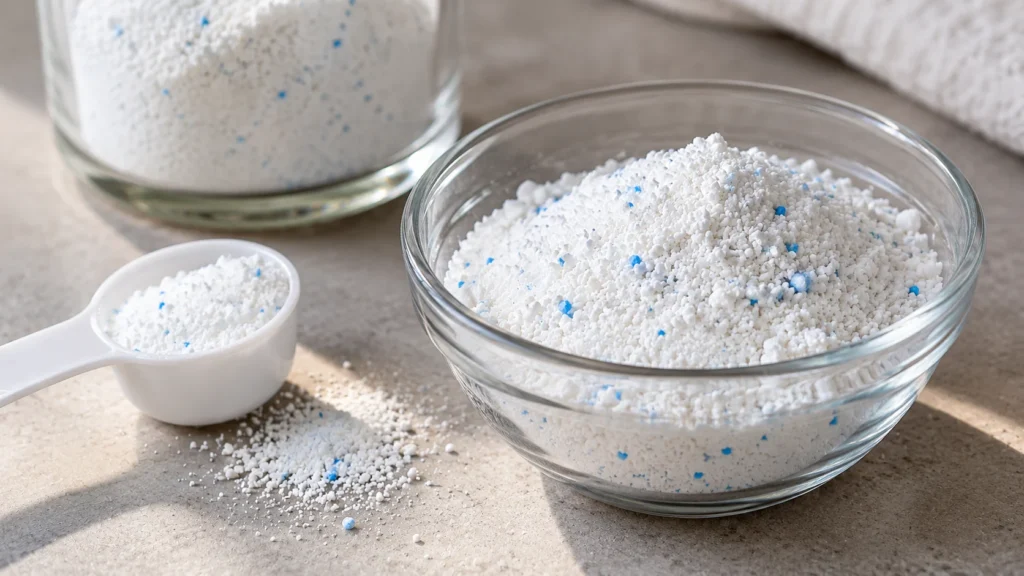
ACI notes that powdered non-chlorine bleaches can contain builders such as sodium carbonate, while other formulation ingredients may include surfactants, enzymes, brighteners, bluing agents, and fragrance.
For example, Church & Dwight’s current ingredient disclosure for OxiClean Versatile Stain Remover identifies:
- Sodium carbonate
- Sodium carbonate peroxide
- Surfactant
- Sodium chloride
- Other formulation ingredients depending on the product
The company identifies sodium carbonate peroxide as the product’s oxygen bleach ingredient.
That distinction matters because a commercial oxygen-bleach cleaner is usually more than a container of pure sodium percarbonate.
What Is Sodium Percarbonate Oxygen Bleach?
Sodium percarbonate oxygen bleach is a solid oxygen-releasing compound widely used in powdered laundry and cleaning products. It is often described chemically as sodium carbonate peroxide.
Its importance comes from what happens when it encounters water. The compound can provide hydrogen peroxide, which supplies the oxidizing action associated with oxygen bleaching, while sodium carbonate contributes alkalinity.
This makes sodium percarbonate particularly useful in powdered laundry products.
It is found in commercial products as well. Church & Dwight’s ingredient disclosures identify sodium carbonate peroxide as the oxygen-bleach ingredient in multiple OxiClean products.
However, pure sodium percarbonate and a finished oxygen-bleach product are not necessarily the same thing. A commercial product may contain other ingredients designed to improve cleaning, stain suspension, fragrance, dissolution, or performance.
What Is Oxygen Bleach Powder?
Oxygen bleach powder is a dry non-chlorine bleaching product designed to dissolve in water and release oxygen-based bleaching chemistry.
Powdered products are popular because they can be stored in a concentrated dry form and used for several purposes, including:
- Laundry boosting
- Stain treatment
- Presoaking
- Whitening washable fabrics
- Cleaning certain household surfaces
- Deodorizing some washable items
- Removing organic stains
- Brightening dingy laundry
ACI recommends adding oxygen bleach directly to the wash water before clothes are added and warns against pouring powdered bleach directly onto wet clothing. It also notes that oxygen bleach is most effective in warm-to-hot water, although individual product instructions should take priority.
The exact scoop size, water temperature, soaking time, and application method should come from the product label.
What Is Oxygen Bleach Used For?
Oxygen bleach is primarily used to oxidize stains and brighten washable materials. It can be useful when ordinary detergent does not completely remove discoloration, food stains, body soils, or other organic residues.
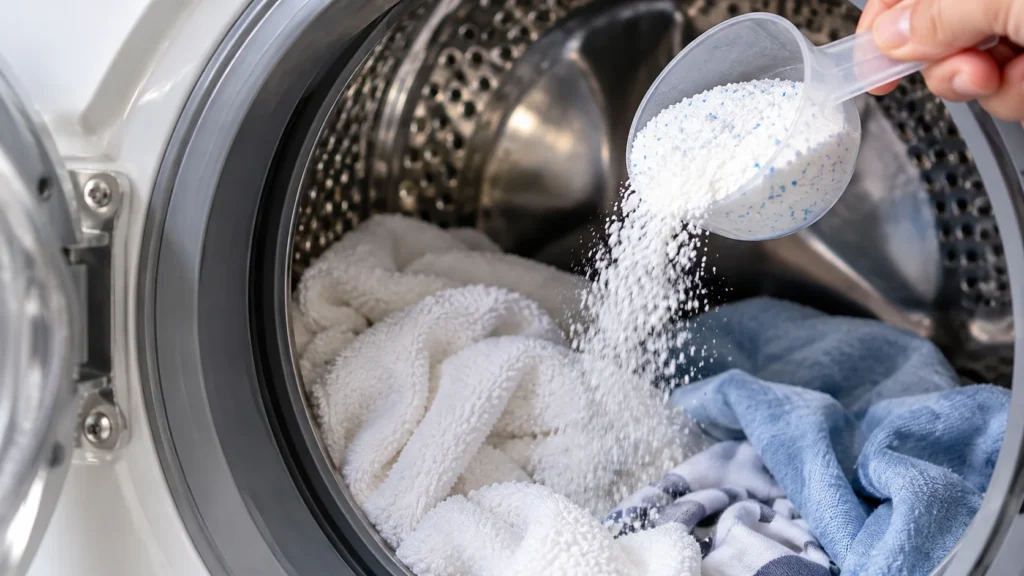
For laundry, common uses include:
- Brightening white clothing
- Treating colored washable fabrics
- Removing many food stains
- Helping with grass stains
- Treating dinginess
- Presoaking heavily stained garments
- Boosting detergent performance
- Cleaning towels and bedding
- Treating washable household textiles
- Removing some odors associated with organic soils
OxiClean describes oxygen bleach as useful for pretreating stains, soaking white items to brighten them, and adding to the washing machine to boost stain-fighting performance.
The result depends on the stain, fabric, temperature, concentration, contact time, and product formulation. Oxygen bleach is not a universal solution for every stain.
Oxygen Bleach for Laundry: How Does It Work?
When oxygen bleach for laundry dissolves in water, its oxygen-based chemistry helps oxidize colored stain molecules and other organic soils. This can make stains easier to remove during the wash.
The process is different from simply washing harder. Detergent helps surround and remove soils, while bleaching agents can chemically alter stain compounds so their color is reduced or eliminated.
A practical laundry process is:
- Read the garment care label.
- Check the oxygen-bleach product directions.
- Dissolve or add the product as directed.
- Add it to the wash water according to the instructions.
- Add laundry according to the washer’s recommended loading method.
- Wash using the recommended temperature.
- Inspect the result before drying if a stain remains.
- Repeat an appropriate treatment if the product label permits it.
ACI explains that bleach helps convert soils into colorless, soluble particles that can then be removed with detergent and wash water.
Is Oxygen Bleach Color Safe?
Many color-safe oxygen bleach products are specifically formulated for use on colored washable fabrics. This is one of the major differences between oxygen bleach and conventional chlorine bleach.
ACI describes oxygen or color-safe bleaches as gentler and suitable for all washable fabrics, while noting that chlorine bleach is more powerful and is unsuitable for materials such as wool and silk.
However, color safe does not mean every fabric is automatically safe.
Before using an oxygen bleach product:
- Read the garment care label.
- Read the product label.
- Test an inconspicuous area when recommended.
- Follow the stated concentration.
- Avoid assuming delicate fabrics are compatible.
- Do not use it on items specifically excluded by the manufacturer.
- Pay particular attention to wool, silk, leather, and dry-clean-only materials.
For example, OxiClean’s own instructions for certain products specifically exclude wool, wool blends, silk, silk blends, leather, and dry-clean-only fabrics.
Best Oxygen Bleach for Laundry: What Should You Look For?
There is no single best oxygen bleach for laundry for every household because the appropriate product depends on the fabric, stain, washer, and intended use.
Instead of choosing only by marketing claims, consider:
- Active oxygen-bleach ingredient
- Powder or liquid format
- Intended laundry applications
- Color-safe instructions
- Fabric restrictions
- Required water temperature
- Pretreatment instructions
- Soaking directions
- Fragrance preferences
- Product concentration
- Manufacturer instructions
- Ingredient disclosure
- Whether the product has a specific certification relevant to your priorities
If you want a product with the EPA Safer Choice label, check the EPA’s official certified-product database rather than assuming that any product described as natural, green, or non-toxic has been EPA certified. The EPA explains that Safer Choice certification involves evaluation of ingredients and the finished product against its applicable criteria.
Is OxiClean Oxygen Bleach?
Some OxiClean products contain oxygen bleach, but OxiClean is a brand rather than the name of one single chemical.
OxiClean itself explains that its products include different formulations and that some contain oxygen bleach. Its Versatile Stain Remover is one example.
Church & Dwight’s ingredient disclosure provides additional product-specific evidence: several OxiClean formulations list sodium carbonate peroxide as the oxygen-bleach ingredient.
Therefore, the answer to is OxiClean an oxygen bleach? is best stated as:
Some OxiClean products are oxygen-bleach products, but not every product carrying the OxiClean brand should be treated as chemically identical.
Always check the exact product’s ingredients and instructions.
Oxygen Bleach vs Chlorine Bleach
The difference between oxygen bleach vs chlorine bleach is important because the two categories use different chemistry and have different fabric applications.
| Feature | Oxygen bleach | Chlorine bleach |
| Common category | Non-chlorine bleach | Chlorine bleach |
| Common active chemistry | Peroxygen compounds | Sodium hypochlorite |
| Typical format | Powder or liquid | Usually liquid |
| Color use | Many products are color-safe | Can cause fading |
| Whitening action | Generally gentler | Generally stronger |
| Laundry use | Stains, brightening, maintenance | Strong whitening and certain disinfection applications |
| Wool/silk | Product-specific; check label | Generally unsuitable |
| Disinfection | Not automatically a disinfectant | Some registered products can disinfect when used as directed |
| Fabric safety | Product and fabric dependent | More restrictive |
ACI states that sodium hypochlorite bleach is the more powerful laundry bleach and can disinfect, while oxygen bleach provides a gentler bleaching action and is useful for maintaining whiteness.
The important point is that oxygen bleach should not automatically be treated as a disinfectant simply because it is a bleach.
Does Oxygen Bleach Disinfect?
Not necessarily.
This is an important distinction in laundry care. A product may contain oxygen bleach and still not be registered or labeled as a disinfectant.
ACI specifically states that color-safe bleach products do not disinfect in the same way that appropriate chlorine-bleach products can.
If your goal is disinfection, look for a product whose label specifically authorizes the intended antimicrobial use. In the United States, disinfectants are regulated by the EPA, and the EPA distinguishes products that qualify as registered antimicrobial pesticides.
Therefore:
Stain removal ≠ disinfection.
Whitening ≠ disinfection.
Oxygen bleach ≠ automatically a disinfectant.
Oxygen Bleach Soak: How Does It Work?
An oxygen bleach soak gives the oxidizing ingredients more contact time with stained fabric before or during washing.
A typical approach is:
- Read the product instructions.
- Use the specified amount of oxygen bleach.
- Dissolve it according to the manufacturer’s directions.
- Fully submerge the compatible fabric.
- Observe the recommended soaking period.
- Rinse or wash as directed.
- Check the result before drying.
Some commercial products specify soaking for several hours for particularly stubborn stains. OxiClean, for example, provides product-specific soak instructions and recommends following the garment and product directions.
Do not assume that longer soaking is always better. Excessive exposure can be inappropriate for some materials, dyes, finishes, or product formulations.
Oxygen Bleach Stain Remover: Which Stains Can It Help?
An oxygen bleach stain remover can be useful against many organic or colored stains, but its effectiveness varies.
Common examples include:
- Grass stains
- Food stains
- Beverage stains
- Body soils
- General dinginess
- Some sweat-related discoloration
- Organic residue
- Some odor-causing soils
OxiClean describes oxygen bleach as useful for lifting dirt and stains and provides specific examples of laundry pretreatment and soaking applications.
Stain age also matters. Heat from a dryer can make some stains more difficult to remove, so treating stains before drying can be helpful.
How to Use Oxygen Bleach in a Washing Machine
Using oxygen bleach laundry products in a washing machine is straightforward when you follow the product instructions.
A general process is:
- Check the garment care labels.
- Sort the laundry appropriately.
- Measure oxygen bleach according to the product label.
- Put the oxygen bleach into the wash water as instructed.
- Do not pour powdered oxygen bleach directly onto wet clothing.
- Add detergent according to the detergent label.
- Select a suitable cycle and temperature.
- Start the wash.
- Inspect stained items after washing.
ACI specifically recommends adding oxygen bleach to the wash water before clothes are added and warns against putting powdered bleach directly on wet garments.
Your washer manual should also be followed if it specifies a particular dispenser or method for laundry additives.
Can Oxygen Bleach Be Used on Whites?
Yes, many oxygen-bleach products are designed to brighten white laundry.
It can be especially useful for:
- White towels
- White sheets
- White cotton clothing
- Washable bedding
- White household textiles
- Dingy washable fabrics
OxiClean specifically markets oxygen-bleach products for whitening and stain removal on white laundry, including clothing, sheets, and towels.
However, a white item can still have a fiber or finish that is incompatible with a particular product. Always check the care label and product instructions.
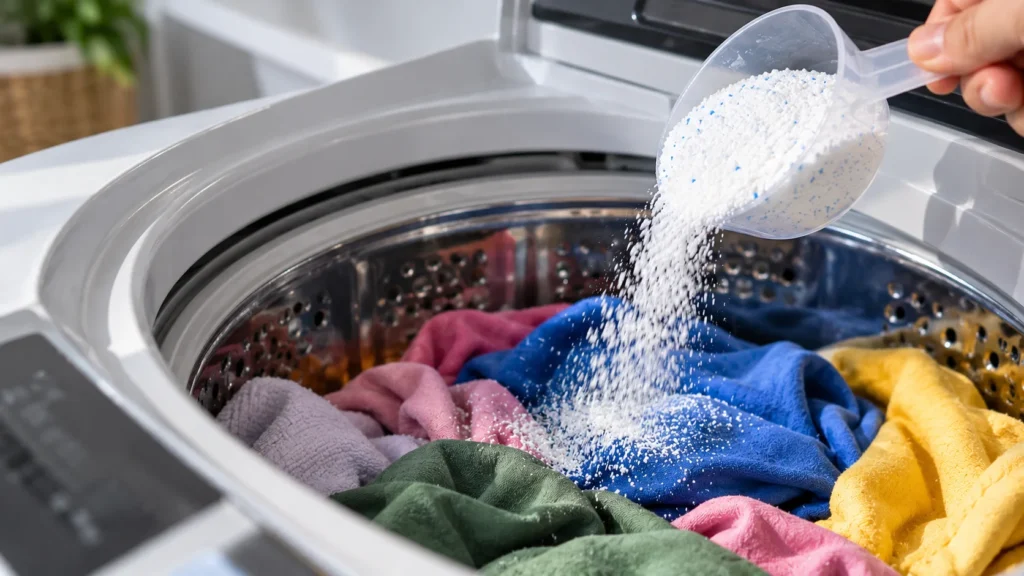
Can Oxygen Bleach Be Used on Colored Clothes?
Many oxygen-bleach products are designed for colorfast washable fabrics, which makes them a popular alternative to chlorine bleach.
OxiClean states that oxygen bleach can be used on colored or patterned clothing when used as directed.
Still, there is an important qualification:
Color safe does not mean colorproof.
Dyes, finishes, fabric blends, previous chemical treatments, and the condition of the garment can all affect the outcome.
For an unfamiliar garment, testing an inconspicuous area according to the product instructions is a sensible precaution.
Oxygen Bleach for Cleaning Around the Home
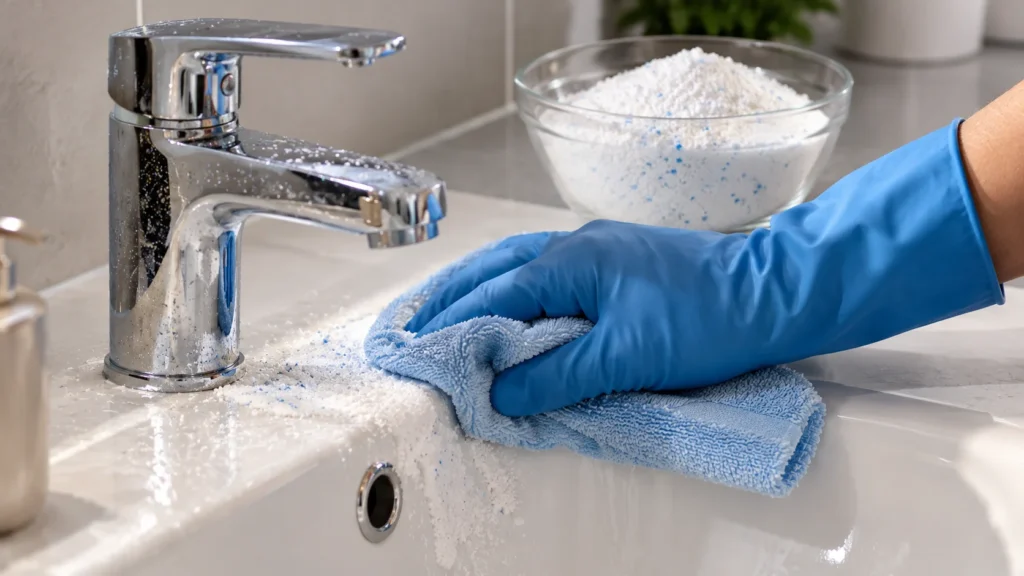
Oxygen bleach is not limited to laundry. Some oxygen-based formulations are also designed for household cleaning.
Potential applications include:
- Washable upholstery
- Certain carpets
- Household textiles
- Some hard surfaces
- Outdoor cleaning products
- Stain treatment
- General organic soil removal
The suitability depends on the specific product. An oxygen bleach deck cleaner, for example, should not be assumed to have the same formulation or directions as a laundry oxygen bleach.
Never transfer instructions from one product category to another without checking the label.
Is Oxygen Bleach Non-Toxic?
The phrase non-toxic oxygen bleach is often used in marketing, but it should not be treated as a universal scientific classification.
Oxygen bleach describes a chemical function; it does not automatically establish that every product is harmless. Different formulations contain different active ingredients and additives, and exposure risks depend on concentration and route of exposure.
The EPA’s Safer Choice program evaluates ingredients and finished products against specific health and environmental criteria. The EPA also cautions that simply using an ingredient appearing on its Safer Chemical Ingredients List does not by itself make a finished product Safer Choice certified.
A better approach is to:
- Read the ingredient list.
- Follow the safety directions.
- Avoid inhaling concentrated powder.
- Avoid eye contact.
- Keep products away from children.
- Store products properly.
- Follow the manufacturer’s instructions.
Non-chlorine and oxygen-based are more chemically informative terms than assuming that a product is completely risk-free.
How to Make Oxygen Bleach
People sometimes search for how to make oxygen bleach at home, usually referring to sodium percarbonate-based cleaning mixtures.
For household laundry, however, there is little reason to manufacture a chemical bleaching product yourself when commercially formulated oxygen-bleach products are available with directions and safety information.
A homemade mixture can also create uncertainty about:
- Ingredient purity
- Concentration
- Stability
- Storage
- Fabric compatibility
- Exposure hazards
- Cleaning performance
For consistent laundry results, a commercially formulated oxygen bleach used according to its label is generally easier to control.
Liquid Oxygen Bleach vs Powdered Oxygen Bleach
Oxygen bleach can be available in both liquid and powdered forms, but the chemistry may differ between products.
| Type | Common characteristics |
| Powdered oxygen bleach | Often based on sodium percarbonate or another dry peroxygen compound |
| Liquid oxygen bleach | May use hydrogen peroxide or another liquid oxygen-releasing system |
| Laundry booster | May combine oxygen bleach with builders and other ingredients |
| Stain remover | Often contains oxygen bleach plus cleaning agents |
| Concentrated professional product | Formulation and instructions vary significantly |
OxiClean confirms that oxygen bleach products can be available in powders, liquids, and other formats.
This is another reason not to assume that every product called oxygen bleach has the same active ingredient.
Oxygen Bleach Brands and Products
There are many oxygen bleach brands and oxygen-based products available for laundry and household cleaning.
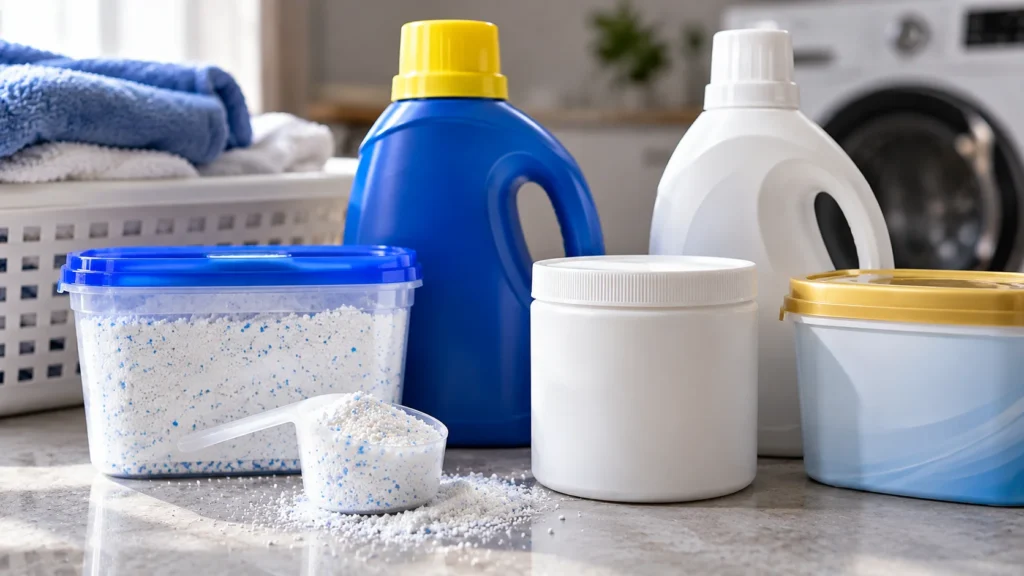
Examples that consumers may encounter include:
- OxiClean
- Meliora
- Molly’s Suds
- Biokleen
- Charlie’s Soap
- AspenClean
- Other non-chlorine bleach and oxygen-brightening products
The important distinction is that brand names do not define the chemistry by themselves.
For example, Church & Dwight’s disclosures show sodium carbonate peroxide functioning as oxygen bleach in multiple OxiClean products.
For other brands, check the exact product’s ingredient list and intended use before assuming it contains sodium percarbonate.
Oxygen Bleach for Workout Clothes
Workout clothing often contains synthetic fibers that can hold onto body oils, sweat residues, and odors.
An oxygen-bleach product may help with some of these soils when the garment is compatible with the product. A useful approach is:
- Check the care label.
- Pretreat heavily stained areas if the product permits.
- Use the recommended amount.
- Wash at the highest temperature permitted by the fabric.
- Avoid excessive product use.
- Inspect the clothing before drying.
- Repeat treatment only according to product directions.
Do not assume that an oxygen bleach product can replace detergent. Oxygen bleach generally works as a bleaching or cleaning booster, while detergent supplies surfactants and other cleaning components.
Jump into Other Related Article
- How to Remove Peanut Butter Stains
- Does Rayon Shrink?
- How to Remove Coffee Stains
- How to Clean Suede Shoes
- Best Stain Remover for Clothes
- How to Clean Stainless Steel
- How to Clean Carpet Stains
Oxygen Bleach Deck Cleaner and Outdoor Uses
Some products marketed as oxygen bleach deck cleaner use oxygen-based chemistry for outdoor stains and organic soils.
But laundry oxygen bleach and outdoor cleaning products should not automatically be considered interchangeable.
A deck cleaner may be formulated for:
- Wood
- Composite surfaces
- Outdoor stains
- Algae or organic buildup
- Dirt and weathering
If the package specifically identifies the product for outdoor surfaces, follow those directions rather than applying laundry instructions.
Likewise, do not assume that a laundry oxygen bleach product is suitable for a deck simply because it contains sodium percarbonate.
Does Oxygen Bleach Damage Fabric?
Used according to its instructions, many oxygen-bleach laundry products are designed to be gentler than chlorine bleach. ACI describes oxygen bleach as a gentler bleaching option and notes that it can be used on washable fabrics.
However, damage can still occur when the product is misused.
Potential problems include:
- Using too much product
- Ignoring fabric-care instructions
- Applying it to unsuitable materials
- Excessive soaking
- Using a formulation not intended for the fabric
- Applying powder directly to wet clothing
- Failing to test an uncertain dye
For delicate fabrics, always follow the garment label and product instructions.
Common Oxygen Bleach Mistakes to Avoid
Even a useful laundry booster can cause problems when used incorrectly.
Avoid these mistakes:
- Assuming oxygen bleach and chlorine bleach are identical.
- Treating every oxygen bleach product as sodium percarbonate.
- Assuming color safe means safe for every fabric.
- Pouring powdered oxygen bleach directly onto wet clothing.
- Ignoring the garment care label.
- Using a laundry product as an outdoor cleaner without checking its label.
- Assuming oxygen bleach disinfects.
- Mixing cleaning chemicals without checking compatibility.
- Using excessive amounts to make a product stronger.
- Assuming every OxiClean product has exactly the same formulation.
- Calling every oxygen bleach product non-toxic.
- Ignoring the product’s soaking instructions.
- Applying oxygen bleach to wool or silk without confirming compatibility.
- Assuming a homemade recipe is equivalent to a formulated commercial product.
- Using oxygen bleach as a substitute for detergent.
Oxygen Bleach Safety and Storage
Oxygen bleach products should be treated as household chemicals, even when marketed as gentler alternatives to chlorine bleach.
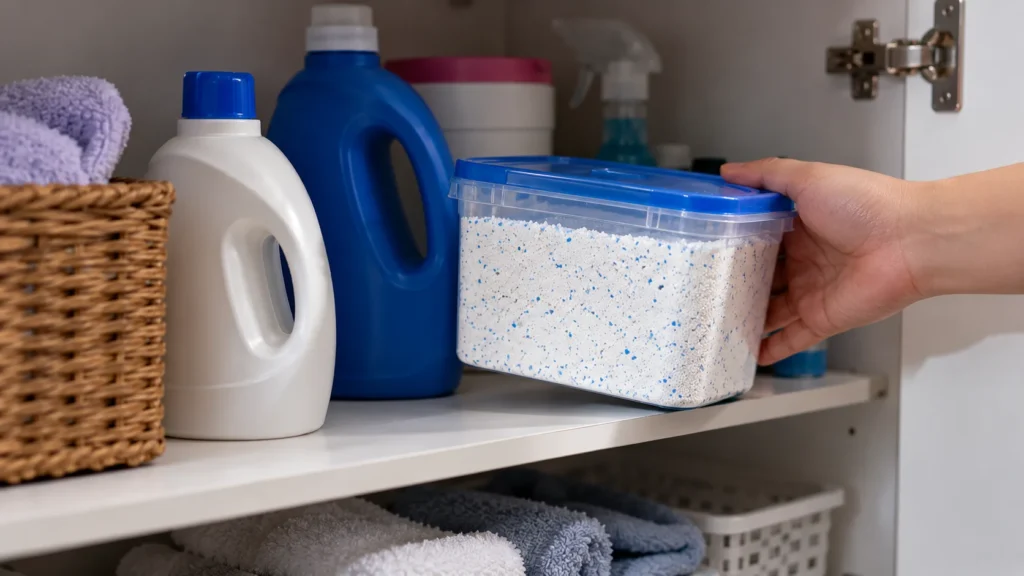
For safer use:
- Keep powder away from eyes.
- Avoid breathing concentrated dust.
- Wash hands after handling when appropriate.
- Follow package directions.
- Keep containers closed.
- Store products in a dry location.
- Keep them away from children and pets.
- Do not mix products unless the manufacturer specifically instructs you to.
- Follow the product’s first-aid instructions in case of exposure.
- Check the SDS for professional or concentrated products when additional technical information is required.
EPA’s Safer Choice program emphasizes that chemical products should be evaluated according to their specific ingredients and formulation rather than broad marketing descriptions.
Oxygen Bleach vs Regular Laundry Detergent
Oxygen bleach and laundry detergent perform different functions.
Laundry detergent primarily uses surfactants and other ingredients to loosen, suspend, and remove soils.
Oxygen bleach adds an oxidative component that can help break down colored stains and brighten fabrics.
Using both can therefore be useful when the product and fabric instructions permit it.
ACI explains that bleach helps convert soils into colorless, soluble particles that can then be removed by detergent and wash water.
This is why oxygen bleach is better viewed as a laundry additive or bleaching agent rather than a direct replacement for detergent.
Final Oxygen Bleach Checklist
Before using an oxygen bleach product, use this quick checklist:
- Identify whether it is chlorine or non-chlorine bleach.
- Check the active ingredients.
- Look for sodium percarbonate if you specifically want a sodium-percarbonate product.
- Read the garment care label.
- Confirm that the product is intended for the fabric.
- Follow the recommended dosage.
- Follow the specified water temperature.
- Test an inconspicuous area when appropriate.
- Never assume every brand uses the same formula.
- Do not assume oxygen bleach disinfects.
- Do not mix it with unrelated chemicals unless the label permits it.
- Store the product safely.
- Follow the manufacturer’s instructions over generic recipes.
Conclusion
Oxygen bleach is a category of non-chlorine bleaching products that use oxygen-releasing chemistry to help remove stains and brighten washable materials. Common oxygen-bleach ingredients include sodium percarbonate, sodium perborate, and hydrogen peroxide, while finished commercial products can contain additional builders, surfactants, enzymes, brighteners, or other ingredients. ACI identifies peroxygen compounds as the basis of non-chlorine bleach, and current OxiClean ingredient disclosures specifically identify sodium carbonate peroxide as an oxygen-bleach ingredient in several products.
For laundry, oxygen bleach can be useful for whites, many colorfast fabrics, stains, towels, bedding, and general brightening when used according to the product and garment instructions. It is generally gentler than chlorine bleach, but gentler does not mean suitable for every fabric or automatically disinfecting. The safest approach is to identify the exact product, read its ingredients and directions, follow the care label, and use the product only for applications specifically supported by the manufacturer.
1. What is oxygen bleach?
Oxygen bleach is a non-chlorine bleaching agent that uses oxygen-releasing compounds to help remove stains and brighten fabrics. Common ingredients include sodium percarbonate, sodium perborate, and hydrogen peroxide.
2. Is OxiClean an oxygen bleach?
Some OxiClean products contain oxygen bleach. For example, Church & Dwight lists sodium carbonate peroxide as the oxygen-bleach ingredient in several OxiClean formulations. However, OxiClean is a brand with multiple products, so the exact formulation should be checked for the product being used.
3. Is oxygen bleach safe for colored clothes?
Many oxygen-bleach products are specifically designed to be color safe and can be used on colorfast washable fabrics. However, always check the garment care label and product instructions because some fabrics and finishes have restrictions.
4. Does oxygen bleach disinfect laundry?
Not automatically. Oxygen bleach can help remove stains and brighten fabrics, but a product should only be considered a disinfectant when its label specifically supports that antimicrobial use. ACI distinguishes oxygen bleach from chlorine bleach products used for disinfection.
5. What is the main ingredient in powdered oxygen bleach?
Sodium percarbonate, also called sodium carbonate peroxide, is a common oxygen-bleach ingredient in powdered laundry products. However, formulations vary, so the ingredient list for the particular product should always be checked. Current Church & Dwight disclosures identify sodium carbonate peroxide as the oxygen-bleach ingredient in several OxiClean products.