
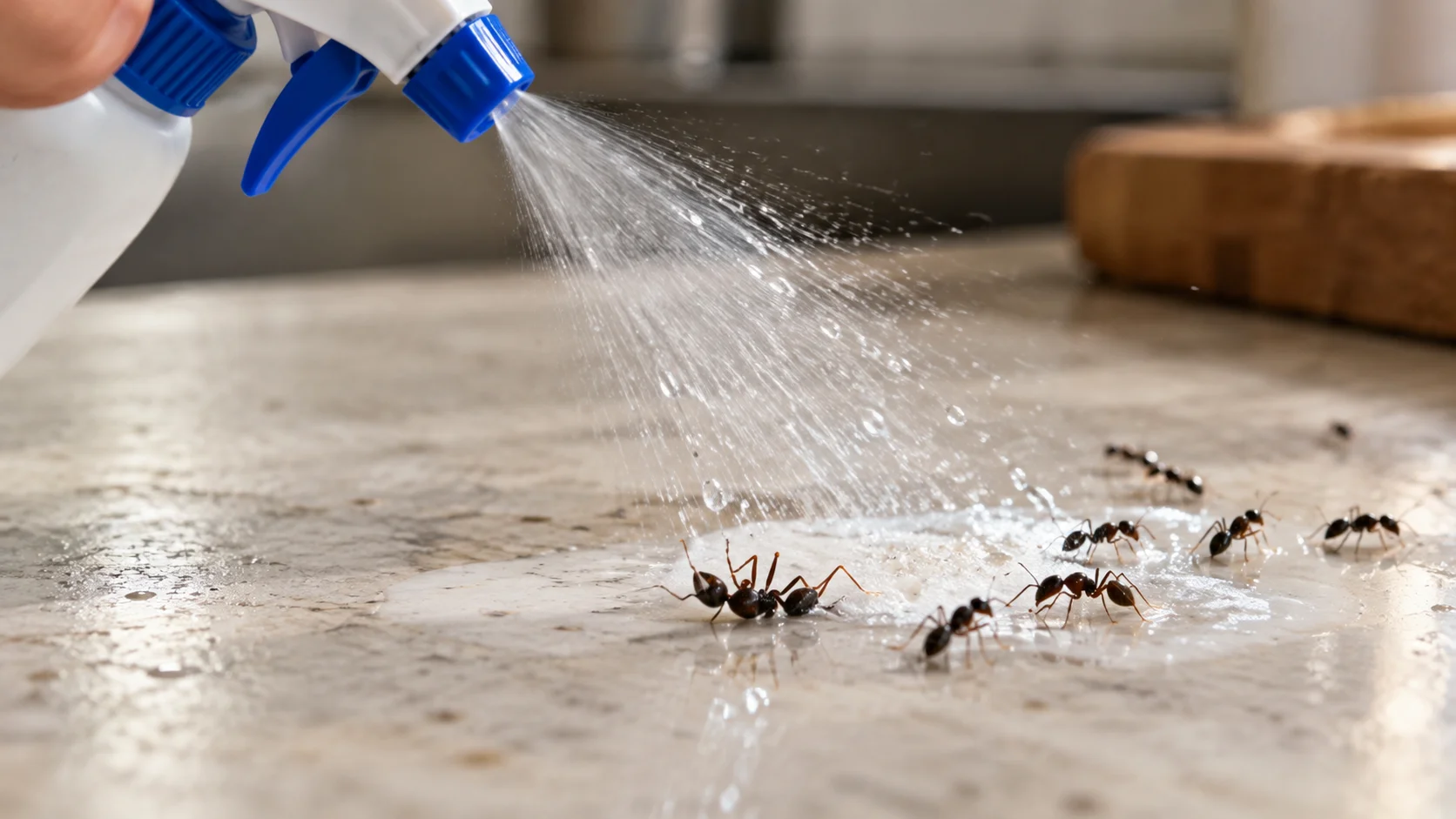
If you have noticed ants marching across a kitchen counter, bathroom floor, patio, or another part of your home, you may wonder, does bleach kill ants? The short answer is that bleach can kill ants when they are directly exposed to a sufficiently strong bleach solution, but that does not make household bleach a reliable ant-control treatment. It may kill individual ants that it contacts without addressing the nest, queen, or larger colony.
The distinction between killing an ant and controlling an infestation is important. Ant colonies can contain many workers, and additional ants may continue entering through cracks, plumbing openings, windows, foundations, or other routes. University pest-management guidance generally recommends identifying the ant, removing food and water sources, sealing entry points, and using properly labeled ant baits when chemical control is needed rather than relying on household cleaning products.
Does Bleach Kill Ants?
Yes, bleach can kill ants through direct exposure, but it is not a dependable method for eliminating an ant colony. Household chlorine bleach commonly contains sodium hypochlorite, an oxidizing chemical used primarily for cleaning and disinfecting. Direct exposure can be harmful to insects, but a cleaner’s ability to kill an individual insect does not mean it provides effective colony control.
The explains that bleach may be regulated as a pesticide when a product is specifically labeled for pest-control use, while bleach sold only as a cleaner or whitening product does not necessarily carry pest-killing directions.
- Bleach can kill ants when directly exposed.
- Direct contact is different from colony control.
- An ant killed on a countertop does not mean the nest has been eliminated.
- Other worker ants may continue entering.
- The queen may remain unaffected.
- Eggs and larvae inside a nest may remain.
- Hidden colonies may be inaccessible.
- Outdoor nests may be far from the visible trail.
- Bleach does not provide dependable long-term ant prevention.
- It is primarily a household cleaning and disinfecting product.
- A cleaning product should not automatically be treated as an insecticide.
- Pest-control claims depend on the product label.
- Using a chemical outside its labeled purpose can create unnecessary risks.
- Ant identification is important for effective control.
- Colony-focused methods are generally more useful for persistent infestations.
How Does Bleach Kill Ants?
The active ingredient in many household chlorine bleaches is sodium hypochlorite. It is a strong oxidizing chemical, which helps explain why direct exposure can damage living tissues. This chemical action can kill an exposed ant, but the precise outcome depends on concentration, exposure, and whether the ant receives enough direct contact.
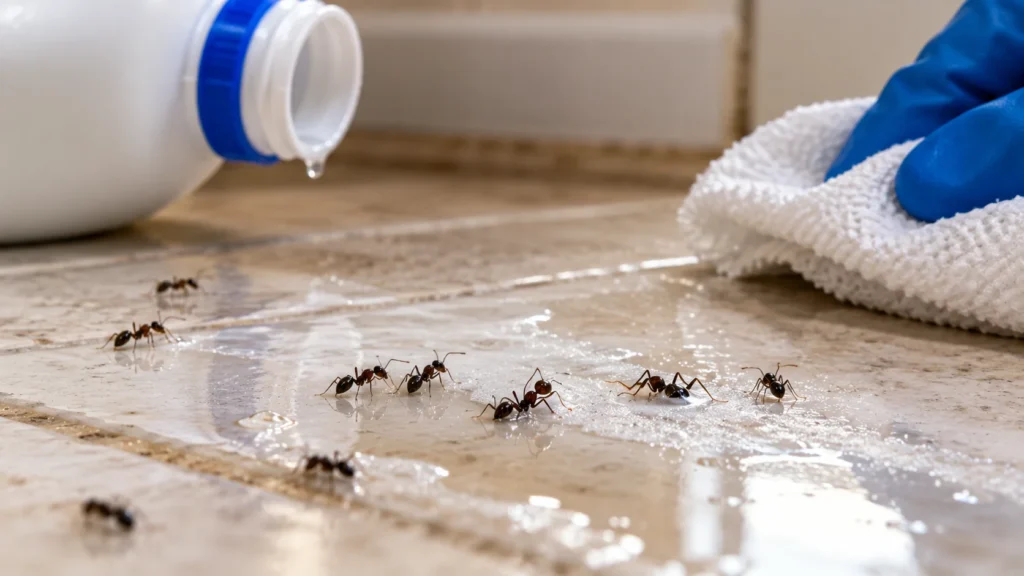
That is why a person may see an ant stop moving shortly after being sprayed with bleach but still have ants returning later. The visible worker was affected, while the underlying colony remained intact.
- Sodium hypochlorite is the active ingredient in many chlorine bleach products.
- Bleach is highly reactive.
- Direct exposure can damage an insect’s body.
- The concentration of the product matters.
- Contact time can influence the result.
- A small amount may not produce the same effect as direct saturation.
- Surface contamination is not the same as treating a nest.
- Ants hidden inside walls may never contact the bleach.
- Ant queens may remain protected inside the colony.
- Larvae and eggs may remain unaffected.
- New workers can continue emerging.
- Other colonies may enter from outside.
- Bleach therefore has limited value as an infestation-control strategy.
- Cleaning ant trails can remove food residues and scent trails.
- A proper ant-control product should be used according to its label.
Does Bleach Kill Ants on Contact?
Bleach can kill ants on direct contact, which is why spraying an exposed ant may appear to work immediately. However, contact killing is a very different concept from controlling an infestation.
University of California IPM guidance explains that simply killing foraging ants does not necessarily control the colony because additional ants can emerge from the nest. For persistent problems, slow-acting baits are useful because worker ants can carry the bait back to the colony.
If your objective is simply to remove a few visible ants from a hard, bleach-compatible surface, cleaning the area afterward may remove the ants and their trail. If your objective is long-term ant control, however, bleach is usually the wrong tool.
How Fast Does Bleach Kill Ants?
There is no reliable universal time for bleach to kill an ant. The result can vary according to the bleach product, concentration, amount of exposure, ant species, and whether the insect receives direct contact.
This is why questions such as how long does it take for bleach to kill ants? or does bleach kill ants instantly? do not have one dependable number. An ant that is directly saturated may die quickly, while an ant receiving only limited exposure may survive.
- Direct exposure can produce a rapid effect.
- Light or incomplete exposure may be less effective.
- Different ant species can respond differently.
- Product concentration varies between bleach products.
- Contact time matters.
- Surface absorption can affect exposure.
- Dilution changes the strength of a bleach solution.
- The visible ant may escape before sufficient exposure.
- Hidden ants are unlikely to contact the bleach.
- A delayed death still does not mean the colony was treated.
- There is no reliable household rule such as bleach kills ants in X seconds.
- Do not increase concentration simply to make it act faster.
- Do not spray excessive bleach around a home.
- Follow the product label for any intended use.
- For infestations, focus on colony management rather than timing individual deaths.
Does Bleach Kill Ants in the House?
Bleach may kill ants that it directly contacts inside a house, but it is not normally the best solution for ants in the house. Indoor ants are often entering because they have found food, water, shelter, or a convenient route into the building.
recommends cleaning food sources, finding entry points, sealing openings, and using appropriate baits when necessary. It specifically notes that cleaning invading ants with soapy water can remove their scent trail.
If ants repeatedly appear in the kitchen, bathroom, pantry, bedroom, or another room, concentrate on finding out why they are there rather than repeatedly spraying individual ants.
Better Steps for Indoor Ants
- Remove crumbs from countertops and floors.
- Wipe up sugary spills.
- Clean grease from cooking areas.
- Store food in sealed containers.
- Empty indoor garbage regularly.
- Clean around pet-food areas.
- Fix leaking faucets and pipes.
- Inspect around sinks.
- Check windows and doors.
- Follow ant trails to possible entry points.
- Seal cracks and openings where ants enter.
- Check around plumbing penetrations.
- Inspect areas near baseboards.
- Consider properly labeled ant bait for persistent activity.
- Keep pest-control products away from children and pets according to their labels.
Does Bleach Kill Ants Outside?
Bleach can affect ants that receive direct exposure outdoors, but using household bleach around patios, foundations, gardens, soil, plants, or other outdoor areas is generally a poor pest-management strategy.
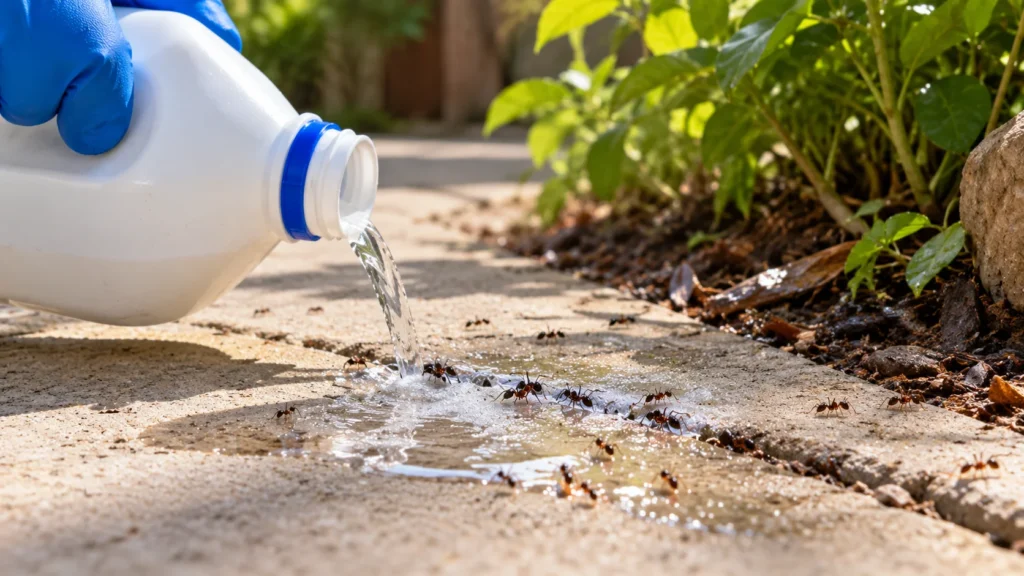
Outdoor ant activity is usually connected to a larger environment containing nests, food sources, moisture, vegetation, and multiple routes into structures. recommends focusing on exclusion, sanitation, habitat modification, and properly selected baits rather than attempting to eliminate every outdoor ant.
- Avoid treating an entire yard with household bleach.
- Do not pour bleach into soil.
- Do not use bleach as a general outdoor pesticide.
- Keep bleach away from plants unless the product specifically permits the application.
- Avoid contaminating drainage areas.
- Do not spray bleach around edible plants.
- Find where ants are nesting or foraging.
- Remove attractive food sources.
- Reduce unnecessary moisture.
- Seal routes into buildings.
- Keep vegetation from creating bridges to structures.
- Consider appropriately labeled outdoor ant bait.
- Follow pesticide labels when using ant-control products.
- Keep bait stations inaccessible to children and pets.
- Seek professional help for persistent or difficult infestations.
Does Bleach Kill Fire Ants?
Direct bleach exposure may kill individual fire ants, but bleach is not a dependable fire-ant colony treatment. Fire ant colonies can be extensive, and killing workers that are visible on the surface does not necessarily eliminate the queen or the colony.
For fire ants and other outdoor ants, use products specifically labeled for the pest and location. The appropriate strategy depends on where the colony is located, the species involved, and whether treatment is individual-mound or broader-area control.
Do not attempt to compensate for bleach’s limitations by using larger amounts or stronger mixtures.
Does Bleach Kill Carpenter Ants?
Bleach may kill a carpenter ant that is directly exposed, but it does not reliably eliminate a carpenter-ant infestation. Carpenter ants can nest in structural wood, especially where moisture or wood decay creates favorable conditions.
notes that carpenter ants can cause structural damage by tunneling into wood to establish nests.
If you repeatedly find large ants indoors, especially around damp or damaged wood, the important question is not simply whether bleach can kill the visible insects. You need to determine whether there is an active nest and why the ants are using the structure.
- Identify the ant before choosing treatment.
- Look for repeated trails.
- Inspect areas with moisture problems.
- Check damaged or decaying wood.
- Look around plumbing leaks.
- Inspect window and door areas.
- Check wall voids where activity is concentrated.
- Avoid simply spraying every visible ant.
- Do not soak structural materials with bleach.
- Correct moisture problems.
- Seal appropriate exterior entry points.
- Use properly labeled ant-control products.
- Consider professional inspection for persistent activity.
- Follow all pesticide label instructions.
- Address the underlying nesting conditions.
Does Bleach Kill Sugar Ants?
Bleach can kill sugar ants that are directly exposed, but it does not solve the reason they are entering your home. Sugar-feeding ants may be attracted by spilled drinks, food residue, fruit, garbage, or other sources of carbohydrates.
notes that household ants may search for sweets and grease and recommends thorough cleaning and sealing entry routes.
For a small indoor trail, cleaning the surface can be useful because it removes food residues and ant scent trails. For repeated activity, baiting may be more effective because worker ants can carry a slow-acting bait back to the nest.
Does Clorox Bleach Kill Ants?
Clorox bleach can kill ants on direct contact, but whether a specific product should be used against ants is a separate question. Clorox sells different products with different formulations and intended uses, so you should not assume that every Clorox product has the same pest-control properties.
The explains that bleach products used as cleaners do not necessarily have pesticide claims or pest-control directions.
Therefore, do not interpret contains bleach as meaning approved ant killer. Check the actual product label and intended use.
Does Bleach Water Kill Ants?
A diluted bleach solution may kill an ant if the insect receives sufficient direct exposure, but dilution reduces the concentration of sodium hypochlorite. Because household bleach products and dilution instructions vary, there is no universal bleach-water-to-kill-ants ratio that should be treated as a standard pest-control recipe.
More importantly, increasing the concentration does not transform household bleach into a good colony treatment.
- Dilution changes chemical strength.
- Different bleach products have different formulations.
- The label provides the appropriate dilution for intended cleaning uses.
- Do not invent a stronger mixture for pest control.
- Do not assume more bleach means better ant control.
- Avoid unnecessary exposure to bleach fumes.
- Keep bleach away from skin and eyes.
- Never mix bleach with other household chemicals.
- Do not use bleach in soil as an ant treatment.
- Do not spray food-contact surfaces unnecessarily.
- Ventilate areas when using bleach for its intended cleaning purpose.
- Store bleach securely.
- Follow the manufacturer’s directions.
- Use an appropriately labeled ant product when pest control is actually required.
- Focus on the colony rather than individual ants.
Does Mopping With Bleach Kill Ants?
If a mop containing an appropriate bleach solution directly contacts ants, it may kill those ants. However, mopping with bleach is not a dependable way to eliminate an infestation.
For ordinary ant trails on suitable hard surfaces, soapy water can be a more practical cleaning approach because specifically recommends wiping or mopping invading ants with soapy water to remove the scent trail they leave behind.
Bleach should therefore be selected because the surface needs bleach-compatible cleaning or disinfectionnot simply because ants are present.
Does Bleach Spray Kill Ants?
A bleach-containing spray may kill an ant when it directly contacts the insect, but a general household cleaner should not automatically be used as an insecticide.
If the product is not labeled for pest control, using it as an ant spray does not provide the same assurance as using a pesticide registered and labeled for ants. The explains that products making pest-killing claims are subject to pesticide labeling requirements.
For repeated ant problems, a properly labeled ant bait or another appropriate treatment is usually a better choice than turning a household cleaner into an improvised pesticide.
Does Bleach Kill Ant Nests?
Bleach is unlikely to provide reliable control of an entire ant nest. A nest may be located under flooring, inside walls, beneath soil, under stones, inside wood, or in another inaccessible location.
Even if bleach kills several visible workers, it may not reach the colony’s queen, brood, or other workers. This is one of the biggest reasons that contact killing and colony control should not be confused.
explains that ant baits work differently: workers collect the bait and carry it back to the nest, where the active ingredient can be distributed to other colony members.
Does Bleach or Vinegar Kill Ants?
Both bleach and vinegar can affect ants when they are directly exposed, but you should never mix bleach and vinegar.
This is a critical safety point. states that mixing vinegar with chlorine bleach releases chlorine gas, which can severely irritate the eyes, nose, throat, and airways.
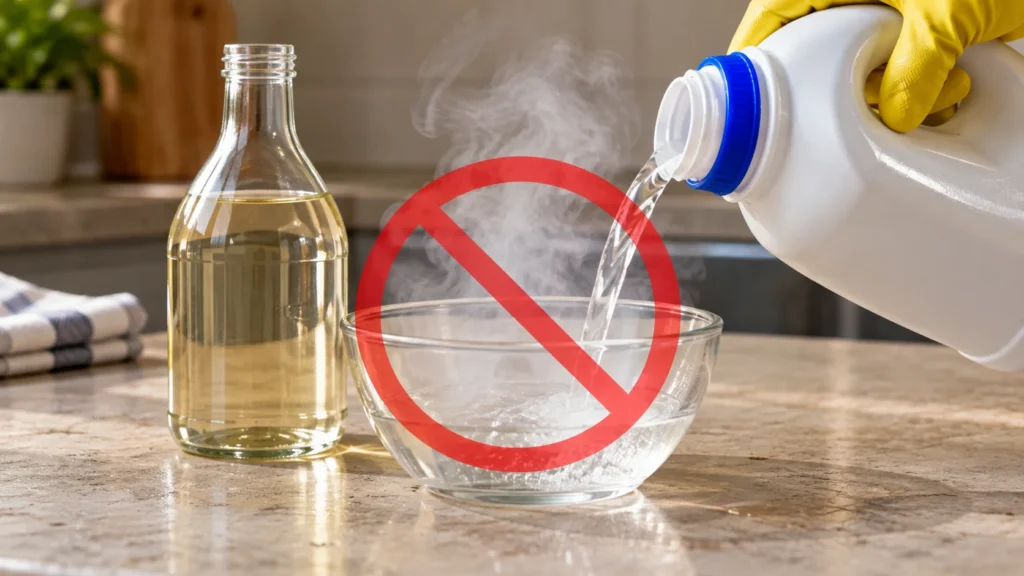
Therefore, the popular idea of combining vinegar and bleach to make a stronger ant killer is dangerous and should not be followed.
- Never mix bleach and vinegar.
- Never combine bleach with acidic cleaners.
- Do not add vinegar to a bleach solution.
- Do not use separate products simultaneously on the same wet surface.
- Read cleaning-product labels.
- Keep the original containers available.
- Ventilate appropriately when using bleach as directed.
- If a dangerous mixture occurs, leave the area and seek appropriate emergency or poison-control guidance.
- Do not deliberately create chlorine gas.
- Do not use homemade chemical combinations as pest-control experiments.
Why You Should Never Mix Bleach and Other Cleaners
Bleach is particularly important to handle carefully because it can react with other household cleaning chemicals. warns that bleach mixed with vinegar can release chlorine gas, while bleach mixed with ammonia can produce chloramine gas.
This means does bleach or vinegar kill ants? should never become can I mix bleach and vinegar to kill ants? The second approach creates a serious chemical hazard without providing a reliable colony-control benefit.
- Never mix bleach with vinegar.
- Never mix bleach with ammonia.
- Avoid combining bleach with unknown cleaners.
- Do not mix bleach with other pest-control products.
- Read every product label.
- Use one cleaning product at a time.
- Rinse surfaces appropriately when product instructions require it.
- Keep cleaning products in their original containers.
- Store chemicals away from children.
- Keep products away from pets.
- Avoid spraying unnecessary chemicals indoors.
- Use ventilation according to the product directions.
- Never intentionally produce fumes to kill pests.
- Stop using a product if you experience concerning fumes or irritation.
- Contact the appropriate poison-control or emergency service after significant exposure.
Does Bleach Keep Ants Away?
Bleach is not a reliable long-term ant repellent. Although cleaning can remove food residues and scent trails, the effect should not be confused with creating a permanent barrier against ants.
recommends sealing entry points and removing food and water sources as important exclusion measures. It also explains that indoor pesticide sprays generally do not prevent additional ants from entering.
For prevention, concentrate on making your home less attractive and less accessible to ants rather than repeatedly spraying bleach along their trails.
Jump into Other Related Article
- How to Remove Peanut Butter Stains
- Does Rayon Shrink?
- How to Remove Coffee Stains
- How to Clean Suede Shoes
- Best Stain Remover for Clothes
- How to Clean Stainless Steel
- How to Remove Turmeric Stains
Better Ways to Get Rid of Ants
If your real goal is getting rid of ants, colony-focused management is usually more effective than killing individual workers. Integrated pest management combines identification, sanitation, exclusion, habitat modification, monitoring, and carefully selected pesticides when necessary.
describes IPM as an approach that begins by understanding why the pest is present and prioritizes prevention and exclusion before chemical control.
1. Remove Food Sources
Ants can be attracted by crumbs, grease, sweet liquids, pet food, garbage, fruit, and other food sources.
- Wipe counters regularly.
- Clean food spills promptly.
- Sweep crumbs from floors.
- Clean sticky areas.
- Store sugar and other foods in sealed containers.
- Keep pet food areas clean.
- Empty garbage regularly.
- Wash reusable food containers.
- Clean under appliances.
- Keep pantry shelves free of spills.
2. Remove Water Sources
Moisture can also encourage ant activity.
- Repair leaking faucets.
- Fix plumbing leaks.
- Dry wet countertops.
- Check beneath sinks.
- Improve drainage around the home.
- Address persistent condensation.
- Avoid leaving standing water indoors.
- Inspect areas around washing machines.
- Check damp basement spaces.
- Correct moisture problems around damaged wood.
3. Seal Entry Points
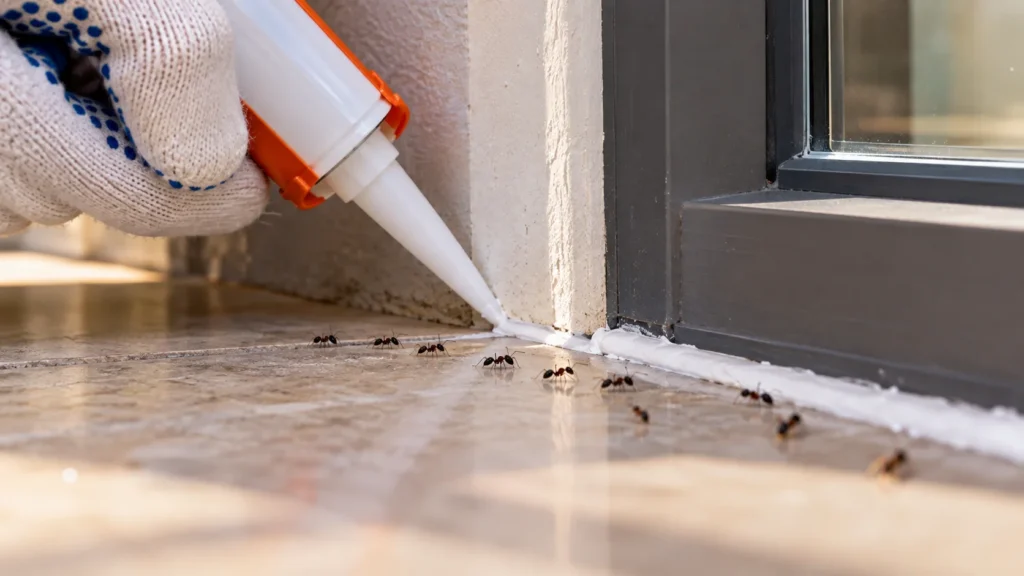
recommends locating where ants enter and sealing openings with caulk or other appropriate materials.
- Seal cracks around windows.
- Repair damaged door seals.
- Close gaps around pipes.
- Seal foundation openings.
- Repair damaged screens.
- Check utility penetrations.
- Inspect baseboards.
- Seal gaps around exterior doors.
- Check garage entry points.
- Look around plumbing penetrations.
4. Use Ant Baits Correctly
Ant bait is often more useful than contact spraying because worker ants can transport slow-acting bait back to the colony. identifies baiting as a key component of ant management.
- Choose a product labeled for the ants you are treating.
- Follow the product label exactly.
- Place bait near active trails when directed.
- Keep bait inaccessible to children and pets.
- Do not contaminate bait with household cleaners.
- Avoid spraying insecticide directly around bait stations.
- Give slow-acting baits time to work.
- Monitor activity.
- Replace bait according to label directions.
- Try a different bait formulation if ants ignore the first one.
- Remember that different ant species have different food preferences.
- Do not expect immediate colony elimination.
- Keep alternative food sources to a minimum.
- Do not randomly mix homemade pesticide recipes.
- Contact a professional if the infestation persists.
notes that ant baits may take weeks or longer to eliminate a colony and advises not spraying insecticide while using bait because spraying can interfere with bait collection.
How to Stop Ants From Coming Back
The best long-term strategy is to combine cleaning with exclusion and appropriate colony control. Killing visible ants without correcting the conditions attracting them often results in the same problem returning.
- Identify the ant species when possible.
- Follow trails to entry points.
- Seal cracks and openings.
- Remove food sources.
- Reduce moisture.
- Keep garbage containers clean.
- Store food securely.
- Keep vegetation from touching the structure.
- Remove outdoor nesting opportunities close to the building where practical.
- Monitor areas where ants previously appeared.
- Use labeled bait when appropriate.
- Avoid unnecessary insecticide spraying.
- Do not rely on bleach as a permanent repellent.
- Check for structural moisture problems.
- Hire a qualified pest professional for persistent infestations.
When Bleach Is Appropriate and When It Is Not
Bleach has legitimate household uses, particularly for cleaning and disinfecting surfaces where its product label permits those applications. The problem is using it as an improvised pesticide simply because it can kill individual ants.
The makes an important distinction: bleach can be both a cleaner and, when a product is specifically registered and labeled for that purpose, a pesticide. A cleaner’s label does not automatically authorize pest-control use.
| Situation | Better approach |
| One or two ants on a counter | Remove them and clean the trail |
| Ants repeatedly entering indoors | Find and seal entry points |
| Food attracting ants | Remove food residue |
| Persistent ant trail | Consider appropriately labeled bait |
| Ant nest outdoors | Use species-appropriate control |
| Carpenter-ant activity | Investigate possible nesting/moisture |
| Fire-ant infestation | Use a properly labeled fire-ant treatment |
| Large recurring infestation | Consider professional IPM |
| Cleaning a bleach-compatible surface | Use bleach according to its label |
| Mixing bleach with vinegar | Never do this |
Common Mistakes People Make With Bleach and Ants
Many online discussions focus on whether bleach kills ants, but the bigger issue is whether the method solves the infestation safely. Several common approaches can waste time or create unnecessary chemical exposure.
- Assuming killing visible ants means the colony is gone.
- Spraying bleach repeatedly around the home.
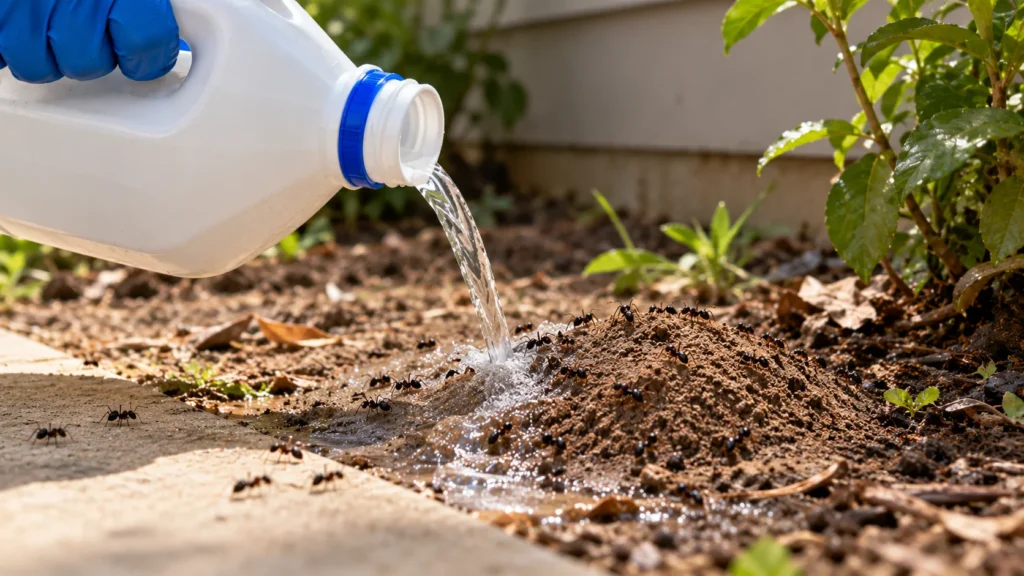
- Pouring bleach into an ant nest.
- Applying bleach to soil.
- Spraying bleach onto plants.
- Using bleach on surfaces where it can cause damage.
- Mixing bleach with vinegar.
- Mixing bleach with ammonia-containing products.
- Increasing bleach concentration to make it stronger.
- Using household bleach as an unlabeled pesticide.
- Ignoring food sources.
- Ignoring leaks and moisture.
- Failing to seal entry points.
- Spraying insecticide around ant bait.
- Ignoring persistent carpenter-ant activity.
Final Answer: Does Bleach Kill Ants?
Yes, bleach can kill ants that receive direct exposure, but it is not a reliable way to eliminate an ant infestation. It may kill individual workers, yet the colony can remain hidden and continue producing or sending out additional ants. For that reason, repeatedly spraying bleach may give the appearance of control without solving the underlying problem.
For a lasting solution, identify the ants, remove food and water sources, seal entry points, and use properly labeled ant baits or other appropriate pest-control methods when necessary. IPM programs generally favor these colony-focused strategies over repeatedly killing visible workers. Most importantly, never mix bleach with vinegar, ammonia, or other incompatible cleaners, because dangerous gases can result.
Conclusion
So, does bleach kill ants? Yes, direct exposure can kill individual ants, and that explains why spraying bleach may appear effective for a few seconds or minutes. But bleach should not be confused with a complete ant-control solution. It generally does not reach hidden nests, queens, larvae, or the wider colony, and it does not address the conditions that caused the ants to enter your home.
A better approach is to treat the reason for the infestation: clean food residues, reduce moisture, seal entry points, identify the ant species, and use an appropriately labeled bait or professional pest-management service when needed. Bleach should be reserved for the cleaning or disinfecting purposes stated on its product label, rather than improvised as a general ant pesticide.
1. Does bleach kill ants instantly?
Bleach can kill an ant after sufficient direct exposure, but there is no reliable universal time for how quickly it will happen. Concentration, exposure, and ant species can affect the result. More importantly, killing an individual ant does not eliminate the colony.
2. Does bleach kill ants on contact?
Yes, direct contact with chlorine bleach can kill exposed ants. However, contact killing does not normally provide effective long-term control because the nest and queen may remain unaffected.
3. Does bleach kill ants outside?
Bleach can affect ants that are directly exposed, but it is not recommended as a general outdoor ant-control method. Do not pour or spray household bleach into soil, around plants, or across outdoor areas simply to kill ants. Use appropriately labeled pest-control products when treatment is necessary.
4. Does bleach or vinegar kill ants?
5. What is better than bleach for getting rid of ants?
For persistent infestations, integrated pest management is generally a better approach. Remove food and water sources, seal entry points, identify the ants, and consider properly labeled slow-acting ant baits. Baits can be carried by worker ants back to the colony, making them more useful for colony control than simply killing ants on contact.