

Wool detergent is a laundry detergent formulated for delicate animal fibers such as wool, Merino wool, cashmere, alpaca, and, in many cases, silk. Unlike a standard heavy-duty laundry detergent, a wool-safe formula is designed to clean without subjecting delicate protein fibers to unnecessarily harsh chemistry or treatment.
The Company recommends choosing a mild, neutral detergent for wool and specifically advises avoiding heavy-duty detergents, enzyme-containing bio detergents, and bleach when washing wool. This makes the detergent you choose an important part of wool care, alongside water temperature, washing action, and drying method.
A good wool laundry detergent should therefore be judged by more than whether it removes dirt. It should also be compatible with the care label, suitable for the particular wool item, and gentle enough to help preserve the garment’s shape, texture, and useful life.
Why Wool Needs a Different Detergent
Wool is a natural protein fiber, and it behaves differently from common everyday fabrics such as cotton and many synthetic fibers. Excessive heat, unsuitable detergent chemistry, friction, and rough handling can contribute to problems such as felting, shrinkage, distortion, or surface damage.
This does not mean wool must always be hand washed. notes that many wool garments can safely be machine washed when their care claim specifically permits machine washing. The key is using the correct cycle and a neutral, mild detergent.
- Wool benefits from gentle washing.
- Many wool items require lower mechanical action.
- Some wool garments are machine washable.
- Others are marked hand wash only.
- Some items are labeled dry clean only.
- Wool should not automatically be treated like cotton.
- Excessive agitation can contribute to felting and distortion.
- Very hot water may be inappropriate for the garment.
- Harsh detergents can be unsuitable for delicate wool.
- Enzyme-containing detergents should be avoided according to .
- Chlorine and oxygen bleach should not be used on wool according to .
- Powdered detergent should be dissolved before use when appropriate.
- Excessive fabric softener can contribute to pilling.
- The care label should always take priority.
- The detergent and washing method need to work together.
What Makes a Detergent Wool Safe?
When searching for a wool safe detergent, look beyond words such as gentle or delicate on the front of a bottle. A more useful starting point is whether the product is specifically formulated for wool and whether its instructions support your garment’s washing method.
‘s guidance is particularly straightforward: a wool detergent should be mild and neutral, and heavy-duty detergents, enzyme-containing bio detergents, and bleaches should be avoided.
- Look for a detergent specifically intended for wool or delicates.
- Prefer a mild or neutral formula.
- Check whether the product is enzyme-free.
- Avoid chlorine bleach.
- Avoid oxygen bleach on wool.
- Check the detergent’s temperature recommendations.
- Make sure the product is suitable for machine washing if you need that.
- Check whether it can be used for hand washing.
- Follow the garment manufacturer’s instructions.
- Avoid assuming a regular detergent is wool-safe.
- Read the product’s dosing instructions.
- Use only the recommended amount.
- Dissolve powdered detergent before contact with delicate wool when applicable.
- Consider fragrance-free options for people who prefer them.
- Look for credible certification or manufacturer information rather than relying only on marketing language.
Best Wool Detergent | What Should You Look For?
There is no single best wool detergent for every household because wool items vary considerably. A Merino base layer, cashmere sweater, handmade wool garment, alpaca scarf, and large wool blanket may all have different care instructions.
The better approach is to choose the best detergent for the specific wool item. recommends a neutral, mild detergent, preferably one carrying its recommendation, while specialized brands offer products designed specifically for wool, cashmere, Merino, or technical wool garments.
| What to look for | Why it matters |
| Mild formula | Better suited to delicate fibers |
| Neutral formulation | Recommended by for wool care |
| Enzyme-free | Helps avoid unsuitable enzyme chemistry |
| No bleach | Wool should not be bleached |
| Wool-specific labeling | Gives clearer intended use |
| Hand-wash instructions | Useful for hand-wash-only items |
| Machine-wash instructions | Helpful for washable wool |
| Low-temperature compatibility | Useful for delicate washing |
| Clear dosing | Helps prevent detergent residue |
| Manufacturer guidance | Makes the product easier to use correctly |
Wool Wash Detergent vs Normal Laundry Detergent
A wool wash detergent is not simply ordinary detergent with a different label. Wool-specific products are designed around the needs of delicate fibers and may use a different formulation or cleaning approach.
recommends mild, neutral wool detergents rather than heavy-duty detergents. The organization also specifically advises against enzyme-containing bio detergents and bleach for wool.
A regular detergent may be excellent for heavily soiled cotton towels, workwear, or everyday synthetic clothing, but that does not automatically make it appropriate for a fine wool sweater.
The difference is particularly important when washing expensive or delicate garments where preserving the original hand feel, shape, and structure matters as much as removing visible dirt.
Jump into Other Related Article
- How to Remove Peanut Butter Stains
- Does Rayon Shrink?
- How to Remove Coffee Stains
- How to Clean Suede Shoes
- Best Stain Remover for Clothes
- How to Clean Stainless Steel
- How to Remove Avocado Stains
What Detergent Is Safe for Wool?
If you are asking what detergent is safe for wool, the safest general answer is a mild, neutral detergent specifically intended for wool or delicate fibers, provided it is compatible with the garment’s care instructions.
recommends mild, neutral detergent and says to avoid heavy-duty detergents, enzyme-containing detergents, and bleach.
Some commercially available examples include:
- Heritage Park Silk & Wool Laundry Detergent the manufacturer describes it as pH-neutral and enzyme-free and says it is intended for silk, wool, cashmere, alpaca, and other protein-based fabrics.
- The Laundress Wool & Cashmere Shampoo the manufacturer describes its formula as enzyme-free and intended for wool, cashmere, Merino, mohair, and blends.
- Delicates the manufacturer describes it as a gentle liquid detergent suitable for delicate garments, including wool, silk, and cashmere, and says it contains no bleach, phosphates, or enzymes.
- Wool Wash specifically designed for Merino wool clothing, with instructions for both machine and hand washing.
- Eucalan Delicate Wash designed for delicate fibers and available for hand washing and machine washing; Eucalan describes its formula as a no-rinse wash.
These are examples rather than a universal ranking. Always compare the detergent’s instructions with the garment’s care label.
Heritage Park Silk & Wool Laundry Detergent
Heritage Park Silk & Wool Detergent is one product specifically formulated around silk and wool care. Its manufacturer describes the fragrance-free formula as pH-neutral and enzyme-free and states that it can be used for wool, cashmere, alpaca, washable furs, silk, and other protein-based fabrics.

The company also states that the detergent can be used in standard and HE washing machines as well as for hand washing. Its product information provides separate dosing instructions for hand washing, HE machines, and standard machines.
For shoppers comparing Heritage Park silk and wool detergent with other options, the useful factors are not simply the brand name. Check the formula, intended fibers, certifications, machine compatibility, fragrance preference, and the care instructions for your garment.
Wool Detergent and Delicate Washing
Delicates is another commonly encountered option when looking for a wool detergent. The manufacturer says the product is designed for delicate garments and is suitable for wool, silk, cashmere, cotton, satin, and polyester. It also states that the formula contains no bleach, phosphates, or enzymes.
The product can be used for hand washing and in regular or HE washers according to its manufacturer.
When using any delicate detergent, however, do not assume that a product’s broad compatibility overrides a garment’s specific instructions. A delicates detergent is still only appropriate when the item itself is washable by the proposed method.
Merino Wool Detergent: What Is Different?
Merino wool is still wool, but it is widely used in lightweight clothing, base layers, socks, travel garments, and performance apparel. A Merino wool detergent should therefore be selected with both the fiber and the garment construction in mind.
, for example, specifically formulates its Wool Wash for Merino wool sports clothing and says the product is intended to clean, deodorize, and maintain the performance characteristics of Merino items.
- Check whether the Merino item is machine washable.
- Use the recommended wool or delicate cycle.
- Choose a wool-safe detergent.
- Avoid bleach.
- Avoid heavy-duty detergent.
- Avoid unsuitable enzyme-containing formulas.
- Use the manufacturer’s recommended dosage.
- Do not overload the washing machine.
- Turn garments inside out when appropriate.
- Use a laundry bag for particularly delicate items if appropriate.
- Avoid unnecessary high temperatures.
- Do not leave wet Merino clothing sitting in a pile.
- Follow the drying instructions.
- Lay flat when the garment requires flat drying.
- Store the garment only after it is completely dry.
Best Detergent for Merino Wool
The best detergent for Merino wool is one that meets the garment’s care requirements while providing a mild cleaning action. There is no need to choose the strongest detergent simply because the garment is dirty.
recommends a mild, neutral detergent for wool and advises choosing a -recommended detergent where possible.
For technical Merino sports clothing, a specialized product such as Wool Wash may be useful because it is specifically formulated for Merino wool garments and provides manufacturer-specific instructions for machine and hand washing.
Best Detergent for Wool and Cashmere
Cashmere requires especially careful treatment because of its fine fibers and delicate construction. A wool and cashmere detergent should be mild and suitable for the item’s care instructions.
The Laundress Wool & Cashmere Shampoo is one example of a product specifically formulated for wool, cashmere, Merino, mohair, and blends. The manufacturer states that the formula is enzyme-free and recommends cold water, a delicate or wool cycle, and flat drying rather than a dryer.
When washing cashmere:
- Read the care label first.
- Use a dedicated wool or cashmere detergent.
- Prefer cold or lukewarm water when permitted.
- Avoid vigorous agitation.
- Do not rub the fabric aggressively.
- Do not wring the garment.
- Rinse according to the detergent and garment instructions.
- Press out excess water gently.
- Reshape the garment.
- Dry it flat when required.
- Keep it away from direct heat.
- Avoid hanging wet knitwear when it may stretch.
- Check for pilling after drying.
- Remove pills carefully with an appropriate tool.
- Store the garment clean and completely dry.
Detergent for Wool Sweaters
A detergent for wool sweaters should be selected according to whether the sweater is machine washable or hand wash only. says machine-washable wool can generally be washed using the wool cycle, usually with gentle action, or a cold/delicates cycle if a wool setting is unavailable.

For a machine-washable wool sweater:
- Turn the sweater inside out.
- Check the care label.
- Place it in a mesh bag if appropriate.
- Select the wool or delicate cycle.
- Use a mild wool detergent.
- Follow the detergent dosage.
- Avoid bleach.
- Avoid heavy-duty detergent.
- Keep the wash temperature within the label’s limits.
- Remove the sweater promptly after the cycle.
- Do not leave it wet in the washer.
- Reshape the garment.
- Lay it flat when required.
- Dry away from direct sunlight when appropriate.
- Store only when completely dry.
specifically recommends turning wool garments inside out before washing and recommends flat drying for many wool sweaters.
Wool Detergent for Washing Machine
You can use wool detergent in a washing machine when both the garment and detergent are suitable for machine washing. Modern washing machines may include dedicated wool cycles designed for reduced mechanical treatment.
states that a machine-washable wool garment can be washed on a wool setting, usually around 40°C with gentle action, or on a cold/delicates cycle if no wool program is available.
A safe machine-washing routine is:
- Verify the garment is machine washable.
- Separate wool items by color.
- Turn garments inside out.
- Avoid filling the drum excessively.
- Choose the wool cycle when available.
- Otherwise choose a suitable cold/delicate cycle.
- Add the recommended wool detergent.
- Do not over-dose.
- Avoid bleach.
- Avoid heavy-duty detergent.
- Start the wash promptly.
- Remove garments when the cycle finishes.
- Reshape knitwear.
- Follow the label for drying.
- Do not assume every wool item can tolerate the same temperature.
‘s care-symbol guidance notes that very mild machine-washable wool cycles reduce mechanical treatment and recommends keeping the drum no more than about one-third full for garments carrying that very mild-wash claim.
How to Hand Wash Wool With Wool Detergent
Hand washing can be an excellent option for wool garments marked Hand Wash Only. The important point is to avoid treating hand washing as vigorous scrubbing.
recommends clean lukewarm water around 30°C, mild detergent, approximately 10 minutes of soaking, and thorough rinsing for appropriate hand-wash wool garments.
- Fill a clean basin with lukewarm water.
- Add the recommended amount of wool detergent.
- Dissolve the detergent thoroughly.
- Turn the garment inside out if appropriate.
- Place the garment gently into the water.
- Allow it to become fully saturated.
- Let it soak for the recommended time.
- Avoid vigorous rubbing.
- Avoid pulling the fabric.
- Do not twist the garment.
- Drain the dirty water.
- Rinse according to the garment and detergent instructions.
- Press out excess water carefully.
- Reshape the garment.
- Dry according to the care label.
‘s washing-symbol guidance specifically says hand-washed wool should not be rubbed, pulled, or wrung.
What Detergent to Use for Wool and Silk
Because both wool and silk are protein fibers, many specialized products are designed to work with both. However, the correct choice still depends on the individual item’s care label.
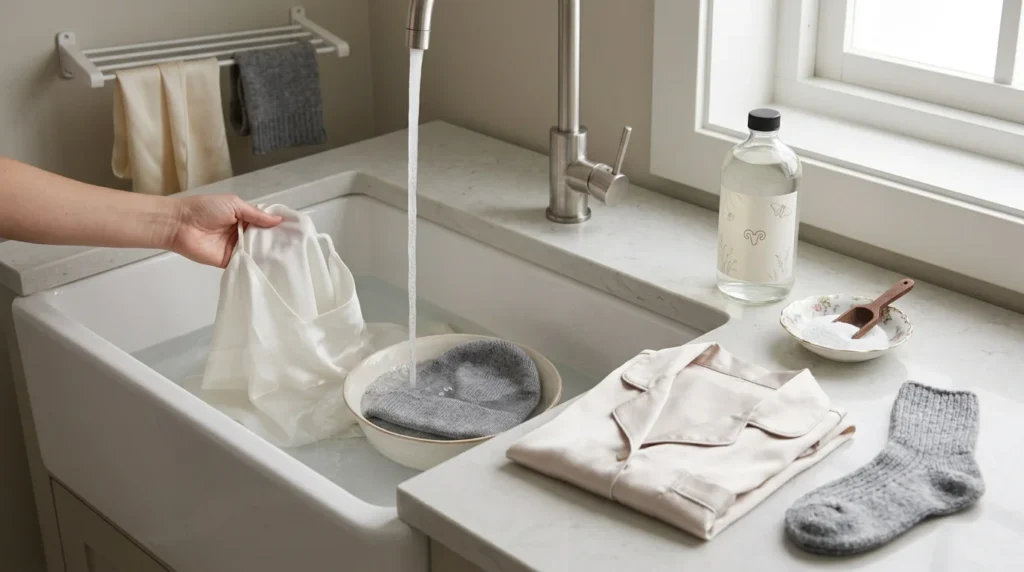
recommends mild, neutral detergent for wool and warns against bleach and enzyme-containing bio detergents. Heritage Park’s Silk & Wool formula is specifically marketed for both fibers and is described by the manufacturer as pH-neutral and enzyme-free.
When looking for detergent for wool and silk, check for:
- Wool and silk compatibility.
- Mild formulation.
- Neutral or suitable pH information.
- Enzyme-free formulation where appropriate.
- No bleach.
- Clear washing directions.
- Hand-wash compatibility if needed.
- Machine-wash compatibility if needed.
- Temperature guidance.
- Transparent ingredient information.
- Reliable manufacturer instructions.
Best Detergent for Wool Blankets
Large wool blankets can be surprisingly durable, but their size and weight make washing more complicated. notes that wool blankets generally do not need frequent washing and are naturally stain and odor resistant.
Before washing a wool blanket, check whether the label permits machine washing. A blanket that is too large for the washer may require professional cleaning even when the fiber itself is washable.
- Read the blanket’s care label.
- Check whether machine washing is permitted.
- Check the recommended temperature.
- Choose a wool-safe detergent.
- Avoid bleach.
- Avoid heavy-duty detergent.
- Do not overload the washer.
- Use a wool or delicate cycle where appropriate.
- Rinse thoroughly according to instructions.
- Remove the blanket promptly.
- Avoid aggressive wringing.
- Reshape it carefully.
- Follow the manufacturer’s drying instructions.
- Keep wet wool from being dragged or stretched.
- Make sure the blanket is completely dry before storage.
Wool Detergent for Rugs
A wool safe detergent for rugs should not be selected in the same way as laundry detergent for a sweater. Wool rugs can have different dyes, backing materials, adhesives, and construction methods.
Before cleaning a wool rug, follow the rug manufacturer’s instructions. If the label calls for professional cleaning, using a household wool detergent may not be an adequate substitute.
- Identify the rug fiber.
- Check the manufacturer’s cleaning instructions.
- Vacuum using a suitable setting.
- Test for colorfastness when instructed.
- Avoid soaking the rug unnecessarily.
- Do not use household bleach.
- Do not assume laundry detergent is appropriate.
- Use a rug-specific product when recommended.
- Protect the backing.
- Avoid excessive friction.
- Prevent prolonged moisture exposure.
- Improve ventilation during drying.
- Watch for dye transfer.
- Stop if the rug’s construction begins to change.
- Use professional cleaning when the manufacturer’s instructions require it.
Can You Use Regular Detergent on Wool?
It is better not to assume that a regular laundry detergent is appropriate for wool. specifically recommends mild, neutral detergent and advises avoiding heavy-duty detergents, enzyme-containing bio detergents, and bleach.
If you accidentally used regular detergent once, do not automatically assume the garment is ruined. Check the item for changes in texture, shape, color, or surface appearance after washing and follow the garment manufacturer’s future-care instructions.
For valuable, vintage, handmade, or particularly delicate wool items, a product specifically intended for wool is a more conservative choice.
Wool Detergent vs Normal Detergent: Quick Comparison
| Feature | Wool detergent | Standard laundry detergent |
| Intended use | Wool and delicate fibers | Everyday laundry |
| Cleaning approach | Generally gentler | Often designed for broader soil loads |
| Enzymes | Often absent in wool-specific formulas | Common in some formulations |
| Bleach | Not appropriate for wool | May be present in some products |
| Wool compatibility | Specifically formulated or labeled | Must be checked |
| Cashmere | Some formulas support it | Not automatically suitable |
| Merino | Many specialized formulas | Check label carefully |
| Hand washing | Many are designed for it | Product dependent |
| Machine washing | Many are compatible | Product dependent |
| Best choice for fine wool | Usually a wool-specific formula | Only if explicitly suitable |
Can You Make DIY Wool Detergent?
People sometimes search for a DIY wool detergent because they want a simple homemade alternative. However, homemade laundry mixtures can be difficult to formulate consistently, especially when caring for expensive natural fibers.
A commercial wool detergent has a defined formulation and usage instructions. If you choose a homemade approach, avoid assuming that common household ingredients are automatically suitable for wool. In particular, do not use bleach or aggressive cleaning chemistry on wool.
For valuable wool garments, a purpose-made mild detergent is generally the more predictable choice.
Common Wool Detergent Mistakes
Choosing the right product is only half of wool care. Incorrect dosing, temperature, agitation, or drying can still damage an otherwise washable wool garment.
- Choosing detergent based only on the word gentle.
- Ignoring the care label.
- Using heavy-duty detergent.
- Using an enzyme-containing detergent when the wool guidance advises against it.
- Using chlorine bleach.
- Using oxygen bleach.
- Overdosing detergent.
- Using excessively hot water.
- Selecting a harsh wash cycle.
- Overloading the machine.
- Leaving wet wool in the washer.
- Wringing a wool sweater.
- Hanging heavy wet knitwear.
- Drying wool in excessive heat.
- Storing wool before it is completely dry.
How to Get the Best Results From Wool Detergent
The detergent itself cannot compensate for unsuitable washing conditions. The best results come from combining an appropriate product with the correct cycle, water temperature, handling, and drying method.

- Check the care label before every new wool item is washed.
- Choose a detergent specifically suitable for wool.
- Use the manufacturer’s recommended amount.
- Avoid unnecessary washing.
- Air wool garments when appropriate between washes.
- Treat stains promptly using a wool-compatible method.
- Turn wool garments inside out before washing.
- Use a laundry bag for particularly delicate garments when appropriate.
- Keep similar colors together.
- Use a wool or delicate cycle when machine washing is allowed.
- Use lukewarm water for appropriate hand-wash items.
- Avoid vigorous agitation.
- Rinse thoroughly when the detergent instructions require rinsing.
- Reshape knitwear after washing.
- Dry according to the garment’s care label.
emphasizes that wool is naturally stain-, odor-, and crease-resistant, meaning many wool garments do not need to be washed as frequently as everyday clothing.
Wool Detergent Buying Checklist
If you are standing in a store or comparing products online, this checklist can make choosing a best wool laundry detergent much easier.
- Is it specifically labeled for wool?
- Does the manufacturer mention Merino?
- Is it suitable for cashmere if you need that?
- Is it suitable for silk if you need a combined detergent?
- Is it mild or neutral?
- Is it enzyme-free?
- Does it contain bleach?
- Is it suitable for your washing machine?
- Can it be used for hand washing?
- Does it provide clear dosing instructions?
- Does it specify water-temperature compatibility?
- Does it offer a fragrance-free option?
- Does it provide ingredient information?
- Does it have credible certification where relevant?
- Does the product’s guidance agree with your garment’s care label?
Final Thoughts
Choosing the right wool detergent is mainly about protecting the fiber while still getting the cleaning performance you need. A mild, neutral wool wash is the safest general direction supported by , while specialized products such as Eucalan, Wool Wash, Heritage Park Silk & Wool Detergent, The Laundress Wool & Cashmere Shampoo, and Delicates offer different approaches for wool and delicate-fabric care.
The most important rule is to match the detergent to the garment rather than choosing a product solely because it claims to be gentle. Check whether the item is machine washable or hand wash only, avoid bleach and unsuitable heavy-duty or enzyme-containing detergents, use the recommended amount, and dry the wool according to its care instructions. With the right wool wash detergent, careful washing can help wool sweaters, Merino clothing, cashmere, blankets, and other wool items stay comfortable and in good condition for longer.
1. What is the best detergent for wool?
2. Can I use regular laundry detergent on wool?
It is better to use a detergent specifically suitable for wool. Regular detergents can have formulations that are not appropriate for delicate wool fibers, so check the ingredients, product instructions, and garment care label before using one.
3. Is safe for wool?
Delicates is marketed by its manufacturer as a gentle detergent suitable for delicate fabrics including wool, silk, and cashmere. The manufacturer also states that it contains no bleach, phosphates, or enzymes.Always follow the specific garment’s care instructions.
4. What detergent is best for Merino wool?
Choose a mild wool-specific detergent that is compatible with the Merino garment’s care label. Wool Wash is specifically formulated for Merino wool clothing, while recommends mild, neutral wool detergent for wool garments generally.
5. Can I wash wool in a washing machine?
Yes, many wool garments can be machine washed when their care label permits it. recommends using the wool cycle, or a cold/delicate cycle when a wool cycle is unavailable, together with a mild wool detergentNever assume that every wool item is machine washable; always check its care claim first.