
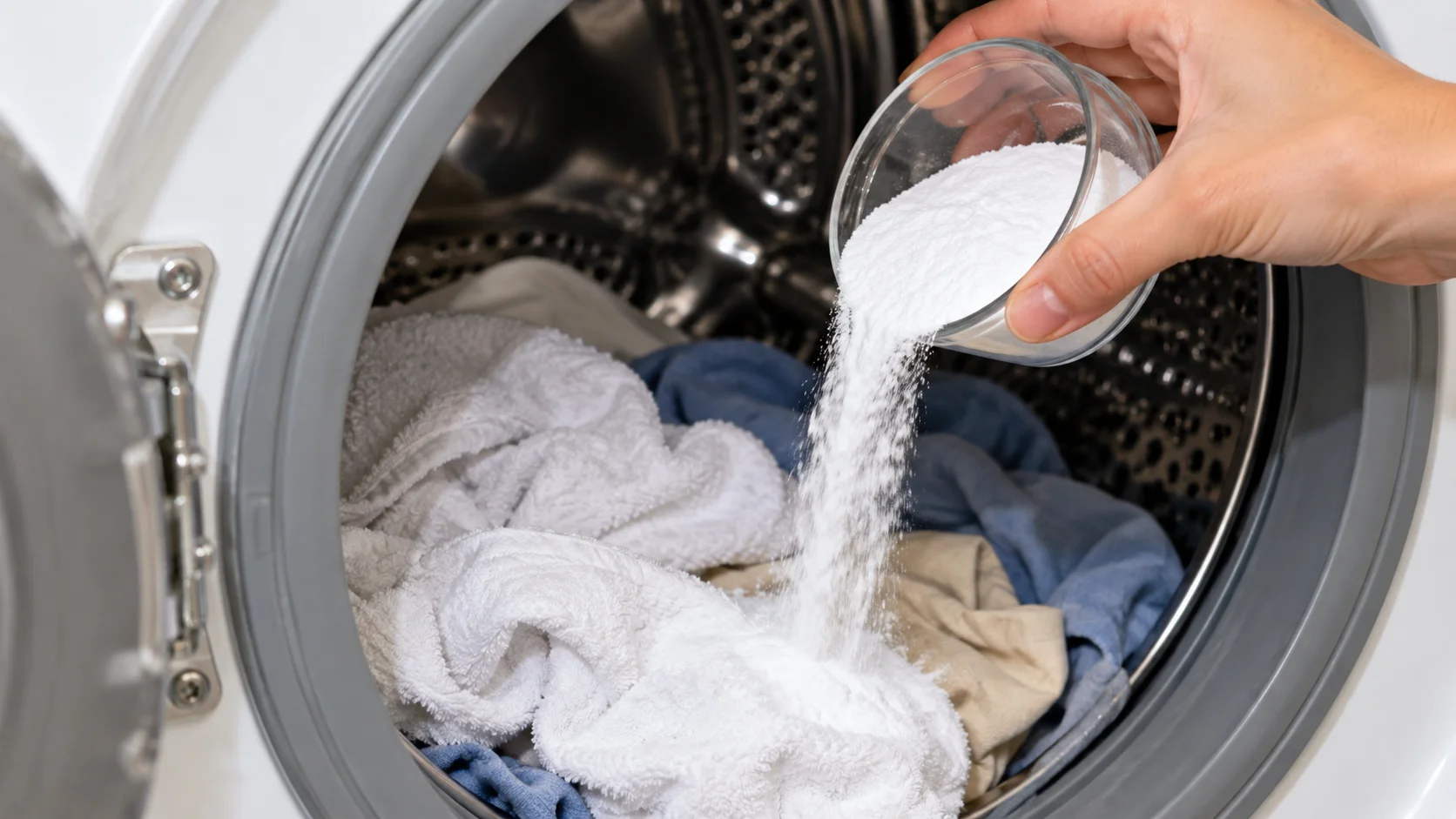
Using baking soda in laundry is a simple way to give a regular wash an extra boost, particularly when clothes have stubborn odors or need a little freshening. Baking soda, also called sodium bicarbonate, is a mild alkaline compound that can help neutralize odors and support cleaning when used alongside regular laundry detergent. Whirlpool and ARM & HAMMER both describe baking soda as a useful laundry aid for freshening clothes, addressing odors, and supporting cleaning performance.
The important distinction is that baking soda for laundry is a laundry booster, not a complete replacement for properly formulated laundry detergent. It can be useful for odors, some stains, and freshening fabrics, but detergent is designed with surfactants and other ingredients specifically formulated to remove a broad range of soils. The amount you use, where you put it, and whether you combine it with other products also matter, especially when dealing with delicate fabrics or a modern washing machine.
What Does Baking Soda Do for Laundry?
Baking soda can serve several purposes in a laundry routine. Its mild alkalinity can help with odors, while adding it to a wash with detergent may support the overall cleaning process. ARM & HAMMER explains that sodium bicarbonate can help neutralize odors by balancing pH levels and can soften wash water, allowing detergent to perform more effectively.
When adding baking soda to laundry, the main benefits include:
- Helping neutralize unpleasant odors.
- Freshening sweaty clothing.
- Supporting the cleaning action of laundry detergent.
- Helping brighten some white and light-colored fabrics.
- Helping address some odor-causing residues.
- Providing a mild laundry boost.
- Helping with certain spot treatments when made into a paste.
- Supporting laundry in homes with hard water.
- Helping freshen towels and linens.
- Deodorizing some washing-machine odors.
- Providing an alternative to heavily fragranced laundry additives.
- Helping loosen some surface soils.
- Supporting stain pretreatment for selected stains.
- Helping reduce some unpleasant smells before drying.
- Giving an ordinary wash an additional cleaning aid.
However, baking soda should not be treated as a universal stain remover. Different stains respond to different treatments, and fabric-care instructions should always take priority.
Is Baking Soda Good for Laundry?
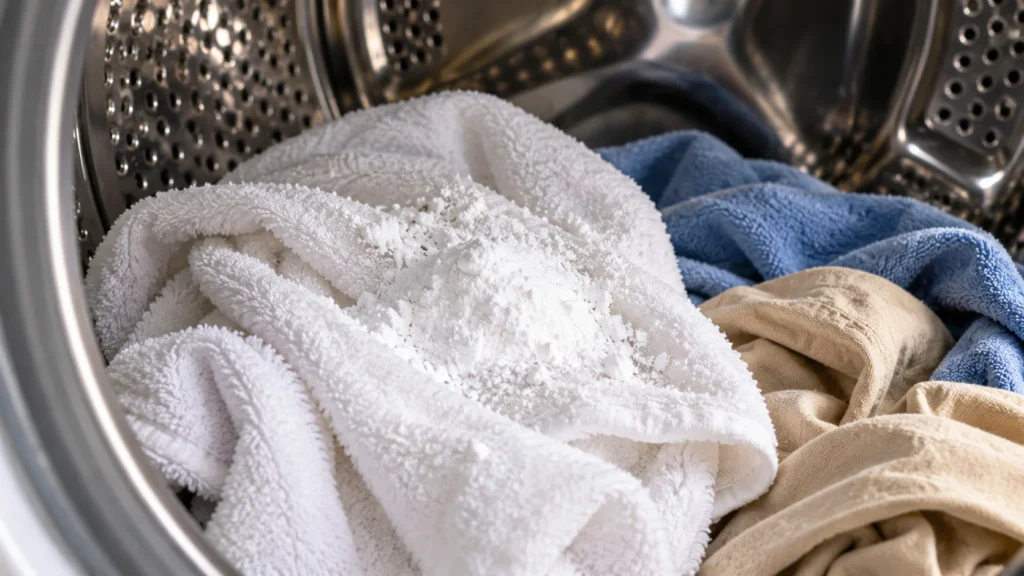
Yes, baking soda is generally useful for laundry when used appropriately, particularly as an odor-neutralizing and cleaning booster. Whirlpool describes baking soda as generally safe for most washing machines and fabrics but recommends checking the washer owner’s manual and clothing-care labels before using it.
It can be especially helpful when:
- Clothes smell sweaty after exercise.
- Towels have developed a stale odor.
- Linens need refreshing.
- Clothing has absorbed smoke or other persistent smells.
- A regular detergent wash needs additional deodorizing support.
- You want to pretreat a suitable stain.
- You need to freshen the washing machine itself.
Baking soda is also already used in some commercial laundry detergents. ARM & HAMMER identifies sodium bicarbonate as an ingredient that helps neutralize odors and supports cleaning.
That said, more baking soda does not automatically mean cleaner laundry. Using a reasonable amount is preferable to repeatedly adding excessive quantities.
How Much Baking Soda for Laundry?
For a typical household load, about ½ cup of baking soda is a commonly recommended amount from major appliance and laundry-product sources. ARM & HAMMER’s laundry-booster directions call for ½ cup added with regular liquid laundry detergent.
Maytag likewise recommends adding up to ½ cup of baking soda directly to the washer tub while putting the normal detergent in its designated dispenser.
A simple amount guide
| Laundry situation | Baking soda amount |
| Regular load | About ½ cup |
| Odor-heavy load | About ½ cup |
| Towels and linens | About ½ cup |
| Pretreating a stain | Equal parts baking soda and water |
| Small load | Consider using less |
| Delicate fabric | Check care label first |
The exact amount should not override the instructions for your washing machine or garment. If the washer manufacturer gives different guidance, follow the owner’s manual.
How to Use Baking Soda in Laundry
The easiest method for how to use baking soda in laundry is to add the baking soda directly to the washer tub along with your normal laundry load and detergent. ARM & HAMMER recommends adding ½ cup of baking soda to the washer with regular liquid laundry detergent and then washing as usual.
Follow these steps:
- Sort your laundry according to color and fabric-care requirements.
- Check the garment care labels.
- Place the clothes into the washer.
- Add your normal laundry detergent according to its label.
- Add about ½ cup of baking soda directly into the washer tub.
- Select the appropriate wash cycle.
- Use the recommended water temperature for the fabrics.
- Start the washing machine.
- Allow the complete wash cycle to run.
- Dry the clothing according to its care instructions.
For best results, don’t use baking soda as an excuse to reduce the amount of detergent below the detergent manufacturer’s recommended dose unless the product instructions specifically allow it.
Jump into Other Related Article
- Laundry Dryer Vent Installation
- Does Rayon Shrink?
- How to Remove Coffee Stains
- How to Clean Suede Shoes
- Best Stain Remover for Clothes
- How to Clean Stainless Steel
- How to Clean Carpet Stains
- Oxygen Bleach
- Homemade Laundry Detergent
- How to Wash a Hat
Where Do You Put Baking Soda in the Washing Machine?
When putting baking soda in laundry, the safest general approach described by Whirlpool and Maytag is to add it directly to the washer tub rather than the detergent dispenser. Whirlpool specifically warns that adding baking soda to the dispenser may clog it.
A simple setup is:
- Baking soda: directly into the washer tub.
- Laundry detergent: in the detergent compartment or as directed by the detergent manufacturer.
- Fabric softener: only if appropriate for the fabric and washer and used according to its instructions.
This distinction is particularly important for high-efficiency machines and washers with specialized dispensers.
Before using baking soda in a newer washer, check the owner’s manual because manufacturers can have model-specific instructions about additives.
Can You Add Baking Soda to Laundry Detergent?
Yes, you can generally use baking soda with laundry detergent. In fact, ARM & HAMMER specifically recommends using its baking soda alongside regular liquid laundry detergent as a laundry booster.
The important point is that baking soda and detergent have different roles.
Laundry detergent is formulated to clean through a combination of ingredients such as surfactants and other cleaning agents. Baking soda can complement that process by helping with odors and wash-water conditions.
For a normal load:
- Add detergent according to the detergent label.
- Add approximately ½ cup of baking soda to the tub.
- Select the correct cycle.
- Avoid adding baking soda to a dispenser unless your washer’s manual specifically says it is acceptable.
Maytag similarly recommends keeping detergent in the appropriate dispenser and putting baking soda directly into the washer tub.
Can Baking Soda Be Used as Laundry Detergent?
Baking soda alone should not be considered a full substitute for laundry detergent.
Although baking soda as laundry detergent is a popular search term, sodium bicarbonate does not perform the same complete cleaning function as a formulated laundry detergent. Baking soda can help deodorize and support cleaning, but it does not provide the complete combination of cleaning ingredients found in a dedicated detergent.
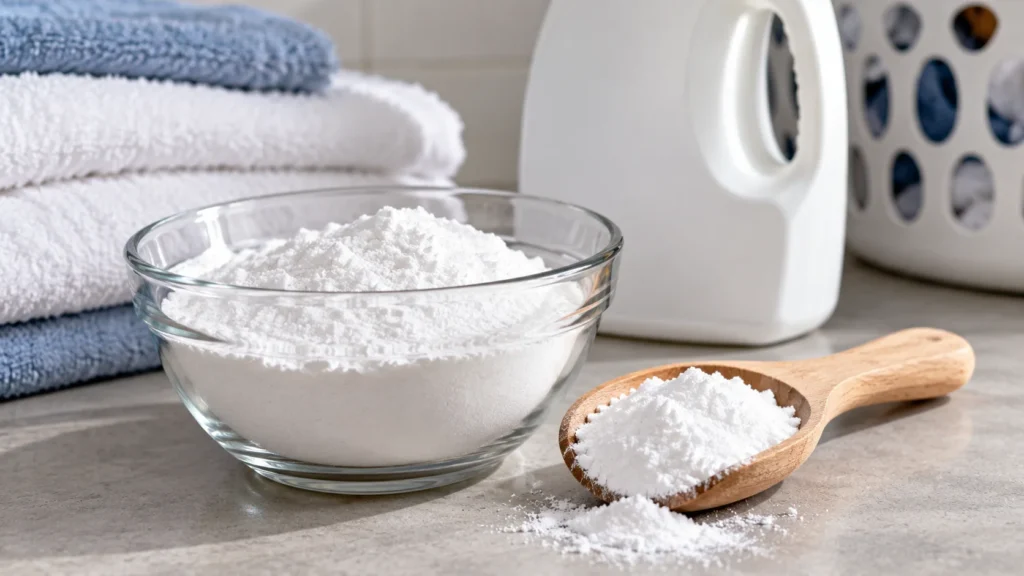
This is why the better approach for routine laundry is:
Laundry detergent + baking soda booster
rather than:
Baking soda instead of detergent
If clothes are heavily soiled, oily, greasy, or stained, relying solely on baking soda may not provide the same cleaning performance as an appropriate detergent.
When baking soda alone may be useful
Baking soda can still be useful on its own for certain limited tasks, such as:
- Freshening an item.
- Pretreating a suitable stain.
- Absorbing or neutralizing certain odors.
- Deodorizing some washable items.
- Freshening an empty washer when the manufacturer permits it.
For normal clothing loads, however, use a properly formulated laundry detergent according to its instructions.
Baking Soda in Laundry for Odor
One of the strongest uses for baking soda in laundry for odor is helping neutralize unpleasant smells rather than simply covering them with fragrance. ARM & HAMMER explains that sodium bicarbonate helps neutralize odors by balancing pH levels.
It can be useful for:
- Sweat odors.
- Workout clothing.
- Pet odors.
- Musty towels.
- Stale bedding.
- Smoke-related odors.
- Clothing that has been sitting in a hamper.
- General freshness.
For an odor-heavy load, add about ½ cup of baking soda to the washer tub along with your regular detergent. Maytag gives the same general recommendation for odor removal.
For particularly stubborn odors, pretreating the affected area may be more useful than simply increasing the amount of baking soda.
How to Use Baking Soda for Stains
Baking soda can also be used as a simple pretreatment for some stains. Whirlpool and Maytag describe making a paste from equal parts baking soda and water and applying it to suitable stained areas before washing.
Baking soda stain-treatment method
- Mix equal parts baking soda and water.
- Stir until a thick paste forms.
- Apply a small amount to the affected area.
- Gently work it into the stain without aggressively damaging the fabric.
- Allow it to sit for around 30 minutes when appropriate.
- Rinse or wash according to the garment-care instructions.
- Inspect the stain before putting the garment in the dryer.
- Repeat or use a stain-specific treatment if necessary.
Whirlpool recommends testing a baking soda treatment on a hidden section first, particularly when working with delicate fabrics.
Never assume baking soda can remove every stain. Protein, oil, dye, rust, ink, and other stains may require different treatments.
Baking Soda for White Clothes
Baking soda for laundry can be useful when you want to freshen or brighten white and light-colored clothing. Whirlpool says baking soda can be added to the wash to help brighten whites and light-colored fabrics.
It is important, however, to distinguish brightening from bleaching.
Baking soda is not chlorine bleach. It does not provide the same whitening or disinfecting chemistry as chlorine bleach or specialized oxygen-based products.
For white clothing:
- Check the care label.
- Use normal laundry detergent.
- Add baking soda when appropriate.
- Choose the correct water temperature.
- Avoid assuming baking soda can remove every yellow or gray stain.
- Use a purpose-designed stain or whitening product when the fabric and care instructions allow it.
Maytag also describes baking soda as a way to help brighten white and light-colored clothing.
Baking Soda for Towels and Linens
Towels, sheets, pillowcases, and other linens can benefit from odor-focused laundry routines because they can hold moisture and body oils between washes.
Using baking soda in laundry can help freshen these items, particularly when they have developed stale or musty odors. Whirlpool recommends about ½ cup of baking soda with detergent for odors on clothing, towels, and linens.
For towels:
- Do not overload the washer.
- Use the detergent recommended for the load.
- Add about ½ cup of baking soda if appropriate.
- Choose a cycle suitable for the towel fabric.
- Make sure towels dry completely.
- Do not leave damp towels sitting in the washer.
- Clean the washer regularly if recurring odors develop.
If towels continue smelling musty after washing, the underlying problem may be the washer, insufficient drying, detergent buildup, or prolonged dampness rather than a lack of baking soda.
Baking Soda and Vinegar in Laundry
The combination vinegar and baking soda in laundry is one of the most common laundry-hack questions, but using both together in the same wash is generally not the best strategy.
Baking soda is alkaline while vinegar is acidic. When they are combined, they react with each other and reduce the distinct pH-related effects that each product has separately. Whirlpool and Maytag both caution that combining them can cancel their individual cleaning advantages.
There is another concern: Whirlpool warns that vinegar can damage rubber seals and hoses in some washing machines and recommends checking the owner’s manual before using vinegar in a washer.
So instead of dumping baking soda and vinegar in laundry at the same time:
- Use baking soda with detergent when appropriate.
- Use vinegar only for a specific pretreatment if the fabric allows it.
- Rinse vinegar-treated garments thoroughly before machine washing.
- Check the washer manufacturer’s instructions.
- Never assume a viral laundry hack is safe for every appliance.
Can You Mix Baking Soda and Laundry Detergent?
Yes. Baking soda and laundry detergent can generally be used together, and this is one of the most practical ways to use baking soda in a normal wash. ARM & HAMMER specifically instructs users to add ½ cup of baking soda with regular liquid laundry detergent.
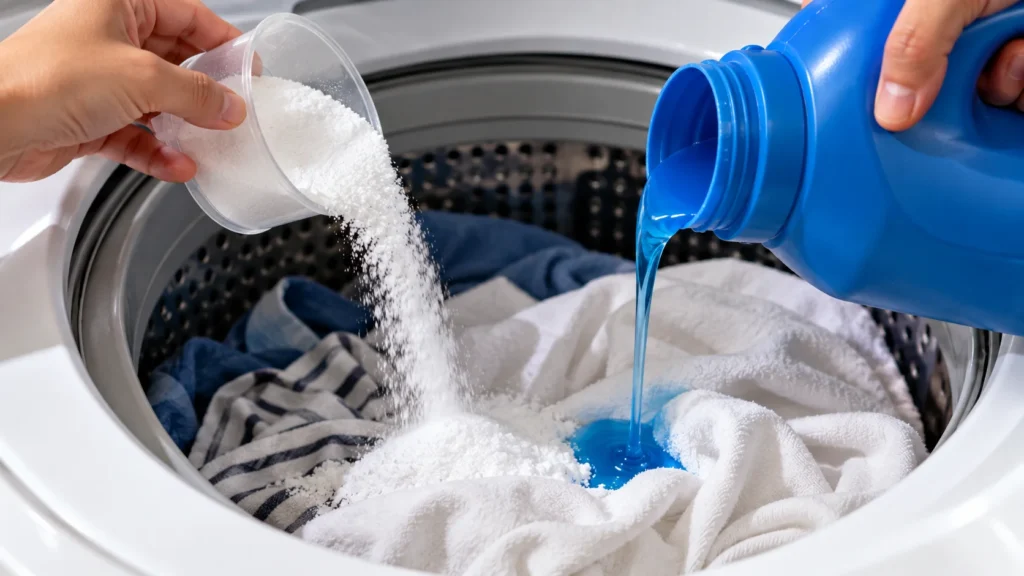
For best results:
- Use the detergent according to its label.
- Put detergent where the washer manufacturer instructs.
- Put baking soda directly into the washer tub if the manufacturer permits it.
- Don’t increase detergent simply because baking soda is being used.
- Don’t add baking soda to a dispenser that may clog.
- Follow the garment-care label.
The combination is best understood as detergent plus booster, rather than two interchangeable detergents.
Can You Mix Baking Soda and Bleach in Laundry?
This question requires more caution because bleach is a reactive chemical product and manufacturers and public-health authorities emphasize not mixing household bleach with other cleaners.
ARM & HAMMER publishes a laundry tip describing baking soda being used with bleach, but the CDC’s broader safety guidance says never mix household bleach or disinfectants with other cleaners or disinfectants because dangerous vapors can result from incompatible combinations.
Because product formulations and concentrations vary, the safest general rule for home laundry is:
Do not improvise mixtures of bleach and baking soda. Follow the bleach label and washing-machine instructions exactly.
If bleach is being used, do not add vinegar, ammonia, acidic cleaners, or other household cleaning products. CDC specifically warns that mixing household bleach with other cleaners can release dangerous vapors.
Baking Soda vs. Washing Soda for Laundry
Baking soda and washing soda are not the same product.
Baking soda is sodium bicarbonate, while washing soda is sodium carbonate. ARM & HAMMER explicitly distinguishes sodium bicarbonate from sodium carbonate and explains that washing soda has a higher alkalinity and is used as a stronger laundry booster.
| Feature | Baking Soda | Washing Soda |
| Chemical name | Sodium bicarbonate | Sodium carbonate |
| Common use | Deodorizing and laundry boosting | Stronger laundry boosting |
| Relative alkalinity | Milder | Higher |
| Odor support | Yes | Yes |
| Water-softening role | Can help | Stronger water-softening action |
| Suitable for every fabric | No; check care label | No; check instructions |
| Best role | Freshening and boosting | Heavy-duty laundry booster |
Because washing soda is more alkaline, it should not simply be substituted for baking soda in equal amounts without checking the product instructions.
Borax vs. Baking Soda for Laundry
Borax and baking soda are also different laundry additives. They should not be treated as interchangeable products.
Baking soda is sodium bicarbonate, while borax is a different chemical compound. If you are comparing borax vs baking soda for laundry, consider what the product is designed to do rather than assuming the stronger-sounding option is automatically better.
Baking soda is particularly useful for:
- Odor neutralization.
- Freshening.
- Mild laundry boosting.
- Supporting detergent.
- Simple stain pretreatment.
For either product, read the package directions and check the garment and washer instructions before use.
Can You Put Baking Soda in an HE Washing Machine?
In general, baking soda can be used in many high-efficiency washing machines, but the washer’s owner’s manual should be the final authority.
Whirlpool states that baking soda is generally safe to use in most washing machines, while Maytag similarly recommends checking the owner’s manual before adding it.
For an HE washer:
- Use HE detergent as required.
- Don’t exceed the detergent manufacturer’s recommended amount.
- Add baking soda directly to the tub when permitted.
- Avoid putting baking soda in a dispenser if the manufacturer warns against it.
- Don’t overload the drum.
- Follow the washer’s cleaning and maintenance instructions.
Baking soda should not be used to deliberately create more suds. HE machines are designed around lower water usage and appropriate low-sudsing detergents.
Can Baking Soda Clean a Washing Machine?
Baking soda can help deodorize a washing machine, but it should not replace the washer-cleaning procedure specified by the manufacturer.
Whirlpool says baking soda is generally safe for cleaning a washing machine and that its deodorizing properties can help freshen the appliance, while also emphasizing that owners should consult the washer manual.
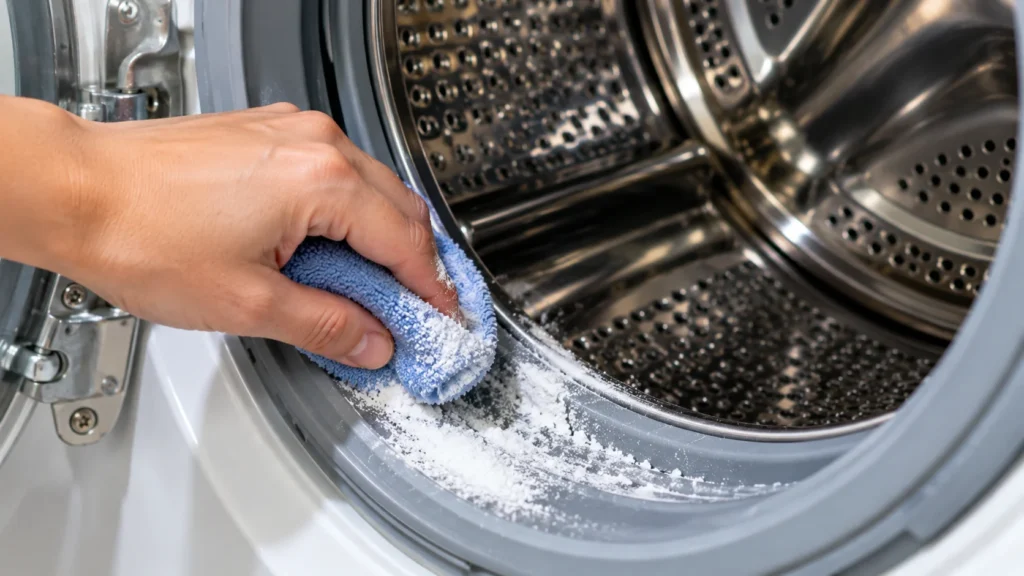
If your washer smells bad, don’t rely on baking soda alone. Also consider:
- Cleaning the detergent dispenser.
- Cleaning the door gasket on front-load washers.
- Running the manufacturer’s recommended cleaning cycle.
- Removing wet laundry promptly.
- Leaving the door or lid open when appropriate.
- Using the correct amount of detergent.
- Following the machine’s maintenance schedule.
Whirlpool specifically recommends cleaning the tub and dispenser drawer and keeping the front-load door gasket clean to help prevent mildew odors.
Baking Soda for Laundry: Common Mistakes to Avoid
Baking soda is simple to use, but several common laundry hacks can make the process less effective or potentially damage clothing or equipment.
Avoid these mistakes:
- Replacing detergent completely with baking soda.
- Adding excessive amounts to every load.
- Putting baking soda into a dispenser that can clog.
- Ignoring garment-care labels.
- Using it automatically on delicate fabrics.
- Mixing it with vinegar and expecting stronger cleaning.
- Improvising chemical mixtures with chlorine bleach.
- Assuming every washer accepts every laundry additive.
- Using baking soda as a universal stain remover.
- Putting stained clothes into the dryer before checking the stain.
- Ignoring recurring odors in the washer itself.
- Overloading the washing machine.
- Assuming natural means appropriate for every fabric.
- Using washing soda and baking soda interchangeably.
- Following viral cleaning recipes instead of product instructions.
Whirlpool specifically recommends caution with delicate fabrics such as wool, cashmere, and silk and advises checking both garment labels and the washer manual.
Baking Soda in Laundry: Best Uses at a Glance
| Laundry problem | Is baking soda useful? | Best approach |
| Sweat odor | Yes | Add about ½ cup with detergent |
| Pet odor | Yes | Add with detergent or pretreat |
| Musty towels | Yes | Add with normal wash |
| General freshness | Yes | Use as a laundry booster |
| Light stains | Sometimes | Try a baking soda-water paste |
| White clothes | Can help brighten | Use with detergent and care label |
| Heavy grease | Limited | Use an appropriate stain treatment |
| Ink stains | Not always | Use a stain-specific method |
| Delicate silk | Use caution | Follow care label |
| Wool | Use caution | Follow care label |
| Washer odor | Can help | Use only if manufacturer permits |
| Replacing detergent | No | Use proper laundry detergent |
| Vinegar + baking soda | Usually unnecessary | Use separately when appropriate |
| Washing soda substitute | No | They are chemically different |
| Borax substitute | No | They are different products |
Final Verdict: Should You Add Baking Soda to Laundry?
Yes, baking soda can be a useful laundry booster, particularly when your main goal is to freshen clothes, neutralize odors, support detergent performance, or pretreat certain stains. A common starting point is about ½ cup directly in the washer tub with your normal detergent, provided your washing-machine and garment-care instructions allow it.
The key is to use baking soda for what it actually does well rather than treating it as a miracle laundry chemical. It is not a replacement for properly formulated detergent, it should not automatically be mixed with vinegar or bleach, and it is not suitable for every fabric or every machine without checking instructions.
Conclusion
Baking soda in laundry is most useful as a simple booster for deodorizing, freshening, and supporting the cleaning process. About ½ cup is a commonly recommended amount for a regular load, and major laundry and appliance manufacturers recommend putting it directly into the washer tub rather than the detergent dispenser when their instructions permit its use.
For the best results, keep your normal laundry detergent as the primary cleaner, use baking soda according to your machine and garment instructions, and be especially careful with combinations such as baking soda and vinegar or baking soda and bleach. Checking the manufacturer’s instructions is more reliable than assuming every laundry hack works safely in every washer.
1. How much baking soda should I put in laundry?
For a typical load, about ½ cup of baking soda is a commonly recommended amount. Add it directly to the washer tub when permitted, and use your regular laundry detergent according to its label.
2. Can I use baking soda instead of laundry detergent?
Baking soda can help freshen and deodorize laundry, but it is not a complete replacement for laundry detergent. Detergent is specifically formulated to remove a broad range of soils using multiple cleaning ingredients.
3. Can you mix baking soda and vinegar in laundry?
Although they can be used separately for certain laundry tasks, mixing baking soda and vinegar causes an acid-base reaction that reduces the distinct effects of each. Whirlpool and Maytag also caution that vinegar can be unsuitable for some washing-machine components.
4. Can I add baking soda directly to the washing machine?
Yes, many manufacturers recommend adding baking soda directly to the washer tub rather than the detergent dispenser. Whirlpool and Maytag both provide this guidance, while also recommending that you check the owner’s manual for your specific machine.
5. Does baking soda remove odors from clothes?
Yes. Baking soda can help neutralize unpleasant laundry odors, including sweat and some pet or musty smells. Adding about ½ cup to a regular wash with detergent is a commonly recommended method.