
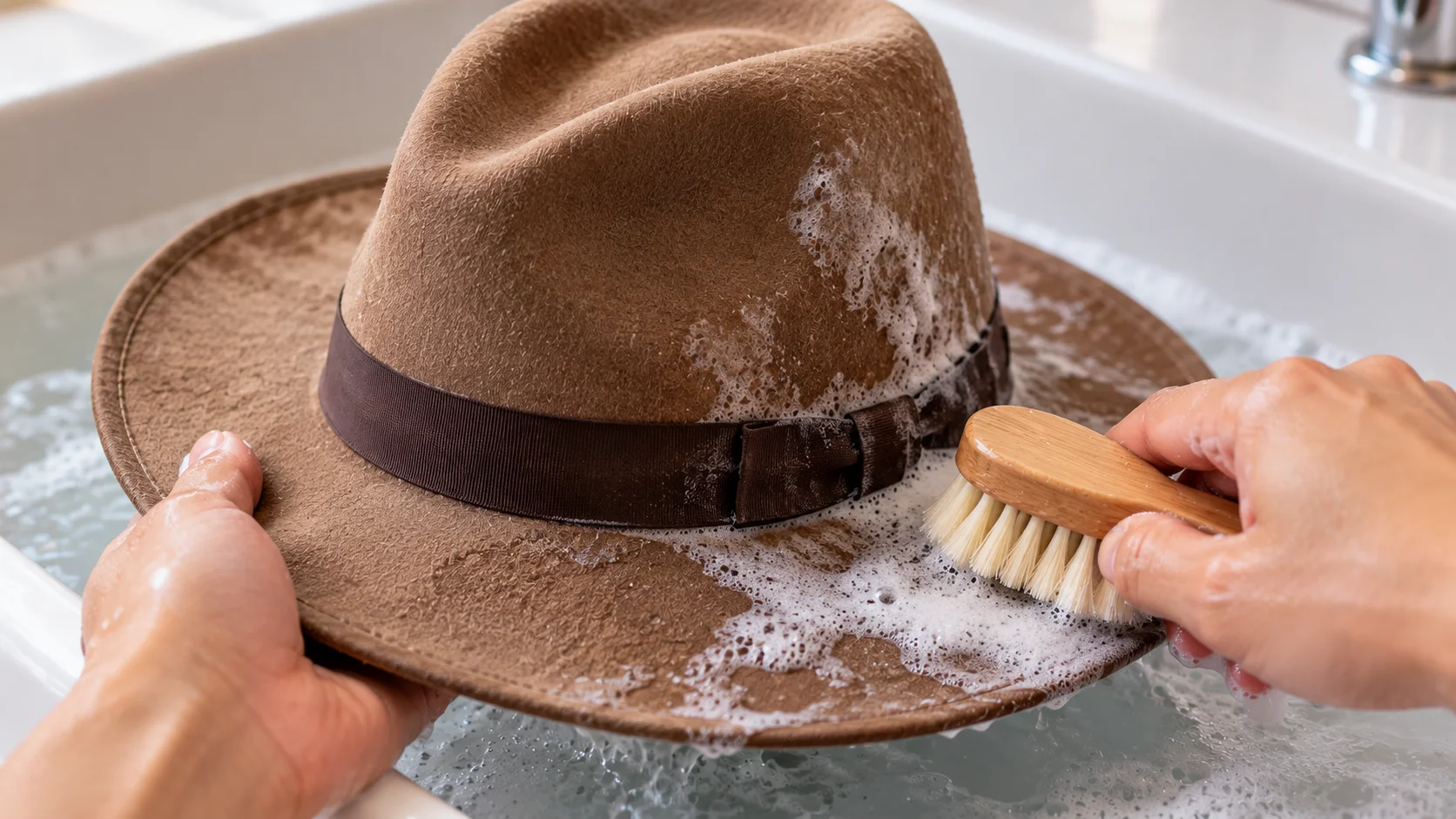
Knowing how to wash a hat correctly can help remove sweat, dirt, body oils, stains, and odors without ruining the crown or brim. Unlike ordinary clothing, hats can contain structured panels, stiffeners, decorative details, sweatbands, and shaped brims that may lose their form when exposed to excessive water, heat, agitation, or harsh cleaners.
For most washable baseball caps, gentle hand washing is the safest general method because you can control the water temperature, pressure, and amount of scrubbing. Whirlpool specifically recommends hand washing as the preferred approach for many baseball caps because structured bills can be damaged or bent by machine agitation.
However, there is no single cleaning method for every hat. A modern cotton or polyester cap with a plastic bill may tolerate more moisture than a vintage cap with a cardboard bill. Wool, felt, straw, leather, suede, waxed cotton, and specialty hats require their own care procedures.
The first step should therefore always be checking the care label and material. For example, Tilley provides machine-washable instructions for some of its hats but specifically says to follow the label because some models are not washable. Melin likewise recommends gentle spot cleaning for most of its hats and identifies only specific models as machine washable.
This guide covers how to wash a hat by hand, how to wash a baseball hat, how to wash a hat in the washing machine, how to wash a hat in the dishwasher, how to wash a trucker hat, how to wash a fitted hat, how to remove sweat stains, and how to care for wool, straw, cotton, polyester, New Era, Tilley, Melin, bucket, visor, snapback, cowboy, and other hats.
The First Hat Inspection Before Washing
Before putting any hat into water, inspect its label, material, construction, color, and brim. This short inspection can prevent the most common forms of damage.
A hat with a cardboard bill should generally not be submerged because water can damage the internal structure. Clorox and Maytag both point out that older baseball caps may contain cardboard in the bill and should instead be spot cleaned.
Modern caps often use plastic or other washable structures, but that still does not guarantee that the entire hat is machine washable. Decorative embroidery, leather details, glued elements, special coatings, and non-colorfast dyes can change the appropriate cleaning method.
If the label says spot clean only, hand wash, dry clean, or do not wash, follow that instruction instead of applying a generic hat-washing method.
15 Things to Check Before Cleaning a Hat
- Care label Look for the manufacturer’s washing instructions.
- Fabric Identify cotton, polyester, wool, nylon, straw, felt, or another material.
- Brim material Determine whether the bill is plastic, cardboard, or another structure.
- Colorfastness Test an inconspicuous area if the care instructions permit wet cleaning.
- Embroidery Check whether logos or stitching require special treatment.
- Leather details Avoid soaking leather components unless specifically approved.
- Suede details Treat suede separately from washable fabric.
- Sweatband Inspect the inner band for stains and buildup.
- Liner Check whether the interior lining has special instructions.
- Shape Note the original crown and brim form before washing.
- Odor Determine whether cleaning or simple airing is sufficient.
- Stains Identify sweat, grease, dirt, food, sunscreen, or other marks.
- Age Vintage hats may require substantially gentler treatment.
- Construction Look for glued, stitched, molded, or laminated sections.
- Drying requirements Confirm whether air drying or another method is specified.
How to Wash a Hat by Hand
Hand washing a hat is generally the most controlled way to clean a washable cap. It minimizes mechanical agitation and lets you concentrate cleaning on the sweatband and stained areas.
Whirlpool recommends hand cleaning for baseball caps because it helps preserve the structure of the hat. Its method uses cool or warm water with a small amount of detergent, gentle treatment of dirty areas, thorough rinsing, reshaping, and air drying.
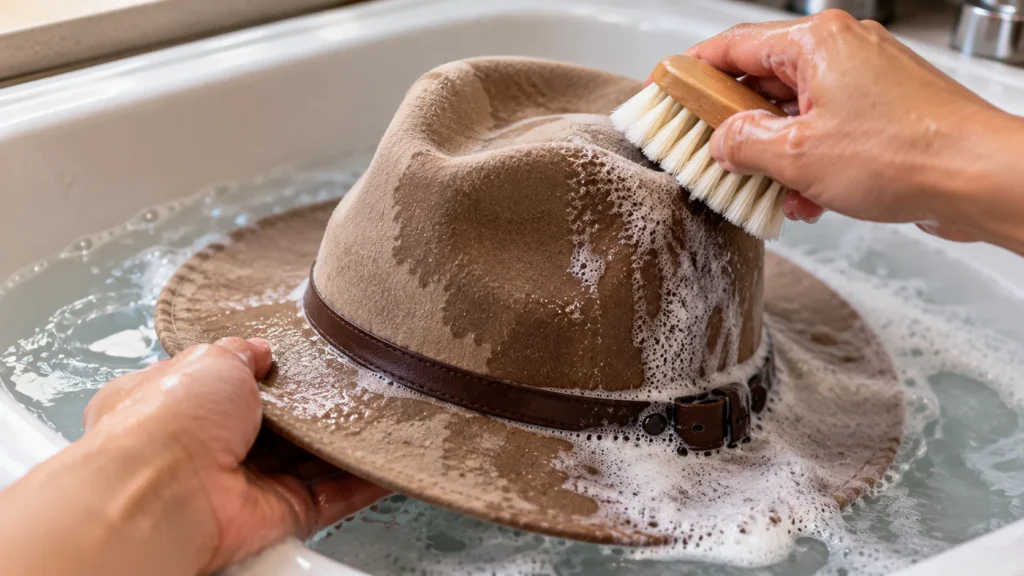
Maytag similarly identifies hand washing as the safest and most recommended approach when the care label does not provide other instructions.
The process is straightforward, but the amount of water and scrubbing should be controlled. A hat does not need aggressive brushing to become clean.
15-Step Hand-Washing Method
- Read the care label before wetting the hat.
- Remove loose dirt using a soft brush or lint roller.
- Fill a clean sink or basin with cool or lukewarm water.
- Add a small amount of mild detergent suitable for the material.
- Mix the water gently to distribute the detergent.
- Test a hidden area if colorfastness is uncertain.
- Wet the hat gradually instead of aggressively twisting it.
- Apply diluted detergent to visibly dirty areas.
- Clean the sweatband carefully because it often contains the most sweat and oil.
- Use a soft toothbrush for stubborn fabric stains.
- Avoid aggressive scrubbing around embroidery and printed graphics.
- Rinse thoroughly with clean, cool water.
- Press gently with a towel to remove excess moisture.
- Reshape the crown and brim while the hat is damp.
- Air dry completely away from excessive heat.
How to Wash a Baseball Hat Without Ruining It
A baseball hat requires special attention because its brim and crown are designed to maintain a particular shape. The safest approach for most washable caps is gentle hand cleaning.
Whirlpool recommends checking the material and avoiding dishwasher cleaning, while Maytag emphasizes checking whether the bill contains cardboard before choosing a washing method.
For an older cap, especially one with a cardboard bill, avoid complete immersion. Instead, clean the crown and sweatband with a damp cloth and mild cleaning solution while keeping the structured bill as dry as reasonably possible.
For a modern washable cap with a plastic bill, more extensive hand washing may be appropriate when the manufacturer’s instructions allow it.
The most important rule is to avoid heat during drying. A clean hat can still be ruined if excessive heat shrinks the fabric or distorts its structure.
How to Wash a Hat With Sweat Stains
Sweat stains are among the most common reasons people search for how to wash sweat out of a hat. Sweat contains salts, oils, and other substances that can gradually discolor the sweatband and surrounding fabric.
The American Cleaning Institute recommends pretreating perspiration stains and laundering at the hottest temperature safe for the fabric; for hats, however, the hat’s construction and care label take priority over general clothing guidance.
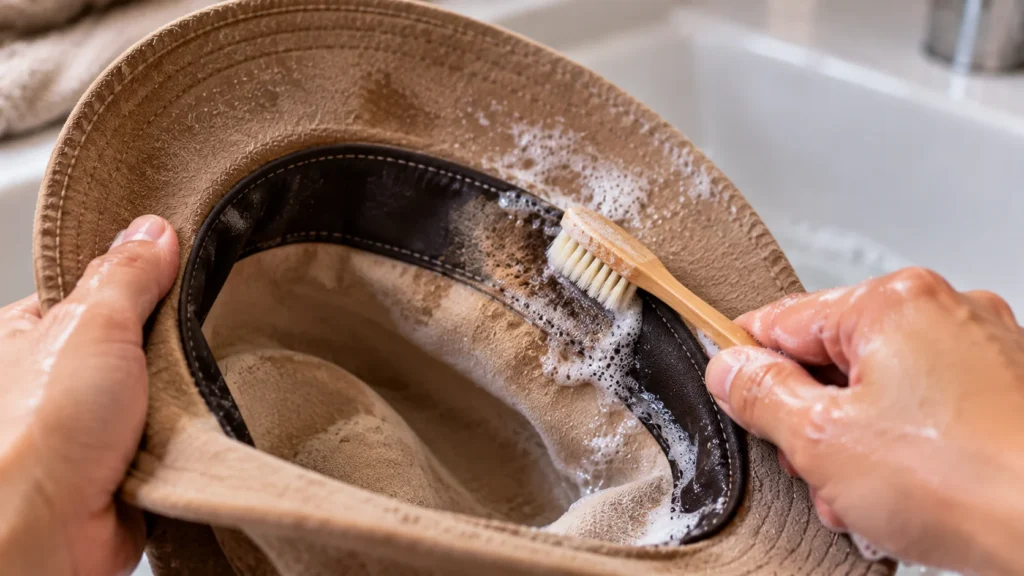
Tilley notes that there is no universally effective method for removing every sweat stain because perspiration chemistry differs from person to person. Its care guidance suggests gentle treatment with warm, not hot, water and a suitable dish detergent for certain washable hats.
For a washable fabric cap, focus cleaning on the sweatband first. Avoid pouring strong stain removers directly onto delicate materials without testing them.
15 Sweat-Stain Cleaning Practices
- Treat stains before they become heavily embedded.
- Check the hat’s care label first.
- Use cool or lukewarm water when recommended.
- Apply mild detergent to the sweatband.
- Work with a soft toothbrush.
- Use short, gentle strokes.
- Avoid hard pressure on stitching.
- Rinse detergent completely.
- Repeat gentle treatment when necessary.
- Avoid chlorine bleach unless explicitly permitted.
- Test stain products on hidden areas.
- Do not use excessive heat to speed drying.
- Reshape the crown while damp.
- Allow complete air drying.
- Clean hats regularly instead of waiting for heavy buildup.
How to Wash a Hat in the Washing Machine
Washing a hat in the washing machine is possible for some washable hats, but it should not be the default method for every cap. Machine agitation can bend brims, distort crowns, loosen decorations, or cause other structural damage.
Quiksilver describes machine washing as a last-resort option for hats and recommends a protective hat cage, mesh delicates bag, or pillowcase along with cold water and a gentle cycle.
Maytag also recommends checking the care label and brim material before machine washing. Hats without a care label are better treated by hand, and cardboard-brim caps should not be machine washed.
If the manufacturer specifically permits machine washing, use the gentlest available settings and avoid heat during drying.
15 Washing-Machine Precautions
- Confirm that the hat is machine washable.
- Check the brim construction.
- Avoid machine washing cardboard-brim hats.
- Use cold or cool water.
- Select a delicate or gentle cycle.
- Use a small amount of mild detergent.
- Place the hat in a hat cage when appropriate.
- A mesh delicates bag can provide additional protection.
- Avoid heavy loads that create excessive friction.
- Do not use high-speed or aggressive cycles.
- Avoid chlorine bleach unless the label permits it.
- Skip high-heat drying.
- Remove the hat promptly after washing.
- Reshape it while damp.
- Air dry completely.
How to Wash a Hat in the Dishwasher
The dishwasher method is one of the most debated ways to clean a hat. Some modern washable caps can potentially be cleaned this way under carefully controlled conditions, but several cleaning authorities recommend hand washing instead.
Whirlpool does not recommend dishwasher washing for baseball caps because heat and dishwasher detergent can damage fibers, remove color, or affect the hat’s shape. Good Housekeeping likewise recommends avoiding the dishwasher because of hot water, food soils, and dishwasher detergents that may not be suitable for fabric.
On the other hand, Martha Stewart’s 2026 guidance describes a dishwasher method for suitable washable caps, emphasizing the top rack, a hat cage or form, no regular dishwasher detergent, a short cycle, and no heated drying.
Because manufacturer guidance can differ, the dishwasher should be treated as an optional method only for hats specifically suitable for this type of cleaning. Hand washing remains the safer general recommendation.
15 Dishwasher Safety Rules
- Check the hat’s care label first.
- Never use the dishwasher for a hat marked hand wash only.
- Avoid vintage cardboard-brim hats.
- Avoid wool, felt, leather, and suede hats.
- Remove detachable decorations when permitted.
- Place the hat on the top rack.
- Use a suitable hat cage if the manufacturer permits it.
- Keep the hat away from the bottom heating element.
- Do not wash it alongside dirty dishes.
- Avoid ordinary dishwasher detergent unless the hat manufacturer specifically permits it.
- Use a short, gentle cycle when appropriate.
- Avoid high-temperature or sanitizing settings.
- Turn off heated drying.
- Remove the hat promptly.
- Reshape and air dry naturally.
How to Wash a Hat With a Hat Cage
A hat cage is a rigid or semi-rigid frame designed to help keep a cap’s shape during cleaning. It can be useful when a hat manufacturer specifically allows machine or dishwasher washing.
Clorox recommends using a hat cage only when the manufacturer recommends that cleaning approach and says that hand washing is generally the safest way to wash a baseball hat.
A cage cannot make an otherwise non-washable hat safe. It protects shape from mechanical movement but does not protect cardboard, leather, suede, unsuitable dyes, or delicate materials from water and detergent.
When a cage is appropriate, make sure the hat is properly secured without excessive pressure. After washing, remove it carefully and allow the hat to dry in its intended shape.
How to Wash a Trucker Hat
A trucker hat typically combines a fabric or structured front with a mesh rear section. Because materials can differ between models, the care label should determine whether the entire hat can be submerged.
For a washable trucker hat, hand cleaning is a good starting point. Concentrate on the front panel and sweatband while using gentle pressure on the mesh.
The mesh should not be aggressively scrubbed because excessive friction can stretch or damage it. A soft brush or cloth is usually sufficient for surface dirt.
For a trucker hat with a structured plastic bill, avoid high heat and reshape it while damp. If the hat contains cardboard or has special construction, use spot cleaning instead.
How to Wash a Fitted Hat
A fitted hat, including many 59FIFTY-style caps, needs careful treatment because it does not have an adjustable rear strap and is designed around a specific circumference.
New Era’s current 59FIFTY product guidance says to hand wash in cool water with mild soap, avoid bleach and hot water, then shape the hat while damp and air dry away from heat.
That makes hand washing particularly appropriate for how to wash a 59FIFTY hat. Avoid forcing the fitted cap into a container that is too small or stretching the crown during cleaning.
Because fitted caps depend on their original structure and size, aggressive machine washing can potentially affect both shape and fit.
15 Fitted-Hat Care Rules
- Read the New Era or manufacturer label.
- Use cool water.
- Choose mild soap.
- Avoid bleach.
- Avoid hot water.
- Clean the sweatband gently.
- Avoid aggressive crown scrubbing.
- Protect embroidered logos.
- Do not twist the cap.
- Do not wring the brim.
- Rinse soap completely.
- Remove excess water with a towel.
- Reshape while damp.
- Keep it away from direct heat.
- Let it air dry fully.
How to Wash a New Era Hat
New Era hats should be treated according to the specific model’s instructions. This is especially important because the brand produces multiple silhouettes and materials.

For a 59FIFTY fitted cap, New Era’s current product guidance specifies cool-water hand washing with mild soap, avoiding bleach and hot water, followed by reshaping and air drying away from heat.
This approach is preferable to assuming that every New Era cap can go into a washing machine or dishwasher.
If the cap has leather, suede, specialty fabrics, or decorative elements, consult the individual product information before wet cleaning.
How to Wash a Cotton Hat
Cotton hats are common because cotton is comfortable and breathable, but cotton can still shrink or lose shape when exposed to unsuitable washing and drying conditions.
Maytag notes that cotton can shrink somewhat in a washer, making temperature and care-label instructions important.
For a washable cotton cap, cool or lukewarm water and mild detergent are generally appropriate when consistent with the manufacturer’s instructions. Hand washing gives the greatest control.
Air drying is preferable when shape preservation matters. Do not assume that because cotton clothing can tolerate a dryer, a structured cotton hat can tolerate the same treatment.
How to Wash a Polyester Hat
Polyester hats are often used for athletic, golf, running, and performance applications. Polyester generally handles moisture well, but the complete hat construction still determines the safest washing method.
A polyester hat with a structured bill should be treated differently from a simple unstructured polyester cap. Embroidery, coatings, sweatbands, and adhesives can also affect care.
Melin’s product-specific instructions demonstrate why material alone is not enough: some of its performance hats require spot cleaning, while its Pace model is specifically identified as machine washable on a gentle cycle.
Therefore, check the exact model before putting a polyester hat in a washing machine.
How to Wash a Wool Hat
Wool hats require more delicate handling than ordinary cotton or polyester caps. Excessive agitation can affect wool fibers, while unsuitable temperatures and drying methods can cause shrinkage or distortion.
Melin’s Thermal Wool guidance recommends avoiding machine washing and, when necessary, hand washing gently in cold water with a mild cleaner intended for wool, followed by air drying.
For wool, avoid treating the hat like a regular baseball cap. Do not aggressively scrub, twist, wring, or expose it to high heat.
If the wool hat is structured, lined, embellished, or particularly valuable, professional cleaning may be safer than experimentation.
15 Wool-Hat Cleaning Rules
- Read the wool-care label.
- Use cold water when instructed.
- Choose a wool-specific cleaner when required.
- Avoid hot water.
- Avoid vigorous agitation.
- Do not scrub aggressively.
- Do not twist the hat.
- Do not wring it.
- Avoid chlorine bleach.
- Avoid high heat.
- Do not use a dryer unless specifically permitted.
- Support the hat while wet.
- Reshape gently.
- Air dry naturally.
- Use professional cleaning for unsuitable or valuable pieces.
How to Wash a Straw Hat
A straw hat should generally not be treated like a washable cotton baseball cap. Straw can crack, distort, or weaken when exposed to excessive moisture or heat.
Stetson’s current straw-hat care guidance recommends gently brushing away dirt and debris, followed by wiping with a damp cloth after testing an inconspicuous area. It also recommends drying at room temperature and avoiding excessive heat.
The goal is controlled surface cleaning rather than soaking the entire hat.
A straw hat should also be handled carefully by its sturdier areas because repeatedly gripping the brim can contribute to warping or twisting. Stetson specifically advises handling the stronger front area where the crown meets the brim.
How to Wash a Felt or Cowboy Hat
Felt and cowboy hats can have specialized construction that makes conventional washing inappropriate. A felt hat should generally be brushed rather than submerged unless its manufacturer specifically provides washing instructions.
Stetson recommends using a soft brush to remove dust and loose dirt from fur-felt hats and warns against exposing them to heat because heat can reactivate the felting process and contribute to shrinkage.
For light-colored felt hats with water or grease spots, Stetson recommends absorbent materials such as talc or cornstarch rather than liquid cleanser. More substantial stains may warrant professional hat cleaning.
This makes professional cleaning a better option for valuable felt or cowboy hats when the stain cannot be safely removed with surface methods.
How to Wash a Visor Hat
A visor hat has less crown material than a conventional cap, but the bill still needs protection. Check the label before soaking it.
For a washable fabric visor, use cool water and mild detergent, concentrating on the sweatband and underside of the brim. Avoid bending the visor aggressively while wet.
If the visor has special materials, leather, suede, or decorative components, use spot cleaning instead of full immersion unless the manufacturer specifically permits washing.
Dry the visor flat or in its natural shape and avoid high heat.
How to Wash a Snapback Hat
A snapback hat can generally be hand cleaned when the material and label permit wet washing. The adjustable plastic closure should not be subjected to unnecessary heat.
Clean the fabric crown and sweatband gently, paying attention to areas that contact the forehead and hair.
Avoid twisting the rear closure or aggressively bending the brim. After rinsing, remove excess water with a towel and allow the cap to air dry in its original shape.
Melin’s care guidance for many of its snapback and strapback products recommends spot cleaning rather than routine machine washing.
How to Wash a Bucket Hat
A bucket hat can be easier to clean than a structured baseball cap when it is made from washable fabric because it typically has a flexible brim.
Still, material matters. A cotton or polyester bucket hat may tolerate hand washing when its care label allows it, while waxed cotton, wool, leather, or specialty fabrics require different treatment.
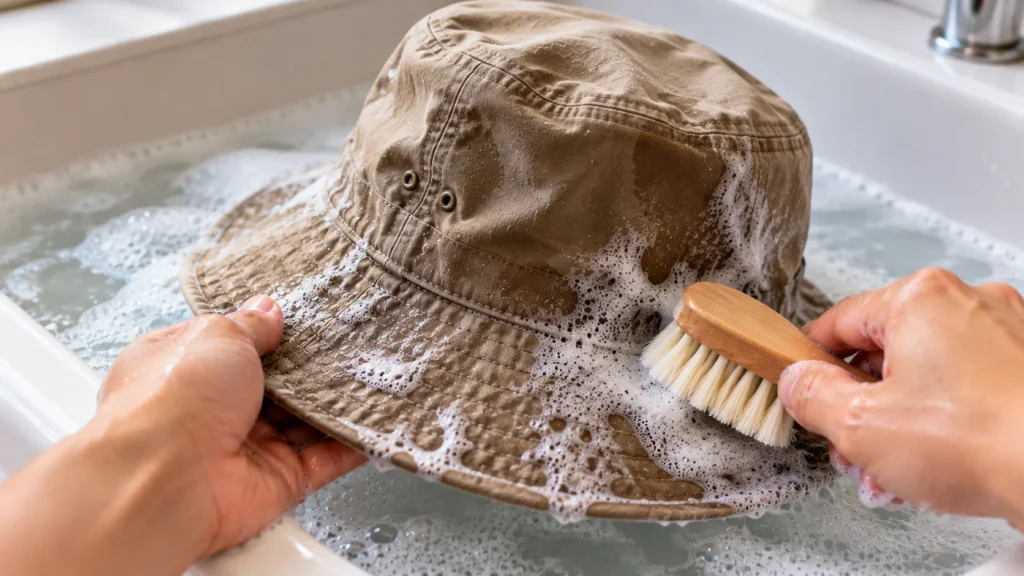
Tilley’s current washable bucket-hat products, for example, include models with machine-wash-delicate or hand-wash-cold instructions, mild detergent requirements, and air-drying instructions.
Always reshape the bucket hat while damp and avoid high heat.
How to Wash a Tilley Hat
Tilley hats have model-specific care instructions, so the label should be checked before cleaning. Tilley’s general care guidance says standard washable hats can be machine washed according to their instructions or gently scrubbed by hand with non-bleach, non-whitening soap.
Tilley specifically warns against putting washable hats in a dryer because they can become misshapen. The company recommends smoothing and reshaping the hat while damp before air drying.
Individual Tilley models can also provide more specific directions. For example, the T3 Classic calls for delicate machine washing or cold hand washing, mild detergent, no bleach or softener, and air drying.
15 Tilley-Hat Care Practices
- Check the label before washing.
- Identify whether the model is washable.
- Use mild detergent.
- Avoid bleach.
- Avoid whitening products.
- Use cool or warm water according to the label.
- Choose delicate machine washing when permitted.
- Hand wash when preferred.
- Remove specified removable components before washing.
- Do not use a dryer.
- Reshape while damp.
- Smooth the crown and brim.
- Air dry naturally.
- Treat sweat stains gently.
- Follow the individual product page when available.
How to Wash a Melin Hat
Melin hats require model-specific care. The company’s current care guide says spot cleaning is generally the safest approach and advises avoiding machine washing or harsh chemicals for many models.
Melin’s Hydro guidance recommends using a damp cloth and mild soap for many stains, while persistent stains may be treated with mild soap and fresh water.
Melin specifically identifies the Pace as its machine-washable hat and recommends a gentle cycle followed by air drying.
Its Thermal Wool, Thermal Nylon, and Thermal Waxed Cotton guidance calls for even more conservative care, including avoiding machine washing for those materials.
The safest approach is therefore to identify the exact Melin collection and follow its product-specific instructions.
How to Wash a White Hat
A white hat can show sweat, dirt, sunscreen, makeup, and oil more clearly than darker colors. This can make regular cleaning particularly important.
Start with the gentlest method compatible with the hat. Avoid automatically reaching for chlorine bleach because the fabric, embroidery, brim, or manufacturer finish may not tolerate it.
The American Cleaning Institute notes that oxygen bleach or other stain treatments may help stubborn perspiration stains when appropriate for the fabric, but the hat’s own care instructions remain the controlling factor.
For a white baseball cap, hand cleaning with a mild detergent is often the best starting point.
How to Wash a Black Hat
A black hat can develop visible white salt-like sweat marks, fading, or detergent residue when cleaned incorrectly. Excessive scrubbing may also produce uneven-looking areas.
Use a mild cleaner and avoid harsh bleaching agents unless specifically permitted by the manufacturer. Rinse thoroughly so detergent does not remain in the fabric.
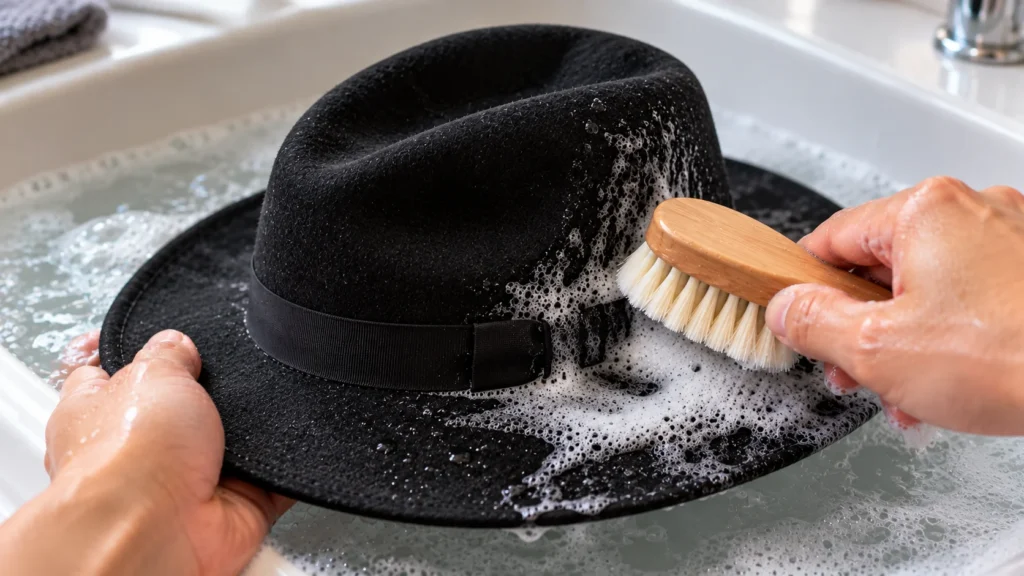
Testing an inconspicuous area is particularly useful when the black fabric is dark-dyed or has a special finish.
Air drying away from intense heat and direct conditions that may affect the material can help preserve the hat’s original appearance.
How to Wash a Dirty Hat Without Damaging It
A heavily dirty hat should not automatically be attacked with the strongest available cleaner. Strong chemicals and aggressive brushing can cause more damage than the original dirt.
Start by removing loose soil. Then identify the stain type and choose the least aggressive treatment that matches the care label.
For a washable fabric hat, mild detergent and controlled hand washing are generally appropriate. For a structured vintage, felt, straw, leather, or specialty hat, surface cleaning or professional treatment may be more appropriate.
15 Rules for a Safe Dirty-Hat Cleaning Routine
- Remove dry dirt first.
- Check the care label.
- Identify the material.
- Inspect the brim.
- Test the cleaner.
- Start with mild soap.
- Use cool or lukewarm water as directed.
- Focus on stained areas.
- Avoid aggressive brushing.
- Protect embroidery.
- Avoid soaking unsuitable hats.
- Rinse away all cleaner.
- Remove excess moisture gently.
- Restore the original shape.
- Air dry completely.
How to Dry a Hat After Washing
Drying is just as important as washing. A properly cleaned hat can lose its shape if it is placed in a hot dryer or left compressed while wet.
For many washable caps, the best method is to reshape the crown and brim while damp and then let the hat air dry naturally. Whirlpool, Tilley, Melin, and New Era all emphasize air drying for different categories of hats.
A clean towel can help remove excess water without twisting the hat. The crown can then be supported with a clean rounded object or carefully shaped by hand, provided the material allows it.
Avoid direct high heat. For specialized felt hats, Stetson specifically warns against heat because it can contribute to shrinkage and other changes.
Jump into Other Related Article
- How to Remove Peanut Butter Stains | Easy Ways to Clean Clothes, Fabric & More
- How to Remove Coffee Stains | Easy Methods for Clothes, Teeth, Carpet & More
- How to Clean Suede Shoes | Easy Ways to Clean Suede at Home
Common Hat-Washing Mistakes
Many damaged hats are not ruined during the actual cleaning stage but during preparation or drying. The most common problem is treating every hat as though it were an ordinary cotton T-shirt.
Another mistake is assuming that a popular online cleaning hack is universally safe. Dishwasher cleaning, washing-machine cleaning, baking soda, stain removers, bleach, and other techniques can have different results depending on the hat’s construction.
15 Mistakes to Avoid
- Ignoring the care label.
- Soaking a cardboard-brim hat.
- Using hot water unnecessarily.
- Using chlorine bleach without approval.
- Scrubbing too aggressively.
- Twisting the crown.
- Wringing the hat.
- Bending the brim repeatedly.
- Using a hot dryer.
- Using dishwasher detergent without checking compatibility.
- Washing delicate hats with ordinary laundry.
- Ignoring colorfastness.
- Applying harsh chemicals to wool.
- Leaving the hat misshapen while drying.
- Assuming one cleaning method works for every material.
Hat Washing Method by Material and Style
| Hat Type | Preferred Starting Method | Main Precaution |
| Cotton baseball cap | Gentle hand wash | Protect shape |
| Polyester cap | Label-approved hand or machine wash | Check construction |
| Trucker hat | Gentle hand cleaning | Protect mesh |
| Fitted 59FIFTY | Cool-water hand wash | Avoid heat |
| Snapback | Gentle hand wash | Protect closure and brim |
| Bucket hat | Label-approved hand/machine wash | Reshape while damp |
| Visor | Gentle hand wash | Protect brim |
| Wool hat | Gentle wool-specific hand care | Avoid heat and agitation |
| Straw hat | Brush and damp-cloth cleaning | Avoid soaking |
| Felt hat | Brush/surface cleaning | Professional cleaning for major stains |
| Cowboy hat | Material-specific care | Avoid generic washing |
| Tilley | Follow model label | No dryer for washable models |
| Melin Hydro | Spot clean | Avoid harsh chemicals |
| Melin Pace | Gentle machine wash | Air dry |
| New Era 59FIFTY | Cool-water hand wash | Avoid bleach and heat |
Hat Washing Safety Guidelines
Hat cleaning products should be used conservatively. A product that is suitable for ordinary clothing may be inappropriate for a specialty hat because hats can contain adhesives, coatings, stiffeners, leather, foam, or other components.
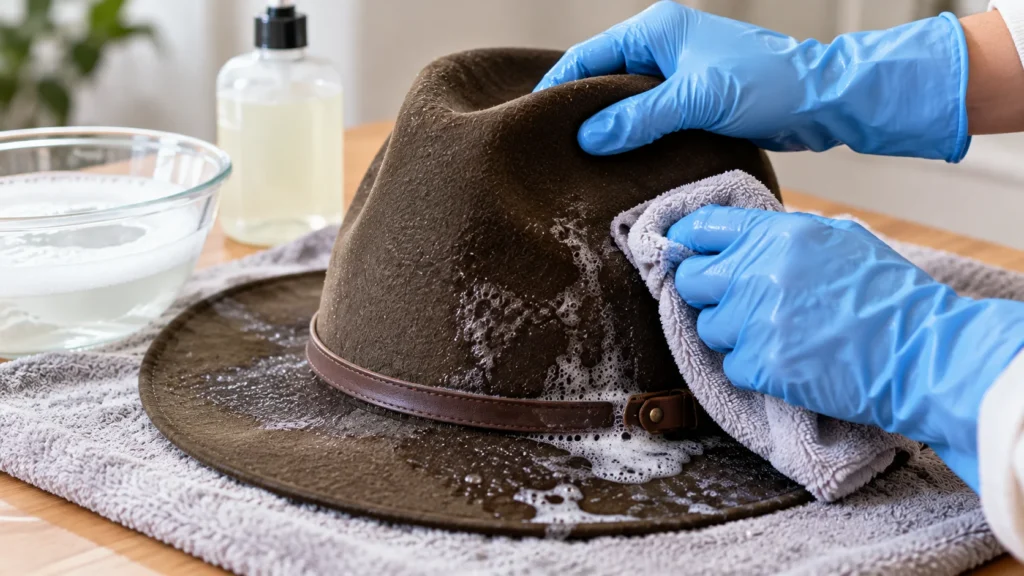
Do not mix cleaning chemicals. In particular, never combine chlorine bleach with ammonia because hazardous fumes can result; the American Cleaning Institute explicitly warns against this combination.
Use ventilation when working with cleaning products, protect your hands if a product label recommends it, and keep cleaning solutions away from children and pets.
15 Safety Rules for Hat Cleaning
- Read the product label.
- Read the hat’s care label.
- Never mix bleach and ammonia.
- Avoid unnecessary chemical combinations.
- Test unfamiliar cleaners.
- Keep chemicals away from children.
- Keep chemicals away from pets.
- Use adequate ventilation.
- Wear protective gloves when required.
- Avoid eye contact with cleaners.
- Do not use high heat to speed drying.
- Follow manufacturer instructions for specialty materials.
- Use professional cleaning when required.
- Stop if the material shows discoloration or damage.
- Rinse washable materials thoroughly after cleaning.
How Often to Wash a Hat
Cleaning frequency depends on how often the hat is worn, how heavily the wearer sweats, and the environment in which it is used.
A hat worn during workouts, outdoor work, sports, hiking, or hot weather may require more frequent attention than a hat worn occasionally. Regular light cleaning can help prevent heavy sweat buildup.
Good Housekeeping recommends washing baseball caps at least monthly for people who wear them frequently, while less frequently worn hats may only need cleaning several times a year.
However, the care label should determine whether that cleaning frequency is appropriate for a particular material.
Final Hat-Washing Routine
For a typical washable modern baseball cap, the safest general routine is simple: check the label, remove loose dirt, test the cleaning solution if needed, use cool or lukewarm water, apply mild detergent, gently clean the sweatband and stained areas, rinse thoroughly, reshape the hat, and air dry.
For a vintage or cardboard-brim hat, avoid soaking and stick to careful spot cleaning. Clorox and Maytag both identify cardboard bills as a reason to avoid full washing.
For a 59FIFTY or other fitted New Era cap, New Era recommends cool-water hand washing with mild soap, avoiding bleach and hot water, followed by reshaping and air drying away from heat.
For Tilley hats, follow the model’s label; many washable models can be delicately machine washed or hand washed, but Tilley advises reshaping and air drying rather than using a dryer.
For Melin hats, identify the exact model because care varies substantially. Many require spot cleaning, while the Pace is specifically designated as machine washable.
For straw, felt, wool, leather, suede, and valuable specialty hats, use material-specific care rather than a generic baseball-cap washing routine.
Conclusion
Learning how to wash a hat starts with understanding that different hats require different levels of care. A modern washable cotton or polyester baseball cap can often be cleaned successfully by hand with cool or lukewarm water and mild detergent, while structured, vintage, wool, felt, straw, leather, and specialty hats may require much gentler treatment.
For most ordinary baseball caps, hand washing is the safest starting point because it provides control over water temperature, cleaning pressure, and the amount of agitation. Whirlpool and Maytag both recommend hand cleaning as a reliable approach for protecting hat structure.
Machine washing and dishwasher cleaning should only be considered when the hat’s material and manufacturer instructions allow them. A hat cage can help preserve shape in approved machine-washing situations, but it cannot make a non-washable hat safe to submerge.
The same principle applies to specific brands. New Era 59FIFTY, Tilley, and Melin hats have different care requirements, and following the exact manufacturer’s instructions is more reliable than applying a universal cleaning hack.
The most important habits are simple: check the label, identify the material, avoid unnecessary heat, clean gently, rinse thoroughly, reshape while damp, and air dry. These steps can remove sweat and dirt while giving the hat the best chance of retaining its original color, fit, structure, and appearance.
What is the safest way to wash a hat?
For most washable baseball caps, gentle hand washing with cool or lukewarm water and mild detergent is the safest general approach. It provides more control than machine washing and reduces the risk of excessive agitation.
Can I wash a baseball hat in the washing machine?
Some baseball hats can be machine washed when the care label permits it. Use a gentle cycle, cool water, mild detergent, and appropriate protection such as a hat cage when recommended. Cardboard-brim and non-washable hats should not be machine washed.
Can I wash a hat in the dishwasher?
Some washable caps can be cleaned in a dishwasher under controlled conditions, but the method is not appropriate for every hat. Guidance varies: Whirlpool recommends against dishwasher washing, while Martha Stewart describes a carefully controlled top-rack method for suitable washable hats.
How do I wash a hat by hand?
Use a clean basin with cool or lukewarm water and a small amount of mild detergent. Gently clean the crown and sweatband, rinse thoroughly, remove excess moisture with a towel, reshape the hat, and air dry.
How do I wash a 59FIFTY hat?
New Era recommends hand washing a 59FIFTY in cool water with mild soap, avoiding bleach and hot water. After washing, shape the hat while damp and allow it to air dry away from heat.
How do I wash a hat without ruining the bill?
Check whether the bill is washable before submerging the hat. Cardboard bills should be spot cleaned rather than soaked, while compatible plastic-brim hats can usually tolerate more extensive cleaning when their labels permit it.
How do I remove sweat stains from a hat?
For a washable fabric hat, gently pretreat the sweatband with an appropriate mild cleaner and use a soft brush or cloth. Tilley notes that sweat stains vary by person and recommends gentle cleaning with warm rather than hot water for suitable hats.