
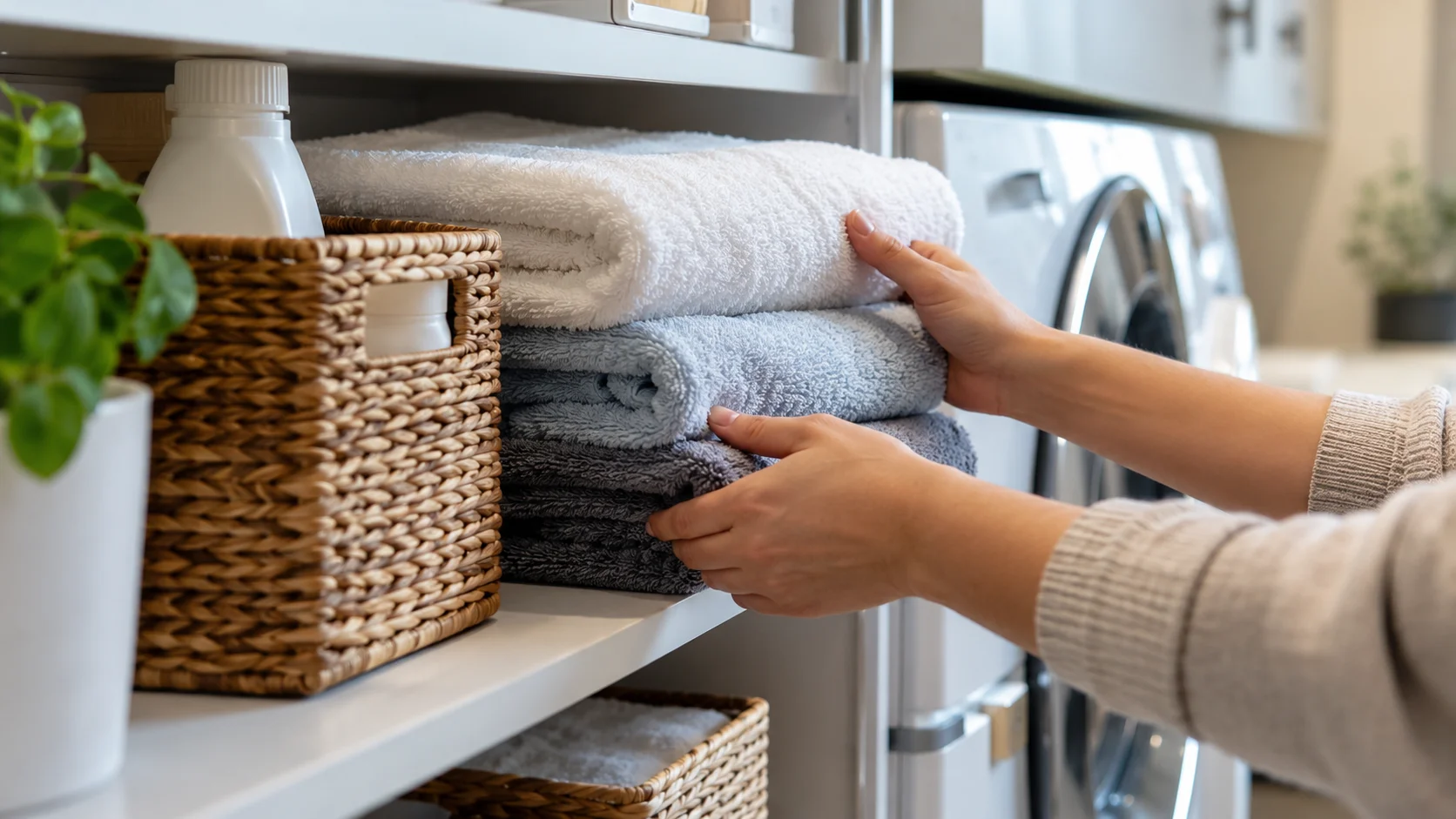
Learning how to organize laundry room space is not simply about making shelves look attractive. A functional laundry room should make washing, drying, folding, sorting, and storing clothes easier while keeping everyday supplies accessible. Detergent, stain removers, hampers, hangers, cleaning products, towels, ironing equipment, and miscellaneous household items can quickly take over a room when they do not have designated places. A good organization system therefore starts by understanding how the room is used and then assigning storage to the activities that happen there. Pottery Barn recommends gathering cleaning products by type, clearing out items that belong elsewhere, and using hampers, hooks, clothing racks, and baskets to create a more functional laundry area.
The challenge is greater when you need to organize a small laundry room or a very narrow laundry closet. In these spaces, walls, cabinet interiors, doors, corners, appliance gaps, and vertical areas become valuable storage opportunities. Home Depot specifically recommends wall-mounted shelves, cabinets, hanging storage, bins, fold-away drying racks, and storage above appliances for making better use of limited laundry-room space. Whether your laundry area is large, tiny, located in a basement, combined with a mudroom, or designed as a laundry room pantry, the goal is the same: give every important item a logical home without making the room harder to use.
Begin With a Laundry Room Reset
Before deciding how to organize your laundry room, remove everything that does not need to stay there. A crowded laundry room often becomes difficult to organize because storage is being used for unrelated household items, empty packaging, duplicate products, and things that have no defined purpose.
Take everything out of cabinets, baskets, shelves, countertops, and drawers. Then group similar items together so you can see what you actually own. Pottery Barn recommends gathering cleaning products by type and removing items that belong elsewhere before adding new organization products.
A useful first sorting system is:
- Laundry detergent
- Stain removers
- Fabric-care products
- Cleaning supplies
- Laundry baskets
- Hangers
- Clothespins
- Towels
- Cleaning cloths
- Ironing supplies
- Drying accessories
- Household paper products
- Pet supplies
- Seasonal items
- Miscellaneous objects
Once everything is grouped, remove empty containers, duplicate products you do not need, damaged storage pieces, and items that have migrated into the room simply because there was an empty corner.
The goal is not to make the laundry room hold as much as possible. The goal is to make the things that genuinely belong there easy to find, use, and put away.
Give Every Category a Permanent Home
One of the easiest ways to keep a laundry room organized is to establish a permanent location for every category.
For example, detergent can always remain in the cabinet beside the washer, while stain treatment stays in a small basket near the sorting area. Hangers can live on a rail beside the dryer, and cleaning cloths can have their own labeled container.
This creates a repeatable system:
- Use the item.
- Return it to its designated location.
- Keep the category together.
- Refill only when necessary.
- Remove empty containers promptly.
An organization system is much easier to maintain when everyone using the laundry room understands where things belong.
Divide the Room Into Functional Zones
When deciding how to organize a laundry room, think about the room as a workspace rather than simply a storage area. Different laundry tasks require different supplies, so placing related items together can reduce unnecessary movement.

A practical laundry room can contain a dirty-clothes zone, washing zone, drying zone, folding zone, and storage zone. If the room also functions as a mudroom or pantry, those activities should have their own clearly separated areas.
Home Depot recommends combining shelving, cabinets, hanging storage, bins, laundry sorters, and folding surfaces to create a more efficient laundry workflow.
Consider these basic zones:
- Sorting zone: Hampers or divided laundry baskets.
- Washing zone: Detergent and stain-treatment supplies.
- Drying zone: Hanging rods, racks, and hangers.
- Folding zone: Countertop or flat work surface.
- Ironing zone: Iron and ironing-board storage.
- Cleaning zone: Household cleaning tools and products.
- Backup-storage zone: Extra detergent and infrequently used supplies.
- Entry zone: Shoes, coats, bags, or outdoor items if the room is also a mudroom.
This zoning system also makes it easier to decide what should be stored at eye level, what can go into cabinets, and what can move to higher shelves.
Keep the Most-Used Items Closest
Everyday supplies should require as little effort as possible to reach.
Place frequently used detergent and stain-treatment products close to the washer. Keep hangers near the drying area. Store folding accessories near the countertop. Less frequently used backup supplies can move to higher cabinets.
This approach prevents a common problem: having plenty of storage but still feeling as though everything is difficult to reach.
Make Vertical Space Work Harder
When you organize a small laundry room, the walls may be more valuable than the floor. Floor space is needed for movement, appliance doors, laundry baskets, and sometimes a folding area, while unused wall height can provide several levels of storage.
Home Depot recommends wall-mounted shelves, adjustable shelving, corner shelves, vertical shelving units, hanging racks, and pegboards as ways to use laundry-room walls more effectively.
Useful vertical-storage options include:
- Floating shelves
- Adjustable wall shelves
- Tall cabinets
- Wall-mounted drying racks
- Hanging rods
- Pegboards
- Hooks
- Door-mounted organizers
- Vertical rolling shelves
- Upper cabinets
Store everyday supplies where they can be reached comfortably. Reserve higher shelves for backup detergent, seasonal supplies, extra linens, or items that are rarely needed.
If you use very high storage, consider keeping a suitable step stool nearby rather than regularly stretching or climbing on unsafe surfaces.
Use the Area Above the Washer and Dryer
The wall above the appliances is often one of the most useful locations in a laundry room.
Depending on the appliance configuration and required clearances, this area can accommodate:
- Open shelving
- Cabinets
- A hanging rod
- Drying accessories
- Baskets
- Laundry supplies
- Decorative storage
Home Depot specifically recommends shelves above washers and dryers for storing detergents, stain removers, dryer supplies, and other laundry accessories.
If you have a top-loading washer, make sure shelves or cabinets do not interfere with the lid opening. This is an important planning detail that can easily be overlooked.
Jump into Other Related Article
- How to Remove Peanut Butter Stains | Easy Ways to Clean Clothes, Fabric & More
- Does Rayon Shrink? What Happens in the Washer and Dryer
- How to Remove Coffee Stains | Easy Methods for Clothes, Teeth, Carpet & More
- How to Clean Suede Shoes | Easy Ways to Clean Suede at Home
- Best Stain Remover for Clothes | Complete Guide for Different Stains
Improve Laundry Room Cabinets and Shelves
Cabinets are ideal for reducing visible clutter, while open shelves make frequently used items easier to reach. Combining both gives you flexibility instead of forcing everything into one storage style.
If your laundry room already has cabinets, organize their interiors before buying replacements. Adjustable shelves, small bins, baskets, pull-out organizers, and dividers can transform a large empty cabinet into several useful storage zones.
Home Depot recommends cabinets for concealed storage and notes that countertop-and-cabinet combinations can provide both storage and workspace.
Try assigning cabinet sections to specific categories:
- Everyday detergent
- Backup detergent
- Stain-care products
- Cleaning supplies
- Towels
- Ironing supplies
- Household extras
- Seasonal items
Keep heavier items on lower shelves where practical and place frequently used products where they are easiest to reach.
Make Open Shelves Look Organized
Open shelving works best when the contents are grouped rather than scattered.
Instead of placing individual bottles, clothespins, brushes, and miscellaneous items across the entire shelf, use baskets or bins to create categories.
For example:
- Basket 1: Stain-care supplies
- Basket 2: Hangers and clips
- Basket 3: Cleaning cloths
- Basket 4: Small laundry accessories
- Basket 5: Backup supplies
Home Depot recommends baskets, bins, cubbies, and labeled containers for grouping laundry supplies and keeping regularly used items within convenient reach.
Labels are especially useful if several people share the laundry room.
Use Smart Storage for Small and Tiny Laundry Rooms
When you need to organize a very small laundry room, the priority should be function per square foot. A storage solution that takes up valuable floor area may not be helpful if it makes the room difficult to move around.
Start with the spaces people frequently overlook:
- Behind the door
- Above the machines
- Beside the machines
- Between side-by-side appliances
- Inside cabinet doors
- Above existing shelves
- In narrow wall sections
- In corners
- Beneath suitable counters
- Around stacked appliances
Pottery Barn highlights narrow gaps, rail systems, hooks, baskets, upper cabinets, and slim storage units as useful options for small laundry areas.
A narrow rolling cart can also be useful where there is a suitable gap between an appliance and wall. It can hold small bottles or accessories and can be moved when access is required.
Choose Fold-Away Solutions
Small laundry rooms benefit from storage that disappears when it is not being used.
Consider:
- Fold-down drying racks
- Collapsible laundry baskets
- Fold-away ironing boards
- Wall-mounted drying rails
- Retractable hanging solutions
- Stackable storage bins
- Slim rolling carts
Home Depot specifically recommends fold-away drying racks, back-of-door storage, vertical shelving, and fold-away ironing boards for compact laundry spaces.
The principle is simple: store the function without permanently sacrificing the floor space.
Create a Better Laundry Sorting System
Sorting clothes before washing can become one of the most frustrating parts of laundry if every load begins with a pile on the floor.
A multi-section hamper can make sorting more automatic. Pottery Barn recommends separate hampers for categories such as darks, whites, and colors so clothing can be sorted before laundry day.
Depending on your household, you could use:
- One hamper for lights
- One hamper for darks
- One hamper for colors
- One basket for delicate items
- One basket for towels
You do not necessarily need five separate hampers. Choose categories that actually match your laundry habits.
For a small laundry room, stackable or collapsible baskets can provide sorting capacity without permanently occupying a large section of the floor.
Keep Clean and Dirty Laundry Separate
Try to prevent clean laundry from being placed directly beside dirty laundry.
A simple system can designate:
One area for incoming laundry
One area for clean laundry
One area for folding
One area for clothing that needs hanging
This reduces confusion and keeps the workflow moving in one direction.
Organize Hangers, Drying Racks, and Hanging Space
Hangers are easy to overlook when planning how to organize hangers in laundry room spaces, but they become much more useful when stored close to the dryer or hanging rod.
Home Depot suggests hanging bars beneath shelves, hooks, pegboards, door storage, and wall-mounted drying racks as ways to add hanging capacity.
You can create a dedicated hanger station using:
- A short hanging rod
- Hooks
- A shelf with a rod underneath
- A pegboard
- A narrow wall rack
- A basket for spare hangers
Keep frequently used hangers within easy reach.
If you routinely hang shirts immediately after drying, placing the hanger station next to the dryer creates a natural workflow.
Give Drying Equipment Its Own Home
Drying racks can take over a laundry room when they are not assigned a storage location.
If possible, install or store the rack against a wall when folded. Wall-mounted and collapsible options are particularly useful for compact spaces. Home Depot recommends fold-out drying racks and wall-mounted solutions for areas where floor space is limited.
Do not block appliance access or required ventilation when installing hanging equipment.
Add a Practical Folding and Work Surface
A folding surface can make the laundry process much easier because it gives clean clothing a temporary destination.
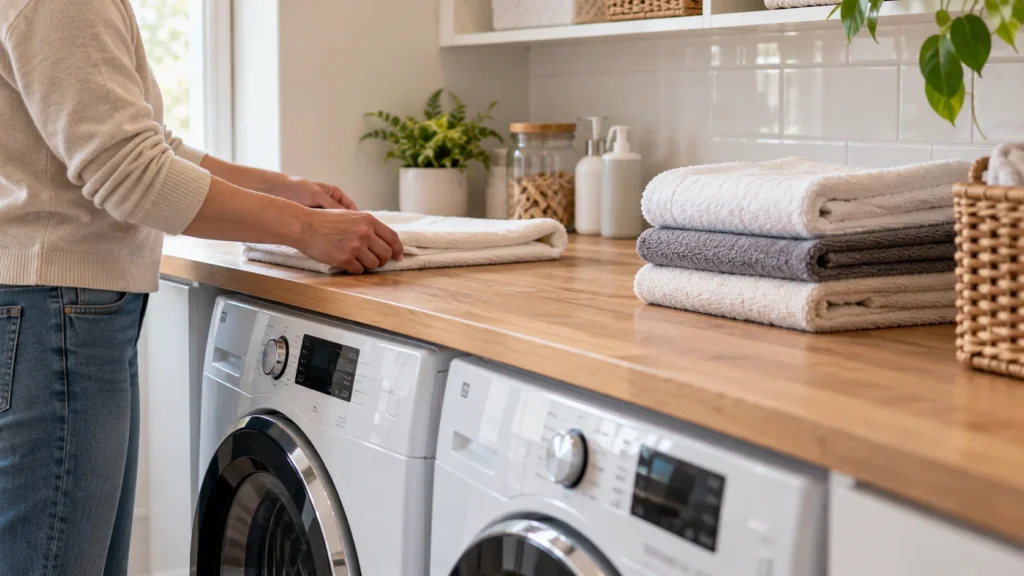
If you have front-loading appliances and the installation allows it, a countertop above the machines can provide:
- Folding space
- Sorting space
- Temporary storage
- A place for baskets
- A workspace for stain treatment
Pottery Barn recommends countertops as useful laundry-room workspace and storage areas, while Home Depot also identifies countertops as a way to create an instant work surface.
For a small room, alternatives include:
- Fold-down wall tables
- Removable folding boards
- Narrow countertops
- Fold-away work surfaces
- A compact rolling table
Avoid using the folding surface as permanent storage. If the countertop becomes covered with bottles and miscellaneous objects, its primary function disappears.
Organize Laundry Room on a Budget
You do not need a complete renovation to organize your laundry room on a budget. Many useful improvements involve rearranging existing storage rather than purchasing expensive cabinetry.
Start with free changes:
- Remove unnecessary items.
- Group products by category.
- Reposition shelves.
- Move rarely used supplies upward.
- Create a dedicated hanger area.
- Use existing baskets more strategically.
- Label existing containers.
- Clear the countertop.
- Designate one basket for miscellaneous items.
Then consider inexpensive upgrades:
- Hooks
- Simple baskets
- Shelf dividers
- Slim rolling carts
- Door organizers
- Small bins
- Adjustable shelves
- Foldable drying racks
Home Depot’s laundry organization guidance includes relatively simple solutions such as baskets, bins, labels, wall shelving, folding stations, and storage on doors.
Do Not Buy Storage Before Measuring
This is one of the easiest ways to waste money.
Measure:
- Shelf width
- Shelf depth
- Cabinet height
- Door clearance
- Appliance width
- Available wall space
- Gaps beside appliances
- Ceiling height
- Walking space
Then purchase storage that fits those dimensions.
A beautiful basket that cannot slide onto the shelf is not useful organization.
Organize a Laundry Room Pantry Safely
A laundry room pantry can combine household storage with laundry functions, but categories should remain clearly separated.
Laundry products and household chemicals should not be casually mixed with food or food-contact items.
A practical layout could be:
Pantry section
- Dry food
- Paper goods
- Kitchen extras
- Sealed household supplies
Laundry section
- Detergent
- Stain removers
- Cleaning products
- Hangers
- Laundry accessories
Use separate cabinets or clearly labeled shelves where possible.
If the room is small, vertical shelving can create separate zones without taking up much floor space.
Keep products in their original labeled packaging and follow the storage instructions on their labels, especially for household chemicals.
Organize a Mudroom Laundry Room
A mudroom laundry room has more organizational demands because it may need to accommodate laundry, coats, shoes, bags, pet supplies, and outdoor equipment.
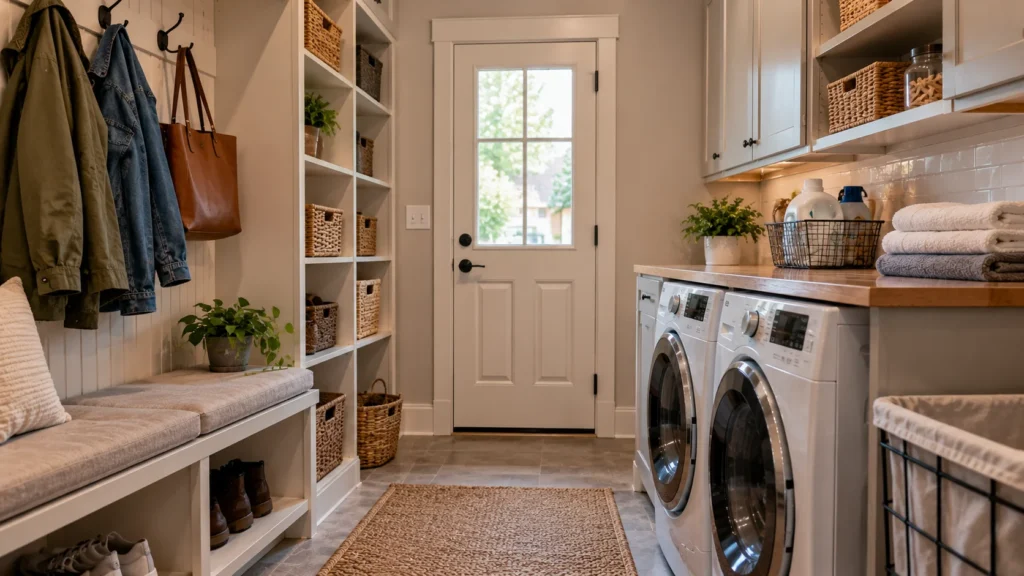
Home Depot’s mudroom guidance recommends vertical shelving, cube storage, cabinetry, and hall-tree-style solutions for combining entry storage with functional space.
Divide the room into two major areas:
Entry zone
- Coats
- Shoes
- Bags
- Outdoor accessories
- Pet items
Laundry zone
- Detergent
- Hampers
- Hangers
- Drying supplies
- Folding area
- Cleaning products
Hooks are especially useful in mudroom laundry areas because they use vertical space while keeping frequently used coats and bags accessible.
Try not to allow entryway items to spread into the appliance area.
Organize a Basement Laundry Room
A basement laundry room often has more available floor and wall space than a closet laundry area, but that extra space can quickly become general household storage.
Instead of filling every empty corner, create dedicated storage zones.
A basement laundry room can accommodate:
- Tall cabinets
- Full-height shelving
- Folding counters
- Hanging rods
- Laundry sorters
- Drying racks
- Cleaning supply cabinets
- Linen storage
- Seasonal household supplies
Keep appliance connections, utility equipment, service areas, and required access paths clear.
The additional space should make the laundry workflow easiernot turn the laundry room into an unplanned storage room.
Use the Back of the Door and Narrow Gaps
When floor space is limited, doors and narrow gaps can become useful organizational surfaces.
Home Depot specifically identifies the backs of doors as valuable hanging space in small or closet laundry rooms.
Depending on the door and clearance, you can use it for:
- Lightweight cleaning supplies
- Small baskets
- Ironing accessories
- Clothespins
- Hangers
- Laundry bags
- Small household tools
Similarly, a narrow gap between appliances may be suitable for a slim pull-out cart or storage rack. Pottery Barn specifically highlights these otherwise overlooked gaps as potential laundry storage locations.
Make sure any storage addition does not interfere with appliance operation, doors, hoses, electrical connections, or service access.
Keep Cleaning Products Controlled and Easy to Find
Laundry rooms often contain multiple types of cleaning products, so organization should also make them easy to identify.
Group products according to purpose rather than putting every bottle together.
Possible categories include:
- Laundry detergent
- Stain treatment
- Fabric-care products
- Surface cleaners
- Specialty cleaning products
- Cleaning cloths
- Brushes
Use a caddy or bin for products that are regularly carried around the home. Pottery Barn recommends gathering cleaning products by type and clearly labeling them.
If children or pets have access to the laundry room, store products according to their safety labels and use appropriately secured storage where required.
Never transfer a chemical into an unmarked container.
Build a Simple System for Miscellaneous Items
Laundry rooms tend to collect small objects that do not have obvious homes.

Think:
- Loose buttons
- Coins
- Socks without pairs
- Clothespins
- Small garment accessories
- Pocket contents
- Repair items
Instead of allowing these things to spread across countertops and shelves, designate one small container for miscellaneous laundry items.
Home Depot specifically recommends creating a designated container for items such as lonely socks, clothespins, buttons, and pocket finds.
Empty the container regularly so it does not become another junk drawer.
Make the System Easy to Maintain
The best answer to how to organize my laundry room is a system that people will actually continue using.
A complicated organization system can look excellent on the first day and fail a month later.
Keep the system simple:
- Store frequently used products nearby.
- Label categories clearly.
- Avoid overfilling baskets.
- Leave some empty storage capacity.
- Return items after use.
- Remove empty containers.
- Keep the folding surface clear.
- Keep dirty and clean laundry separate.
- Review supplies periodically.
Pottery Barn emphasizes that organized storage can make laundry tasks easier, while Home Depot recommends assigning places for supplies and using labels to make the system easier for everyone to follow.
The goal is not perfection. The goal is reducing friction every time laundry needs to be done.
Small Laundry Room Ideas for Maximum Efficiency
If you are specifically searching for small laundry room ideas, focus on changes that create storage without consuming the space you need to work.
Useful options include:
- Install shelves above the appliances.
- Add upper cabinets.
- Use a slim rolling cart.
- Install hooks behind the door.
- Add a wall-mounted drying rack.
- Use a short hanging rod.
- Choose stackable compatible appliances when appropriate.
- Add baskets for grouped supplies.
- Use labeled containers.
- Create a folding surface.
- Store backup supplies higher up.
- Keep daily products at reachable height.
- Use a narrow pull-out organizer.
- Install adjustable shelving.
- Use corners with suitable corner shelves.
- Keep the floor mostly clear.
- Store ironing equipment vertically.
- Use collapsible laundry baskets.
- Create a dedicated hanger zone.
- Remove unrelated household clutter.
Home Depot and Pottery Barn both recommend combinations of shelving, cabinets, hanging storage, baskets, and compact solutions for maximizing small laundry spaces.
A Practical Laundry Room Organization Routine
Once the room is organized, maintaining it does not have to become another large household project.
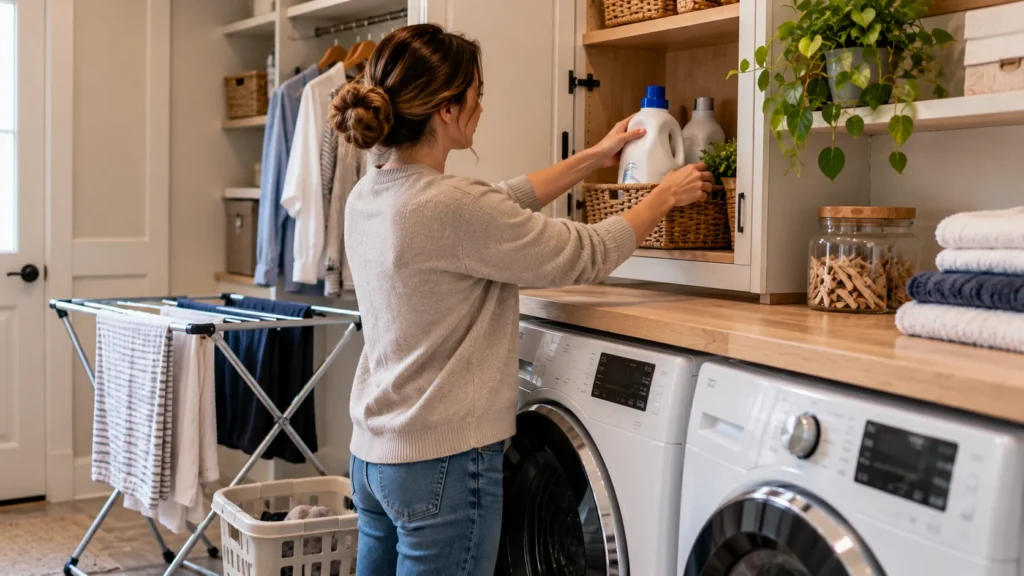
At the end of a laundry session, spend a few minutes returning items to their homes.
A simple reset can include:
- Return detergent to its cabinet.
- Put stain remover back in its basket.
- Return hangers to the hanging area.
- Fold away the drying rack.
- Put empty baskets away.
- Clear the folding surface.
- Remove empty product packaging.
- Return cleaning tools to their storage.
- Move misplaced household items elsewhere.
- Check whether the laundry sorter needs emptying.
This small routine prevents clutter from accumulating until another major reorganization becomes necessary.
Common Laundry Room Organization Mistakes
Several mistakes can make a laundry room feel crowded even when there is enough storage.
Buying containers before decluttering: Storage cannot solve the problem of owning too many unnecessary items.
Ignoring vertical space: Empty walls often represent valuable storage potential.
Putting everything on open shelves: Too many visible products can create visual clutter.
Overfilling baskets: A basket that is impossible to pull out is not useful storage.
Forgetting appliance clearance: Shelves and cabinets must not interfere with doors, lids, ventilation, connections, or servicing.
Keeping everyday products too high: Frequently used detergent should not require a step stool.
Using the countertop as permanent storage: A folding station needs to remain usable.
Mixing unrelated categories: Cleaning products, pantry supplies, clothing accessories, and miscellaneous household items become harder to find when mixed together.
Ignoring the door: The back of a suitable door can provide additional vertical storage.
Creating an overly complicated system: If putting an item away takes too many steps, the system may not survive everyday use.
Conclusion
The most effective way to organize laundry room space is to begin with the workflow rather than the decorations. Remove unnecessary items, group similar supplies, establish functional zones, and give frequently used products convenient homes. Shelves, cabinets, baskets, hanging rods, drying racks, rolling carts, door organizers, and countertops can then be used according to the size and layout of the room. Current guidance from Home Depot and Pottery Barn supports using vertical storage, labeled containers, dedicated sorting areas, hanging solutions, and folding surfaces to make laundry spaces more functional.
For how to organize a small laundry room, the biggest opportunity is usually unused vertical and narrow space. Use the wall above appliances, the backs of doors, suitable gaps, corners, and tall shelving while keeping appliance access and walking areas clear. A basement laundry room can accommodate more substantial cabinetry and work surfaces, while a tiny laundry room may benefit more from fold-away racks, slim carts, and wall-mounted storage. Whatever the room size, a successful system should make laundry easier to sort, wash, dry, fold, and put awayand simple enough that the whole household can maintain it.
1. What is the best way to organize a laundry room?
Start by decluttering and dividing the space into functional zones for sorting, washing, drying, folding, and storage. Keep frequently used supplies near the appliances and use cabinets, shelves, baskets, and labels to keep categories together.
2. How do you organize a small laundry room?
Use vertical storage, shelves above appliances, wall-mounted drying racks, narrow carts, door organizers, hooks, baskets, and fold-away solutions. Keep the floor clear and store rarely used items in higher cabinets or shelves.
3. How do you organize laundry room cabinets?
Group products by purpose and use smaller bins or baskets inside larger cabinets. Keep everyday supplies within comfortable reach and place backup or seasonal products higher up. Labeling cabinets can also make the system easier for everyone to maintain.
4. How do you organize a very small laundry room on a budget?
Declutter first, then use inexpensive hooks, baskets, shelf dividers, labels, slim carts, and wall-mounted storage. Reorganizing existing shelves and making better use of vertical space can improve the room without requiring a complete renovation.
5. How do you organize a mudroom laundry room?
Separate the space into entry and laundry zones. Keep coats, shoes, bags, and outdoor items near the entrance while placing detergent, hampers, hangers, and drying supplies near the washer and dryer. Vertical shelving and cabinetry can help combine the two functions without allowing one area to overwhelm the other.