
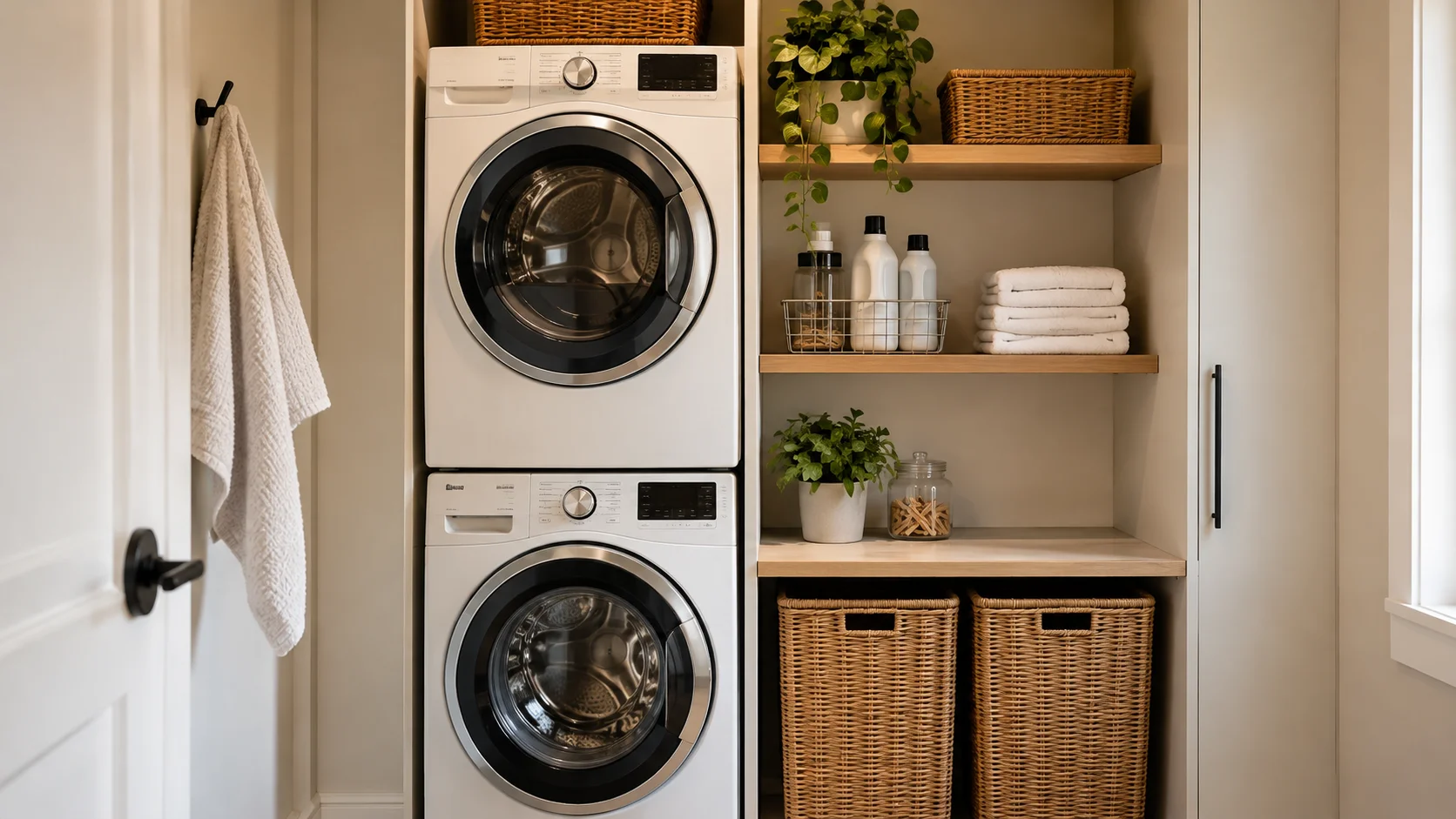
Small laundry rooms can be surprisingly difficult to design because they need to handle several jobs in a limited footprint. Washing, drying, sorting, folding, hanging, storing detergent, and keeping cleaning supplies accessible all compete for the same few feet. The good news is that a compact laundry room does not need to feel crowded or unfinished. With thoughtful storage, a suitable washer-and-dryer configuration, vertical organization, practical lighting, and carefully chosen finishes, even a narrow closet or hallway laundry area can become efficient and attractive.
The best small laundry room ideas focus on how the space actually works rather than simply adding decoration. Open shelves can keep everyday supplies within reach, cabinets can hide visual clutter, stacked appliances can free valuable floor space, and a slim rolling cart can turn an unused gap into useful storage. The following ideas cover small laundry room storage, organization, cabinets, shelving, sinks, pantry combinations, top-loading machines, stackable washers and dryers, farmhouse and modern styles, DIY improvements, and budget-friendly upgrades.
1. Start With the Layout Before Choosing Décor
The layout should be the foundation of any small laundry room design. Before selecting wallpaper, paint, cabinets, or decorative accessories, measure the available floor, wall, door, and appliance space. Consider where the washer and dryer open, where laundry baskets will stand, and how much room you need to move around the machines. A beautiful arrangement becomes frustrating if a cabinet blocks an appliance door or there is nowhere to place a basket while loading clothes.
Houzz’s small-laundry-room design guidance highlights the importance of choosing an appliance configuration according to available space, including side-by-side and stacked arrangements. (Houzz)
Use these planning steps:
- Measure the full width and depth of the laundry area.
- Record the height available above the washer and dryer.
- Measure door swings and nearby walkways.
- Mark plumbing and electrical locations before planning cabinets.
- Check the clearance needed for appliance doors.
- Decide whether folding space is essential.
- Identify walls that can support shelves or cabinets.
- Look for unused corners that could hold narrow storage.
- Consider where dirty laundry enters the room.
- Decide where clean laundry will leave the room.
- Reserve an accessible location for everyday detergent.
- Keep frequently used items between easy-to-reach heights.
- Place rarely used supplies higher or farther away.
- Plan storage around the appliances rather than against them.
- Leave enough working space to load and unload comfortably.
2. Choose Between Side-by-Side and Stackable Appliances
One of the biggest decisions in a compact laundry room is whether the washer and dryer should sit beside each other or be stacked. Side-by-side machines provide a convenient horizontal surface that can potentially become a folding counter, while stacked appliances use more vertical space and reduce the floor area occupied by laundry equipment. The right choice depends on the room’s dimensions, appliance specifications, access requirements, and how you use the space.
Stacked washer-and-dryer arrangements are particularly useful when floor space is limited. Houzz’s design examples show stacked machines being used in small laundry rooms, closets, and hallway-style spaces while leaving room for adjustable shelving or other storage. (Houzz)
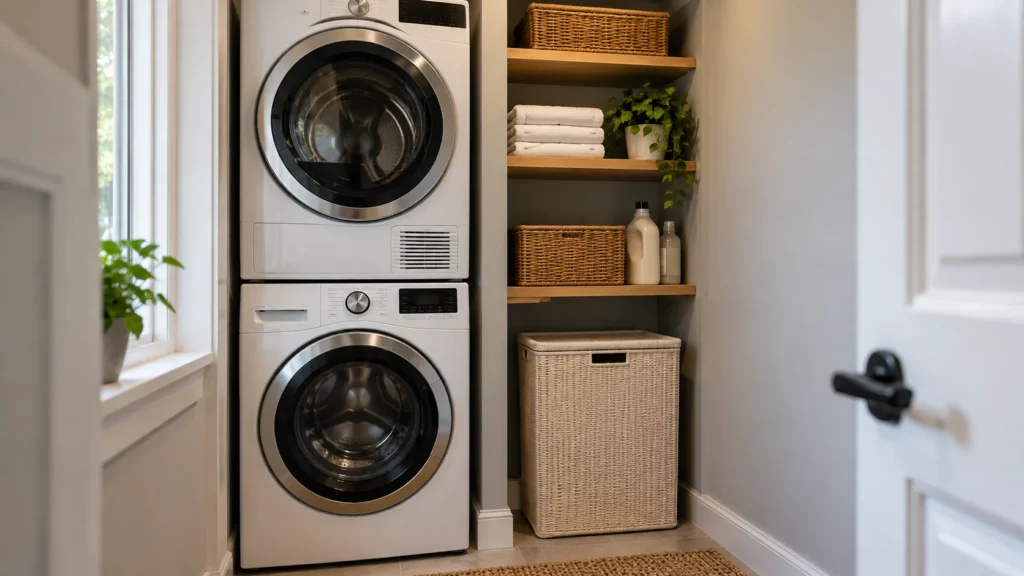
Small Laundry Room Ideas With Stackable Washer Dryer
Consider these approaches:
- Stack compatible washer and dryer units to reduce the appliance footprint.
- Build storage beside the stacked units when wall width permits.
- Add adjustable shelves above or beside the appliances.
- Use a tall cabinet for detergent, towels, and cleaning supplies.
- Place a narrow hamper beside the appliance tower.
- Install a hanging rail in the remaining vertical space.
- Use the wall behind or beside the appliances for hooks.
- Keep heavy storage at comfortable heights.
- Reserve upper shelves for seasonal or infrequently used items.
- Use matching baskets to make open shelving look intentional.
- Consider a folding drying rack that can be stored vertically.
- Use a slim trolley in any remaining floor gap.
- Add lighting above the appliance area.
- Keep the appliance controls and doors unobstructed.
- Verify that the machines and stacking system are designed to work together.
3. Make Vertical Storage the Main Feature
When floor space disappears quickly, the walls become your most valuable storage resource. Tall shelving, wall-mounted cabinets, rails, hooks, and drying racks can hold many laundry essentials without consuming the walking area. IKEA’s laundry-room solutions specifically emphasize wall storage, shelves, cabinets, baskets, drying racks, and flexible systems for making compact laundry areas more functional. (IKEA)
Vertical storage also allows you to divide items by frequency of use. Everyday products can stay at eye level, while spare supplies and seasonal items can move higher. This creates a more organized room without requiring a larger footprint.
Useful vertical small laundry room storage ideas include:
- Install shelves above the washer and dryer.
- Use cabinets that extend toward the ceiling.
- Add a wall-mounted hanging rail.
- Install hooks for reusable laundry bags.
- Hang an ironing board vertically when appropriate.
- Mount a fold-down drying rack.
- Add a narrow pegboard for lightweight accessories.
- Use a wall organizer for small laundry tools.
- Install baskets beneath shelves.
- Use a tall shelving unit in an unused corner.
- Add a narrow rail for hangers.
- Place a small basket on a wall shelf for clothespins.
- Use adjustable shelves when storage needs change.
- Reserve the highest shelves for backup products.
- Add a step stool only if needed and store it safely out of the way.
4. Use Small Laundry Room Cabinet Ideas to Hide Clutter
Cabinetry can make a tiny laundry room appear considerably calmer because it conceals detergent bottles, stain-treatment products, spare towels, and miscellaneous household supplies. Closed cabinets are especially useful when the laundry room is visible from a kitchen, hallway, bathroom, or living area. Combining closed cabinets with a few open shelves can give you both hidden storage and quick access to frequently used items.
IKEA’s small laundry examples demonstrate how closed storage can be combined with open shelving and baskets, creating an arrangement that keeps supplies accessible while reducing visible clutter. (IKEA)
Try these small laundry room cabinet ideas:
- Install upper cabinets above side-by-side machines.
- Use a tall cabinet beside stacked appliances.
- Choose adjustable interior shelves.
- Store backup detergent behind closed doors.
- Keep cleaning cloths together in one cabinet section.
- Use bins inside deep cabinets to prevent items from disappearing.
- Label interior bins for easier retrieval.
- Keep everyday products on the lowest practical shelf.
- Use slim cabinets in narrow gaps.
- Consider a shallow cabinet where depth is limited.
- Use a cabinet above a folding counter.
- Match cabinet finishes to the rest of the home.
- Combine one closed cabinet with one open shelving area.
- Avoid filling every cabinet to maximum capacity.
- Leave a little empty space so the system remains usable.
5. Small Narrow Laundry Room Ideas That Save Floor Space
A narrow laundry room needs a different strategy from a square room. Instead of trying to place large furniture everywhere, concentrate storage along the walls and use slim accessories. A narrow rolling cart, vertical shelving tower, wall-mounted drying rack, or behind-the-door organizer can add functionality without making the walkway difficult to use.
The key is to use the room’s length and height instead of adding bulky objects to the floor. Even a few inches of unused space between appliances, cabinets, or walls can sometimes become useful storage.
For small narrow laundry room ideas, consider:
- Use a slim rolling cart between appliances and a wall when safe and practical.
- Install shallow shelves instead of deep cabinets.
- Choose vertical baskets instead of wide hampers.
- Mount a drying rack on the wall.
- Use the back of the door for lightweight organization.
- Add hooks to unused wall sections.
- Choose stacked appliances when appropriate for the room.
- Keep the center walkway as open as possible.
- Use a tall cabinet instead of multiple low cabinets.
- Store small supplies in labeled containers.
- Use foldable laundry baskets that can be collapsed when empty.
- Hang ironing equipment rather than storing it on the floor.
- Install lighting under cabinets or shelves where suitable.
- Use one consistent storage system to reduce visual noise.
- Keep decorative objects limited so the room remains functional.
6. Small Laundry Room Ideas With Top Loading Washer
Top-loading washers require special planning because the lid needs to open freely. This makes certain countertop and cabinet arrangements unsuitable unless they are specifically designed around the appliance. Rather than placing a permanent shelf directly over the opening, use wall storage higher up or position cabinets where they will not interfere with the lid.
For a top-loader, measure the open-lid height before installing shelves or cabinets. This simple step can prevent a storage solution from becoming an obstacle.
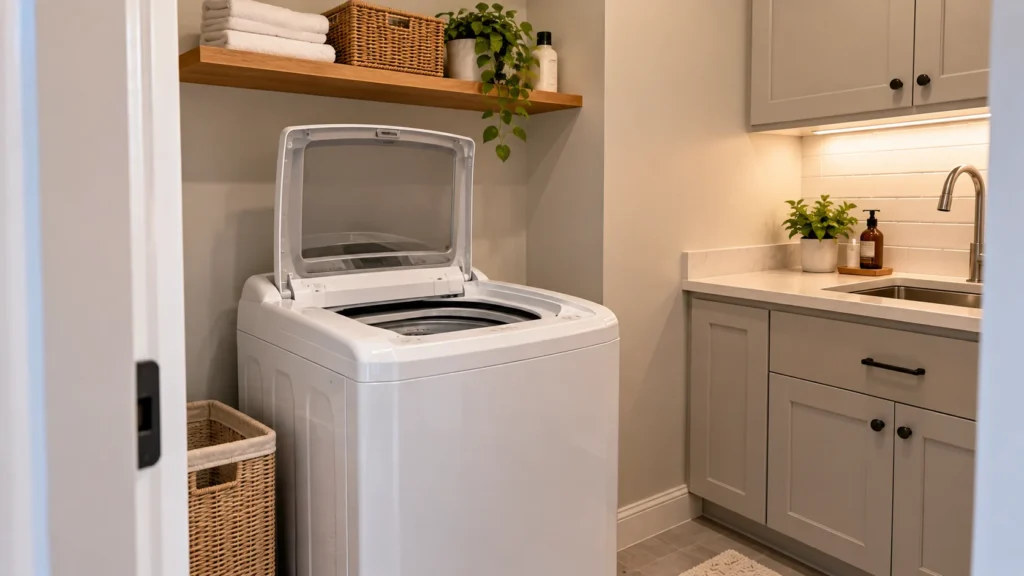
Practical small laundry room ideas with top loading washer include:
- Measure the machine with the lid fully open.
- Keep shelves high enough to avoid interference.
- Use side-wall storage when overhead clearance is limited.
- Install a shallow shelf on an adjacent wall.
- Place a tall cabinet beside the washer if space allows.
- Use baskets to organize small supplies.
- Keep detergent within easy reach but away from the lid path.
- Use wall hooks for laundry bags.
- Add a narrow rolling cart beside the machine.
- Choose a folding drying rack that stores vertically.
- Use a nearby counter rather than covering the washer.
- Add a wall-mounted hanging rail.
- Use closed cabinets for backup supplies.
- Keep the area immediately around the washer clear.
- Recheck clearance after installing any new storage.
7. Add a Folding Surface Without Making the Room Bigger
A dedicated folding area is useful, but a small laundry room may not have enough floor space for a separate table. Instead, look for opportunities to create a folding surface above or beside the machines. In a side-by-side arrangement, a properly planned countertop can create a continuous work area. In other layouts, a fold-down wall surface may provide temporary workspace without permanently occupying the floor.
A folding surface can also serve as a staging area for clean clothes, baskets, towels, or items waiting to be put away. The goal is to create one reliable place for these tasks rather than allowing clean laundry to accumulate on appliances or the floor.
Useful solutions include:
- Add a countertop above suitable side-by-side machines.
- Install a fold-down table where appropriate.
- Use a narrow counter beside the appliances.
- Choose a surface that is easy to clean.
- Keep the folding zone clear of unnecessary décor.
- Store baskets underneath when possible.
- Use labeled baskets for different household members.
- Create a temporary folding surface instead of a permanent table.
- Use a countertop to stage clean laundry.
- Keep stain-treatment products away from the clean-clothes area.
- Add a nearby hanging rail for clothes that should not be folded.
- Use baskets underneath for items waiting to be returned.
- Consider a pull-out work surface where cabinetry allows it.
- Keep enough clearance to stand comfortably.
- Make the work surface part of the storage plan.
8. Build Better Small Laundry Room Shelving Ideas
Shelving is one of the easiest ways to increase storage without a complete remodel. Open shelves make everyday supplies visible and accessible, while adjustable shelves allow you to change the arrangement when your storage needs change. IKEA also demonstrates the use of open shelves, baskets, wall-mounted systems, and storage combinations in compact laundry settings. (IKEA)
For a cleaner appearance, avoid filling every shelf with unrelated objects. Group similar items together and use baskets or containers to visually organize smaller products.
Good small laundry room shelving ideas include:
- Place shelves above the machines where clearance allows.
- Use adjustable shelving for flexibility.
- Add baskets to open shelves.
- Reserve eye-level shelves for daily-use products.
- Put backup supplies higher up.
- Use one shelf for clean towels.
- Create a dedicated shelf for laundry accessories.
- Add a narrow shelf beside the appliances.
- Use corner shelving in suitable layouts.
- Choose shallow shelves in narrow rooms.
- Label baskets instead of labeling every individual item.
- Keep shelves easy to wipe clean.
- Avoid storing unstable heavy objects overhead.
- Use matching containers for a more cohesive appearance.
- Leave some empty shelf space for future needs.
9. Small Laundry Room Pantry Ideas
Combining a laundry room with pantry storage can be practical, particularly when a utility area is close to a kitchen. However, food storage and laundry products should be clearly separated. Detergents, bleach, stain removers, and other household chemicals should not share open storage with food.
A divided cabinet system can make a laundry room/pantry combination much easier to manage. Use one clearly designated zone for pantry goods and another for laundry and cleaning supplies.
For small laundry room pantry ideas:
- Keep pantry food in a dedicated cabinet or section.
- Store laundry chemicals separately from food.
- Use closed cabinets for household cleaning products.
- Label storage zones clearly.
- Keep food away from products that could leak.
- Use baskets for packaged pantry items.
- Install shelves at different heights.
- Reserve lower areas for heavier pantry items.
- Keep frequently used foods easy to reach.
- Avoid mixing laundry accessories with food containers.
- Use sealed containers for suitable dry goods.
- Keep the pantry zone visually distinct.
- Clean spills immediately.
- Review expired or unused pantry items regularly.
- Keep the entire storage system easy to inspect.
10. Create a Small Laundry Room With a Sink
A sink can be extremely useful for hand-washing, soaking, rinsing, and handling messy items, but it can also consume valuable floor and counter space. In a compact room, the sink should be integrated into the layout rather than added as an afterthought.
If you are remodeling, consider how the sink relates to the washer, dryer, cabinets, and available walking space. A compact sink may be more practical than a large utility basin when the room has limited width.
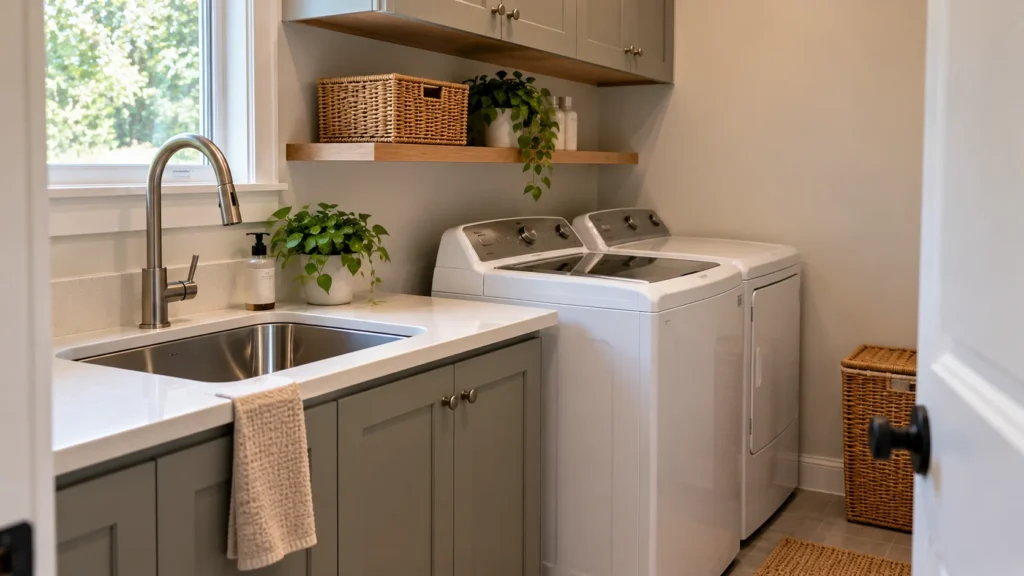
Consider these small laundry room sink ideas:
- Choose a sink size that fits the room’s actual workflow.
- Position it where plumbing can be handled appropriately.
- Use the cabinet beneath it for suitable storage.
- Keep laundry chemicals separated from clean towels.
- Use a small drying area beside the sink if possible.
- Install wall storage above nearby unused space.
- Keep the sink counter clear.
- Store hand-washing accessories together.
- Use a narrow faucet configuration when appropriate.
- Choose easy-clean surfaces around the sink.
- Avoid blocking appliance access.
- Keep a small basket for washable cleaning cloths.
- Use the area below the sink for organized supplies.
- Keep plumbing access available for maintenance.
- Make sure the sink does not reduce the room’s main walkway.
11. Choose a Design Style: Modern, Farmhouse, or Black and White
A small laundry room can still have a strong visual identity. The trick is to make decorative choices that support the room’s function instead of competing with storage. Modern rooms often benefit from simple cabinets, clean lines, minimal hardware, and restrained colors. Farmhouse spaces can use natural textures, baskets, wood details, and classic finishes.
For small black and white laundry room ideas, contrast can define the space without requiring many decorative pieces. White cabinetry with black hardware, patterned flooring, or a dark accent wall can create visual interest while keeping the overall palette controlled.
For a farmhouse-inspired space:
- Use warm wood accents.
- Add woven baskets.
- Choose simple cabinet hardware.
- Use a restrained patterned tile.
- Keep open shelving organized.
- Add a practical hanging rail.
- Use neutral textiles.
- Introduce texture through baskets rather than clutter.
- Choose classic rather than oversized décor.
- Keep appliances visually integrated.
For a modern room:
- Use flat or simple cabinet fronts.
- Keep storage visually consistent.
- Choose clean-lined shelves.
- Use a limited color palette.
- Hide backup supplies behind doors.
- Add simple task lighting.
- Use minimal decorative accessories.
- Select easy-clean finishes.
- Keep countertops uncluttered.
- Let functional storage become part of the design.
12. Small Laundry Room Wallpaper, Tile, Paint, and Flooring Ideas
Finishes can make a small laundry room feel more personal without taking up any physical space. Wallpaper can create a strong feature wall, tile can add durability and pattern, and paint can change the visual character of the room quickly. Because the room is small, you do not need large quantities of materials to make an impact.
Houzz’s laundry-room gallery shows a wide range of finishes, including ceramic tile, subway tile, mosaic surfaces, wallpaper, wood tones, and different cabinet colors, providing inspiration for compact spaces. (Houzz)
Small Laundry Room Paint Color Ideas
Consider:
- Soft white for a clean appearance.
- Warm white for a less stark atmosphere.
- Pale gray for a contemporary look.
- Soft green for a natural feel.
- Muted blue for a calm accent.
- Beige for warmth.
- A darker accent wall for contrast.
- Black and white for a graphic style.
- One continuous wall color to visually simplify the room.
- A ceiling color that complements the walls.
Small Laundry Room Tile Ideas
You can also consider:
- Simple subway tile.
- Small-format patterned tile.
- Light ceramic tile.
- Geometric accent tile.
- Neutral backsplash tile.
- Easy-clean wall surfaces.
- Coordinated floor and wall tones.
- A restrained black-and-white pattern.
- Wood-look tile for visual warmth.
- A simple backsplash behind a sink or counter.
Small Laundry Room Flooring Ideas
Choose flooring based on the room’s practical requirements, cleaning needs, installation conditions, and overall design. A small area means even a modest flooring pattern can become a major visual element, so balance bold patterns with simpler walls and storage.
Jump into Other Related Article
- How to Remove Peanut Butter Stains | Easy Ways to Clean Clothes, Fabric & More
- Does Rayon Shrink? What Happens in the Washer and Dryer
- How to Remove Coffee Stains | Easy Methods for Clothes, Teeth, Carpet & More
- How to Clean Suede Shoes | Easy Ways to Clean Suede at Home
- Best Stain Remover for Clothes | Complete Guide for Different Stains
13. Add Lighting That Makes Every Corner Useful
Lighting is often overlooked in compact laundry rooms, yet poor lighting can make an already small space feel more cramped. A single ceiling fixture may not illuminate shelves, cabinets, counters, or corners adequately. Layering general lighting with targeted illumination can make sorting, treating stains, folding, and organizing easier.
IKEA’s compact laundry-room examples also highlight practical lighting as part of a functional small-space setup. (IKEA)
Useful small laundry room lighting ideas include:
- Use bright general room lighting.
- Add under-cabinet lighting where suitable.
- Illuminate dark shelving.
- Place task lighting near folding areas.
- Use lighting that makes labels easy to read.
- Keep switches accessible.
- Avoid fixtures that interfere with cabinets or doors.
- Choose fixtures that suit the room’s moisture and electrical requirements.
- Use a simple fixture in a minimalist room.
- Add decorative lighting only when it does not reduce functionality.
14. Use DIY Improvements for a Budget-Friendly Makeover
You do not need to remodel the entire room to make a noticeable difference. Some of the most effective DIY small laundry room ideas involve organization rather than construction. Rearranging existing supplies, adding labels, installing simple hooks, changing storage containers, and creating a better sorting system can dramatically improve usability.
For renters or homeowners with limited budgets, prioritize changes that solve a specific problem first.
Try these simple upgrades:
- Declutter before buying storage.
- Repurpose suitable baskets you already own.
- Add adhesive or removable hooks where appropriate.
- Label storage containers.
- Create a dedicated stain-treatment basket.
- Add a simple hanging rail.
- Reorganize existing shelves by frequency of use.
- Replace mismatched containers with coordinated bins over time.
- Use a narrow trolley where a full cabinet is too expensive.
- Create a laundry-sorting station with separate baskets.
- Use the back of the door for lightweight storage.
- Add a simple shelf to an unused wall where appropriate.
- Paint a feature wall instead of remodeling every surface.
- Replace old hardware for a quick visual refresh.
- Make one improvement at a time and evaluate the result.
15. Organize a Small Closet or Hallway Laundry Room
A laundry closet or hallway laundry area needs to perform efficiently because it often has very little spare room. The best approach is to make the appliances the central element and build storage around them. Doors can conceal the machines when the area is near living spaces, while vertical shelving can make use of the wall space that remains.
Houzz examples include compact laundry installations created in extra closets and small hallway areas, including stacked full-size washer-and-dryer arrangements with adjustable shelving nearby. (Houzz)
For a small hallway laundry room:
- Use stacked appliances when appropriate.
- Install shallow shelves around the appliances.
- Keep the hallway clear.
- Use doors that do not interfere with appliance operation.
- Store laundry baskets vertically.
- Add hooks inside suitable doors.
- Keep everyday detergent near the machines.
- Place spare products higher up.
- Use a compact drying rack.
- Add a hanging rod for clothes that need immediate hanging.
- Keep visual clutter behind closed doors where possible.
- Choose finishes that connect with the surrounding hallway.
- Use consistent storage containers.
- Keep the floor mostly open.
- Make cleaning and maintenance access easy.
16. Small Mudroom Laundry Room Ideas
When laundry shares space with a mudroom, the room has to handle both clothing and household traffic. This makes zoning particularly important. Laundry supplies should stay near the appliances, while shoes, coats, bags, and outdoor items should have their own dedicated area.
For small mudroom laundry room ideas, consider:
- Add hooks for jackets and bags.
- Use a narrow bench if space permits.
- Place laundry baskets beneath seating where practical.
- Separate clean and dirty clothing zones.
- Use vertical cubbies.
- Add a tall cabinet for household supplies.
- Keep mudroom footwear away from clean laundry.
- Use washable baskets.
- Install a hanging rail for freshly dried clothing.
- Add a small shelf for everyday items.
- Keep the main walkway open.
- Use closed storage for visually messy items.
- Choose durable, easy-care finishes.
- Give every frequently used item a defined location.
- Keep laundry and entryway functions visually connected but physically organized.
17. Make the Room Feel Bigger With Smart Visual Choices
Storage solves the practical problem, but visual design can make a small room feel less crowded. The goal is not necessarily to make the room look enormous; it is to make the available space feel intentional and easy to navigate.
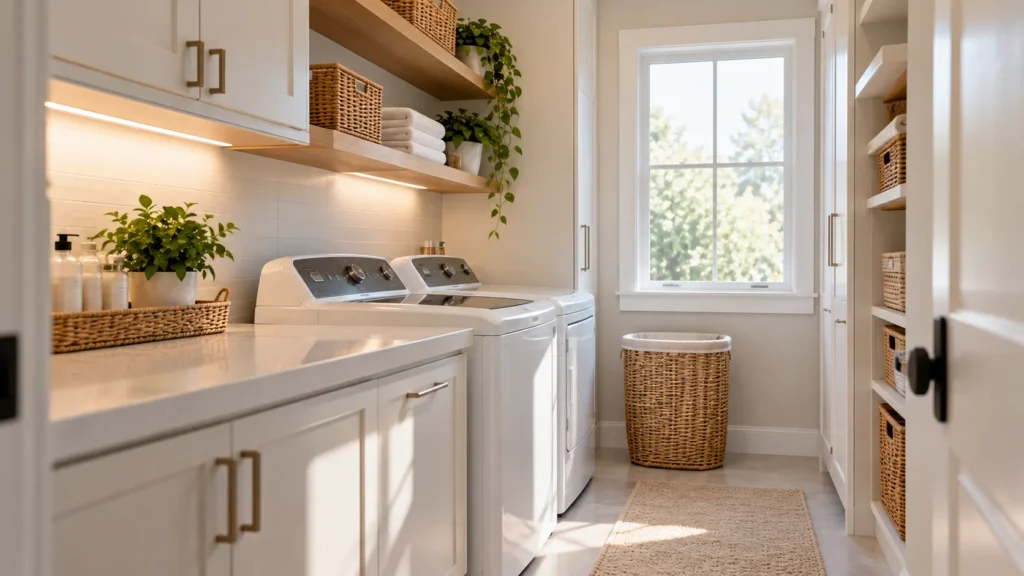
Use these small-space design principles:
- Keep the color palette controlled.
- Avoid filling every wall with decoration.
- Use vertical lines to draw the eye upward.
- Choose consistent storage containers.
- Use mirrors only where they genuinely help the layout.
- Keep countertops visually clear.
- Match cabinet and shelf finishes.
- Use light colors when they suit your style.
- Add one strong accent instead of many small ones.
- Keep bulky objects off the floor.
- Use baskets to contain visually similar items.
- Choose furniture and storage that match the room’s scale.
- Keep frequently used items accessible.
- Hide unnecessary packaging when practical.
- Maintain clear walking and working areas.
18. Create a Laundry Organization System That Stays Organized
A small laundry room becomes much easier to manage when every item has a designated home. Organization should not depend on constantly rearranging things. Instead, create simple zones for detergent, stain care, sorting, drying, folding, ironing, and household supplies.
IKEA’s small laundry examples use combinations of closed storage, open shelves, baskets, wall-mounted drying equipment, and interior cabinet organizers to keep supplies accessible while reducing clutter. (IKEA)
A simple maintenance system can include:
- Keep everyday detergent in one consistent location.
- Store backup products together.
- Use separate baskets for sorting laundry.
- Return hangers to the same location after use.
- Fold or store drying racks immediately after use.
- Keep stain-treatment products together.
- Remove empty containers promptly.
- Avoid using the washer or dryer as permanent storage.
- Review clutter regularly.
- Keep shelves from becoming catch-all spaces.
- Return cleaning tools to their assigned locations.
- Wash or clean laundry baskets when needed.
- Keep a small amount of open storage capacity.
- Adjust the system when your household’s laundry habits change.
- Do a quick reset after completing a laundry cycle.
19. Common Small Laundry Room Design Mistakes to Avoid
Even a well-designed room can become difficult to use if storage is added without considering the workflow. One common mistake is buying organizers before measuring the space. Another is using every available wall for cabinets and shelves without leaving room for movement, maintenance, or appliance access.
Avoid these problems:
- Buying storage without measuring first.
- Blocking a top-loader’s lid.
- Installing shelves too low above appliances.
- Overfilling cabinets.
- Keeping every cleaning product visible.
- Ignoring the door swing.
- Using bulky furniture in a narrow room.
- Creating too many different storage zones.
- Leaving no space for laundry baskets.
- Choosing decorative finishes before solving workflow issues.
- Storing food beside laundry chemicals.
- Putting heavy items in difficult-to-reach locations.
- Ignoring lighting.
- Forgetting where clean laundry will be folded.
- Treating the room as decoration instead of a working space.
Conclusion
The most effective small laundry room ideas combine storage, workflow, and design instead of treating each element separately. Stackable appliances can reduce the floor footprint, while cabinets, open shelves, baskets, hooks, drying racks, and narrow carts can turn unused walls and gaps into functional storage. A top-loading washer needs different overhead clearance from a front-loading or stacked arrangement, while a laundry room combined with a pantry or mudroom needs clearly separated zones. Small details such as lighting, paint, tile, wallpaper, and coordinated containers can then give the room a finished appearance.
You do not need a large renovation to create a better laundry space. Start by measuring the room, identifying its biggest problem, and assigning every important item a practical home. Whether you have a tiny closet, narrow hallway, basement utility area, mudroom, or compact dedicated laundry room, the strongest design is the one that makes washing, sorting, drying, folding, and storing clothes easier without wasting the limited space you already have.
1. What are the best small laundry room ideas?
The most useful ideas include vertical shelving, wall-mounted cabinets, stackable appliances where appropriate, slim rolling carts, hanging rails, fold-down drying racks, organized baskets, and compact folding surfaces. The best combination depends on the room’s dimensions and appliance configuration.
2. How do you organize a very small laundry room?
Start by measuring the room and removing items that do not need to stay there. Use vertical walls for storage, keep everyday supplies accessible, place backup products higher up, and use narrow or foldable storage wherever possible. Keeping the floor and main walkway clear can make the room considerably easier to use.
3. What are good small laundry room ideas with a top loading washer?
With a top-loading washer, the lid’s opening path needs to remain clear. Use higher wall shelves, side storage, narrow cabinets, hooks, or nearby shelving rather than placing an obstruction directly above the lid. Always measure the appliance with the lid open before installing overhead storage.
4. Are stackable washers and dryers good for small laundry rooms?
Stacked washer-and-dryer configurations can be useful when floor space is limited because they use vertical rather than side-by-side floor space. Houzz’s small laundry examples show stacked configurations used in compact rooms and closets with remaining space for shelving and storage. (Houzz)
5. How can I make a small laundry room look stylish without losing storage?
Choose a limited color palette, coordinate baskets and containers, use attractive open shelving selectively, and hide backup supplies behind cabinets. You can also introduce personality through paint, wallpaper, tile, lighting, hardware, or a small number of decorative pieces while keeping the main work areas clear.