
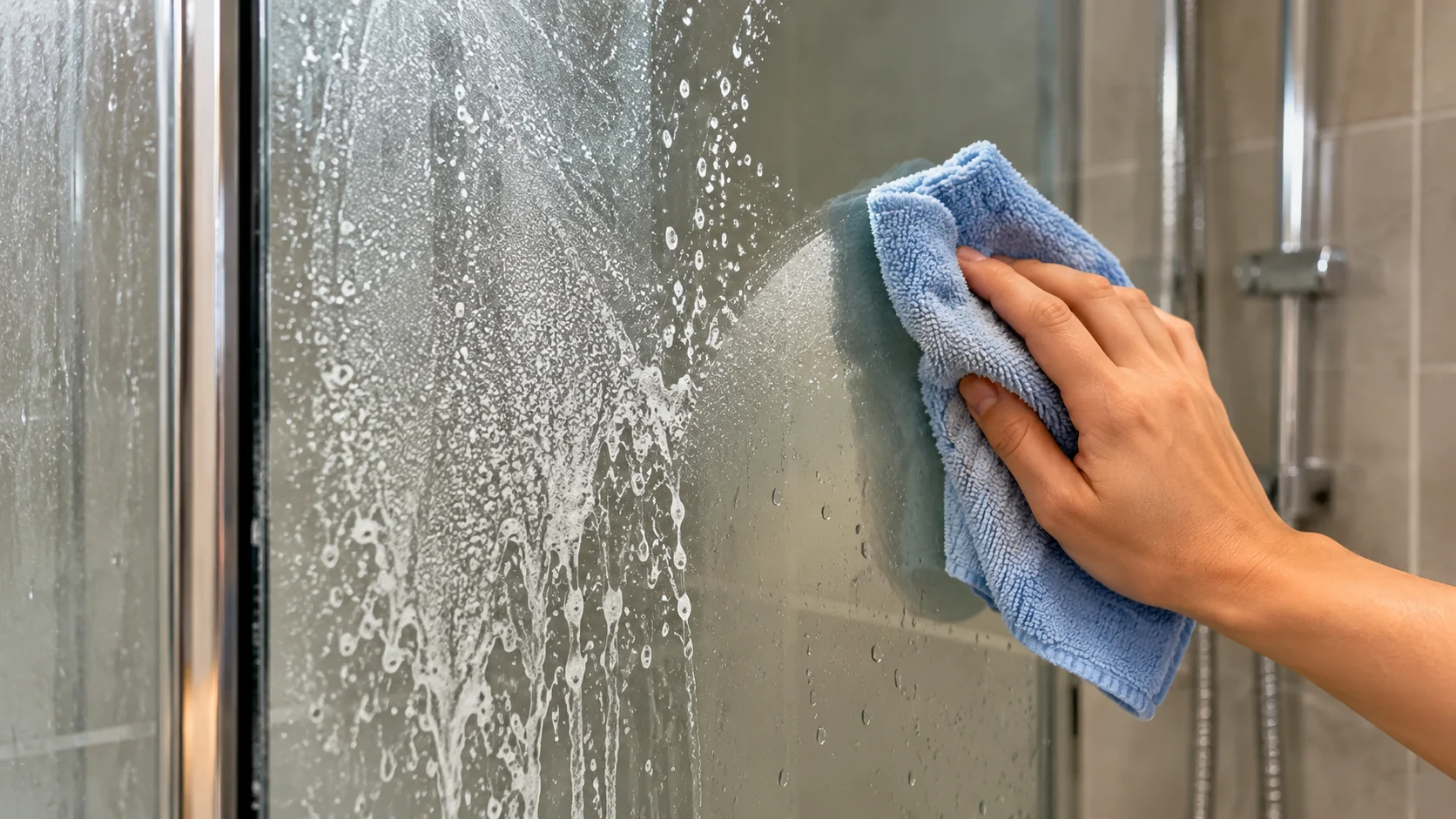
Learning how to clean shower glass helps keep your bathroom looking bright, fresh, and well-maintained. Glass shower doors can quickly develop cloudy water spots, white mineral deposits, soap scum, and a dull film that makes even a clean bathroom look dirty. These marks often become more difficult to remove when water droplets and soap residue are left to dry repeatedly on the glass. Fortunately, regular maintenance and the right cleaning method can restore clarity without requiring expensive equipment or harsh chemicals.
The best way to clean shower glass depends on the type of buildup and the glass finish. A mild glass-safe cleaner and a microfiber cloth may be enough for everyday marks, while stubborn soap scum may respond better to a suitable cleaner designed to break down that residue. Hard water stains can require a different approach because they contain mineral deposits rather than ordinary dirt. Delta Shower Doors recommends using appropriate, nonabrasive cleaning methods and avoiding products or tools that can damage glass treatments and hardware.
Why Does Shower Glass Get Dirty So Quickly?
Shower glass is exposed to water, soap, shampoo, conditioner, body oils, and bathroom humidity every day. When droplets dry on the surface, they can leave mineral deposits behind. Soap ingredients may also combine with minerals in hard water, creating a stubborn residue that clings to the glass. Over time, these deposits can build up into a cloudy layer that ordinary wiping may not remove.
The appearance of the glass can help you identify the likely problem. White circular spots often indicate mineral deposits from dried water. A cloudy or greasy film may be soap scum, while streaks can result from excess cleaner or an unclean cloth. Identifying the residue first helps you choose a suitable cleaning method instead of repeatedly scrubbing the glass with an ineffective product.
Common causes of dirty shower glass
- Hard water stains: Minerals in water can remain on the glass after droplets evaporate.
- Soap scum: Soap residue combines with minerals and other shower deposits.
- Shampoo and conditioner: Product splashes may leave a film on the surface.
- Body oils: Oils can contribute to a greasy-looking layer.
- Dried water spots: Droplets leave visible marks when they evaporate.
- Cleaning streaks: Excess cleaner or residue on a cloth can leave the glass looking cloudy.
- Bathroom humidity: Moisture can keep the shower area damp for longer.
- Infrequent cleaning: Repeated layers of residue become harder to remove.
Delta Shower Doors emphasizes using the right cleaning products and methods to protect shower glass and its surrounding components.
How to Clean Glass Shower Doors With Soap Scum
Soap scum can make glass shower doors look cloudy, greasy, or dull even after a quick rinse. Unlike ordinary water spots, soap scum often forms a sticky layer that collects around the edges, near handles, and along the bottom of the door.
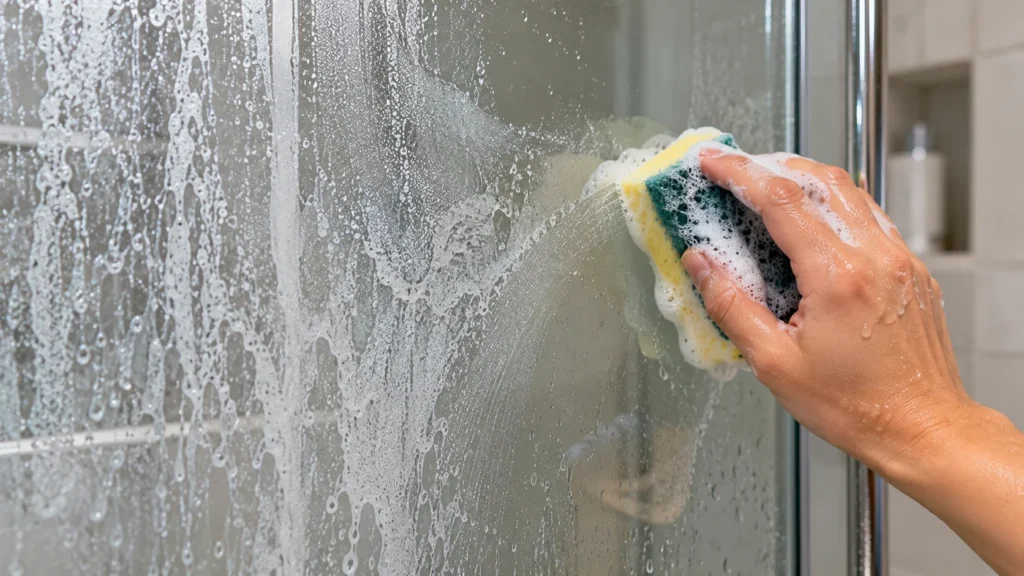
For this type of buildup, start with mild dishwashing liquid or a bathroom cleaner specifically labeled as safe for shower glass. Re-Bath recommends allowing a suitable cleaner to sit briefly, gently scrubbing with a nonabrasive sponge or soft brush, rinsing thoroughly, and drying the glass to reduce streaks.
Step-by-step soap scum removal
- Rinse the glass with warm water to loosen surface residue.
- Apply a glass-safe soap scum cleaner according to its label.
- Allow the product to sit for the recommended time.
- Gently scrub with a soft sponge or microfiber cloth.
- Focus on cloudy patches and areas near the handles.
- Use a soft brush around edges where residue collects.
- Rinse the glass thoroughly.
- Remove excess water with a clean squeegee.
- Wipe the glass dry with a fresh microfiber cloth.
- Inspect the surface in good lighting to check for remaining film.
Avoid aggressive scrubbing. Steel wool, abrasive scouring pads, and gritty powders can scratch glass or damage protective coatings. Delta recommends mild detergent, warm soapy water, and nonabrasive cleaning tools for its shower doors.
Can dish soap clean shower glass?
Yes, mild dishwashing liquid can help remove greasy soap residue from many glass shower doors. Use a small amount diluted in water, and rinse it off thoroughly. Do not assume that every concentrated cleaning product is suitable for every glass coating or metal finish; check the product label and the shower door manufacturer’s instructions first.
How to Clean Hard Water Stains From Glass Shower Doors
Hard water stains are usually mineral deposits left behind when water evaporates. They often appear as white rings, chalky spots, or cloudy patches that remain even after ordinary glass cleaner has been used.
The right treatment depends on the severity of the deposits and the materials surrounding the glass. A suitable acidic cleaner may dissolve some mineral buildup, but acidic products can damage natural stone, grout, metal finishes, and certain coatings. Southern Living explains that mineral deposits can require a different approach from the detergent-based cleaning used for soap scum.
Method 1: Use a cleaner made for hard water stains
For stubborn deposits, choose a product specifically labeled for shower glass and mineral buildup.
- Read the full product label.
- Confirm that the cleaner is safe for your type of glass.
- Check whether it is compatible with the surrounding metal and stone.
- Test it on a small, inconspicuous area.
- Apply it as directed.
- Use a soft cloth rather than an abrasive pad.
- Rinse thoroughly.
- Dry the glass to prevent new spots.
A purpose-made cleaner is often the most straightforward option when you do not know how a household acid might interact with the shower’s finishes.
Method 2: Consider diluted white vinegar, if the manufacturer permits it
Vinegar is acidic and can help dissolve certain mineral deposits. However, it is not appropriate for every shower enclosure, particularly when natural stone, sensitive grout, or a manufacturer-specific coating is present.
If your shower door instructions permit vinegar, you can use a diluted solution for suitable surfaces:
- Mix equal parts white vinegar and water in a clean spray bottle.
- Test the solution on a small, inconspicuous area.
- Apply it to the affected glass only.
- Leave it for a short period, following any manufacturer restrictions.
- Wipe gently with a soft cloth.
- Rinse thoroughly with clean water.
- Dry the glass completely.
Do not allow the solution to run onto marble, limestone, or other acid-sensitive stone. Do not combine vinegar with bleach or any other cleaning product.
Important: Delta Shower Doors specifically advises against several chemicals in its cleaning guidance, including hydrogen peroxide solution and certain solvents. Product compatibility varies, so the door manufacturer’s instructions should take priority over a generic home remedy.
What if hard water stains will not come off?
If the glass remains cloudy after suitable cleaning, the problem may not be removable residue. Long-term exposure to harsh chemicals or abrasive cleaning can damage the surface or a protective coating. In some cases, the glass itself may be etched.
Etching is different from a deposit sitting on top of the glass. More scrubbing may not restore the original clarity and could make the damage worse. Stop using stronger products if you cannot tell whether the marks are mineral buildup or permanent surface damage.
Jump into Other Related Article
- Laundry Dryer Vent Installation
- Does Rayon Shrink?
- How to Remove Coffee Stains
- How to Clean Suede Shoes
- Best Stain Remover for Clothes
- How to Clean Stainless Steel
- How to Clean Carpet Stains
- Oxygen Bleach
- Homemade Laundry Detergent
- All in One Washer Dryer
- Small Laundry Room Ideas
How to Clean Shower Glass With Vinegar
White vinegar is a popular household cleaning ingredient because its acidity can help loosen some mineral deposits. It may be useful for suitable glass surfaces, but it is not a universal solution for every shower door.
A cautious vinegar-cleaning method
- Check the shower door manufacturer’s care instructions.
- Confirm that vinegar is safe for the glass coating and nearby materials.
- Dilute white vinegar with water if the manufacturer permits its use.
- Test a small area first.
- Apply only to the intended glass surface.
- Wipe with a soft microfiber cloth.
- Rinse thoroughly.
- Dry with a squeegee and clean cloth.
Vinegar is not necessarily the best treatment for thick soap scum. A mild detergent or a suitable soap scum remover may work better for greasy residue, while a compatible acidic cleaner may be more effective against mineral deposits.
Should you mix vinegar and baking soda?
Mixing vinegar and baking soda produces bubbles, but the reaction also neutralizes much of the acidity of the vinegar. It should not be assumed that more fizz means better cleaning. Never add vinegar to a surface or drain that may contain bleach or another incompatible chemical.
For shower glass, it is generally more useful to identify the type of buildup and use one suitable cleaning product at a time.
How to Clean Shower Glass With Baking Soda
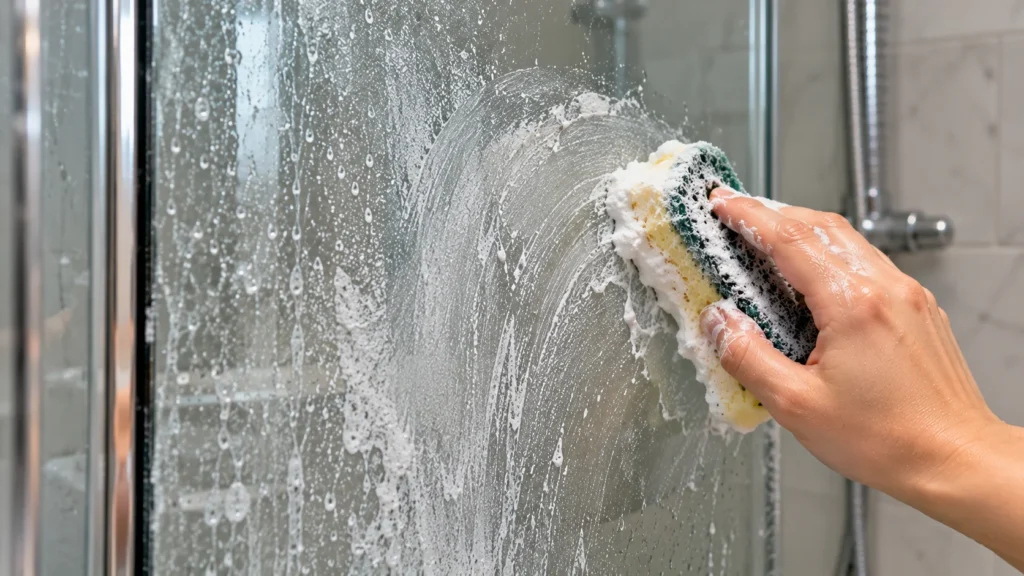
Baking soda is often recommended for stubborn soap scum because it can help loosen residue when used carefully. However, it is mildly abrasive, and some shower glass manufacturers advise against abrasive cleaning products. A baking soda paste should therefore not be your first choice for glass with a special coating or an unknown finish.
Southern Living describes baking soda as one possible approach for soap scum buildup, while also emphasizing gentle cleaning and precautions for delicate surfaces.
If baking soda is permitted for your shower glass
- Check the door manufacturer’s cleaning instructions.
- Test the method on a hidden area.
- Mix a small amount of baking soda with water to form a soft paste.
- Apply it gently to a small area of residue.
- Use a soft, nonabrasive cloth without pressing hard.
- Rinse the area thoroughly.
- Check for scratches, dullness, or changes in the coating.
- Stop if the surface appears damaged.
- Dry the glass with a microfiber cloth.
Avoid vigorous rubbing, especially on glass with a water-repellent treatment. If the manufacturer recommends only mild detergent and a soft cloth, follow that guidance instead of using baking soda.
Is baking soda better than vinegar?
Neither is best for every type of stain. Vinegar may help dissolve certain mineral deposits, while a suitable detergent is often a better choice for greasy soap scum. Baking soda may help with some residue but can pose an abrasion risk.
The most effective cleaning method is the one that targets the specific buildup without damaging the glass or its coating.
How to Clean Frosted Shower Glass
Frosted shower glass has a textured or etched appearance that provides privacy. Its surface may hold residue differently from smooth glass, particularly when the texture contains small grooves or irregularities.
Before cleaning frosted glass, determine whether the finish is etched into the glass, applied as a coating, or created through a textured treatment. Follow the manufacturer’s instructions because the safest cleaner can vary with the finish.
Cleaning steps for frosted glass
- Rinse the glass with clean water.
- Apply a mild detergent solution if approved for the surface.
- Use a soft microfiber cloth or gentle brush.
- Work carefully over textured areas without excessive pressure.
- Clean around the edges where soap residue collects.
- Rinse away all cleaning solution.
- Dry with a clean, soft cloth.
- Inspect the surface for remaining residue.
Avoid steel wool, abrasive powders, and harsh scrubbers. These can damage certain finishes and may leave visible changes in the glass appearance.
How to remove cloudy marks from frosted glass
First, clean the surface with an appropriate mild detergent. If cloudy marks remain, determine whether they are mineral deposits or part of the glass’s finish. Do not use an acidic cleaner unless the manufacturer confirms that it is compatible with the glass and surrounding materials.
If the frosted finish is permanently etched or damaged, ordinary cleaning may not restore its original appearance.
How to Clean Tempered Glass Shower Doors Without Scratching Them
Tempered glass is heat-treated glass used in many shower enclosures. Although it is designed for safety, it can still be scratched, damaged by unsuitable cleaning methods, or affected by incompatible products and coatings.
Delta recommends using a nonabrasive cloth or sponge and avoiding aggressive scrub brushes that could damage glass or a protective coating.
Best practices for scratch-free cleaning
- Use a clean microfiber cloth.
- Choose a mild detergent or approved glass cleaner.
- Rinse away loose grit before wiping.
- Avoid dry scrubbing over dusty or gritty surfaces.
- Do not use steel wool or metal scouring pads.
- Avoid abrasive powders unless the manufacturer specifically approves them.
- Use a soft sponge for stubborn residue.
- Test unfamiliar products on an inconspicuous area.
- Keep cleaning tools free from grit and debris.
- Follow the shower door manufacturer’s care instructions.
One of the simplest ways to avoid scratching shower glass is to remove loose particles with water before wiping the surface. Rubbing grit across the glass can create scratches even when the cloth itself feels soft.
What if your glass has a protective coating?
Some shower doors have factory-applied water-repellent coatings designed to reduce spotting and make cleaning easier. Delta’s SpotGuard coating, for example, is designed to resist water spots and soap scum buildup.
A coated door may require more careful product selection than untreated glass. Avoid assuming that a cleaner safe for ordinary glass is also safe for every coated surface.
How to Clean Shower Glass Door Tracks, Frames, and Seals
Even when the glass looks clean, dirt can collect in sliding-door tracks, around frames, beneath seals, and near hinges. These areas may trap hair, soap residue, dust, and moisture, which can make the whole shower enclosure appear dirty.
Cleaning the glass alone will not remove grime from these surrounding components.
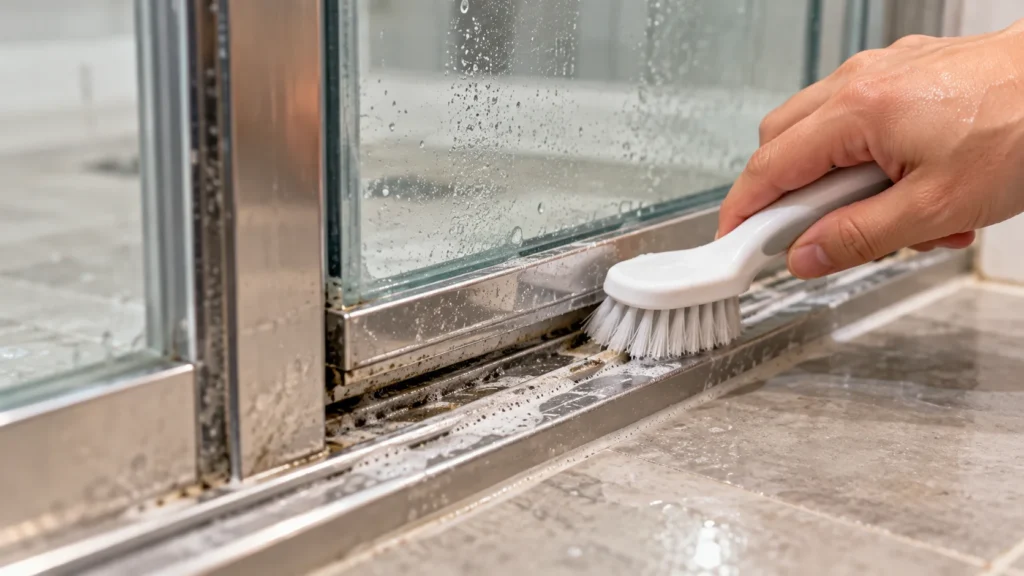
Cleaning sliding shower door tracks
- Open the door to expose the accessible track.
- Remove loose hair and dust with a cloth or suitable vacuum attachment.
- Apply a compatible bathroom cleaner.
- Use a small soft brush to clean corners and grooves.
- Wipe away the loosened dirt.
- Rinse only as appropriate for the track and surrounding materials.
- Dry the track thoroughly.
- Check that the door slides smoothly.
Do not flood a track with liquid if it contains components that should remain dry or if water could enter an area not designed to drain. Follow the enclosure manufacturer’s instructions.
Cleaning the rubber shower door seal
Rubber or vinyl seals can accumulate soap scum, mildew-like discoloration, and dirt.
- Wipe the seal with a damp microfiber cloth.
- Use mild soapy water if compatible with the material.
- Gently scrub grooves with a soft toothbrush.
- Rinse away residue.
- Dry the seal thoroughly.
- Check for cracks, brittleness, or loose sections.
If a seal is damaged, cleaning alone will not restore its function. Replace it with a compatible part if needed.
Cleaning metal frames and handles
Shower door hardware may be made from chrome, stainless steel, brushed nickel, or a coated finish. Use a cleaner suitable for the specific material, wipe gently, and dry after cleaning to reduce spotting.
Avoid letting acidic cleaners sit on metal finishes unless the manufacturer explicitly permits it. Rinse away accidental splashes promptly and follow the product instructions.
How to Keep Glass Shower Doors Clean Longer
The easiest way to maintain clean shower glass is to remove water before it dries and to prevent soap scum from building up over several weeks. Regular maintenance reduces the amount of scrubbing needed during a deep clean.
Delta recommends using a squeegee after each use and wiping the glass dry with a clean, soft microfiber cloth, particularly in areas with hard water.
Daily habits for clearer shower glass
- Use a squeegee after showering. Pull water from the glass toward the bottom so fewer droplets remain.
- Wipe the edges. Pay attention to corners and areas near the door frame.
- Dry the handles. Water and soap residue can collect around hardware.
- Keep the bathroom ventilated. Use the exhaust fan when available to help remove moisture.
- Avoid leaving products against the glass. Shampoo bottles can leave rings or residue where they touch the surface.
- Rinse away soap splashes. Do not allow thick residue to dry repeatedly.
- Keep a microfiber cloth nearby. A quick wipe is easier than a prolonged deep clean.
A simple weekly and monthly routine
| Frequency | Cleaning task |
| After each shower | Squeegee the glass and wipe away excess water |
| Weekly | Wipe the glass with a suitable mild cleaner |
| Every one to two weeks | Inspect and clean door edges, handles, and seals |
| Monthly or as needed | Deep-clean soap scum and persistent water spots |
| When buildup appears | Treat mineral deposits using a compatible product |
These are practical maintenance guidelines rather than fixed requirements. If your water leaves heavy deposits, you may need to wipe the glass more frequently.
Can you prevent hard water stains completely?
Daily drying can significantly reduce the amount of mineral residue left behind, but it may not eliminate spotting entirely. Water hardness, shower use, ventilation, and the type of glass coating all affect how quickly deposits appear.
If your shower has a water-repellent coating, follow the manufacturer’s maintenance instructions to preserve its performance.
Common Mistakes to Avoid When Cleaning Shower Glass
Using the wrong cleaner or tool can make shower glass look worse instead of better. Some stains are removable deposits, while others may be scratches, etching, or coating damage. Before trying a stronger treatment, make sure the problem is actually dirt or mineral buildup.
Avoid these common mistakes:
- Using abrasive scrubbers: Steel wool and rough pads can scratch glass or damage coatings.
- Scrubbing dry glass: Loose grit can scratch the surface when rubbed across it.
- Using too much cleaner: Excess product can leave streaks and residue.
- Ignoring the manufacturer’s instructions: Some doors have special finishes that restrict which products can be used.
- Mixing cleaning products: Combining incompatible products can release hazardous fumes.
- Using vinegar on every surface: Acidic cleaners can damage natural stone and certain finishes.
- Applying baking soda aggressively: Its abrasive properties may dull or scratch sensitive surfaces.
- Leaving cleaner on too long: Always follow the product’s recommended contact time.
- Forgetting to rinse: Residual cleaning solution can dry into streaks.
- Using a dirty cloth: Old residue and trapped grit can spread grime back onto the glass.
- Ignoring the door seals: Dirt and moisture can collect around seals even after the glass is cleaned.
- Assuming permanent marks are stains: Etching and coating damage may not respond to ordinary cleaning.
Delta advises testing a small, inconspicuous area before using a commercial cleaner and avoiding products that may damage its shower door finishes or coatings.
Conclusion
Learning how to clean shower glass becomes much easier when you identify the type of buildup before choosing a cleaning method. Mild detergent and a soft microfiber cloth are good starting points for everyday dirt and soap scum, while stubborn mineral deposits may require a compatible hard-water stain remover. Vinegar and baking soda are sometimes suggested as household solutions, but neither is suitable for every glass finish. Always check the manufacturer’s instructions, avoid abrasive tools, rinse thoroughly, and dry the surface to reduce streaks.
To keep glass shower doors clear for longer, use a squeegee after each shower, wipe away excess moisture, and clean the door edges, tracks, handles, and seals regularly. A short daily routine can prevent water spots and soap scum from becoming difficult to remove. If the glass remains cloudy after appropriate cleaning, consider whether the surface is etched or its protective coating is damaged rather than continuing to scrub it. With the right products and consistent care, your shower glass can stay cleaner and clearer without unnecessary effort.
1. What is the best way to clean shower glass?
The best starting point is a mild detergent or a glass-safe shower cleaner with a soft microfiber cloth or nonabrasive sponge. Rinse the surface thoroughly, use a squeegee to remove excess water, and dry the glass to reduce streaks. Always follow the manufacturer’s care instructions.
2. How do you remove hard water stains from glass shower doors?
Use a cleaner specifically designed for hard water stains and confirmed safe for your shower glass. A diluted vinegar solution may help with certain mineral deposits if the manufacturer permits it. Avoid acidic cleaners on natural stone and sensitive finishes, and test any unfamiliar product in a hidden area first.
3. How do you clean soap scum off shower glass?
Apply a suitable soap scum remover or mild detergent, allow it to work for the time specified on the label, and gently wipe the glass with a soft sponge. Rinse thoroughly and dry with a microfiber cloth. Avoid abrasive pads that could scratch the glass or damage a protective coating.
4. Can you use baking soda to clean glass shower doors?
Baking soda may help loosen some soap scum, but it is mildly abrasive and can damage certain glass finishes or coatings if used aggressively. Check the manufacturer’s instructions first. If the manufacturer recommends only mild detergent and a soft cloth, use that method instead.
5. How do you keep glass shower doors clean every day?
After each shower, use a squeegee to remove water from the glass and wipe the edges with a clean microfiber cloth. Keep the bathroom ventilated, rinse away soap splashes, and clean the door tracks and seals regularly. These habits help reduce water spots and prevent soap scum from accumulating.