
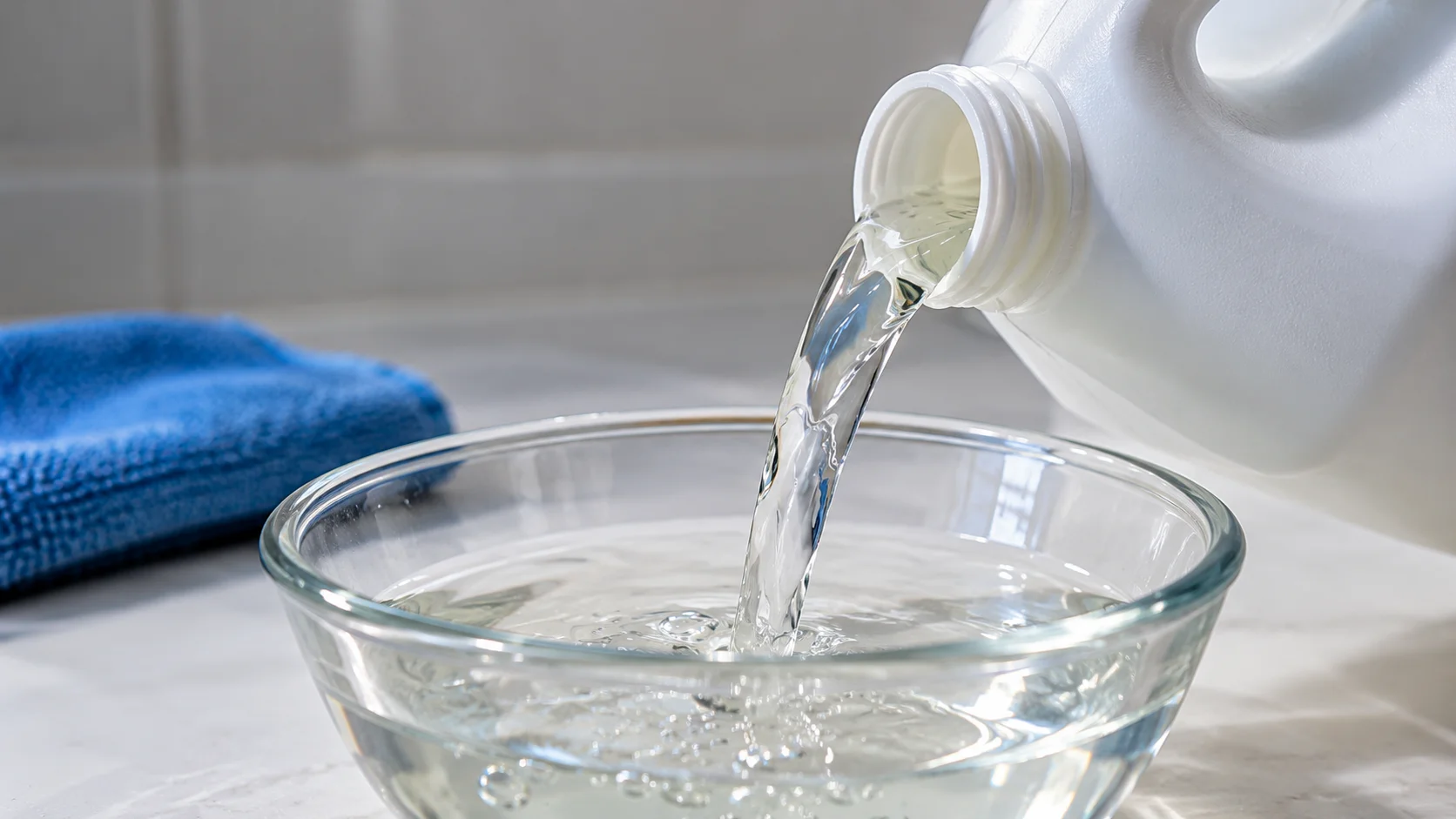
The pH of bleach is strongly alkaline, which is one reason bleach behaves differently from acidic household products. Most household chlorine bleach contains sodium hypochlorite (NaOCl) in water, and commercial bleach solutions are commonly formulated at a high pH to improve stability during storage. Depending on the product, concentration, formulation, age, and dilution, the measured pH can vary rather than being one universal number. For example, a Clorox Disinfecting Bleach safety data sheet lists a pH of 11.8–12.4, while scientific and government sources commonly describe household sodium hypochlorite bleach as having a pH around 12.
Understanding the ph level of bleach is useful when comparing household bleach, concentrated bleach, bleach water, chlorine solutions, and other cleaning chemicals. It is also important for safety because changing the pH of a sodium hypochlorite solution can change its chemical behavior. Most importantly, bleach should never be mixed with vinegar, acids, ammonia, or other cleaners because dangerous gases or other hazardous reactions can occur. The CDC specifically advises never mixing household bleach with another cleaner or disinfectant.
Jump into Other Related Article
- How to Remove Peanut Butter Stains
- Does Rayon Shrink?
- How to Remove Coffee Stains
- How to Descale a Coffee Maker with Vinegar
- Best Stain Remover for Clothes
- How to Clean Stainless Steel
- How to Clean Suede Shoes
What Is the pH of Bleach?
The pH of bleach is typically strongly alkaline, commonly around pH 11–13 for commercial sodium hypochlorite solutions, although the exact value depends on the formulation and concentration. Household bleach is not a neutral product like pure water, which has a pH close to 7 under ordinary conditions.
The high pH is associated with the alkaline conditions used to keep sodium hypochlorite solutions relatively stable. A CDC publication notes that common household bleach has a pH of approximately 12 to prolong its shelf life. Commercial bleach products can have different specifications, however, so the product’s safety data sheet or label is the best source for an exact product value.
Quick answer
- pH of household bleach: commonly around 11–13
- Typical household sodium hypochlorite bleach: approximately pH 12
- Clorox Disinfecting Bleach: 11.8–12.4 according to its SDS
- pH of diluted bleach: lower or otherwise different depending on dilution and water chemistry
- Neutral pH: 7
- Acidic pH: below 7
- Alkaline/basic pH: above 7
Because formulations differ, it is better to describe bleach as strongly alkaline rather than claiming that every bleach product has exactly the same pH.
What Is the pH Level of Bleach on the pH Scale?
On the standard pH scale of bleach, a household sodium hypochlorite solution falls on the alkaline side. The pH scale generally runs from 0 to 14, with 7 considered neutral, values below 7 considered acidic, and values above 7 considered alkaline.
A simplified comparison makes the position of bleach easier to understand:
| Substance or solution | Approximate pH category |
| Strong acids | Very low pH |
| Vinegar | Acidic |
| Pure water | Around neutral |
| Baking soda solution | Mildly alkaline |
| Household sodium hypochlorite bleach | Strongly alkaline |
| Concentrated sodium hypochlorite products | Strongly alkaline |
The exact pH of a product should not be inferred solely from its name. Different bleach products may contain different concentrations of sodium hypochlorite and other ingredients, so their measured pH can vary.
The chemical composition also matters. Sodium hypochlorite is the active ingredient in many chlorine bleach products, and CDC information identifies liquid sodium hypochlorite as one of the principal forms of hypochlorite disinfectants.
What Is the pH of Household Bleach?
The pH of household bleach is usually around 11 to 13, with approximately 12 being a useful general reference for conventional sodium hypochlorite bleach. This is not an exact specification for every brand or bottle.
For example, the Clorox Disinfecting Bleach SDS reports a pH range of 11.8–12.4. A CDC scientific article also describes common household bleach as having a pH of about 12. These sources support the commonly cited figure of approximately pH 12 while showing why a range is more accurate than a single universal number.
The concentration of sodium hypochlorite is another important variable. The CDC says that most household bleach products used for household disinfection in the United States contain approximately 5%–9% sodium hypochlorite, although products and intended uses vary.
Why household bleach has a high pH
A high pH helps maintain the chemistry of sodium hypochlorite solutions during storage. This is one reason commercial bleach is formulated as an alkaline solution rather than being sold as a neutral liquid.
That does not mean you should try to adjust the pH yourself. Altering bleach chemistry can affect its stability, performance, and safety.
What Is the pH of Sodium Hypochlorite Bleach?
The pH of household bleach sodium hypochlorite solutions is generally strongly alkaline. Commercial sodium hypochlorite solutions are commonly formulated in the approximate 11–12.5 range, although stronger or specially formulated products can differ.
A chemistry reference from Wiley describes commercial sodium hypochlorite solutions as typically having a pH of 11–12.5, with the ability to be adjusted or buffered depending on the formulation.
Sodium hypochlorite has the chemical formula NaOCl. In water, it participates in chemical equilibria involving hypochlorous acid and hypochlorite ions. The relative proportions of these forms are influenced by pH.
This is important because pH is not merely a number printed on a bottle. It is connected to how chlorine-containing chemistry behaves in solution.
What Is the pH of Clorox Bleach?
The pH of Clorox bleach depends on the exact Clorox product, so it is better not to give one number for every Clorox-branded bleach.
For example, the Clorox Disinfecting Bleach SDS lists a pH of 11.8–12.4 for the product covered by that document. That provides a reliable product-specific reference for the question what is the pH of Clorox bleach?
This also explains why online answers that simply state Clorox has a pH of 13 can be misleading. Product formulations, concentrations, and intended applications can differ.
What about the pH level of Clorox bleach after dilution?
Dilution changes the chemical environment and can change the measured pH. The final value depends on the bleach concentration, dilution water, temperature, and other conditions.
For that reason, you should follow the product label or manufacturer’s instructions rather than attempting to create a particular pH by adding another chemical.
What Is the pH of Chlorine Bleach?
The phrase chlorine bleach usually refers to bleach containing a chlorine-based active ingredient such as sodium hypochlorite. For typical household sodium hypochlorite bleach, the pH is strongly alkaline.
The CDC identifies aqueous sodium hypochlorite as a widely used chlorine disinfectant and notes that household bleach commonly contains sodium hypochlorite in the several-percent range.
It is important to distinguish chlorine bleach from every product that happens to be called bleach. Hair bleach, oxygen bleach, and chlorine bleach are not interchangeable chemical products.
- Chlorine bleach: commonly based on sodium hypochlorite.
- Oxygen bleach: commonly uses oxygen-releasing compounds rather than sodium hypochlorite.
- Hair bleach: generally uses oxidizing ingredients designed for cosmetic hair-lightening applications.
- Pool chlorine products: may contain sodium hypochlorite, calcium hypochlorite, or other chlorine chemistry.
Therefore, searching for the pH of bleach without identifying the type can produce conflicting answers.
What Is the pH of Concentrated Bleach?
The pH of concentrated bleach is generally strongly alkaline, but there is no single pH that applies to every concentrated bleach product.
Commercial sodium hypochlorite products can be sold at concentrations substantially higher than ordinary household laundry bleach. A chemistry reference describes commercial sodium hypochlorite solutions in concentrations extending beyond typical household formulations and notes that commercial bleach commonly has a pH around 11–12.5.
The term concentrated bleach can also be used differently by manufacturers. Therefore, concentration should always be checked from the product label or safety data sheet rather than estimated from pH alone.
Does a higher pH always mean stronger bleach?
No. pH and available chlorine concentration are different measurements.
A bleach product can have a high pH without allowing you to determine its exact sodium hypochlorite concentration from the pH alone. Likewise, two products with similar pH values can have different available chlorine concentrations.
For practical use, follow the product’s specified concentration and directions rather than using pH as a substitute for those instructions.
What Is the pH of Liquid Bleach?
The pH of liquid bleach depends on what type of liquid bleach is being discussed. For ordinary liquid chlorine bleach based on sodium hypochlorite, the solution is alkaline and commonly falls around pH 11–13.
The Clorox Disinfecting Bleach SDS, for example, reports a pH of 11.8–12.4.
However, liquid bleach is not a sufficiently precise chemical description by itself. Some liquid products sold as bleaches may use different active ingredients, concentrations, fragrances, stabilizers, or other formulation components.
When an exact pH matters, use the manufacturer’s SDS rather than assuming every liquid bleach has the same pH.
What Is the pH of Bleach Solution After Dilution?
The pH of a bleach solution after dilution is not necessarily the same as the pH of the original bleach. Diluting sodium hypochlorite with water changes its concentration and chemical equilibrium.
The final pH can also depend on the water being used. Water chemistry, temperature, and the original bleach formulation can influence the measured result.
For household cleaning or disinfection, there is usually no reason to adjust bleach to a target pH yourself. The CDC recommends using appropriate household bleach and following the instructions for preparing the intended dilution.
Bleach water is different from bottled bleach
This distinction is important:
Bottled bleach = concentrated commercial product containing sodium hypochlorite and other formulation ingredients.
Bleach water = a diluted solution prepared by adding bleach to water.
Because the concentrations differ, their chemical properties and appropriate uses also differ.
What Is the pH of Bleach Water?
The pH of bleach water depends on how much bleach is diluted into the water and on the characteristics of the water itself. It will generally remain on the alkaline side when sodium hypochlorite is diluted, but the exact pH should not be guessed.
The CDC recommends following product directions when preparing bleach solutions and emphasizes using the appropriate concentration for the intended purpose.
For example, CDC guidance for certain household disinfection situations specifies ordinary unscented bleach with a sodium hypochlorite concentration of 5%–9% and provides specific dilution instructions. Those instructions are designed for the particular application and should not be generalized to every cleaning task.
What Is the pH of Laundry Bleach?
When laundry bleach means traditional chlorine bleach, it is usually a sodium hypochlorite solution and therefore strongly alkaline. The pH is commonly in the same general range as household chlorine bleach.
However, laundry products can differ. Some are chlorine-free or oxygen-based bleaches and have different chemistry.
Before using bleach on fabric:
- Read the garment care label.
- Check whether the fabric permits chlorine bleach.
- Follow the bleach manufacturer’s instructions.
- Use the recommended dilution rather than creating a stronger mixture.
- Do not combine bleach with other laundry chemicals unless the product instructions explicitly permit it.
The CDC notes that sodium hypochlorite can cause irritation and burns at household bleach concentrations, while also warning about its corrosive and reactive properties.
What Is the pH of Bleach and Vinegar Together?
This is one of the most important safety questions about the pH of bleach and vinegar.
Do not mix bleach and vinegar.
Vinegar is acidic, while sodium hypochlorite bleach is strongly alkaline. Adding an acid to hypochlorite chemistry can promote the release of chlorine gas, which can be dangerous to breathe.
The CDC explicitly warns that household bleach should never be mixed with other cleaners or disinfectants. CDC chemical-safety information also identifies acidic cleaning agents as incompatible with sodium hypochlorite because chlorine gas can be released.
So the question should not be treated as a simple what pH do they make? experiment. The mixture creates a chemical safety hazard.
Never mix bleach with:
- Vinegar
- Toilet-bowl cleaners
- Acidic descalers
- Ammonia
- Ammonia-containing cleaners
- Other disinfectants
- Unknown cleaning chemicals
If bleach is accidentally mixed with another cleaner and irritating fumes develop, move away from the area and seek appropriate emergency or poison-control guidance rather than attempting to neutralize the mixture yourself. The CDC advises avoiding exposure to chlorine gas and emphasizes ventilation and safe handling.
What Is the pH of Hair Bleach?
The phrase pH of hair bleach can be confusing because cosmetic hair-lightening products are not necessarily the same thing as household chlorine bleach.
Hair-lightening products may contain ingredients such as persulfate compounds and hydrogen peroxide systems, depending on the formulation. Their pH is controlled for the cosmetic process and can differ substantially from sodium hypochlorite household bleach.
Therefore:
Do not use the pH of household chlorine bleach as the pH of hair bleach.
Likewise, household chlorine bleach should never be used as a substitute for a cosmetic hair-lightening product.
If you are working with a specific hair product, its packaging or manufacturer documentation is the appropriate source for its pH.
What Is the Typical pH Range of Bleach?
For ordinary sodium hypochlorite bleach, a practical general range is about pH 11–13, with many household products clustering around approximately pH 12.
There is good evidence for using a range rather than a single number:
| Bleach type | Typical pH description |
| Household sodium hypochlorite bleach | Strongly alkaline, often around 11–13 |
| Conventional household bleach | Often approximately 12 |
| Clorox Disinfecting Bleach example | 11.8–12.4 |
| Concentrated sodium hypochlorite | Strongly alkaline; formulation-dependent |
| Diluted bleach solution | Changes with dilution and water chemistry |
| Oxygen bleach | Different chemistry; do not assume sodium hypochlorite pH |
| Hair bleach | Different cosmetic chemistry; product-specific |
| Pool chlorine | Product-specific; may use different hypochlorite compounds |
A scientific review/reference describes commercial bleach as typically having a pH around 11–12.5, while a CDC publication gives approximately pH 12 for common household bleach.
Why Does Bleach Have a High pH?
The high pH balance of bleach is connected to the stability and chemistry of sodium hypochlorite solutions.
Sodium hypochlorite exists in an aqueous chemical system involving hypochlorite and hypochlorous acid. As pH changes, the relative distribution of these chemical forms changes. This is one reason pH can influence how hypochlorite solutions behave.
A CDC study discussing hypochlorite specifically notes that common household bleach has a pH around 12 to help prolong shelf life.
This also explains why randomly adding an acidic substance to bleach is not a safe way to balance its pH. Changing pH can change the chemistry of the solution and may create hazardous conditions.
Does Bleach Have a pH of 12 or 13?
Both numbers can appear in online discussions because bleach does not have one universal pH.
If someone asks, Bleach has a pH of what?, a reasonable general answer is:
Household sodium hypochlorite bleach is strongly alkaline and is commonly around pH 12, with actual commercial products varying by formulation.
For example, Clorox Disinfecting Bleach is documented at pH 11.8–12.4.
Some products may measure higher or lower depending on concentration and formulation. Therefore, saying that typical household bleach always has a pH of exactly 13 is too broad.
What Is the pH of 10% Bleach?
The pH of 10% bleach cannot be determined accurately from the 10% concentration alone.
First, 10% bleach can refer to different ways of expressing concentration, such as sodium hypochlorite concentration or available chlorine, depending on the product and documentation. Second, formulation and stabilization can affect pH.
A higher sodium hypochlorite concentration does not give you a simple mathematical formula for calculating pH.
For a particular 10% sodium hypochlorite product, check its Safety Data Sheet (SDS) for the manufacturer’s measured pH. This is much more reliable than assuming that every 10% solution has the same pH.
How Does pH Affect Sodium Hypochlorite?
pH affects the chemical balance of a sodium hypochlorite solution. Hypochlorite chemistry is therefore more complicated than simply saying higher pH means stronger bleach.
The effectiveness and stability of a hypochlorite solution can depend on several factors:
- Sodium hypochlorite concentration
- Available chlorine concentration
- pH
- Temperature
- Organic matter
- Storage time
- Light exposure
- Water chemistry
- Intended application
CDC information notes that the effectiveness of hypochlorite solutions can depend on factors including concentration and pH.
This is why professional disinfection procedures specify concentration, contact time, application method, and other conditions rather than relying on pH alone.
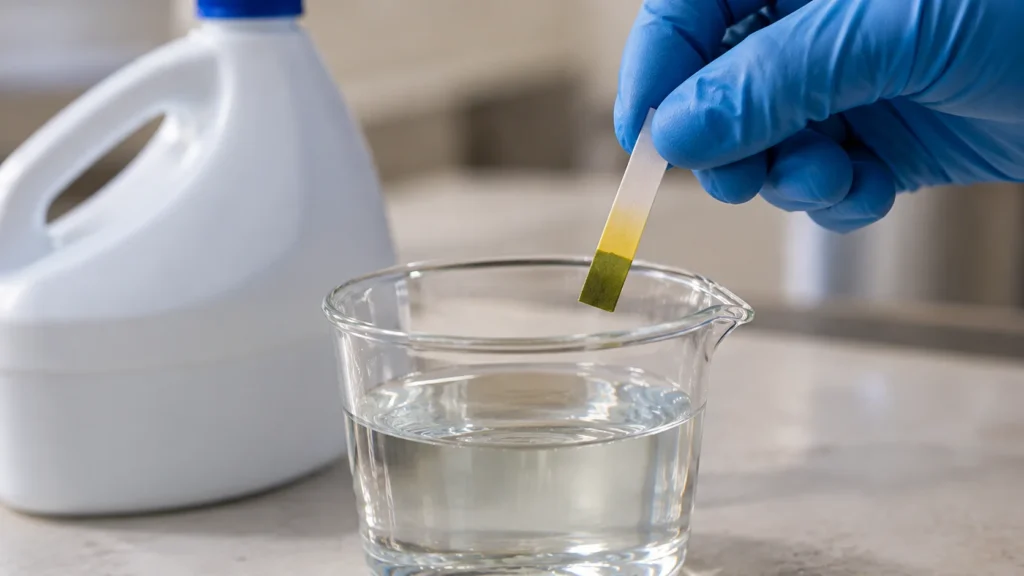
Can You Test the pH of Bleach?
Technically, pH can be measured with appropriate laboratory equipment, but testing household bleach is not necessary for ordinary cleaning.
If you are measuring a chemical solution in a controlled setting, use equipment designed for the substance and follow appropriate laboratory safety procedures. Household pH strips may not provide the accuracy needed for concentrated chemical solutions.
For normal household use, the safer approach is:
- Identify the exact product.
- Read the label.
- Check the manufacturer’s SDS if you need technical specifications.
- Follow the stated dilution and application instructions.
- Never add acids or other chemicals simply to change the pH.
The manufacturer’s documentation is particularly important because pH can vary between bleach formulations.
Is a High pH the Reason Bleach Is Dangerous?
The high pH contributes to the chemical properties of bleach, but pH alone does not explain all of bleach’s hazards.
Sodium hypochlorite is a reactive oxidizing chemical. Household bleach can irritate or burn tissue at sufficiently high concentrations, and accidental mixing with incompatible substances can release hazardous gases.
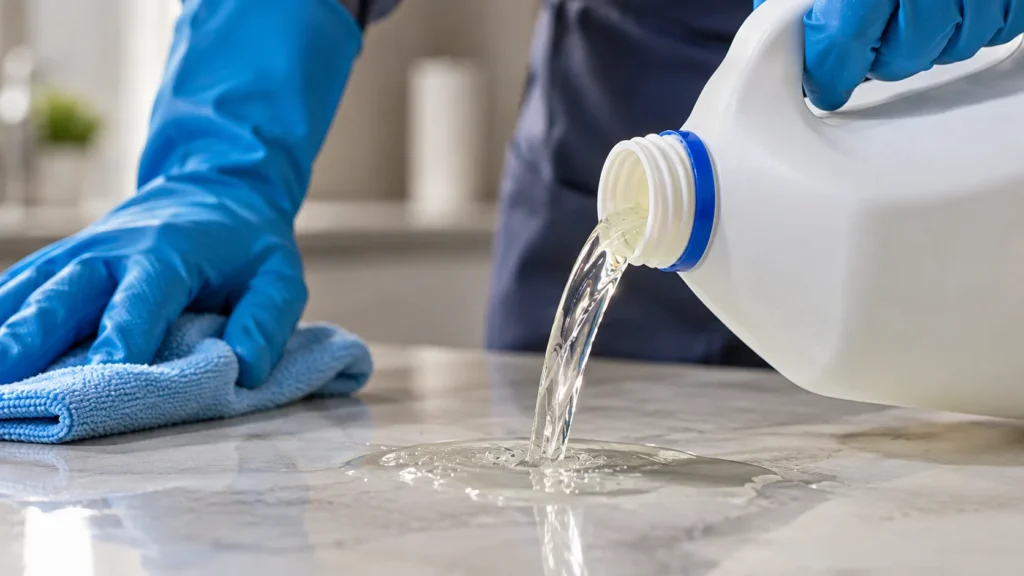
The CDC states that household bleach at common sodium hypochlorite concentrations can cause ocular irritation and burns and can release toxic chlorine gas when mixed with acids or ammonia.
Safe handling therefore depends on more than knowing the pH.
Basic bleach safety checklist
- Use bleach only for its intended purpose.
- Follow the product label.
- Provide good ventilation.
- Avoid prolonged skin contact.
- Use appropriate protective equipment when recommended.
- Keep bleach away from children and pets.
- Never mix bleach with vinegar.
- Never mix bleach with ammonia.
- Never combine bleach with an unknown cleaner.
- Store the product as directed.
- Do not assume that all bleach products have identical concentrations.
- Do not deliberately adjust bleach pH at home.
Does Diluting Bleach Make It Safe?
Dilution reduces the concentration of sodium hypochlorite, but diluted bleach is not automatically harmless.
The correct dilution depends on the intended application and the product’s starting concentration. The CDC provides application-specific guidance and stresses following product instructions.
Dilution also does not make it safe to mix bleach with vinegar or another cleaner. Chemical incompatibility remains a concern.
If you need bleach for disinfection, use the concentration and contact time specified for that particular use instead of assuming that more bleach or less bleach is better.
Bleach pH vs Vinegar pH: Why the Difference Matters
Bleach and vinegar sit on opposite sides of the pH scale:
| Product | General pH character |
| Household sodium hypochlorite bleach | Strongly alkaline |
| Vinegar | Acidic |
| Water | Approximately neutral |
| Baking soda solution | Mildly alkaline |
The difference between bleach and vinegar is chemically significant. Do not interpret their opposite pH values as an invitation to combine them.
Acids can react with hypochlorite and lead to chlorine gas formation. The CDC specifically lists acidic cleaning agents among substances that can be incompatible with sodium hypochlorite.
Common Mistakes About the pH of Bleach
Several common statements about bleach pH are oversimplified.
Mistake 1: All bleach has a pH of 13.
Not necessarily. Household sodium hypochlorite products can vary, and one Clorox product is documented at pH 11.8–12.4.
Mistake 2: pH tells you how strong the bleach is.
pH and bleach concentration are different measurements. You cannot accurately determine sodium hypochlorite concentration from pH alone.
Mistake 3: Adding vinegar makes bleach stronger.
Adding vinegar to bleach is dangerous and can release chlorine gas. It should never be done.
Mistake 4: Hair bleach and household bleach have the same pH.
They are different product categories with different chemical systems.
Mistake 5: Every chlorine product has the same pH.
Pool products, household bleach, commercial hypochlorite solutions, and formulated cleaners can differ.
Mistake 6: Diluted bleach is just water.
No. Dilution reduces concentration but does not turn the solution into ordinary water.
What Is the Actual pH of Bleach?
If the question is what is the actual pH of bleach?, the most accurate answer is that there is no single actual pH for every bleach product.
For household sodium hypochlorite bleach, a practical range is roughly 11–13, with around pH 12 being a useful general reference. A specific product should be checked through its technical documentation. For example, Clorox Disinfecting Bleach is listed at 11.8–12.4, while CDC literature describes common household bleach at approximately pH 12.
The concentration, formulation, storage conditions, dilution, and water chemistry can all affect the measured value.
Quick Reference: pH Levels of Bleach
If you need a concise answer for the most common searches around this topic, use the following guide:
| Search question | Answer |
| What is the pH of bleach? | Usually strongly alkaline, commonly around 11–13 for sodium hypochlorite bleach. |
| What is the pH of household bleach? | Commonly around pH 12, depending on formulation. |
| What is the pH level of bleach? | Typically strongly alkaline. |
| What is the pH value of bleach? | Often approximately 12 for household sodium hypochlorite bleach. |
| What is the pH of Clorox bleach? | Product-specific; Clorox Disinfecting Bleach SDS lists 11.8–12.4. |
| What is the pH of chlorine bleach? | Generally strongly alkaline when based on sodium hypochlorite. |
| What is the pH of bleach solution? | Depends on concentration, dilution water, and formulation. |
| What is the pH of concentrated bleach? | Strongly alkaline, but the exact value depends on the product. |
| What is the pH of bleach water? | Depends on the dilution and water chemistry. |
| What is the pH of laundry bleach? | Usually alkaline when it is sodium hypochlorite chlorine bleach. |
| What is the pH of bleach and vinegar? | Do not mix them; the combination can release dangerous chlorine gas. |
| What is the pH of hair bleach? | Product-specific and chemically different from household chlorine bleach. |
| Does bleach have a pH of 12? | Many household sodium hypochlorite products are around pH 12, but exact values vary. |
| Does typical household bleach have a pH of 13? | Some formulations may approach that range, but 13 should not be treated as a universal household-bleach value. |
Conclusion
The pH of bleach is strongly alkaline, and ordinary household sodium hypochlorite bleach is commonly around pH 12, with many products falling broadly in the 11–13 range. A product-specific example is Clorox Disinfecting Bleach, whose SDS reports a pH of 11.8–12.4. The exact pH can vary according to sodium hypochlorite concentration, formulation, stabilization, dilution, and other conditions.
The most important takeaway is that pH should not be used as a substitute for understanding bleach concentration or following product instructions. Never mix bleach with vinegar, acids, ammonia, or unknown cleaners. The CDC recommends using bleach according to its intended application, maintaining ventilation, and avoiding combinations with other cleaning chemicals because hazardous reactions and gases can result.
1. What is the pH of household bleach?
Household sodium hypochlorite bleach is strongly alkaline and is commonly around pH 12, although actual products can vary. A Clorox Disinfecting Bleach SDS lists pH 11.8–12.4.
2. What is the pH of Clorox bleach?
The exact value depends on the specific Clorox product. For Clorox Disinfecting Bleach, the manufacturer’s SDS reports a pH of 11.8–12.4. Therefore, it is more accurate to check the documentation for the exact product than to assign one pH to every Clorox bleach.
3. What is the pH of sodium hypochlorite bleach?
Commercial sodium hypochlorite solutions are generally strongly alkaline. A chemistry reference gives a typical commercial bleach range of approximately pH 11–12.5, while other household formulations can vary.
4. What happens to the pH when bleach is mixed with vinegar?
Bleach should never be mixed with vinegar. Vinegar is acidic, and adding an acid to sodium hypochlorite can result in the release of dangerous chlorine gas. The CDC specifically advises against mixing bleach with other cleaners and disinfectants.
5. Is bleach acidic or alkaline?
Household chlorine bleach based on sodium hypochlorite is alkaline, not acidic. Its pH is generally well above neutral, commonly around pH 12 for conventional household products.