
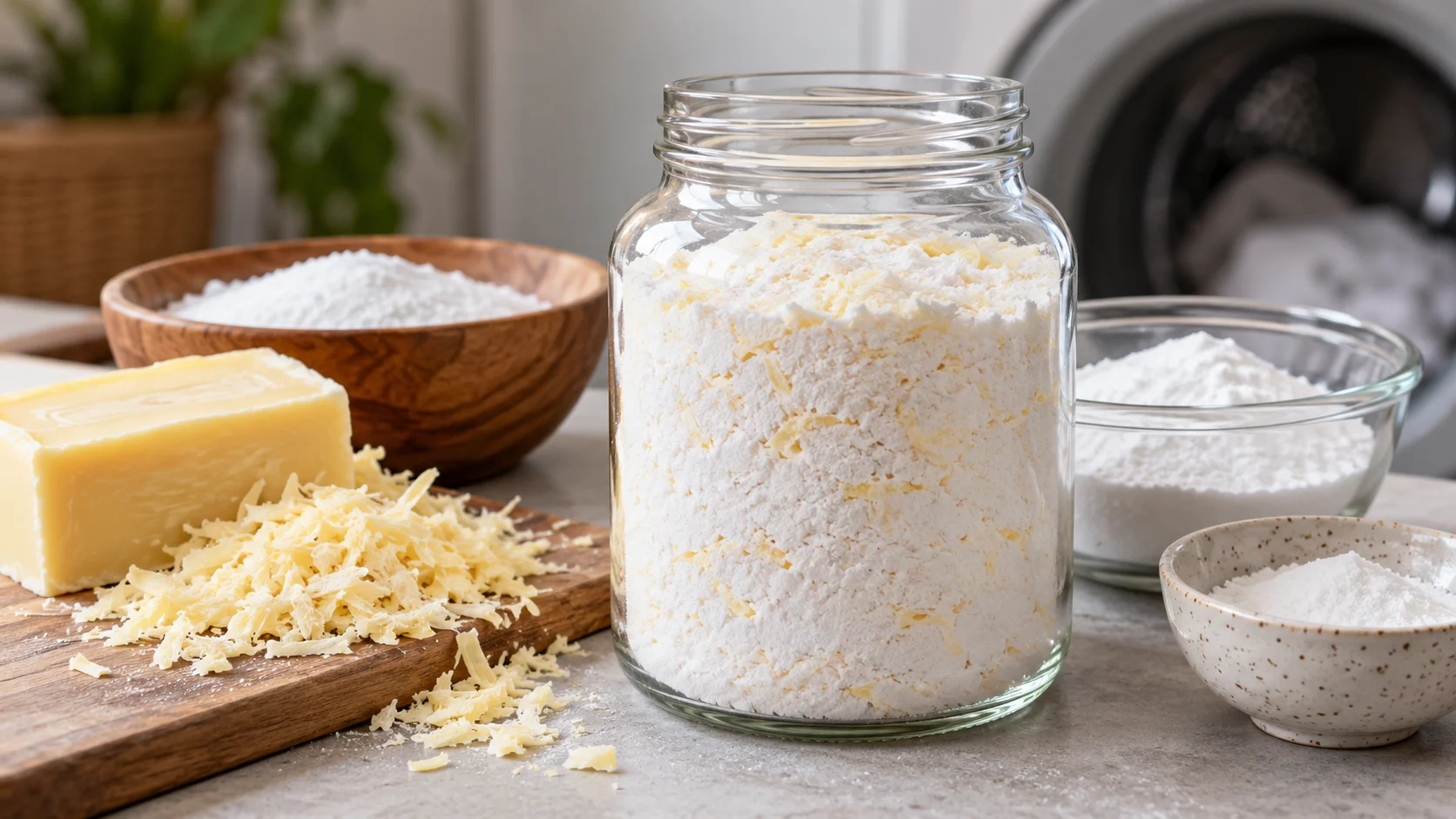
A homemade laundry detergent recipe usually combines a small number of household cleaning ingredients into a powder or liquid mixture intended for washing clothes. Common DIY recipes use ingredients such as washing soda, baking soda, Borax, and grated laundry bar soap. These recipes are popular because they are inexpensive to prepare, easy to customize, and give users control over the ingredients they put into a laundry mixture. However, an important distinction is often missed: many recipes called homemade laundry detergent are actually homemade laundry soap mixtures, because soap and modern synthetic laundry detergents are chemically different. The American Cleaning Institute explains that soap can react with hard-water minerals and form insoluble soap curd, which can deposit on fabrics and washing machines.
Homemade formulas also deserve more caution than their simple ingredient lists suggest. Commercial detergents are formulated and tested for particular washing conditions, while DIY recipes generally do not have the same performance testing, dosing instructions, compatibility testing, or standardized safety labeling. ACI specifically advises consumers to consider whether a homemade cleaner has actually been tested for cleaning performance and whether its ingredients are safe when combined. This guide therefore covers practical homemade laundry detergent recipes, including powder and liquid versions, while clearly explaining their limitations, Borax safety, HE washer compatibility, ingredients, storage, and when a commercial detergent may be the more appropriate option.
What Is Homemade Laundry Detergent?
Homemade laundry detergent is a DIY cleaning mixture prepared at home rather than purchased as a finished commercial laundry detergent. Most traditional recipes combine alkaline builders with soap or other cleaning ingredients.
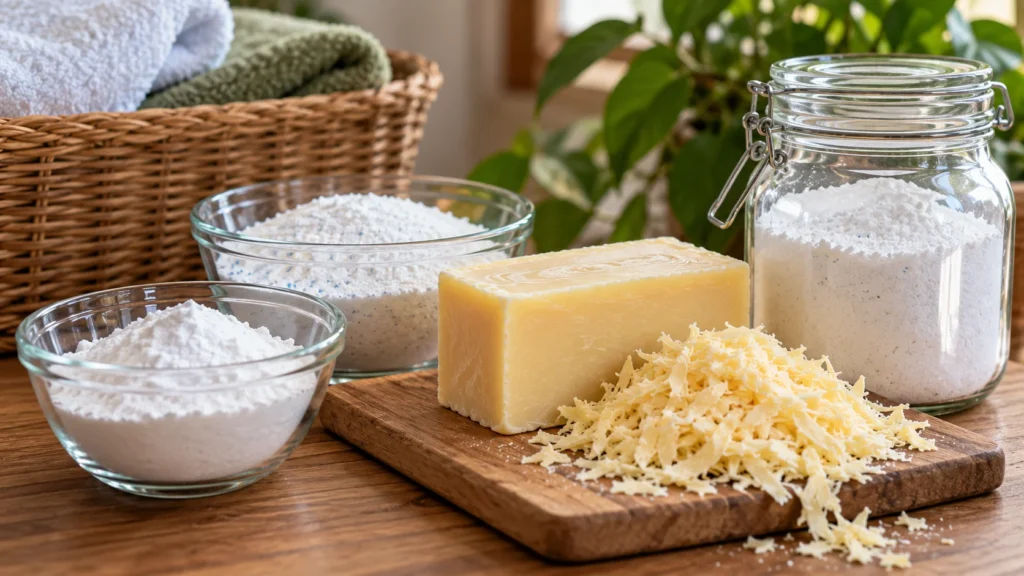
A frequently used homemade powder contains:
- Grated laundry bar soap
- Washing soda
- Borax
- Optional baking soda
Washing soda is sodium carbonate, while baking soda is sodium bicarbonate. They are not interchangeable ingredients. ACI explains that sodium carbonate is a fairly strong alkaline salt commonly used as a laundry detergent builder, whereas sodium bicarbonate is a milder alkali.
The word detergent can therefore be misleading when a recipe relies primarily on bar soap. ACI explains that soap and detergent are different product categories and that modern laundry detergents were developed partly because conventional soap can react with hard-water minerals and form deposits.
Is Homemade Laundry Detergent the Same as Commercial Detergent?
No. A homemade recipe and a commercially formulated laundry detergent should not automatically be treated as equivalent.
Commercial laundry detergents are formulated around specific cleaning requirements. They can contain surfactants, builders, enzymes, polymers, preservatives, fragrance systems, optical brighteners, and other ingredients selected to work together under particular wash conditions.
ACI explains that cleaning depends on chemical, mechanical, and thermal energy working together. Detergent supplies chemical energy, while the washer provides mechanical action and water temperature contributes thermal energy.
A homemade recipe may provide alkalinity and some cleaning action, but it does not necessarily reproduce the complete formulation of a modern detergent.
This difference matters especially when:
- You have hard water.
- You use an HE washer.
- You wash in cold water.
- You need enzyme-based stain removal.
- You wash delicate fabrics.
- You need a product with validated antimicrobial claims.
- You want consistent results from load to load.
Homemade Laundry Detergent Recipe Ingredients
The most common homemade laundry detergent recipe ingredients are easy to recognize, but each performs a different role.
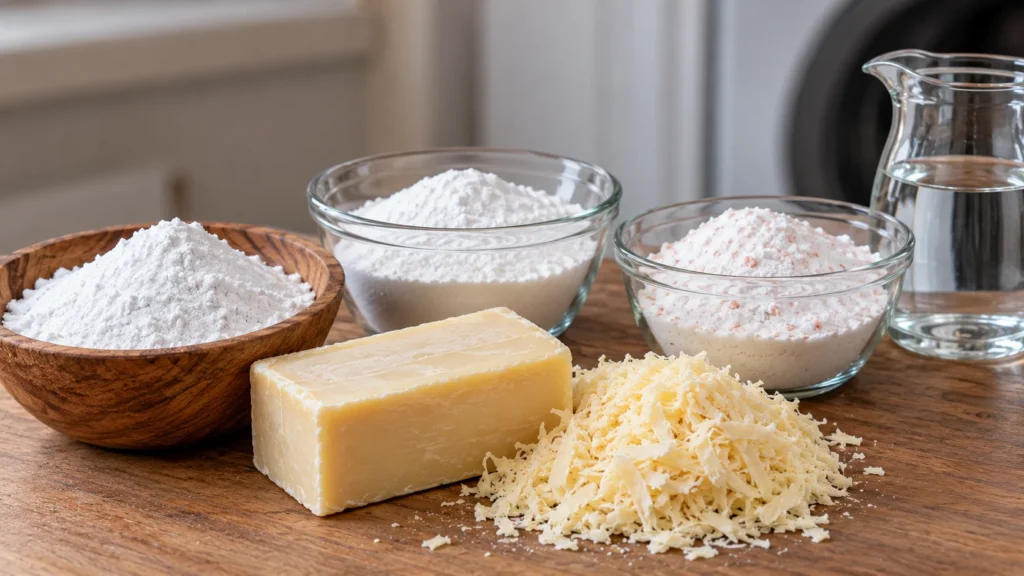
Washing soda
Washing soda is sodium carbonate. It is an alkaline builder used in laundry products and can help soften water by precipitating hardness minerals.
Baking soda
Baking soda is sodium bicarbonate. It is a milder alkali than washing soda and can be used in some laundry formulations.
Borax
Borax is sodium borate. ACI describes it as a mildly alkaline, water-soluble salt that can provide alkalinity buffering and help loosen soils and stains.
Laundry bar soap
Grated laundry soap supplies soap-based cleaning chemistry. However, soap can react with hard-water minerals and form insoluble deposits.
Water
Water is primarily used in liquid recipes to dissolve or disperse the ingredients. It also becomes part of the final concentration and determines how much mixture is used per load.
Best Homemade Powder Laundry Detergent Recipe
For readers specifically searching for a best homemade powder laundry detergent recipe, a simple traditional formula is:
Ingredients
- 1 cup washing soda
- 1 cup Borax
- 1 bar laundry soap, finely grated
- ½ cup baking soda, optional
This type of formula is consistent with several long-standing DIY laundry recipes published online, although those recipes are not equivalent to laboratory-tested commercial detergents.
Homemade Powder Laundry Detergent Instructions
- Finely grate the laundry bar soap.
- Break up any large soap pieces.
- Measure the washing soda.
- Measure the Borax.
- Add the optional baking soda.
- Combine the dry ingredients in a large, clean container.
- Stir thoroughly until the mixture looks uniform.
- Transfer it to a tightly closed container.
- Label the container with all ingredients.
- Store it in a cool, dry location.
A traditional recipe published by This Simple Home uses ½ cup Borax, ½ cup washing soda, and 1 cup grated Fels-Naptha soap, with 1–2 tablespoons used per load. Other recipes use different proportions, demonstrating why there is no universally validated best homemade formula.
Important dosage note
Do not assume that a tablespoon of one homemade mixture equals a tablespoon of another. Concentration varies with:
- Soap quantity
- Powder particle size
- Builder concentration
- Water hardness
- Load size
- Soil level
- Washer type
Start conservatively rather than adding large amounts of homemade powder.
How to Make Homemade Laundry Detergent Recipe Step by Step
If your goal is how to make homemade laundry detergent, the powder version is considerably simpler than a liquid formula.
Step 1: Prepare the soap
Use a grater to turn the laundry bar into very small pieces.
Fine particles are preferable because larger pieces can dissolve more slowly.
Step 2: Measure the builders
Measure your washing soda and Borax separately before combining them.
Do not substitute baking soda for washing soda unless you are deliberately changing the recipe.
Step 3: Combine the powders
Add the grated soap, washing soda, Borax, and optional baking soda to a large mixing container.
Step 4: Mix thoroughly
Stir until the soap particles appear evenly distributed throughout the powders.
Step 5: Label the container
Write down:
- Ingredient names
- Date prepared
- Intended use
- Basic handling warnings
This is particularly important for homemade mixtures because they do not come with the standardized labeling of commercial laundry products.
Step 6: Store correctly
Keep the container tightly closed and dry.
ACI recommends keeping laundry products safely stored and away from children and other vulnerable household members.
Homemade Liquid Laundry Detergent Recipe
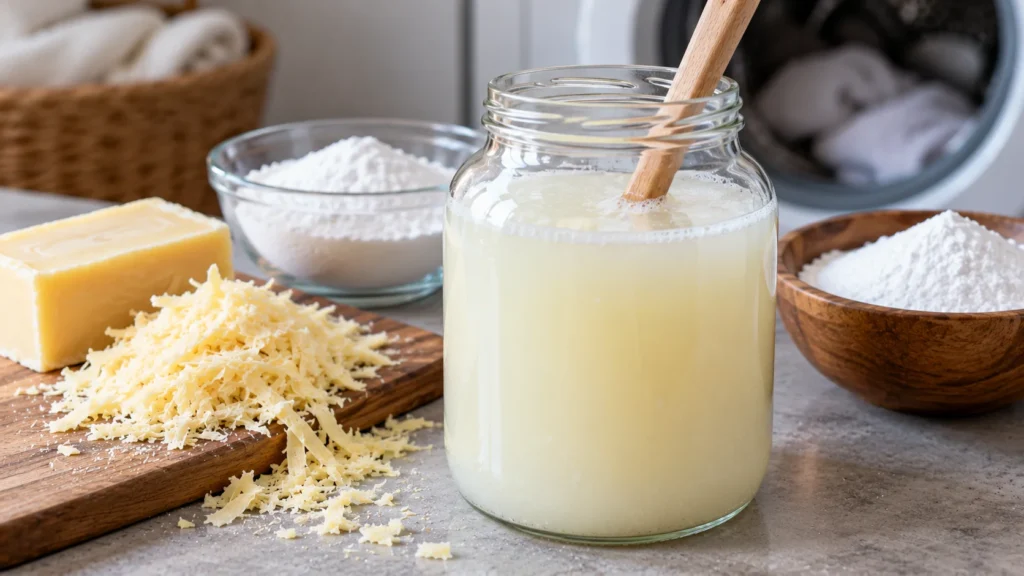
A homemade liquid laundry detergent recipe traditionally uses grated soap, washing soda, Borax, and water.
One commonly published DIY formula uses:
- ½ cup Borax
- 1 cup washing soda
- 1 bar grated laundry soap
- Several gallons of water
HouseLogic, for example, describes a traditional liquid recipe using ½ cup Borax, 1 cup washing soda, one bar of Fels-Naptha, and 3 gallons of water. The recipe involves dissolving grated soap in hot water, combining it with the other ingredients, adding water, and allowing the mixture to sit.
However, liquid homemade detergent has an important disadvantage: its final concentration can be inconsistent.
Evaporation, measuring differences, incomplete dissolution, settling, and gel formation can all change the texture and concentration.
Homemade Liquid Laundry Detergent Instructions
A traditional method works as follows:
- Grate the laundry soap finely.
- Heat several cups of water.
- Add the grated soap gradually.
- Stir until the soap dissolves.
- Combine the washing soda and Borax separately.
- Add the dissolved soap mixture to a suitable container.
- Add the remaining water.
- Stir thoroughly.
- Cover the container.
- Allow the mixture to cool and thicken if the recipe specifies this.
- Stir again before use if separation occurs.
HouseLogic’s documented DIY comparison found that homemade liquid detergent can form a gel-like or uneven consistency after sitting.
Because the formula is not standardized, do not assume a homemade liquid is equivalent to a concentrated commercial liquid detergent.
Best Homemade Liquid Laundry Detergent Recipe
The best liquid recipe depends on what you mean by best.
If you prioritize:
- Easy preparation
- Few ingredients
- Low upfront cost
- Traditional DIY methods
then a simple soap + washing soda + Borax formula is commonly used.
If you prioritize:
- Consistent concentration
- HE washer compatibility
- Cold-water performance
- Enzyme stain removal
- Predictable dosing
- Manufacturer-backed testing
a commercial detergent has advantages that a homemade recipe cannot automatically reproduce.
Whirlpool explains that HE detergents are specifically formulated for low-water washing and are designed to produce fewer suds.
Homemade Laundry Detergent Recipe With Borax
A homemade laundry detergent recipe with Borax generally combines Borax with washing soda and grated laundry soap.
A common powder formulation is:
- 1 cup Borax
- 1 cup washing soda
- 1 grated laundry soap bar
Some recipes add baking soda or other boosters, but adding more ingredients does not automatically improve cleaning.
ACI explains that Borax provides moderate alkalinity buffering and can aid in loosening soils and stains.
What Borax actually does
Borax is not simply a replacement for detergent.
It contributes:
- Alkalinity
- Water-conditioning effects
- Soil-loosening support
- Cleaning assistance
The primary cleaning system still depends on the overall formulation and washing process.
Homemade Laundry Detergent Recipe Without Borax
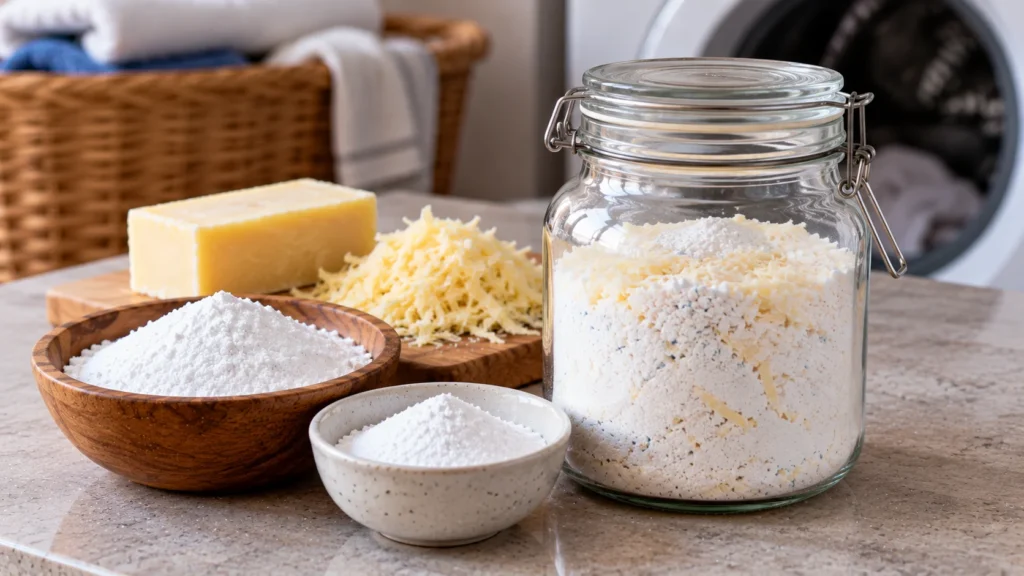
A homemade laundry detergent recipe without Borax can be made using washing soda, baking soda, and soap, but removing Borax changes the formula.
For example:
- 1 cup washing soda
- ½ cup baking soda
- 1 grated laundry soap bar
Mix the dry ingredients thoroughly and store them in a sealed container.
However, this should be considered a DIY laundry soap mixture, not a scientifically validated equivalent to a commercial detergent.
If you specifically want to avoid Borax, a commercial fragrance-free or ingredient-transparent detergent may provide more predictable performance.
EPA’s Safer Choice program evaluates ingredients and finished products against specific criteria, whereas homemade formulas do not receive the same product-level certification.
Homemade Laundry Detergent Recipe No Borax and No Soap
If you want a homemade laundry detergent recipe no Borax and no soap, the choices become much more limited.
A mixture based only on baking soda or washing soda should not be described as a complete laundry detergent.
These ingredients can contribute alkalinity and cleaning support, but they do not reproduce the complete surfactant system found in a commercial detergent.
For example:
- Baking soda can provide mild alkalinity.
- Washing soda provides stronger alkalinity and water-softening action.
- Neither automatically provides the full detergent formulation needed for every laundry condition.
ACI describes modern detergents as carefully formulated cleaning products rather than simply combinations of household powders.
If the goal is a simple laundry booster rather than a complete detergent, washing soda or baking soda can have a place in appropriate laundry routinesbut they should not automatically replace detergent.
Homemade Laundry Detergent Recipe for HE Washers
This is one of the most important sections for anyone searching for a homemade laundry detergent recipe for HE washers.
Homemade detergent should not automatically be considered HE-safe.
GE Appliances states explicitly that homemade laundry detergent has not been tested in its washers and therefore does not recommend using homemade laundry detergent in its high-efficiency machines.
Whirlpool likewise explains that HE machines use low water levels and require low-sudsing detergent designed for those conditions.
This creates a major issue for DIY recipes containing soap.
Why homemade soap can be problematic in an HE washer
HE washers use:
- Less water
- Mechanical tumbling or agitation
- Low-sudsing detergent
- Carefully controlled rinsing
A homemade soap mixture may produce unexpected sudsing or leave residue.
Whirlpool warns that excessive detergent or non-HE detergent can cause excessive suds, longer cycles, poor rinsing, and poor cleaning performance.
Best practice for HE machines
If your manufacturer specifically says homemade detergent is not recommended, follow that guidance.
Do not assume a recipe labeled HE on a blog has been tested by your washer manufacturer.
Homemade HE Laundry Detergent Recipe: What to Know
There are online recipes marketed as homemade HE laundry detergent recipes, but the label itself does not establish compatibility.
Whirlpool’s product documentation is particularly useful here. It notes that even products described as natural, organic, or homemade HE detergents may generate excessive suds.
Therefore, the safer decision framework is:
- Check the owner’s manual.
- Check the detergent requirements.
- Look for the HE designation when commercial detergent is required.
- Avoid assuming low quantity means low sudsing.
- Monitor for excessive suds.
- Watch for residue.
- Stop using a homemade formula if the washer develops performance problems.
This is more reliable than trusting an internet recipe’s claim that it is HE safe.
Homemade Laundry Detergent Recipe for Sensitive Skin
A homemade laundry detergent sensitive skin recipe is often promoted as an alternative to fragranced commercial products.
A simple DIY powder might omit fragrance and essential oils:
- 1 cup washing soda
- 1 cup baking soda
- 1 cup Borax, if you choose to use it
- 1 grated laundry soap with a suitable formulation
But homemade does not automatically mean hypoallergenic.
Potential issues include:
- Borax exposure
- Soap residue
- Fragrance in the chosen soap
- Essential oils
- Incomplete rinsing
- Fabric residue
- Unknown concentration
For someone trying to reduce fragrance exposure, a commercial fragrance-free detergent with transparent labeling can provide more predictable information about the formulation.
ACI notes that commercial laundry products are available in fragrance-free and dye-free formulations.
Homemade Hypoallergenic Laundry Detergent Recipe
The phrase hypoallergenic homemade laundry detergent should be used carefully.
There is no universal DIY recipe that can guarantee a hypoallergenic result.
A safer way to formulate the goal is:
Avoid unnecessary additives
- Avoid added fragrance.
- Avoid essential oils.
- Avoid dyes.
- Avoid unnecessary scent boosters.
- Use the minimum effective detergent amount.
- Rinse thoroughly.
- Wash according to the garment instructions.
If persistent skin irritation occurs after wearing freshly washed clothes, the cause may not be the detergent alone, so changing laundry products should not be treated as a medical diagnosis or solution.
Homemade Natural Laundry Detergent Recipe
A homemade natural laundry detergent recipe often includes ingredients described as natural or mineral-based.
A common combination is:
- Washing soda
- Baking soda
- Borax
- Vegetable-oil-based or other laundry soap
However, natural does not mean risk-free.
ACI specifically explains that homemade cleaners are still chemical mixtures and that the word natural does not eliminate the need to consider safety, testing, and performance.
EPA similarly cautions consumers about broad terms such as green, eco-safe, and environmentally friendly when evaluating cleaning products.
Homemade Non-Toxic Laundry Detergent Recipe
There is no responsible way to guarantee that a homemade laundry mixture is completely non-toxic.
Every ingredient has chemical properties, and risk depends on:
- Dose
- Concentration
- Exposure route
- Duration
- Individual sensitivity
- Storage
- Accidental ingestion
- Eye or skin contact
ACI explicitly states that all cleanersincluding homemade mixturescontain chemicals and that homemade products may lack the safety testing and exposure information available for commercial formulations.
So instead of calling a DIY formula non-toxic, it is more accurate to describe exactly what it contains and how it should be handled.
Homemade Eco Friendly Laundry Detergent Recipe
A homemade eco friendly laundry detergent recipe may appear environmentally attractive because it uses fewer ingredients or eliminates a commercial bottle.
But environmental impact is more complicated.
You also need to consider:
- Ingredient production
- Transportation
- Packaging
- Water use
- Wastewater chemistry
- Washing temperature
- Number of rinses
- Product concentration
- Cleaning effectiveness
EPA explains that homemade cleaning products are not automatically greener and that commercially formulated products may offer performance and ingredient advantages.
For people specifically looking for verified environmental performance, EPA’s Safer Choice program provides a more evidence-based framework than simply choosing products described as natural or eco-friendly.
Homemade Dry Laundry Detergent Recipe
A homemade dry laundry detergent recipe is essentially a powdered DIY formulation.
One simple example is:
Ingredients
- 1 cup washing soda
- 1 cup Borax
- 1 grated laundry soap bar
Instructions
- Grate the soap very finely.
- Add washing soda.
- Add Borax.
- Mix completely.
- Break apart any clumps.
- Store in an airtight container.
- Label the container.
- Keep it dry.
A published traditional recipe uses these same broad ingredient categories, although quantities vary among DIY sources.
The variation between recipes is itself evidence that there is no single standardized homemade detergent formula.
Homemade Powdered Laundry Detergent Recipe vs Liquid
Choosing between homemade powdered laundry detergent and liquid mostly comes down to storage and preparation.
| Feature | Homemade powder | Homemade liquid |
| Preparation | Simple mixing | Heating and dissolving usually required |
| Storage | Compact | Requires larger container |
| Water content | Very low | High |
| Concentration | Easier to keep consistent if mixed well | Can vary after settling |
| Shelf storage | Generally simpler | More complicated |
| Measuring | Tablespoon-based | Volume-based |
| Cold-water performance | May have dissolution issues | May dissolve more easily |
| HE compatibility | Still unverified unless manufacturer approves | Still unverified unless manufacturer approves |
Whirlpool notes that powdered detergents can sometimes leave residue if they do not dissolve completely, particularly under colder conditions.
This is an important consideration for DIY powder.
Homemade Laundry Detergent Recipe With Epsom Salt
Some DIY recipes include Epsom salt, or magnesium sulfate, as an additional ingredient.
However, Epsom salt is not a necessary component of a basic homemade laundry detergent recipe.
It should not automatically be added because it sounds like a useful laundry ingredient.
A recipe containing:
- Washing soda
- Borax
- Soap
- Epsom salt
has different chemistry from a recipe containing only the first three ingredients.
There is also no reason to assume that adding more mineral salts automatically improves cleaning.
For a simple DIY recipe, fewer ingredients make it easier to identify the cause if you encounter:
- Residue
- Excess suds
- Poor cleaning
- Fabric stiffness
- Washer buildup
Homemade Scented Laundry Detergent Recipe
A homemade scented laundry detergent recipe can use fragrance or essential oils, but adding scent introduces another variable.
A basic powder recipe can be made without fragrance, and scent can be added separately through a properly formulated laundry product.
If you do choose an essential oil, remember:
- More fragrance does not mean cleaner laundry.
- Essential oils can leave residues.
- Some people are sensitive to fragrances.
- Oils may behave differently in water.
- A homemade scent mixture is not standardized.
For a fragrance-sensitive household, a fragrance-free commercial detergent may be easier to control.
Homemade Organic Laundry Detergent Recipe
The phrase organic laundry detergent can be misleading because detergent ingredients have different regulatory and chemical definitions.
A DIY recipe made with plant-derived soap should not automatically be called organic.
If organic certification matters, look for an applicable certification and verify what exactly has been certified.
Similarly, plant-based does not mean that a product is automatically safer or more effective.
EPA recommends relying on meaningful product certifications rather than vague environmental marketing claims.
Homemade Laundry Detergent Recipe Safe Effective: What Makes One Practical?
A safe homemade laundry detergent recipe should prioritize predictable handling over adding as many ingredients as possible.
A practical formula should have:
- Clearly identified ingredients
- Clear measurements
- Safe storage
- No incompatible chemical mixtures
- A defined intended use
- Appropriate fabric limitations
- Appropriate washer limitations
- Simple dosing
- Adequate rinsing
ACI’s guidance on homemade cleaners emphasizes exactly these issues: consumers should know whether the recipe has been tested, whether the ingredients are safe when combined, how accidental exposure should be handled, and whether the mixture actually performs as claimed.
Does Homemade Laundry Detergent Actually Clean Clothes?
It can provide cleaning action, but performance is not guaranteed to match commercial detergent.
Cleaning requires a combination of:
- Chemical action
- Mechanical action
- Thermal action
- Time
ACI explains this as the three forms of cleaning energy chemical, mechanical, and thermal with time affecting how effectively they work together.
A homemade mixture containing soap and alkaline builders can help loosen and remove some soils.
But commercial detergents may contain specialized ingredients such as:
- Enzymes
- Surfactants
- Builders
- Soil-suspending polymers
- Optical brighteners
- Chelating agents
Those ingredients can provide more targeted cleaning than a basic DIY mixture.
Can Homemade Laundry Detergent Remove Tough Stains?
It can remove some stains, but homemade detergent should not be expected to remove every difficult stain.
Stain type matters.
For example:
- Protein stains may respond to enzymes.
- Grease needs effective surfactants.
- Mineral deposits may require an appropriate acidic treatment.
- Pigment stains may require bleaching.
- Ground-in dirt can respond to detergent plus mechanical action.
ACI’s stain guide recommends different approaches for different stain categories, including enzyme products and oxygen bleach where appropriate.
This is one reason commercial detergents can outperform simple homemade formulas: their ingredients are selected to address multiple soil types.
Homemade Laundry Detergent and Hard Water
Hard water is one of the biggest challenges for homemade laundry soap.
Hard water contains calcium and magnesium ions. Traditional soap can react with these minerals and create insoluble soap curd.
ACI specifically identifies this as a major drawback of soap in laundry and explains that it can deposit on fabrics and washing machines.
Washing soda and other builders can help by interacting with hardness minerals, but they do not necessarily eliminate every problem associated with soap.
If your home has hard water and you notice:
- Gray fabric
- Stiff towels
- Soap residue
- Washer buildup
- Poor rinsing
- Dingy whites
a commercial detergent designed for your water conditions may provide more predictable results.
Jump into Other Related Article
- How to Remove Peanut Butter Stains
- Does Rayon Shrink?
- How to Remove Coffee Stains
- How to Clean Suede Shoes
- Best Stain Remover for Clothes
- How to Clean Stainless Steel
Homemade Laundry Detergent for Cold Water
Cold-water washing creates another challenge for DIY powdered formulas.
Soap particles and powders can dissolve more slowly in cold water. Whirlpool notes that powdered detergent may not dissolve as effectively as liquid detergent under some cold-water conditions and can leave residue.
If you wash primarily in cold water:
- Grate soap very finely.
- Avoid excessive powder.
- Do not overload the washer.
- Give the detergent enough water contact.
- Check for residue after washing.
- Consider a commercially formulated cold-water detergent if problems persist.
Commercial detergents are often specifically formulated for modern cold-water washing.
Homemade Laundry Detergent Storage and Safety
Storage is an important part of any homemade laundry detergent recipe.
Store the mixture:
- In a sealed container
- In a cool, dry area
- Away from food
- Away from children
- Away from pets
- Away from moisture
- Away from incompatible chemicals
Do not store homemade detergent in an unmarked container.
ACI points out that commercial cleaning-product packaging includes important information such as warning labels and first-aid instructions. Homemade mixtures do not automatically have those protections, which is why ACI recommends labeling DIY products with ingredient and safety information.
Is Borax Safe in Homemade Laundry Detergent?
Borax requires responsible handling.
Poison Control identifies Borax as sodium borate and warns that borates should be handled according to product instructions. It also advises seeking medical attention if someone ingests a borate.
Important precautions include:
- Do not ingest Borax.
- Avoid inhaling powder.
- Avoid getting powder in the eyes.
- Wash exposed skin.
- Keep it away from children.
- Keep it away from pets.
- Store it in its original or clearly labeled container.
- Follow the product’s safety instructions.
Do not describe Borax-containing laundry detergent as automatically non-toxic.
Homemade Laundry Detergent and Essential Oils
Adding essential oils is popular in homemade scented laundry detergent recipes, but they are optional and not required for cleaning.
Essential oils primarily add fragrance.
They do not automatically:
- Improve stain removal
- Replace detergent
- Disinfect laundry
- Make the formula safer
- Make the detergent natural
- Make the detergent hypoallergenic
If fragrance is desired, use only an amount appropriate for the formulation and consider whether the fragrance is compatible with your household needs.
Common Homemade Laundry Detergent Mistakes
Avoid these common DIY laundry mistakes:
- Calling a soap mixture a tested commercial detergent.
- Assuming every recipe works in every washer.
- Using homemade detergent in an HE washer without checking the manual.
- Adding excessive Borax.
- Adding excessive washing soda.
- Using baking soda and washing soda as though they were identical.
- Using too much grated soap.
- Mixing several unrelated cleaning products.
- Adding bleach to the homemade detergent mixture.
- Adding vinegar to the detergent container.
- Assuming natural means risk-free.
- Assuming non-toxic is a guaranteed property.
- Using the mixture on delicate fabrics without checking the care label.
- Storing the mixture without a label.
- Leaving powder exposed to humidity.
- Expecting one recipe to remove every type of stain.
- Assuming homemade detergent will always save money.
- Ignoring hard-water problems.
- Using excessive detergent because the clothes seem dirty.
- Assuming more foam means better cleaning.
ACI specifically warns against mixing cleaning products simply because a recipe appears popular online.
Homemade Laundry Detergent vs Commercial Detergent
| Factor | Homemade detergent | Commercial detergent |
| Ingredient control | High | Depends on product |
| Standardized formula | Usually no | Yes |
| Performance testing | Usually limited or absent | Product-specific testing |
| HE certification/testing | Usually unavailable | Many products are designed for HE |
| Dosing consistency | Depends on recipe | Manufacturer-defined |
| Hard-water performance | Formula dependent | Product dependent |
| Enzymes | Usually absent from simple recipes | Common in many formulas |
| Storage instructions | User-created | Manufacturer provided |
| Safety label | User must create one | Manufacturer supplied |
| Fragrance-free choices | Possible | Widely available |
| Environmental claims | Difficult to verify | Certifications may be available |
| Convenience | Requires preparation | Ready to use |
EPA explains that commercially formulated cleaning products are specifically developed and evaluated, while homemade cleaners may lack comparable testing and safety information.
Is Homemade Laundry Detergent Cheaper?
It can be, but cost savings depend on local ingredient prices and how much mixture you actually use per load.
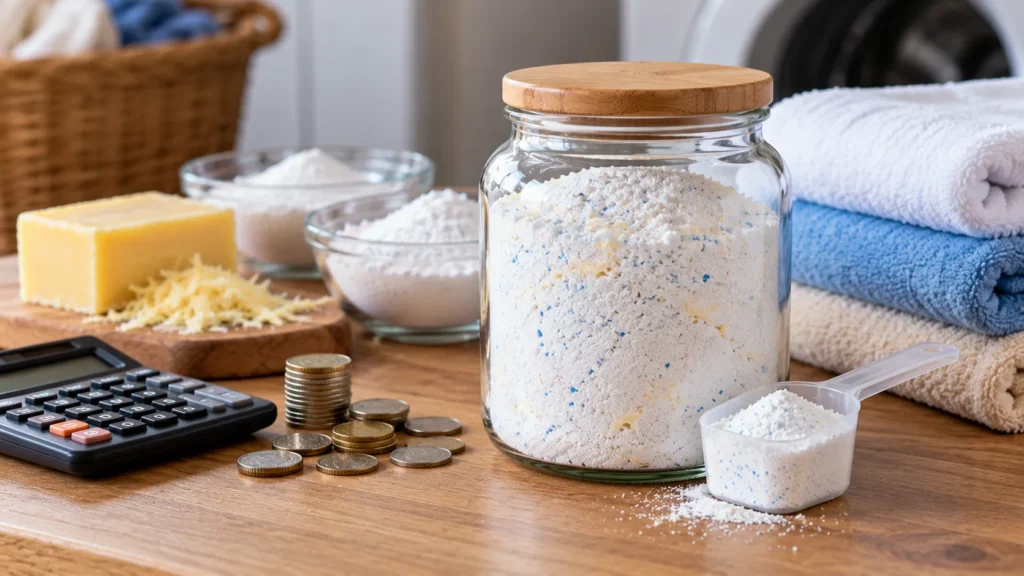
Calculate the real cost this way:
Total ingredient cost ÷ number of loads = cost per load
Include:
- Soap cost
- Borax cost
- Washing soda cost
- Baking soda cost
- Optional additives
- Containers
- Preparation time
- Failed batches
- Extra rinses
- Potential washer maintenance
A cheap recipe is not necessarily cheaper if it causes residue, requires extra rinsing, or performs poorly enough that garments need to be rewashing.
Homemade Laundry Detergent Recipe DIY: A Practical Approach
If you want to experiment with a DIY homemade laundry detergent recipe, keep the first batch simple.
A basic powder formula is easier to evaluate than a mixture containing ten different ingredients.
Simple DIY formula
- 1 cup washing soda
- 1 cup Borax
- 1 grated laundry soap bar
Preparation
- Grate the soap finely.
- Combine all ingredients.
- Mix thoroughly.
- Store in a labeled, sealed container.
- Keep dry.
- Use a small amount for an appropriate test load.
- Inspect the clothes and washer afterward.
Do not use this formula in an HE washer if the manufacturer prohibits homemade detergent. GE explicitly says homemade laundry detergent has not been tested in its HE washers and does not recommend its use.
When Should You Use Commercial Laundry Detergent Instead?
A commercial detergent may be the more appropriate choice when you need:
- HE washer compatibility
- Reliable cold-water performance
- Enzyme-based stain removal
- Consistent dosing
- Fragrance-free formulations
- Specialized fabric care
- Validated disinfection claims
- Product-level safety instructions
- Third-party environmental certification
- Predictable results in hard water
This does not mean every commercial detergent is automatically better for every household. It means the formulation and testing are more standardized.
EPA’s Safer Choice program can also help consumers identify commercial cleaning products that meet specific ingredient and performance criteria.
Homemade Laundry Detergent Recipe Checklist
Before making your own laundry mixture, check these points:
- Recipe: Are all ingredients clearly identified?
- Measurements: Are quantities specific?
- Washer: Does your manufacturer permit homemade detergent?
- HE: Is your washer high efficiency?
- Water: Is your water hard or soft?
- Temperature: Do you normally wash cold?
- Fabric: Are you washing everyday cottons or delicate materials?
- Safety: Is the mixture stored securely?
- Label: Have you identified every ingredient?
- Performance: Do you have realistic expectations?
- Residue: Will you monitor for buildup?
- Stains: Do you need enzymes or oxygen bleach?
- Fragrance: Do you actually need added scent?
- Cost: Have you calculated cost per load?
- Environment: Are environmental claims supported by evidence?
If several answers are uncertain, a commercially formulated detergent may be easier to use safely and consistently.
Conclusion
A homemade laundry detergent recipe can be made with familiar ingredients such as washing soda, Borax, baking soda, and grated laundry soap, and traditional powder recipes remain popular because they are inexpensive and straightforward to prepare. However, many DIY formulas are more accurately described as homemade laundry soap mixtures rather than direct equivalents of modern laundry detergent. Soap can interact with hard-water minerals and produce deposits, while commercial detergents are formulated with combinations of surfactants, builders, enzymes, polymers, and other ingredients for specific cleaning conditions.
The most important consideration is not simply whether a recipe contains natural or familiar ingredients. It is whether the formula is appropriate for your fabric, water conditions, washing machine, and cleaning goal. HE washer users should be particularly cautious, because manufacturers such as GE explicitly state that homemade laundry detergent has not been tested in their HE washers, while Whirlpool explains that HE machines require low-sudsing detergent formulated for low-water washing. If you do make a DIY mixture, keep the formula simple, label it clearly, store it securely, avoid chemical mixing experiments, and treat Borax and other ingredients as household chemicals rather than automatically non-toxic materials.
1.What is the best homemade laundry detergent recipe?
A commonly used traditional powder recipe combines 1 cup washing soda, 1 cup Borax, and 1 grated laundry soap bar. Some recipes also add baking soda. However, there is no scientifically established single best homemade formula, and DIY mixtures are not equivalent to tested commercial detergents. ACI notes that homemade cleaners may lack product-level testing for performance, safety, and compatibility.
2. Can I use homemade laundry detergent in an HE washer?
Do not assume that homemade detergent is HE-safe. GE Appliances states that homemade laundry detergent has not been tested and therefore does not recommend it in its HE washers. Whirlpool also explains that HE washers require low-sudsing detergent designed for low-water washing.
3. Can I make homemade laundry detergent without Borax?
Yes, you can make a simpler DIY laundry powder without Borax using ingredients such as washing soda, baking soda, and laundry soap. However, removing Borax changes the formulation and cleaning characteristics. It should not automatically be considered equivalent to a commercial detergent.
4. Is homemade laundry detergent safe for sensitive skin?
Not automatically. A homemade formula can still contain ingredients that irritate the skin or leave residue on clothing. If fragrance is the concern, a fragrance-free commercial detergent may offer more predictable formulation information. ACI notes that commercial laundry products are available in fragrance- and dye-free options.
5. Does homemade laundry detergent really work?
It can provide cleaning action, particularly on ordinary soils, but results depend on the recipe, water hardness, fabric, temperature, washer, and type of stain. Commercial detergents can contain specialized ingredients that homemade soap-based recipes usually lack. ACI explains that effective cleaning depends on chemical, mechanical, thermal, and time-related factors working together.