
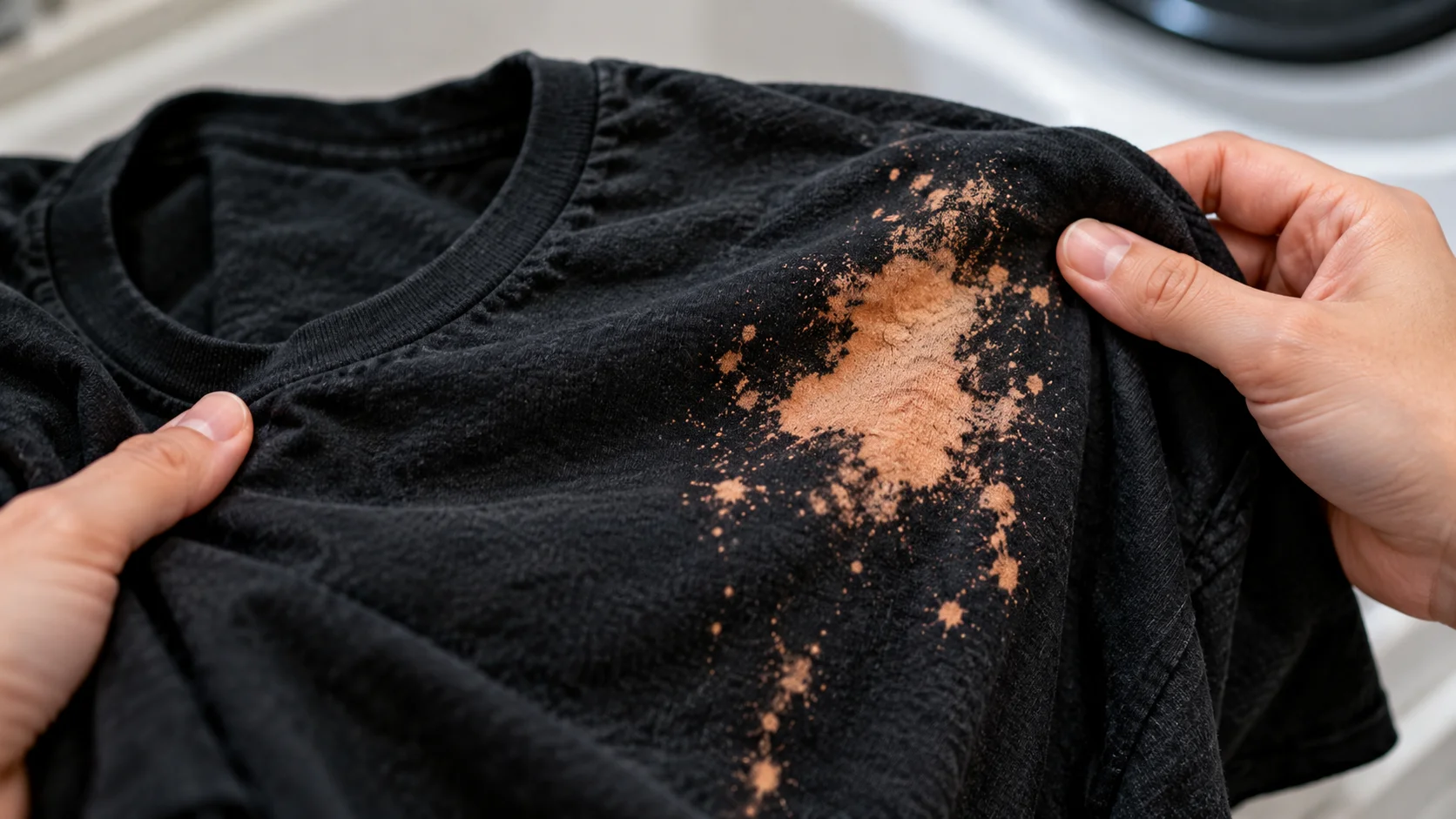
Learning how to get bleach out of clothes starts with identifying what actually happened to the fabric. A fresh bleach spill, a bleach smell, and a pale bleach spot are three different problems. Liquid chlorine bleach can chemically alter or remove fabric dyes, so a true bleach mark is usually not something that can simply be washed away. The best solution depends on whether the garment has bleach residue, an unwanted odor, a color change, or permanent dye loss.
If you are trying to learn how to get bleach stains out of clothes, especially black, blue, grey, red, or other dark clothing, the goal is often to restore or disguise the lost color rather than remove the bleach itself. For white clothing, yellow discoloration may have a different cause and can sometimes be permanent when bleach was misused. This guide explains what you can realistically fix, what methods are worth trying, and which popular combinations should be avoided.
What Happens When Bleach Gets on Clothes?
Bleach does not behave like an ordinary food, grease, or dirt stain. Chlorine bleach can discolor fabric by chemically changing dyes and pigments, which is why a black shirt may develop orange, red, tan, or pale spots after exposure. The American explains that sodium hypochlorite bleach is a powerful laundry bleach that can whiten fabrics, while chlorine compounds can also discolor fabrics.
This distinction matters because washing a garment repeatedly cannot necessarily restore dye that has already been removed.
- Fresh liquid bleach: Rinse the affected area promptly with plenty of clean water.
- Bleach smell: Rinse and launder the garment according to its care label.
- White or pale spot: The dye may already have been removed.
- Orange or reddish mark on black fabric: The original dark dye may have been altered or removed.
- Yellow discoloration on white fabric: It may result from inappropriate bleach use, concentrated bleach, fiber incompatibility, or another type of discoloration.
- Small bleach spot: Recoloring may be practical.
- Large bleach area: Dyeing the entire garment may produce a more consistent appearance.
- Delicate fabric: Check the care label before attempting any treatment.
Can You Actually Get Bleach Out of Clothes?
If by “bleach” you mean liquid bleach that has just spilled onto clothing, the first priority is to remove and dilute the remaining chemical with water. If you mean a bleach stain or spot that has already changed the fabric’s color, the answer is different: you generally cannot wash the original color back into the fabric.
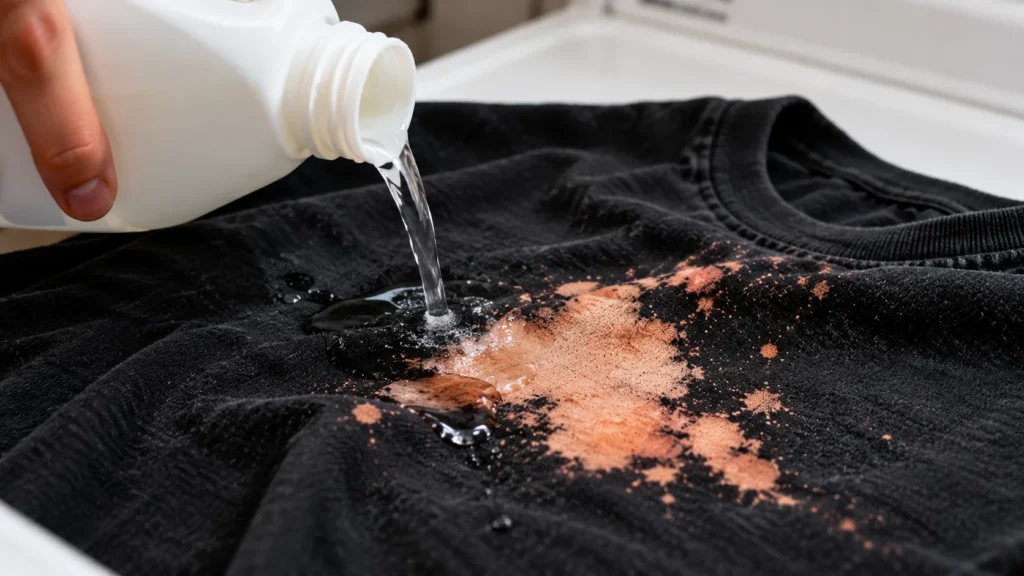
Clorox specifically notes that color loss from undiluted bleach on black clothing cannot be reversed. It recommends cosmetic approaches such as carefully matching the color with a permanent marker for small spots.
So, the practical answer is:
- You can remove remaining bleach residue by thorough rinsing and laundering.
- You can reduce or remove bleach odor through rinsing and washing.
- You usually cannot remove a true bleach discoloration as though it were a normal stain.
- You can often recolor, dye, cover, or redesign a damaged area.
- The sooner you respond to a fresh spill, the better you can limit additional chemical exposure.
How to Get Fresh Bleach Out of Clothes
If bleach has just spilled on a garment, do not wait for the fabric to dry. Immediately separate the item from other clothing and flush the affected area with plenty of clean water.
Do not attempt to neutralize the bleach with another household cleaner. The safest approach is dilution and thorough rinsing, followed by laundering according to the garment’s care instructions. Household bleach should never be mixed with other cleaners because dangerous vapors can result.
Steps for a Fresh Bleach Spill
- Remove the garment from contact with the bleach source.
- Rinse the affected area immediately with clean running water.
- Continue rinsing thoroughly rather than allowing concentrated bleach to remain on the fibers.
- Keep the garment away from other clothing until it has been rinsed.
- Check the care label before washing.
- Wash the garment using the recommended detergent and cycle.
- Inspect the fabric after washing.
- Do not assume that a pale spot will disappear during laundering.
- If the color has already changed, treat it as dye damage rather than a normal stain.
- Allow the garment to dry according to its care instructions before deciding whether recoloring is needed.
Jump into Other Related Article
- Laundry Dryer Vent Installation
- Does Rayon Shrink?
- How to Remove Coffee Stains
- How to Clean Suede Shoes
- Best Stain Remover for Clothes
- How to Clean Stainless Steel
- How to Clean Carpet Stains
- Oxygen Bleach
How to Get Bleach Stains Out of Clothes
The phrase “bleach stain” can be misleading. If bleach has removed or changed the garment’s dye, there may be no conventional stain left to dissolve. Instead, there is a color-loss area.
The American recommends testing fabric compatibility before using bleach and notes that bleach should be appropriate for the specific fiber, finish, and garment.
For an existing bleach mark, consider these options:
- Tiny mark: Carefully recolor the area with a matching fabric marker.
- Several small marks: Touch up each spot if you can achieve a close color match.
- Large area: Consider dyeing the whole garment.
- Patterned garment: Cover the damage with embroidery, appliqué, patches, or intentional design.
- Very valuable garment: Consider professional textile repair or dyeing.
- Severe damage: Repurpose the garment if restoration would be unreliable.
Do not keep washing a garment expecting a permanent bleach mark to disappear.
How to Get Bleach Out of Black Clothes
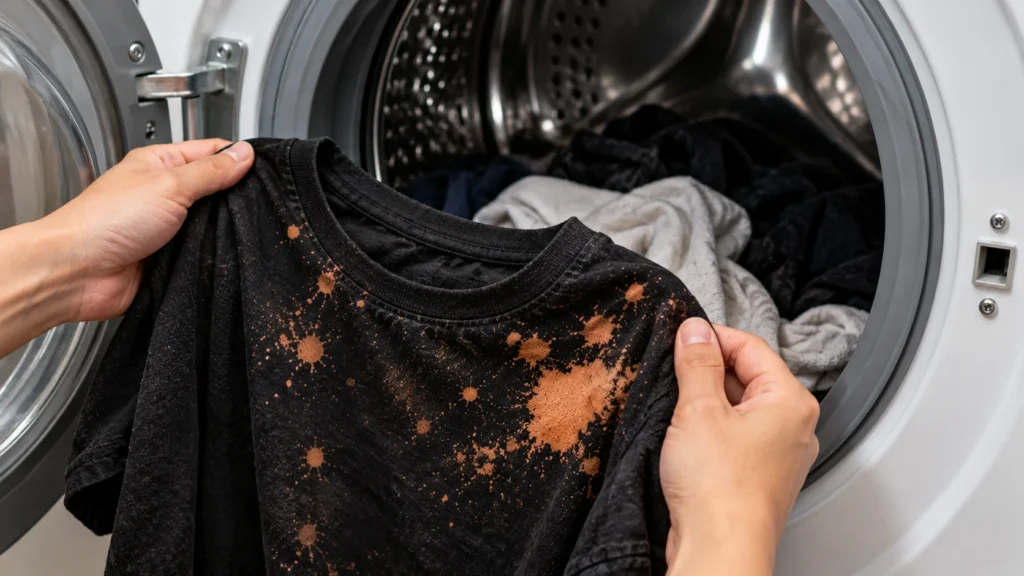
Black clothing is one of the most obvious places to see bleach damage. A small splash may create an orange, red, brown, tan, or pale spot because the bleach has changed the dye.
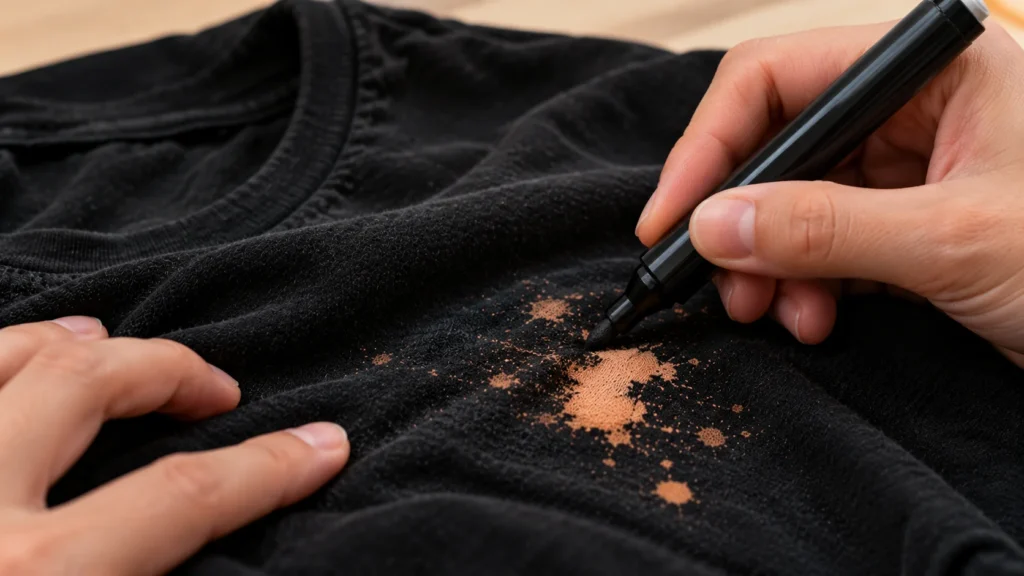
Unfortunately, how to get bleach out of black clothes is usually a question of restoration rather than stain removal. Clorox confirms that color loss from accidental bleach exposure on black clothing cannot be reversed simply by washing.
Best Options for Black Clothing
- Rinse fresh bleach exposure immediately.
- Wash the garment after thoroughly rinsing it.
- For a tiny spot, use a black fabric marker or suitable permanent fabric-color product.
- Test any coloring product on an inconspicuous area first.
- For several spots, consider professional garment dyeing.
- For a large faded section, dyeing the entire garment may look more uniform.
- Follow the dye manufacturer’s instructions carefully.
- Do not apply additional chlorine bleach in an attempt to make the color even.
- Consider turning an accidental spot into a deliberate bleach-art design.
- Replace the item if the damage is extensive and restoration is impractical.
How to Get Bleach Stains Out of Black Clothes
When searching for how to get bleach stains out of black clothes, remember that the word “stain” describes the appearance rather than the chemistry.
A bleach spot on black fabric is usually not something you can dissolve with vinegar, baking soda, detergent, or another stain remover. Those products cannot recreate dye that has already been destroyed.
For small bleach spots:
- Rinse and wash the garment first.
- Let it dry completely.
- Find a color-matching fabric marker or fabric dye.
- Test it somewhere hidden.
- Apply very small amounts to the damaged area.
- Allow the color to dry before adding more.
- Blend outward carefully.
- Follow the product’s care instructions.
- Wash the garment separately the first time after recoloring.
- For major damage, consider dyeing the entire garment instead.
How to Get Bleach Marks Out of Dark Clothes
Dark fabrics can show bleach damage in several colors, including red, orange, brown, yellow, or grey. The exact shade depends on the original dye and the way the bleach interacted with it.
If you are trying to figure out how to get bleach marks out of black clothes, the most realistic choices are recoloring or redesigning.
For dark clothing:
- Black fabric marker → best for tiny black spots.
- Fabric dye → better for larger areas.
- Full-garment dyeing → useful when many areas are damaged.
- Patches → practical for localized damage.
- Embroidery → useful for decorative garments.
- Bleach-art redesign → an option when restoration is impossible.
- Professional dyeing → best for valuable or difficult garments.
Avoid repeatedly treating the same spot with chemicals. More chemical exposure can enlarge the damaged area.
How to Get Bleach Stains Out of Grey Clothes
Grey clothing can be particularly difficult because grey is often created by a combination of dyes rather than a single simple color. A bleach spot may therefore appear pink, orange, yellow, brown, or nearly white.
For how to get bleach stains out of grey clothes, first wash and dry the garment after thoroughly rinsing any fresh bleach. If the discoloration remains, use a fabric-color product that matches the garment as closely as possible.
For a uniform result, dyeing the entire garment may be more successful than trying to repair one isolated spot.
How to Get Bleach Out of Colored Clothes
Colored clothes should not automatically be treated with more bleach. Whether a fabric can safely tolerate bleach depends on its fiber, dye, construction, and care instructions. Clorox recommends testing a hidden area before using chlorine bleach on colored clothing.
If bleach has already damaged a colored garment:
- Rinse fresh exposure immediately.
- Wash according to the care label.
- Identify the original color as closely as possible.
- Use a compatible fabric-color product for small damage.
- Consider whole-garment dyeing for larger damage.
- Test any dye or marker on a hidden section.
- Avoid applying more chlorine bleach.
- Do not assume oxygen bleach will restore the original color.
- Consider professional repair for expensive garments.
- Accept that severe chemical color loss may not be completely reversible.
How to Get Bleach Out of Red, Blue, Green and Brown Clothes
Different dyes respond differently to chlorine bleach, so the damaged area may not look white. A red shirt can develop orange or pink areas, blue can become pinkish or pale, green can become yellowish, and brown can develop reddish or orange tones.
The color of the bleach spot does not necessarily tell you what new stain is present. It can simply indicate how the original dye reacted.
Practical Repair Approach
- Red clothes: Match the original red with fabric dye or a fabric marker.
- Blue clothes: Look for the closest blue shade and test before applying.
- Green clothes: Matching may be difficult, so whole-garment dyeing can provide better consistency.
- Brown clothes: A reddish or orange bleach spot may require a carefully matched brown dye.
- Multicolor clothes: Consider professional repair because multiple dyes may have been affected.
How to Get Yellow Bleach Stains Out of White Clothes
Yellow bleach marks on white clothing require special care because the yellowing may be permanent. Bleach does not always make white fabrics whiter. Incorrect concentration, unsuitable fibers, excessive exposure, or direct application can cause yellowing.
Clorox explains that misuse of bleach can cause permanent yellowing, particularly when unsuitable fibers such as spandex are involved or when bleach is used too strongly.
If white clothing has yellowed:
- Stop adding more chlorine bleach.
- Check the fiber content on the care label.
- Determine whether the garment contains spandex, wool, silk, mohair, or another bleach-sensitive fiber.
- Wash according to the manufacturer’s instructions.
- Consider a suitable non-chlorine stain-removal product if compatible.
- Do not mix multiple stain removers together.
- If the yellowing resulted from chemical damage, understand that it may not be reversible.
- Consider professional textile cleaning for valuable garments.
The American also warns that a white garment is not automatically safe for chlorine bleach; fiber content, finishes, and trims matter.
How to Get Bleach Smell Out of Clothes
A bleach smell is different from a bleach stain. If the garment smells strongly of bleach after accidental exposure, rinse it thoroughly and wash it according to the care label.
Do not add vinegar, ammonia, or another cleaner to “neutralize” the bleach. guidance says household bleach should never be mixed with other cleaners because dangerous vapors can be produced.
For lingering odor:
- Rinse the garment thoroughly.
- Wash it separately if substantial bleach was involved.
- Use normal laundry detergent according to its label.
- Run an additional rinse if the care label permits.
- Dry the garment appropriately.
- Keep the area ventilated.
- Do not combine bleach with vinegar or ammonia.
- If strong fumes are present, move to fresh air rather than trying another chemical treatment.
If bleach fumes cause breathing difficulty, significant coughing, chest tightness, or other serious symptoms, leave the area and seek appropriate medical or poison-control assistance.
How to Get Hair Bleach Out of Clothes
Hair-lightening products are not necessarily identical to household chlorine bleach. Hair bleach products may contain different bleaching chemicals and developers, so treatment depends on the product and fabric.
If hair bleach has spilled onto clothing:
- Rinse the area immediately with cool or lukewarm water.
- Avoid rubbing aggressively.
- Check the garment care label.
- Wash the item using an appropriate detergent.
- Inspect the color after washing.
- If a permanent color change remains, treat it as dye damage.
- Use a suitable fabric-color product for repair if practical.
- Do not add household chlorine bleach.
- Do not mix hair-bleaching chemicals with other cleaners.
- Seek professional textile advice for expensive garments.
How to Get Stains Out of White Clothes Without Bleach
You do not need chlorine bleach for every white-clothing stain. In fact, bleach is unsuitable for some fibers and finishes. The American recommends checking the garment label and choosing a fabric-safe stain treatment.
Depending on the stain, alternatives may include:
- Liquid laundry detergent
- Enzyme-based prewash products
- Oxygen bleach
- Fabric-safe stain removers
- Presoaking
- Proper laundering at the hottest temperature permitted by the care label
For example, ACI’s stain-removal guidance recommends different treatments depending on whether the problem is dye transfer, food, protein stains, perspiration, or other substances.
The important point is to identify the actual stain before selecting a treatment.
How to Get Pink Out of White Clothes Without Bleach
Pink clothing can occur when a red or dark garment transfers dye onto white laundry. This is different from a pink area caused by chlorine bleach damage.
For dye transfer, ACI recommends using a packaged color remover according to its directions and laundering afterward.
A sensible process is:
- Separate the affected white garment.
- Do not dry it with high heat until you know the dye transfer is removed.
- Read the care label.
- Use a fabric-compatible color-removal product.
- Follow the package directions exactly.
- Rinse and launder as directed.
- Repeat only if the product permits it.
- Avoid mixing different stain-removal chemicals.
If the pink area is actually caused by bleach-related dye alteration, a color remover will not necessarily restore the original color.
How to Get Red Dye Out of Clothes Without Bleach
If red dye has transferred onto another garment, do not automatically reach for chlorine bleach. First determine whether the affected garment is white, colored, synthetic, delicate, or bleach-safe.
ACI recommends packaged color removers for dye-transfer problems and notes that bleach should only be used when appropriate for the fabric.
For a white bleach-safe garment, a suitable bleach may sometimes be part of stain treatment, but the garment’s care instructions must come first.
How to Get Mold or Mildew Out of Clothes Without Bleach
Mold and mildew stains are different from bleach stains. You do not need to use chlorine bleach automatically, and some fabrics should never be treated with it.
For how to get mold out of clothes without bleach or how to get mildew out of clothes without bleach, start by checking the care label and selecting a fabric-safe laundry treatment. Oxygen bleach may be appropriate for some washable fabrics, but it is not interchangeable with chlorine bleach and should be used according to the product directions.
The American describes oxygen bleach as a gentler, non-chlorine option for suitable washable fabrics.
Do not combine bleach with vinegar or other household cleaners in an attempt to improve mold removal.
How to Get Stains Out of White Clothes With Bleach
If you actually mean ordinary stains on white clothes—not damage caused by bleach—chlorine bleach may be appropriate for some bleach-safe fabrics.
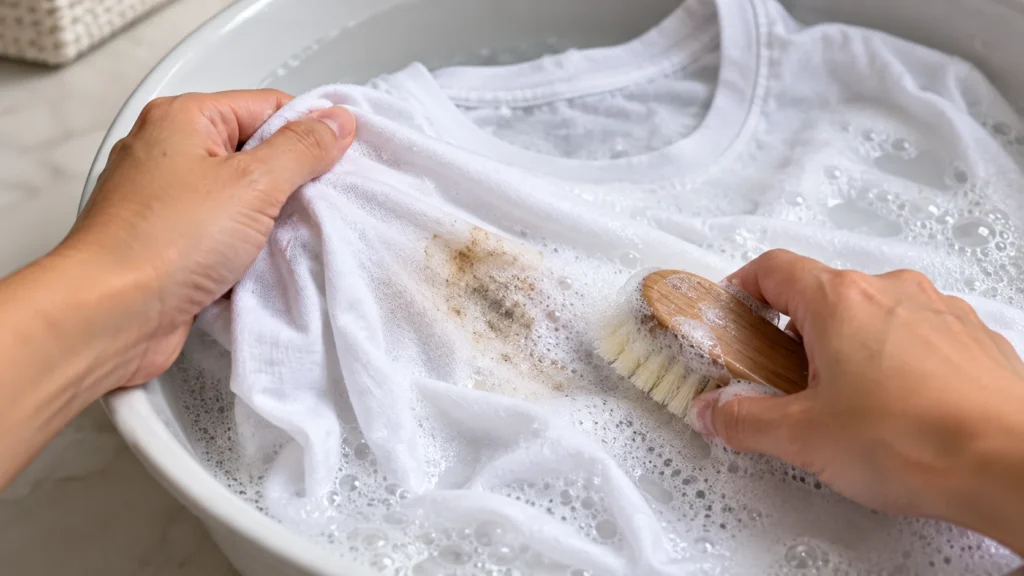
ACI recommends checking the care label first because white clothing is not automatically bleach-safe. Wool, silk, mohair, spandex, certain finishes, and some trims can be unsuitable for chlorine bleach.
For suitable garments:
- Read the bleach product label.
- Follow the manufacturer’s dilution instructions.
- Never pour undiluted bleach directly onto clothing.
- Use the washer’s bleach dispenser if instructed.
- Test questionable fabrics before laundering.
- Keep bleach away from incompatible cleaners.
- Rinse thoroughly.
- Follow the garment’s drying instructions.
How to Get Old Bleach Stains Out of Clothes
Old bleach marks are usually harder to repair because the chemical color loss has already occurred. Time does not turn a bleach mark into an ordinary stain.
For an old bleach spot:
- Wash the garment normally first.
- Identify the affected fiber.
- Determine whether the original dye was permanently removed.
- Test a matching fabric marker on an inconspicuous area.
- Use fabric dye for larger areas.
- Consider dyeing the entire garment.
- Use patches or embroidery if appropriate.
- Do not repeatedly apply household chemicals.
- Consider professional dye restoration for valuable pieces.
- Accept that some severe discoloration cannot be completely reversed.
Can Baking Soda Remove Bleach Stains From Clothes?
Baking soda is frequently recommended online for laundry problems, but it cannot recreate fabric dye that has been removed by chlorine bleach.
It may be useful in certain laundry-cleaning situations, but it should not be presented as a reliable method for reversing permanent bleach discoloration.
If the garment has a true bleach spot, focus on rinsing, laundering, recoloring, dyeing, or redesigning rather than trying increasingly strong chemical mixtures.
Can Vinegar Remove Bleach Stains From Clothes?
Vinegar should not be used as a DIY neutralizer for bleach. More importantly, bleach should never be mixed with vinegar or other acidic cleaners because chlorine-containing gases can be released.
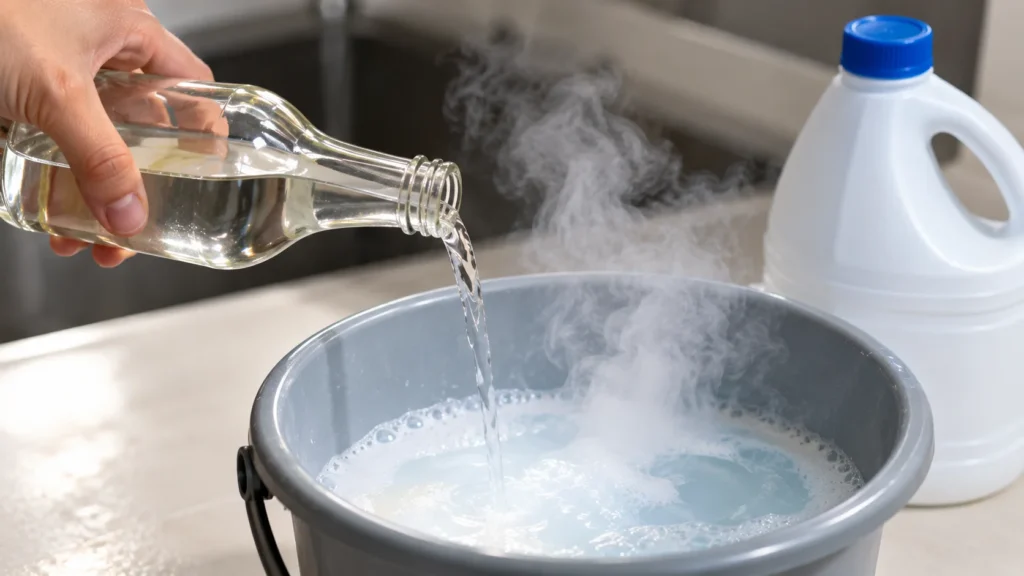
guidance explicitly warns against mixing household bleach with other cleaners, and its chemical-safety information notes that bleach mixed with acids can release chlorine gas.
If you accidentally mixed bleach and vinegar and notice strong irritating fumes:
- Leave the area immediately.
- Get into fresh air.
- Ventilate the area if you can do so safely.
- Do not continue handling the mixture.
- Seek medical or poison-control advice if symptoms occur.
What About Oxygen Bleach for Bleach-Damaged Clothes?
Oxygen bleach is not a magic treatment for chlorine-bleach discoloration. It is a different type of laundry bleach that can be gentler on suitable washable fabrics.
ACI explains that oxygen bleach is generally gentler than sodium hypochlorite bleach and can be useful for maintaining whiteness and treating suitable laundry.
It may help with an ordinary stain, but if chlorine bleach has already removed the dye from a black shirt, oxygen bleach cannot simply put that original black dye back.
How to Prevent Bleach Spots on Clothes
Prevention is much easier than repairing permanent dye loss. The biggest improvement is keeping chlorine bleach away from clothing that is not specifically suitable for it.
Use these habits:
- Read garment care labels before using bleach.
- Follow the bleach product’s dilution instructions.
- Never pour undiluted chlorine bleach directly onto clothing.
- Use the washer’s designated bleach dispenser when available.
- Avoid bleach on wool, silk, mohair, leather, and spandex unless the product and garment specifically indicate compatibility.
- Keep white and dark laundry properly separated.
- Check the bleach dispenser for leftover product if unexpected spots repeatedly appear.
- Never mix bleach with vinegar.
- Never mix bleach with ammonia.
- Never combine bleach with random stain removers.
- Store bleach in its original labeled container.
- Keep bleach away from children and pets.
Whirlpool explains that bleach should be used according to the washer and product instructions and that undiluted bleach should not be applied directly to clothing.
What to Do When Bleach Spots Keep Appearing After Washing
If dark clothing repeatedly develops unexplained pale, orange, or reddish spots, the problem may not be a single accidental spill. Bleach can sometimes carry over from a washer’s bleach dispenser.
Clorox notes that improperly dispensing or incompletely flushed bleach can potentially carry over into a later load and cause discoloration on dark items.
Check:
- Whether chlorine bleach was recently used in the washer.
- Whether the bleach dispenser is being emptied correctly.
- Whether the dispenser needs cleaning according to the washer manual.
- Whether another household product contains bleaching agents.
- Whether the garment was washed with a product incompatible with its dye.
- Whether the marks appear only on dark clothing.
If the issue continues, consult the washing machine manufacturer’s care and maintenance instructions.
Bleach Stain Repair: What Works Best?
There is no single method for every garment because the word “bleach stain” can describe several different situations.
| Problem | Most practical approach |
| Fresh bleach spill | Rinse immediately with plenty of water |
| Lingering bleach smell | Rinse and launder; ventilate |
| Small black bleach spot | Carefully recolor |
| Large black discoloration | Consider whole-garment dyeing |
| Orange/red mark on dark fabric | Treat as dye loss and recolor |
| Yellowed white fabric | Identify cause; misuse may be permanent |
| Ordinary stain on white clothes | Use fabric-safe stain treatment |
| Red dye transfer | Consider a suitable color remover |
| Mold/mildew | Use a fabric-appropriate mold/mildew treatment |
| Valuable garment | Consider professional textile restoration |
Common Mistakes When Trying to Remove Bleach From Clothes
Many online remedies make bleach damage sound like an ordinary stain. That can lead to more damage rather than less.
Avoid these common mistakes:
- Using more bleach: This can enlarge the damaged area.
- Applying bleach directly: Undiluted bleach can cause additional discoloration and fiber damage.
- Using vinegar afterward: Bleach and acids should not be mixed.
- Using ammonia: Bleach and ammonia can create hazardous gases.
- Scrubbing aggressively: Scrubbing cannot restore lost dye and may damage fibers.
- Ignoring the care label: Fiber type matters.
- Assuming white means bleach-safe: Some white fabrics are not suitable for chlorine bleach.
- Trying random chemical combinations: Household cleaners can react dangerously.
- Expecting baking soda to restore color: It cannot recreate destroyed dye.
- Expecting washing to reverse color loss: A permanent bleach mark generally requires recoloring or redesign.
Final Bleach-Damage Checklist
Before attempting to repair clothing damaged by bleach, identify the problem first.
- Is the bleach still wet? Rinse immediately.
- Does the garment only smell of bleach? Rinse and launder.
- Is there a pale spot? It may be dye loss.
- Is the garment black? Recoloring is usually more realistic than stain removal.
- Is the garment white and yellow? Determine whether bleach misuse caused permanent yellowing.
- Is the mark pink or orange? Do not assume it is a normal stain.
- Is dye transferred from another garment? Consider a color-removal product.
- Is the fabric delicate? Follow its care label and consider professional cleaning.
- Are you considering vinegar or ammonia? Do not mix them with bleach.
- Is the damage extensive? Whole-garment dyeing may provide a more even result.
Conclusion
Knowing how to get bleach out of clothes requires one important distinction: bleach residue can be rinsed and washed away, but bleach discoloration is often permanent dye loss. For a fresh spill, immediately rinse the garment thoroughly with clean water and then launder it according to the care label. For black, grey, blue, red, green, or brown clothing that already has a bleach spot, the most realistic solutions are careful recoloring, fabric dye, professional restoration, or turning the damage into an intentional design. Clorox confirms that accidental color loss on black clothing cannot simply be reversed through washing.
For white clothing, yellow bleach stains require extra caution because inappropriate bleach concentration, unsuitable fibers, or misuse can create discoloration that may be permanent. Avoid experimenting with vinegar, ammonia, or other cleaners as bleach “neutralizers.” guidance is clear that bleach should not be mixed with other household cleaners because hazardous vapors can result. The safest repair strategy is therefore to identify the type of damage first, follow the garment and product instructions, and choose restoration rather than increasingly aggressive chemical treatments.
1. Can you get a bleach stain out of clothes?
2. How do you get bleach out of black clothes?
If the bleach is fresh, rinse the garment thoroughly with clean water and then wash it according to the care label. If the black fabric has already developed a light, orange, red, or brown spot, the dye has likely been damaged. Small areas can sometimes be recolored with a suitable fabric marker, while larger areas may look better after dyeing the entire garment.
3. How do you get yellow bleach stains out of white clothes?
4. Does vinegar remove bleach stains from clothes?
5. How do you get the bleach smell out of clothes?
Thoroughly rinse the garment, then launder it according to the care label and detergent instructions. If the smell is strong, keep the area ventilated and avoid mixing the clothing or wash water with vinegar, ammonia, or other cleaners. If bleach fumes cause breathing problems or significant irritation, move to fresh air and seek appropriate medical or poison-control assistance.