
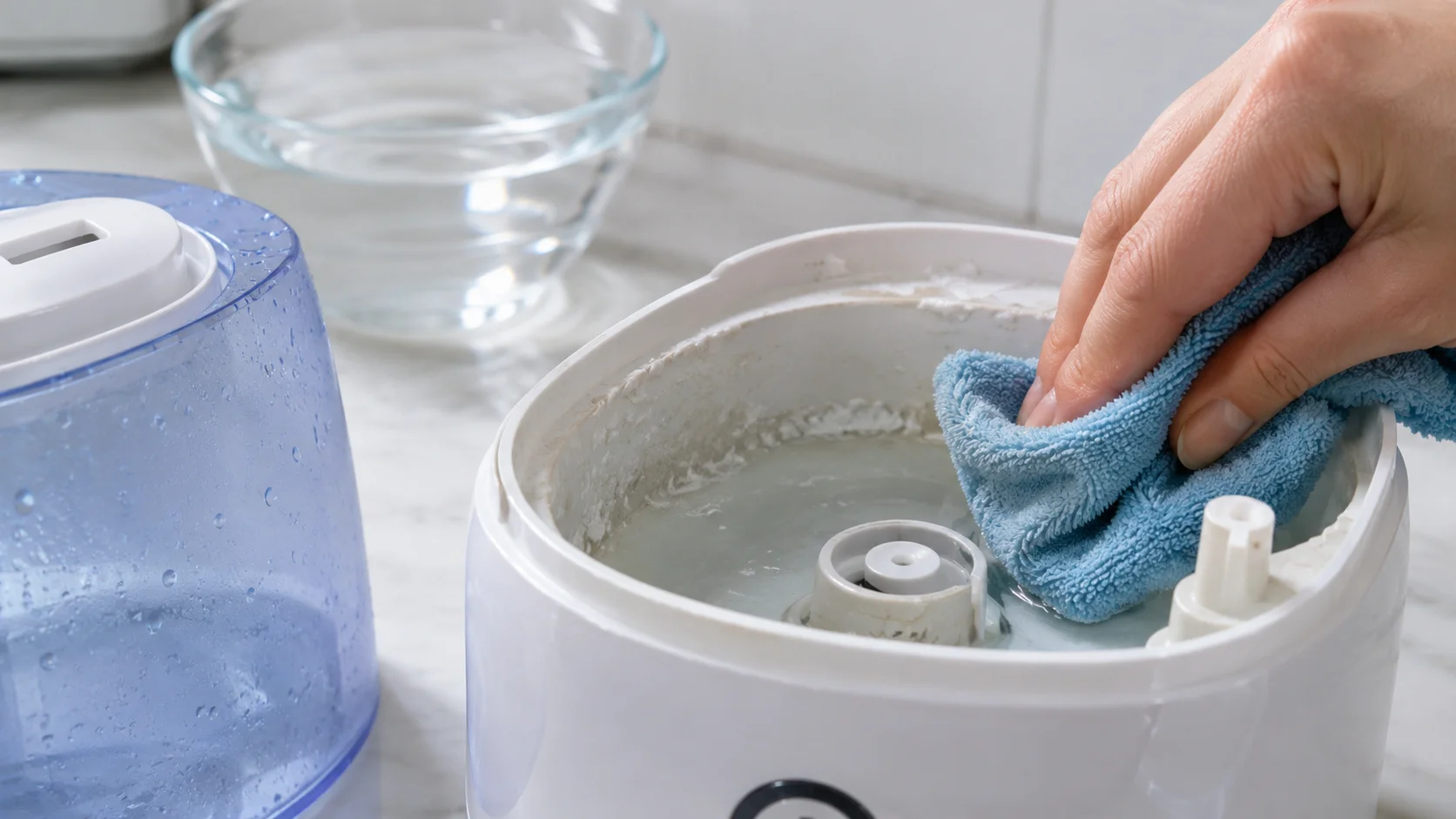
White crusty deposits around a humidifier’s water tank, base, or heating element are often signs of mineral buildup. These deposits develop when minerals in tap water remain behind as water evaporates. Over time, limescale can become difficult to remove, interfere with normal operation, and make routine cleaning more challenging. If your humidifier has developed a chalky coating or no longer looks clean after a regular rinse, descaling may be necessary.
Learning how to descale a humidifier is straightforward when you use the right cleaning method for your particular model. Many humidifiers can be descaled with plain white vinegar, while others require a manufacturer-approved cleaning solution. However, the process differs between cool-mist, warm-mist, ultrasonic, evaporative, and specialized models. A method that works for a removable plastic water tank may not be suitable for a heating element, electronic base, filter, or sensor.
This guide explains how to descale a humidifier step by step, how to use vinegar safely, how often to remove mineral deposits, and what to know about Vicks, Levoit, Dreo, Dyson, and Honeywell humidifiers. You will also learn how to clean a humidifier filter, remove stubborn scale without vinegar, and prevent mineral deposits from returning.
Important: Always follow the cleaning instructions for your exact model. Descaling removes mineral deposits, but it does not replace routine cleaning and disinfection. Never mix vinegar with bleach or other cleaning chemicals.
What Does Descaling a Humidifier Mean?
Descaling a humidifier means removing mineral deposits that accumulate when water evaporates and leaves behind dissolved minerals, such as calcium and magnesium. These deposits commonly appear as white, gray, or chalky crust around the tank opening, water tray, and other water-contact surfaces. Hard water generally contributes to faster buildup than water with a lower mineral content.
Regular rinsing may remove loose residue, but hardened scale often needs a suitable descaling solution and sufficient contact time. White vinegar can help dissolve many mineral deposits on compatible surfaces, although heavy buildup may require more than one treatment. The goal is to loosen the scale without damaging seals, coatings, filters, or other components.
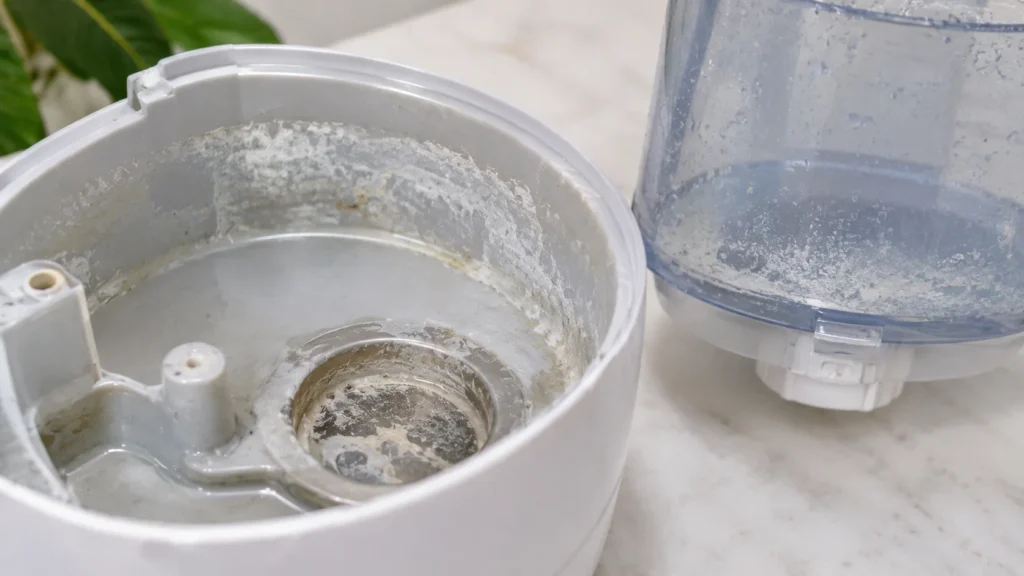
Signs your humidifier needs descaling
- White crust around the water tank or base.
- Chalky deposits on a removable water tray.
- Mineral residue around a warm-mist heating element.
- Visible scale that remains after rinsing.
- Water-contact surfaces that feel rough or gritty.
- Repeated mineral accumulation despite regular cleaning.
- A filter with noticeable mineral deposits, if the manufacturer permits cleaning rather than replacement.
Descaling is most useful when you can see mineral buildup. If you notice slime, mold-like spots, or a musty odor, the humidifier may also need routine cleaning and manufacturer-approved disinfection.
How to Descale a Humidifier Step by Step
The safest approach is to separate the humidifier into the parts the manufacturer identifies as removable, then treat only the surfaces approved for descaling. Never immerse the electrical base or allow liquid to enter vents, switches, wiring, or control panels. Before cleaning, unplug the unit and let any warm-mist model cool completely.
White vinegar is a common option for compatible water-contact surfaces because its acidity helps dissolve mineral scale. The correct concentration, soaking time, and rinsing procedure depend on the humidifier’s instructions, so do not assume every component can be soaked. If the manual specifies a different descaler, use that instead.
Step-by-step descaling instructions
- Turn off and unplug the humidifier. Disconnect the power before handling water or cleaning products.
- Empty the water tank. Pour out the remaining water and remove any loose debris.
- Disassemble removable parts. Separate the tank, cap, tray, and other components only as directed by the manual.
- Inspect the deposits. Identify where the mineral scale has accumulated and check for damaged parts.
- Prepare the approved descaling solution. Use white vinegar or a manufacturer-approved product only if suitable for the model.
- Apply the solution to compatible surfaces. Wet the affected area without flooding electrical components.
- Allow the deposits to loosen. Follow the model’s recommended contact time rather than leaving parts to soak indefinitely.
- Remove softened scale gently. Use a soft cloth or nonabrasive brush if permitted.
- Drain and rinse thoroughly. Remove all cleaning solution and loosened residue.
- Inspect the parts again. Repeat the approved treatment if deposits remain and the manual permits it.
- Dry the exterior and reassemble. Ensure all components are correctly positioned and any required parts are dry.
- Refill and operate according to the manual. Use the recommended water type and confirm that the unit works normally.
If the scale does not loosen, avoid scraping it with a knife, metal tool, or abrasive pad. Such tools may scratch surfaces, damage coatings, or create places where residue can accumulate.
Jump into Other Related Article
- Tile Grout Repair | How to Fix Cracked, Missing, and Damaged Grout
- Brick Stain Colors | Exterior, Interior, Fireplace, Paver, and Before and After Ideas
- How to Clean a Shower Head With Vinegar | A Step-by-Step Guide
How to Descale a Humidifier With Vinegar
White vinegar is a common household option for removing mineral deposits from humidifiers that are compatible with acidic cleaners. Its acidity helps loosen many calcium-based deposits, making them easier to wipe away. Some manufacturers recommend soaking certain components for approximately 15–20 minutes, but the correct method depends on the model and the location of the scale.
Do not assume that every tank, filter, gasket, or internal component can be soaked in vinegar. Some evaporative wicks and treated filters can be damaged by cleaning chemicals. Never run the humidifier with vinegar inside it, and rinse every treated surface thoroughly before returning the unit to service.
The vinegar descaling method
- Unplug the humidifier and empty the tank and base.
- Remove any filter or cartridge that the manual instructs you to take out.
- Prepare the vinegar solution specified by the manufacturer.
- Apply it to the compatible surfaces with mineral deposits.
- Let the solution sit for the recommended contact time.
- Use a soft brush or cloth to loosen softened scale.
- Empty the solution and rinse the cleaned components thoroughly.
- Check for remaining residue and repeat only if permitted.
- Allow the parts to dry as directed before reassembling.
If your humidifier’s manual prohibits vinegar, choose the approved alternative rather than experimenting with stronger acids or household chemicals.
How to Descale a Humidifier Without Vinegar
If you do not want to use vinegar, there are other options, but the best choice depends on the appliance. A manufacturer-approved humidifier descaler may be suitable for compatible components. Some products use citric acid, but you should not assume that a generic citric-acid solution is safe for every tank, coating, seal, heating element, or sensor.
For light deposits, warm water and a soft cloth may remove loose residue. For hardened limescale, water alone may not be sufficient. Check the manual for approved products and contact the manufacturer if it does not specify an alternative descaling method.
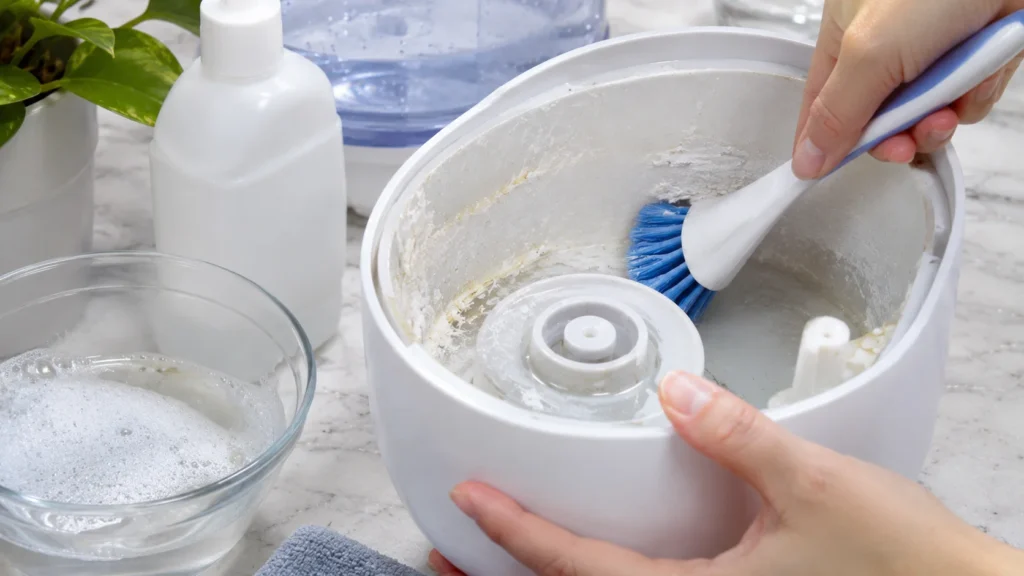
Alternatives to white vinegar
- Manufacturer-approved descaler: Use the product at the stated concentration and follow its rinsing instructions.
- Water and a soft cloth: Suitable for loose residue and routine wiping where the manual permits it.
- A soft-bristle brush: Helps lift loosened scale without aggressive scraping.
- Citric-acid cleaner: Use only if the humidifier manufacturer confirms compatibility.
- Replacement components: A heavily scaled disposable wick or damaged cartridge may need replacement instead of cleaning.
Avoid using abrasive powders, metal scrapers, undiluted acids, or general-purpose bathroom descalers unless the manufacturer explicitly approves them. Never mix cleaning chemicals. In particular, vinegar must never be mixed with bleach because the combination can release toxic chlorine gas.
How to Descale Different Humidifier Brands
The basic principle of descaling is similar across many humidifiers, but brand names alone are not enough to determine the correct procedure. Manufacturers may use different tank designs, filter materials, coatings, and cleaning instructions across their product ranges. Always confirm the model number before applying a cleaning solution.
How to descale a Vicks humidifier
Vicks sells different humidifier designs, including warm-mist and cool-mist models. A warm-mist model may have a heating element that collects scale, while a cool-mist model may have an ultrasonic component or another water-contact assembly.
Unplug the unit and allow a warm-mist humidifier to cool completely. Remove the tank and other designated parts, then consult the instructions for the exact model before applying vinegar. Do not immerse the electrical base, and do not run the unit with a cleaning solution inside it.
How to descale a Vicks warm-mist humidifier
Warm-mist humidifiers heat water, so mineral deposits can collect around the heating chamber. Turn the unit off, unplug it, and allow it to cool according to the manual before cleaning. Use only the recommended method for the heating chamber and removable components.
Never scrape the heating element with a sharp metal tool or switch on the humidifier while descaling. If scale remains after the approved cleaning procedure, consult the model’s instructions or contact the manufacturer.
How to descale a Vicks cool-mist humidifier
Cool-mist humidifiers may use an ultrasonic nebulizer or a different mechanism to produce mist. Mineral deposits on an ultrasonic component can interfere with mist output, but the cleaning procedure depends on the model.
Empty the tank and base, then clean the accessible water-contact surfaces according to the manual. If vinegar is approved, use it only on the specified components and rinse thoroughly afterward. Keep water away from the electrical controls.
How to descale a Levoit humidifier
Levoit humidifiers vary by model, so check the product manual before selecting a descaling method. Levoit’s general humidifier-care guidance discusses using distilled white vinegar on compatible components to loosen mineral deposits, followed by gentle brushing, thorough rinsing, and drying.
Remove the tank and other designated components, and check whether the model includes a filter, float, or additional accessory that must be handled separately. Do not soak a component simply because it fits inside the tank. Follow the model-specific instructions for reassembly and water selection.
How to descale a Dreo humidifier
For a Dreo humidifier, begin with the cleaning instructions for your exact model. Identify the tank, base chamber, mist outlet, and any removable ultrasonic components described in the manual. Unplug the unit and empty the water before cleaning.
Use vinegar or another descaler only where the manufacturer permits it. Avoid pouring liquid into openings that lead to electrical components, and never operate the humidifier while cleaning solution is present. If deposits remain around a delicate component, contact Dreo support rather than scraping it aggressively.
How to descale a Dyson humidifier
Dyson humidifiers may use specialized designs and cleaning cycles, so a generic vinegar-soaking procedure should not be applied without checking the model’s instructions. Find the product’s official maintenance guidance and determine whether it specifies a dedicated deep-clean cycle, a particular descaling solution, or other steps.
Do not assume that a procedure for a basic ultrasonic humidifier is suitable for a Dyson machine with additional components. Follow the exact instructions for cleaning, rinsing, and restarting the device.
How to descale a Honeywell humidifier
Honeywell offers warm-mist, cool-mist, and evaporative humidifiers, and their cleaning methods differ. Its support guidance describes vinegar-based scale removal for certain models, while evaporative wick filters may need replacement rather than chemical cleaning.
Check the model number and remove the wick or filter if the manual instructs you to do so. Never clean a filter with vinegar or bleach when the manufacturer prohibits those chemicals. Replace a hardened, damaged, or foul-smelling filter according to the product instructions.
How Often Should You Descale a Humidifier?
How often you should descale a humidifier depends on water hardness, how frequently you use it, and the manufacturer’s maintenance recommendations. A humidifier used every day with hard tap water may develop visible scale sooner than one used occasionally with lower-mineral water.
For many households, checking the humidifier weekly and descaling when needed is a practical routine. Some manufacturers recommend weekly scale removal during regular use, while others specify different intervals. Follow your model’s manual rather than treating one schedule as universal.
Recommended maintenance schedule
| Maintenance task | Suggested approach |
| Empty and refill water | Daily during regular use, following the manual |
| Rinse the tank | Regularly, ideally with daily water changes |
| Inspect for mineral buildup | Weekly |
| Descale | When deposits appear or as the manual recommends |
| Clean and disinfect | At the manufacturer’s recommended interval |
| Replace disposable filters or wicks | According to the model and water conditions |
| Clean before seasonal storage | Before storing and again before reuse, as directed |
These are general guidelines, not replacements for the manufacturer’s specific instructions. If mineral deposits develop quickly, inspect your water quality and consider using water with a lower mineral content if your humidifier supports it.
How to Descale a Humidifier Filter
Not every humidifier filter can be descaled. Some evaporative humidifiers use absorbent wicks that collect minerals from the water. Other models have cartridges or specialized filters that should be replaced rather than treated with a cleaning solution.
Before cleaning, identify the filter type and check the manual. If the manufacturer permits soaking in plain water, this may loosen some mineral deposits. Do not use vinegar, bleach, soap, or other chemicals on a filter unless the manufacturer specifically approves them. Honeywell, for example, advises against chemically cleaning certain wick filters and recommends replacing them when necessary.
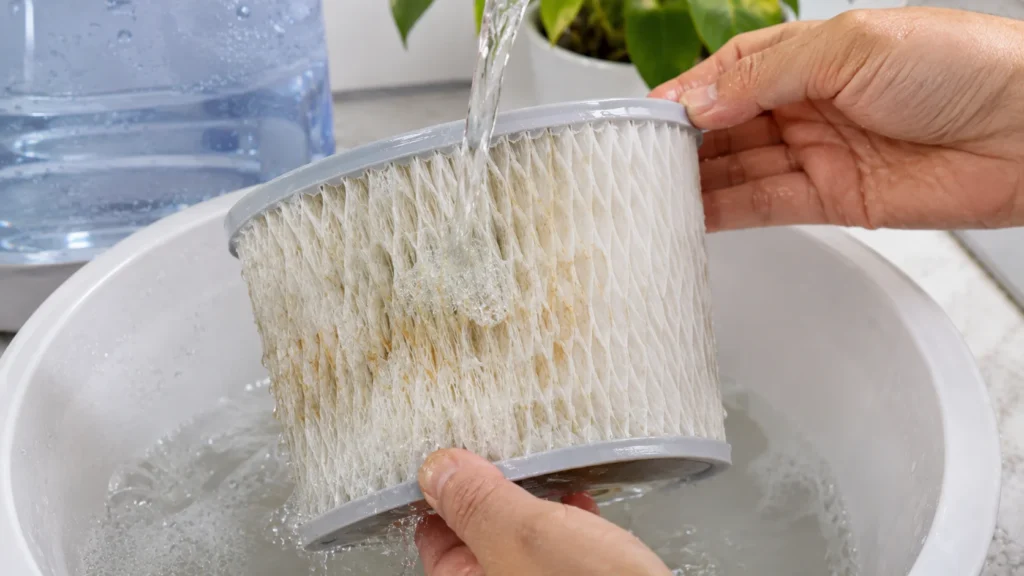
When to clean or replace the filter
- Light mineral deposits: Follow the manufacturer’s approved rinsing or soaking procedure.
- Hard, crusty buildup: Check whether the filter is designed for cleaning or requires replacement.
- Persistent odors: Replace the filter if the manual recommends it.
- Reduced moisture output: Inspect the filter and replace it if it is clogged or damaged.
- Visible mold-like growth: Stop using the humidifier until the affected parts are addressed according to the manufacturer’s cleaning instructions.
A clogged filter may not recover its original performance after cleaning. Replacing a disposable filter is often the more appropriate solution.
How to Prevent Mineral Buildup in a Humidifier
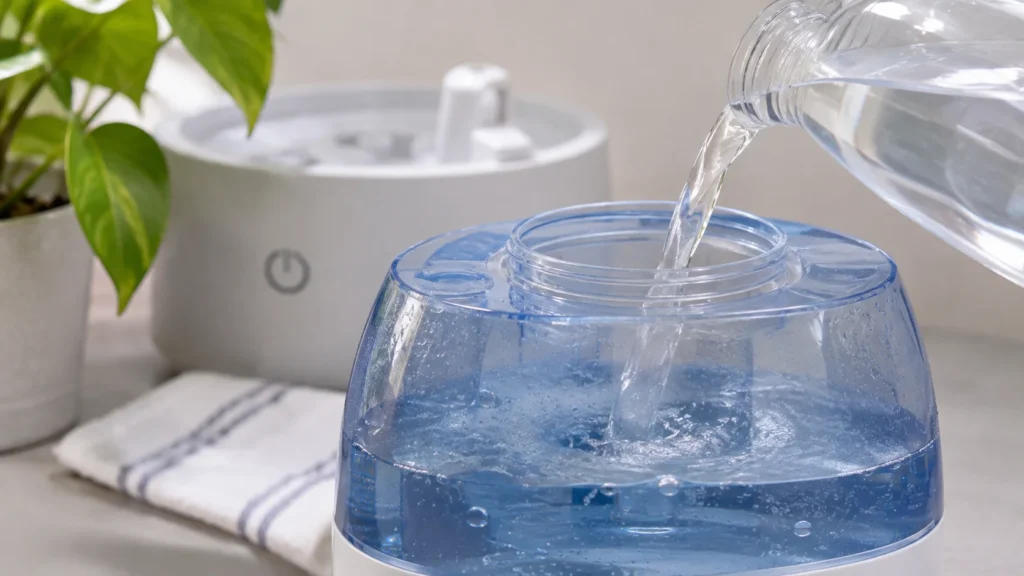
Preventing scale is easier than removing a thick layer after it hardens. Water contains different amounts of dissolved minerals, and those minerals remain behind when the water evaporates. Using water with fewer minerals can reduce the rate at which deposits form, although it does not eliminate the need for cleaning.
AIRCARE recommends lower-mineral water to help limit buildup, while Levoit also highlights distilled water as a way to reduce mineral deposits in compatible humidifiers. Always check whether your specific model requires or permits a particular water type.
Habits that help keep your humidifier scale-free
- Use distilled water if recommended or permitted for your model.
- Empty standing water regularly.
- Rinse the tank during routine maintenance.
- Inspect the base for white deposits each week.
- Descale before heavy buildup becomes difficult to remove.
- Replace mineral cartridges according to the manufacturer’s schedule.
- Change disposable wick filters as directed.
- Avoid leaving unused water in the humidifier for extended periods.
- Clean the unit before storing it for a season.
- Follow the manufacturer’s instructions when restarting a stored humidifier.
Regular maintenance also helps you identify damaged seals, cracked tanks, and other issues before they become more serious.
Conclusion
Knowing how to descale a humidifier helps you remove chalky mineral deposits before they interfere with normal operation. The basic process involves unplugging the appliance, emptying the tank, treating compatible surfaces with an approved descaler, gently removing loosened scale, and rinsing thoroughly.
White vinegar is a useful option for many models, but it is not suitable for every filter, seal, heating element, or specialized component. Whether you own a Vicks, Levoit, Dreo, Dyson, or Honeywell humidifier, use the instructions for your exact model rather than relying on a universal cleaning recipe.
Finally, inspect your humidifier regularly, replace filters when required, and consider lower-mineral water if your model supports it. Consistent care can reduce stubborn scale buildup and help your humidifier remain in good working condition.
1. What is the easiest way to descale a humidifier?
Unplug the humidifier, empty the tank, and remove the components specified in the manual. Use an approved descaling solution on compatible surfaces, loosen deposits with a soft brush or cloth, and rinse thoroughly. The exact solution and contact time depend on the model.
2. Can I use white vinegar to descale a humidifier?
Yes, many humidifiers permit white vinegar for removing mineral deposits. However, some components and filters may be incompatible with vinegar. Check the manufacturer’s instructions before using it, and never mix vinegar with bleach.
3. How long should vinegar sit in a humidifier?
Some manufacturers recommend contact times of around 15–20 minutes for particular components, while others specify different procedures. Follow your model’s instructions and do not leave vinegar soaking indefinitely without approval.
4. How often should I descale my humidifier?
Inspect it weekly and descale when mineral deposits appear or when the manufacturer recommends it. Hard water and frequent use may require more frequent maintenance.
5. How do I descale a humidifier without vinegar?
Use a manufacturer-approved descaler or another approved cleaning method. Warm water and a soft cloth may remove loose residue, but hardened scale often requires a suitable descaling product.
6. Can I use baking soda to remove humidifier scale?
Baking soda is not the first choice for hardened mineral scale, and abrasive scrubbing can damage some surfaces. Use only products and methods approved for your humidifier. A compatible descaler is generally more suitable for mineral deposits.
7. How do I descale a Vicks humidifier?
Check the instructions for your exact Vicks model. Unplug the unit, empty the tank, allow warm-mist components to cool, and clean only the approved surfaces using the specified procedure.
8. How do I descale a Levoit humidifier?
Follow the Levoit manual for your model. Its general care guidance discusses vinegar for compatible components, followed by gentle cleaning and thorough rinsing. Check filter and accessory instructions separately.
9. Can I descale a humidifier filter with vinegar?
Not always. Some filters can be damaged by vinegar or other chemicals. Check the manual, and replace disposable filters when required.
10. Why does white scale keep returning?
Minerals in the water remain behind during evaporation. Hard water can cause deposits to return quickly, even after a thorough cleaning. Using lower-mineral water where permitted and maintaining the humidifier regularly can help reduce buildup.
11. Does descaling disinfect a humidifier?
No. Descaling removes mineral deposits; it does not replace the manufacturer’s cleaning and disinfection procedure. Follow the separate instructions for keeping water-contact surfaces hygienic.
12. Can I run my humidifier with vinegar inside it?
No. Do not operate the humidifier with vinegar or another cleaning solution inside it. Complete the approved cleaning procedure, rinse thoroughly, and reassemble the unit according to the manual before using it again.