
If your dishwasher smells unpleasant, leaves bits of food on plates, or seems less effective than it used to be, its filter is a good place to start. During a wash cycle, the dishwasher filter catches food particles and other debris so they do not continually circulate through the appliance. Over time, that trapped material can build up and interfere with cleaning performance.
Learning how to clean a dishwasher filter is a straightforward maintenance task for many modern dishwashers. In most models with a removable filter, you can take it out, rinse away loose debris, gently scrub it with a soft brush, and reinstall it correctly. The exact removal method varies, however, so always check your owner’s manual before twisting or lifting any components.
This guide explains how to clean a dishwasher filter step by step, how often to do it, what to avoid, and what to know about Whirlpool, KitchenAid, Maytag, Bosch, Samsung, GE, LG, and other brands. It also covers vinegar, stubborn residue, unpleasant odors, and signs that a filter may need replacement rather than another cleaning.
What Does a Dishwasher Filter Do?
The dishwasher filter catches food particles, small scraps, and other debris during washing. This helps prevent residue from circulating back onto dishes and protects parts of the drainage system from certain types of debris. In many modern dishwashers, the filter is located at the bottom of the tub, beneath the lower rack.
Some dishwashers use a removable filter that needs periodic cleaning, while others have a maintenance-free filtration system or a different type of debris collector. Whirlpool and KitchenAid, for example, provide separate guidance for removable and maintenance-free systems. That is why identifying your model matters before attempting to remove anything.
Signs Your Dishwasher Filter Needs Cleaning
Your filter may need attention if you notice any of these signs:
- Food particles remain on plates after a completed cycle.
- Glasses or dishes feel gritty after washing.
- The dishwasher develops a persistent food-like odor.
- Visible grease or scraps cover the filter.
- Water drains more slowly than usual.
- The filter mesh appears coated with residue.
- Cleaning performance declines despite using the correct detergent.
- A filter-cleaning indicator appears on a model that has one.
These symptoms can also have other causes, such as blocked spray arms, incorrect loading, drainage problems, or detergent issues. Cleaning the filter is a useful first step, but persistent problems may require further troubleshooting.
Jump into Other Related Article
- Best Deck Stain and Sealer | Complete Guide for Pressure Treated, Cedar, Old, and Full Sun Decks
- Best Tub Cleaner | 7 Effective Options for Soap Scum, Hard Water, and Tough Stains
- How to Clean Floor Tile Grout Without Scrubbing | Easy, Low-Effort Methods
What You Need Before Cleaning a Dishwasher Filter
You usually do not need special tools to clean a removable dishwasher filter. Warm water, a soft brush, and a little mild dish soap are enough for many routine cleanings. The goal is to remove trapped debris without damaging the mesh, plastic parts, or seals.
Before starting, consult the dishwasher’s owner’s manual for the correct removal method and any model-specific warnings. If your manual identifies the filter as maintenance-free, do not dismantle it simply because another dishwasher uses a removable design.
Cleaning Supplies Checklist
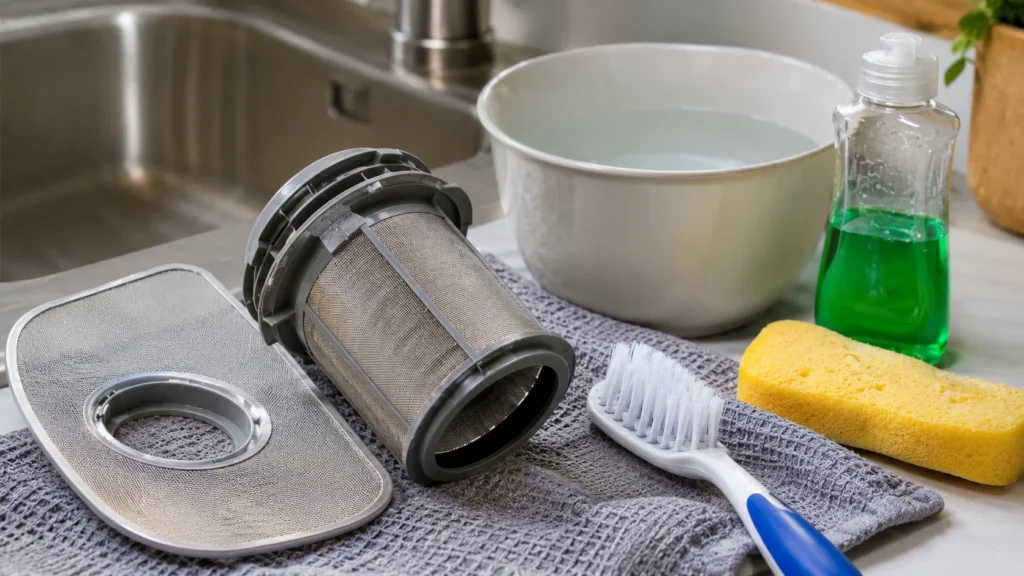
Gather these items before you begin:
- Warm running water.
- A soft toothbrush or small cleaning brush.
- Mild dish soap, if needed.
- A soft sponge or cloth.
- A sink or basin for rinsing.
- A towel for wiping up spills.
- The owner’s manual or official model-specific instructions.
Avoid wire brushes, abrasive scouring pads, and harsh chemicals unless the manufacturer explicitly approves them. Whirlpool and KitchenAid warn that rough cleaning tools can damage dishwasher filters.
How to Clean a Dishwasher Filter Step by Step
For a dishwasher with a removable filter, the process generally involves accessing the filter, removing it carefully, washing away debris, and reinstalling it securely. The exact twist direction and locking mechanism can vary, so use the instructions for your model rather than forcing a stuck component.
Step 1: Turn Off the Dishwasher and Empty the Lower Rack
Make sure the dishwasher is not running and allow any hot components or water to cool. Open the door and remove the lower rack so you can reach the bottom of the tub.
Look for the filter near the base of the dishwasher, often around the bottom spray arm or in a corner of the tub. Before removing it, check for large debris or sharp objects in the surrounding area. If you spot broken glass, do not reach blindly into the filter opening.
Step 2: Remove the Filter Carefully
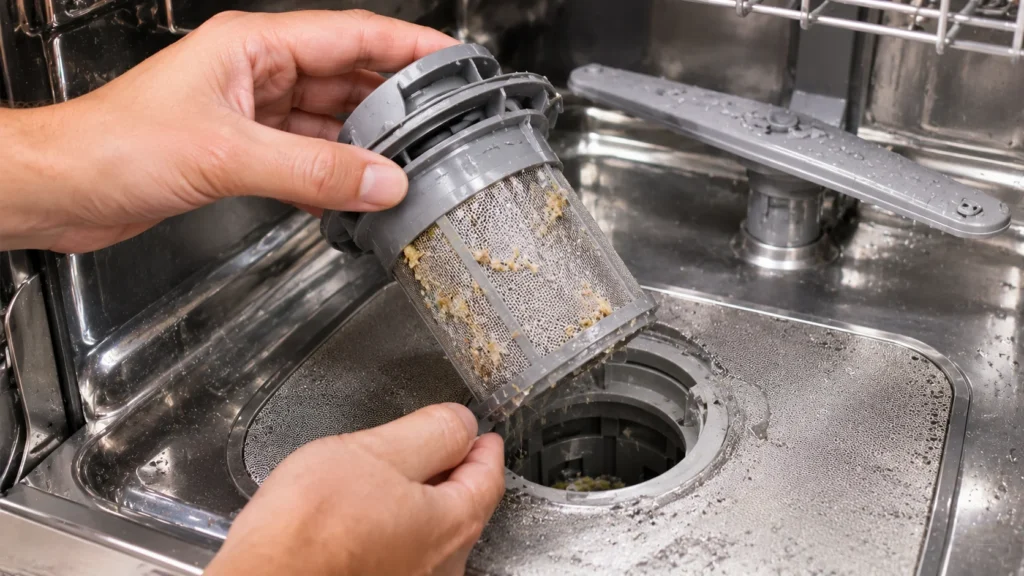
Many removable filters have a twist-lock design. Some models use an upper filter assembly and a lower filter plate, while others use a different arrangement. Follow your manual to unlock the correct components and lift them out without bending or forcing anything.
If the filter does not move easily, stop and check the model-specific instructions. Applying excessive force can break plastic tabs or damage the filter housing. Keep track of how the parts fit together so you can reinstall them in the correct order.
Step 3: Rinse Away Loose Food Debris
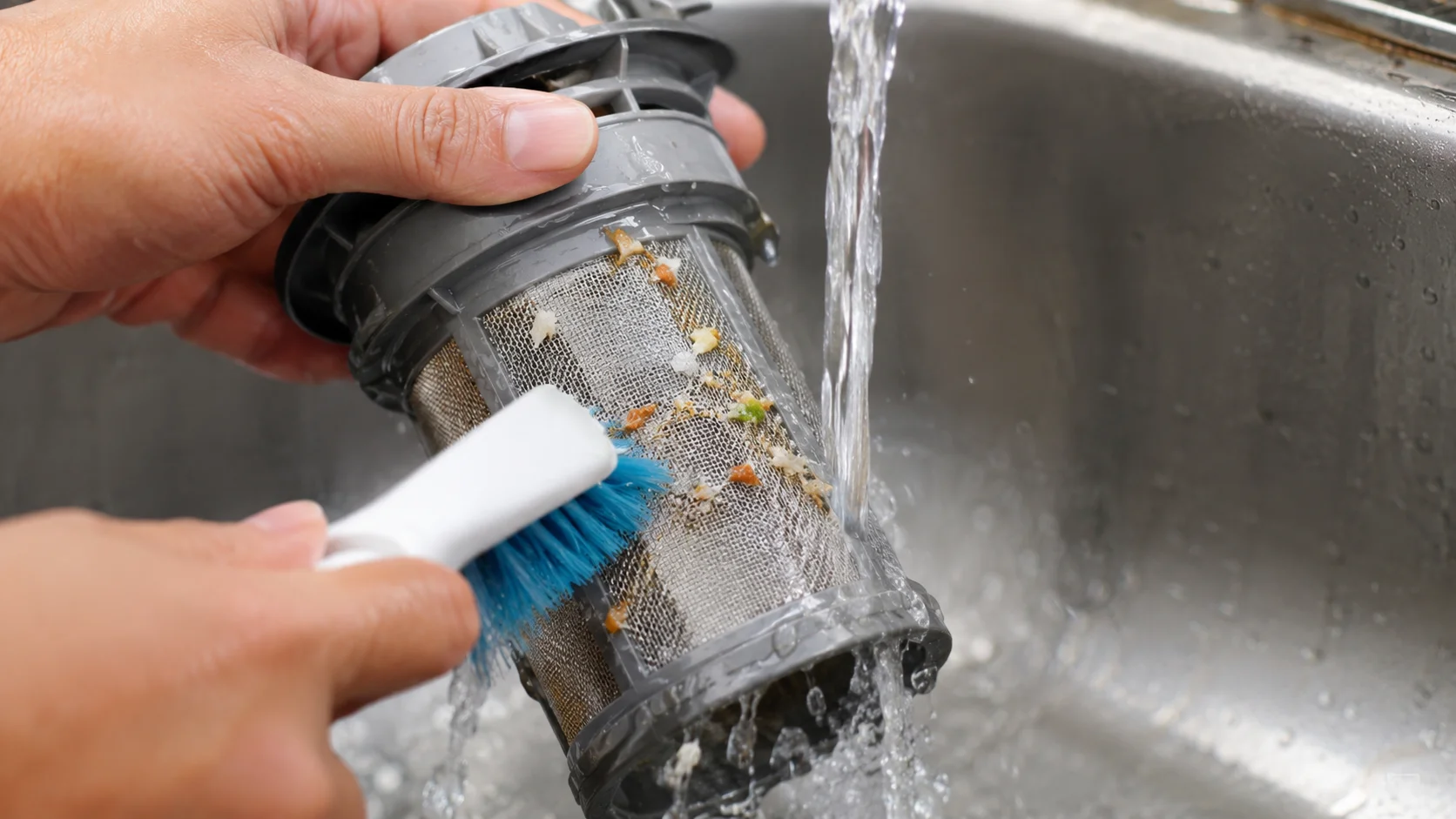
Hold the removable filter under running warm water to loosen food particles, grease, and other residue. Rotate it as needed so water reaches the mesh and the small openings where debris may collect.
Remove loose scraps gently rather than pushing them deeper into the filter. If food remains stuck, let the filter soak briefly in warm water before brushing. Do not use boiling water unless the manufacturer specifically says it is suitable for your filter materials.
Step 4: Gently Scrub Stubborn Residue
Use a soft toothbrush or cleaning brush to work away food particles trapped in the mesh or around plastic components. A small amount of mild dish soap can help with greasy residue, provided the manufacturer permits it.
Brush gently and pay attention to seams, grooves, and corners. Avoid sharp tools, wire brushes, and abrasive pads, which may damage the filter or create openings that allow debris through. If a deposit will not come off with gentle cleaning, check the manual before trying stronger products.
Step 5: Rinse the Filter Thoroughly
Rinse all filter components under running water until the loosened debris and soap are gone. Check both sides of the mesh and inspect the edges for food particles that may have been missed.
A clean filter should be free of visible scraps and greasy buildup. If the mesh is torn, warped, cracked, or otherwise damaged, cleaning may not be enough; you may need a replacement part made for your model.
Step 6: Reinstall and Lock the Filter
Place the lower filter or filter plate back into its correct position, if your model uses one. Reinstall the upper filter assembly and follow the manufacturer’s locking procedure. On some Whirlpool and KitchenAid designs, the upper assembly must be turned until it locks securely.
Check that all parts sit flat and are properly secured. Never run a dishwasher with a required filter missing or improperly installed, because this can cause damage. Once the filter is secure, return the lower rack and follow the manual’s guidance for resuming normal use.
How to Clean Different Dishwasher Filter Brands
The basic cleaning process is similar for many dishwashers, but filter designs are not identical. Whirlpool, KitchenAid, Maytag, Bosch, Samsung, GE, LG, Kenmore, Miele, and Amana may use different filter assemblies depending on the model and production year.
Use the brand guidance below as a starting point, then confirm the exact instructions in your owner’s manual. A brand name alone does not tell you whether a particular dishwasher has a removable, self-cleaning, or maintenance-free filter.
How to Clean a Whirlpool Dishwasher Filter
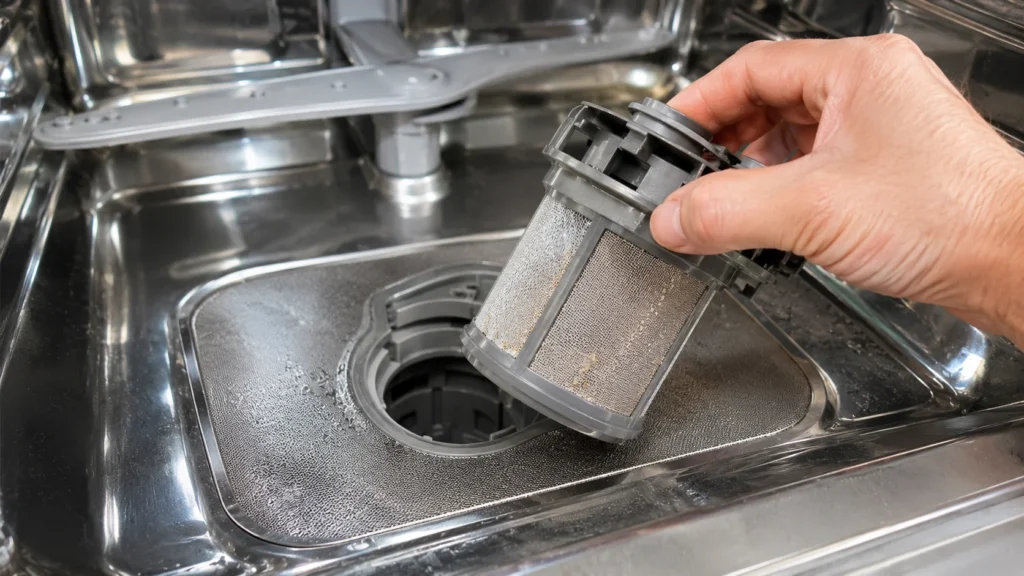
For many Whirlpool dishwashers with a removable filter, the upper assembly turns counterclockwise to unlock and lift out. The lower filter may then be lifted or pulled out separately, depending on the design. Rinse the parts under running water and use a soft brush for stubborn residue or mineral deposits.
When reinstalling, make sure the lower filter is seated correctly and the upper assembly is locked. Some Whirlpool models have a maintenance-free filter system instead, so check the model instructions before trying to remove a filter.
How to Clean a KitchenAid Dishwasher Filter
To clean a removable KitchenAid dishwasher filter, pull out the lower rack and locate the filter at the bottom of the tub. Follow the model’s removal instructions, rinse the components, and gently brush away food particles with a soft toothbrush or sponge. KitchenAid cautions against using wire brushes or abrasive sponges.
Some KitchenAid models feature a maintenance-free filtration system that does not require routine manual filter cleaning. If your manual identifies your filter as maintenance-free, follow its specific care instructions instead of dismantling the assembly.
How to Clean a Maytag Dishwasher Filter
For a Maytag dishwasher with a removable filter, start by checking the owner’s manual for the filter’s location and removal method. In many designs, you will need to remove the lower rack, unlock the filter, rinse it, and gently brush away remaining debris.
Reinstall the filter according to the instructions and make sure it is secure before using the dishwasher. If the filter will not unlock or appears different from the illustrations in your manual, do not force it; identify the exact model first.
How to Clean a Bosch Dishwasher Filter
Bosch’s general guidance for removable filters is to take the filter out, rinse it under running water, and use soapy water and a soft brush when it is very dirty. The filter is typically accessible from the bottom of the dishwasher after removing the lower rack.
Bosch recommends periodic filter cleaning, with its US guidance suggesting cleaning every few months for many models. The right interval can vary with use and the model’s instructions, so check your owner’s manual for the recommended schedule.
How to Clean a Samsung Dishwasher Filter
To clean a Samsung dishwasher filter, consult the manual for your exact model before removing any components. If the filter is removable, follow the specified unlocking method, rinse away food particles, and use a soft brush where needed.
Avoid assuming the filter turns in a particular direction or that every Samsung model uses the same arrangement. After cleaning, reinstall the filter as instructed and verify that it sits securely before starting a cycle.
How to Clean a GE Dishwasher Filter
For a GE dishwasher with a removable filter, consult the model manual to locate the filter and determine how it detaches. Rinse the filter under running water and gently remove stuck-on residue with a soft brush, provided the instructions allow it.
If you cannot find a removable filter, do not pry open the pump or filter housing. Some designs use different debris-management systems, and model-specific instructions are the safest way to identify the correct maintenance procedure.
How to Clean LG, Kenmore, Miele, and Amana Dishwasher Filters
For LG, Kenmore, Miele, and Amana dishwashers, the same general principle applies: identify the filter system first, then follow the manufacturer’s removal, washing, and reinstallation instructions. If the filter is removable, warm running water and a soft brush are often appropriate for routine debris removal.
Do not assume that a cleaning method for one model applies to every dishwasher under the same brand. If your dishwasher is older, locate the manual using its model number, and check whether the filter is designed for owner maintenance.
How Often Should You Clean a Dishwasher Filter?
The best cleaning schedule depends on how frequently you use the dishwasher, how much food residue enters it, and whether the filter is designed for manual maintenance. A household that runs several cycles each day may need to inspect its filter more often than a home that uses the appliance occasionally.
For many dishwashers with removable filters, cleaning about once a month is a practical starting point. KitchenAid suggests monthly cleaning for many models and more frequent attention for heavy use, while Bosch gives a longer interval for many of its models. Always follow the interval stated in your own manual.
A Simple Dishwasher Filter Maintenance Schedule
| Task | Suggested timing |
| Check for visible food scraps | Whenever loading or unloading |
| Inspect for odor or residue | Weekly, or when symptoms appear |
| Clean a removable filter | Follow the manual; monthly is a common starting point |
| Check filter condition and fit | During each cleaning |
| Clean the dishwasher interior | Follow the appliance and cleaner instructions |
| Replace a damaged filter | When damage is found and the correct replacement is available |
A maintenance-free filter may not need routine removal and washing. If your appliance has a filter-cleaning indicator, follow the instructions for that feature rather than relying solely on a calendar.
Can You Clean a Dishwasher Filter With Vinegar?
Vinegar is sometimes used for removing mineral deposits and residue from household appliances, but it is not necessary for every dishwasher filter. For routine food particles and grease, warm water, mild dish soap when approved, and a soft brush are usually the better starting point.
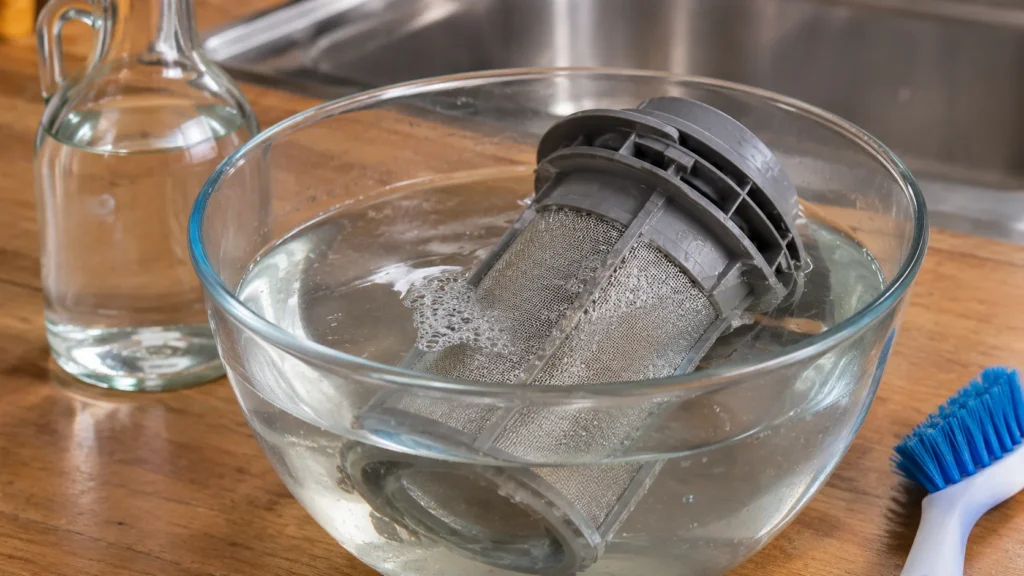
KitchenAid describes a vinegar-and-warm-water soak for some stubborn filter buildup, but compatibility depends on the filter and appliance instructions.
Before using vinegar, confirm that your manufacturer permits it, and never mix it with bleach or other cleaning chemicals.
How to Clean a Dishwasher Filter With Vinegar Safely
- Remove the filter only if your model is designed for manual removal.
- Rinse away loose food and grease with warm running water.
- Check the manual to confirm whether a vinegar soak is permitted.
- If approved, use the manufacturer’s recommended dilution and soaking time.
- Gently brush any remaining residue with a soft brush.
- Rinse the filter thoroughly so no cleaning solution remains.
- Reinstall the filter securely according to the manual.
Do not pour vinegar into the dishwasher’s filter housing as a substitute for cleaning the filter, and do not use concentrated acids or harsh descalers unless the manufacturer explicitly recommends them.
15 Tips to Keep Your Dishwasher Filter Clean Longer
A few small habits can help prevent excessive buildup and make routine filter cleaning easier. These suggestions complement—not replace—the maintenance instructions for your particular dishwasher.
- Inspect the filter regularly. Check for visible scraps and grease instead of waiting for cleaning performance to decline.
- Remove large food scraps. Scrape large pieces into the trash before loading dishes.
- Avoid unnecessary pre-rinsing. Follow your dishwasher’s loading guidance; many modern models are designed to handle ordinary food residue.
- Use a soft brush. Gentle brushing helps remove buildup without damaging the mesh.
- Avoid wire brushes. Metal bristles and abrasive pads can damage the filter.
- Do not force the filter loose. Check the model instructions if it resists turning or lifting.
- Clean both sides. Food particles can cling to the underside and inside the filter assembly.
- Use suitable cleaning products. Follow the manual before using soap, vinegar, or specialized cleaners.
- Keep the filter correctly seated. Incorrect installation can interfere with the dishwasher’s operation.
- Inspect for damage. Replace cracked, warped, or torn components as recommended.
- Check for sharp objects carefully. Broken glass and other hard debris can cause injury or damage.
- Follow your model’s cleaning interval. Heavy use may require more frequent inspection.
- Clean the rest of the dishwasher when needed. A dirty tub or drain area may contribute to odors even after the filter is clean.
- Use the correct detergent. Follow the manufacturer’s advice for detergent type and amount.
- Keep the manual accessible. Model-specific instructions are especially important for older dishwashers and unusual filter designs.
Common Dishwasher Filter Problems and How to Handle Them
Cleaning the filter can resolve many minor maintenance issues, but it will not fix every dishwasher problem. If your dishes remain dirty or the appliance drains poorly after cleaning, inspect other accessible components according to the manual and consider professional service when necessary.
The Filter Is Stuck and Will Not Come Out
A filter may feel stuck because it has a locking mechanism, accumulated residue, or a removal method you have not identified. Check the manual for the correct direction and sequence, and avoid using pliers or excessive force.
If the filter remains stuck, consult the manufacturer’s support service. Breaking a locking tab can turn a simple cleaning task into a replacement or repair.
The Filter Still Looks Dirty After Rinsing
Grease and mineral deposits may remain after a quick rinse. Try a brief soak in warm water and gentle brushing if the manufacturer permits it. Avoid abrasive tools or strong chemicals that may damage the filter material.
If the mesh is permanently discolored, deformed, or damaged, check whether replacement is recommended. Appearance alone does not always indicate that a filter has failed, so inspect its condition and cleaning performance as well.
The Dishwasher Smells Bad After Cleaning
A clean filter may not eliminate odors if food residue remains elsewhere in the dishwasher. Check the accessible drain area, door gasket, spray arms, and tub according to the owner’s manual. Make sure the drain hose and plumbing are installed correctly if drainage problems persist.
If the odor resembles burning, or you notice leaking, unusual noises, or standing water that will not drain, stop using the appliance if necessary and follow the manufacturer’s troubleshooting or service instructions.
Conclusion
Learning how to clean a dishwasher filter can help you maintain cleaning performance, reduce trapped food residue, and identify potential problems before they become more serious. For most manually maintained filters, the basic process is simple: access the filter, remove it according to the manual, rinse away debris, brush gently when needed, and reinstall it securely.
The most important detail is that not every dishwasher uses the same filter system. Whirlpool, KitchenAid, Maytag, Bosch, Samsung, GE, LG, Kenmore, Miele, and Amana models may have different removal methods or maintenance requirements. Always confirm your model’s instructions before removing components or using vinegar and other cleaning products.
Make filter inspection part of your regular kitchen maintenance routine, and address persistent odors, drainage problems, or poor cleaning performance rather than assuming the filter is always the cause. A clean, correctly installed filter is a small but useful step toward keeping your dishwasher working as intended.
How do I clean a dishwasher filter quickly?
Remove the lower rack, take out the filter if your model permits it, rinse it under warm running water, and gently brush away stuck debris. Reinstall it securely according to the manual before running the dishwasher.
How often should I clean my dishwasher filter?
Monthly cleaning is a useful starting point for many manually cleaned filters, but the correct interval varies. Some manufacturers recommend more frequent cleaning for heavy use, while other models have different maintenance schedules or maintenance-free filters.
Do all dishwashers have a removable filter?
No. Dishwasher filtration systems vary. Some models have removable filters that require regular cleaning, while others use maintenance-free systems or different debris collectors. Check the owner’s manual before attempting removal.
Can I use dish soap to clean a dishwasher filter?
Mild dish soap may be suitable for some removable filters, particularly when grease is present. Follow the manufacturer’s instructions, use a soft brush, and rinse thoroughly so no soap residue remains.
Can I use baking soda to clean a dishwasher filter?
Warm water and gentle brushing are usually sufficient for ordinary food debris. Before applying baking soda or another cleaning product directly to the filter, check the manufacturer’s guidance to make sure it is compatible with the filter materials.
Why does my dishwasher filter get dirty so quickly?
Frequent dishwasher use, food residue, and the type of meals being washed can cause debris to accumulate quickly. Inspect the filter regularly and follow the recommended cleaning schedule for your model.
How do I clean an old Whirlpool dishwasher filter?
First, identify the exact model and locate its manual. Older Whirlpool dishwashers may use a different filter design from newer models, so verify whether the filter is removable and follow the specified cleaning procedure.
How do I know if my dishwasher filter needs replacing?
Look for cracks, torn mesh, warped plastic, broken locking tabs, or a filter that cannot be secured correctly. If damage is present, find the correct replacement for your model rather than trying to repair it with glue or other improvised materials.
Should I run the dishwasher without its filter?
No, not if the appliance requires that filter to be installed. Running a dishwasher with a missing or improperly secured filter can cause damage. Confirm that the filter is correctly fitted before starting a cycle.
Why are my dishes still dirty after cleaning the filter?
Other possible causes include blocked spray arms, incorrect loading, unsuitable detergent use, water-supply problems, or a drainage issue. Check the owner’s manual and troubleshoot one issue at a time. If poor cleaning continues, contact the manufacturer’s support service.
Is cleaning a dishwasher filter the same as cleaning the entire dishwasher?
No. Filter cleaning removes debris trapped in the filtration system, while a full dishwasher cleaning may involve the tub, door gasket, spray arms, and other accessible areas. Follow the separate maintenance instructions for each component.
Where can I find instructions for my dishwasher model?
Check the owner’s manual or the manufacturer’s official support website. Search using the full model number on the appliance’s rating label, since instructions can differ between models within the same brand.