
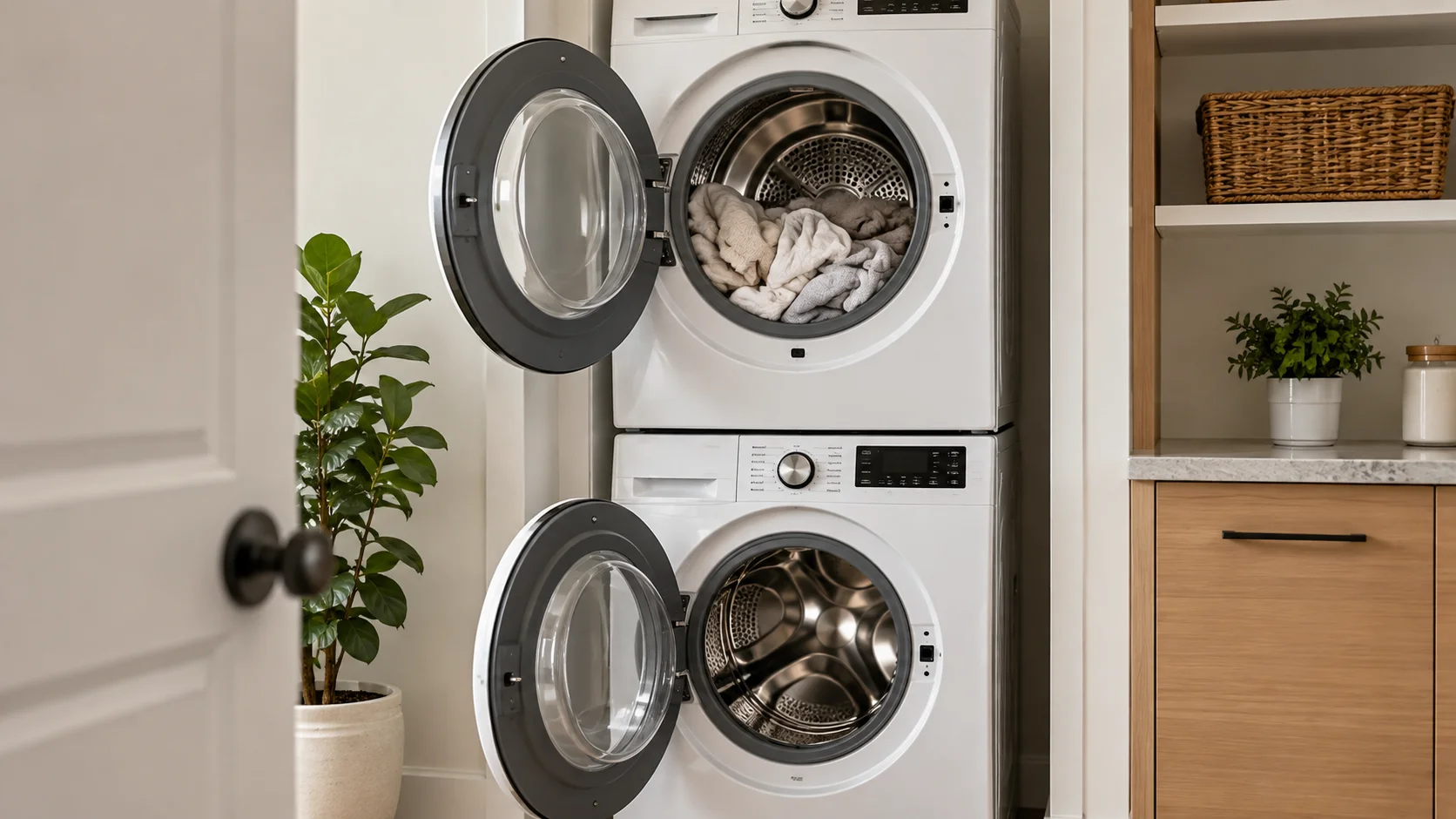
A stackable washer and dryer combines two separate laundry appliances into one vertical installation, allowing the washer and dryer to occupy roughly the floor space of one machine. This configuration is particularly useful in apartments, condos, laundry closets, small homes, RVs, and other areas where horizontal floor space is limited. Most conventional stackable sets use a front-load washer and compatible dryer, secured with a manufacturer-approved stacking kit. Whirlpool describes stackable pairs as two separate appliances that can be arranged vertically or placed side by side, while laundry centers are built as a single pre-stacked unit.
The most important consideration is not simply finding two appliances that physically fit together. The washer and dryer must be designed and approved for stacking, and the correct stacking kit must be used. LG, for example, specifically warns that not all washer and dryer combinations are stackable and that compatible models must have matching dimensions.
For shoppers comparing an LG stackable washer and dryer, GE stackable washer and dryer, Whirlpool stackable washer and dryer, Samsung stackable washer and dryer, Maytag, Electrolux, Frigidaire, Bosch, Miele, or Speed Queen, the right choice depends on available dimensions, capacity, dryer type, installation requirements, budget, and household laundry volume.
What a Stackable Washer and Dryer Setup Includes
A stackable washer and dryer is normally made up of two independent front-load appliances. The washer sits on the floor and the dryer is installed directly above it. A compatible stacking kit connects the machines and helps keep the upper dryer secure during operation.
Unlike an all-in-one washer dryer combo, the washer and dryer remain separate machines. This can provide greater flexibility because the pair may often be installed side by side instead of vertically, provided the manufacturer’s specifications allow both configurations. Whirlpool specifically identifies this flexibility as one of the differences between stackable appliances and permanently integrated laundry towers.
Stackable appliances are also different from traditional top-load washers. A top-load washer requires clearance above its lid, whereas a front-load washer is generally more suitable for vertical stacking. Many compact stackable systems are front-load machines because their doors open from the front and the dryer can safely sit above the washer when the combination is approved.
The configuration is especially useful when floor width is limited but ceiling height is available. Consumer Reports notes that vertically stacking appliances can be useful when laundry areas are no wider than a closet or are constrained by doors, corners, plumbing, or other obstacles.
Stackable Washer and Dryer Dimensions
Stackable washer and dryer dimensions vary by model, so shoppers should always check the individual specification sheets before purchasing. There is no single universal size that applies to every stackable pair. Lowe’s also recommends measuring width, height, depth, and available clearance before buying rather than relying on a presumed standard dimension.
For many full-size front-load stackable pairs, Whirlpool gives a useful general range of approximately 24–28 inches wide, 32–34 inches deep, and about 39 inches tall per appliance, resulting in roughly 78 inches when stacked. Whirlpool recommends planning for approximately 29 inches of width and around 80 inches of vertical space, while also accounting for depth and installation requirements.
Compact models can be narrower. Consumer Reports notes that many compact washer and dryer sets measure about 24 inches wide, making them suitable for particularly tight laundry spaces.
15 Measurements to Check Before Buying
Before ordering a stackable washer and dryer set, measure the complete installation area rather than only the appliance opening.
- Opening width Measure the narrowest point of the laundry space.
- Opening height Check the floor-to-ceiling distance.
- Appliance depth Include the space required for hoses, cords, and vent connections.
- Door clearance Make sure the washer door can open fully.
- Dryer door clearance Check the upper dryer door swing.
- Ceiling clearance Leave enough room above the dryer for installation and service.
- Side clearance Follow the manufacturer’s required spacing.
- Rear clearance Account for plumbing, electrical connections, and ventilation.
- Hallway width Measure the delivery path.
- Doorway height Check whether the appliances can enter the home.
- Stairway dimensions Important when the laundry room is upstairs or downstairs.
- Floor condition Confirm that the installation surface is solid and level.
- Water connection location Ensure the washer hoses can reach the supply.
- Electrical connection location Confirm that the outlet matches the appliance requirements.
- Dryer ventilation requirements Determine whether the dryer needs an external vent.
Full-Size Stackable Washer and Dryer Options
A full-size stackable washer and dryer provides more capacity than many compact systems while still saving floor width through vertical installation. This can be useful for families that regularly wash towels, bedding, clothing, and other bulky loads.
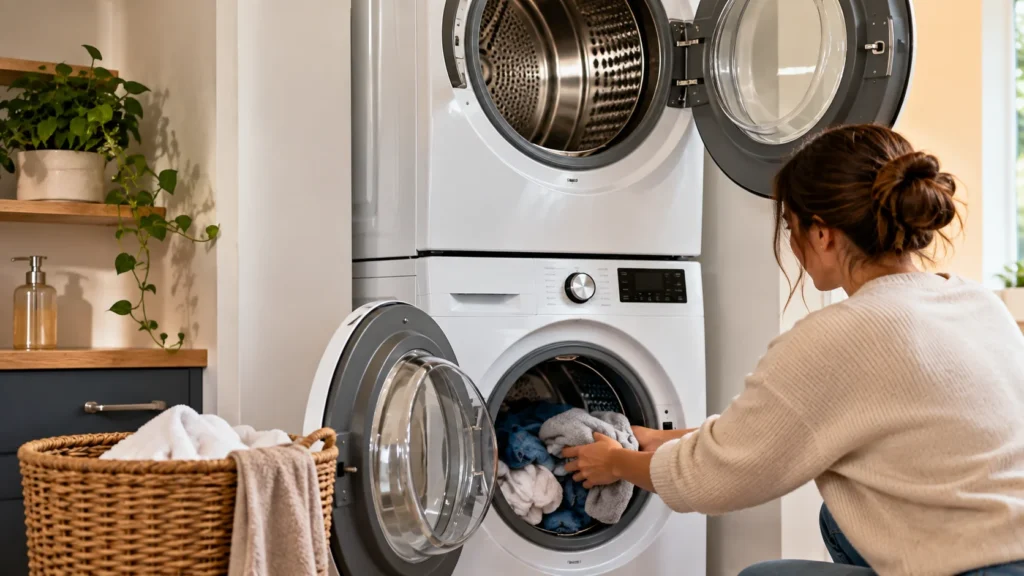
Full-size front-load pairs commonly have widths around the upper-20-inch range, although exact dimensions vary considerably by manufacturer and model. Consumer Reports currently evaluates stackable pairs from brands including LG, Electrolux, GE, Maytag, Samsung, and Whirlpool, along with compact options from other manufacturers.
A larger washer does not automatically mean the pair will fit your room. The dryer, stacking kit, door swing, hoses, venting, and service clearance must all be considered. A model that fits the width may still be too deep for a closet.
For larger households, capacity can be an important reason to choose separate stackable appliances instead of a smaller laundry center. Whirlpool notes that stackable units generally provide access to a broader range of capacities and features than many laundry-center configurations.
Small and Apartment-Size Stackable Washer and Dryer Sets
A small stackable washer and dryer can be particularly useful in an apartment, condominium, tiny home, guest suite, or narrow laundry closet. Compact machines sacrifice some drum capacity to reduce their physical footprint.
Consumer Reports describes compact washers and dryers as a solution for laundry spaces where full-size appliances cannot fit. Its testing also notes that compact washers are often water- and energy-efficient, although their smaller capacity can mean more loads for households with significant laundry needs.
Compact sets commonly use front-load designs and may be approximately 24 inches wide. However, width alone does not determine whether the appliance is suitable. Depth and total stacked height are equally important.
For an apartment installation, also consider building requirements. Some locations may have restrictions concerning dryer venting, electrical circuits, drainage, appliance weight, or installation by a qualified professional.
LG Stackable Washer and Dryer
An LG stackable washer and dryer is available in multiple configurations, including full-size and compact systems. LG markets stackable washers and dryers specifically for space-saving laundry areas and also offers ventless heat-pump dryers for installations where an external exhaust duct is not practical.
LG also sells dedicated stacking kits for different appliance widths. Its current stacking-kit range includes kits designed for specific 27-inch and 29-inch front-load laundry pairs.
The important point is model compatibility. An LG washer and LG dryer should not automatically be assumed to stack simply because they have the same brand name. The manufacturer’s compatibility information and stacking-kit specifications should be checked for the exact models.
LG also offers LG ThinQ connectivity on selected laundry appliances, allowing compatible machines to be monitored and controlled through the company’s app.
GE Stackable Washer and Dryer
A GE stackable washer and dryer can be a practical choice for shoppers who want separate front-load machines in a vertical configuration. GE offers front-load laundry products designed for different household sizes, capacities, and installation requirements.
When comparing GE sets, focus on the exact washer and dryer model numbers rather than selecting only by brand. The correct stacking accessory, appliance dimensions, electrical requirements, and dryer configuration should all be verified before installation.
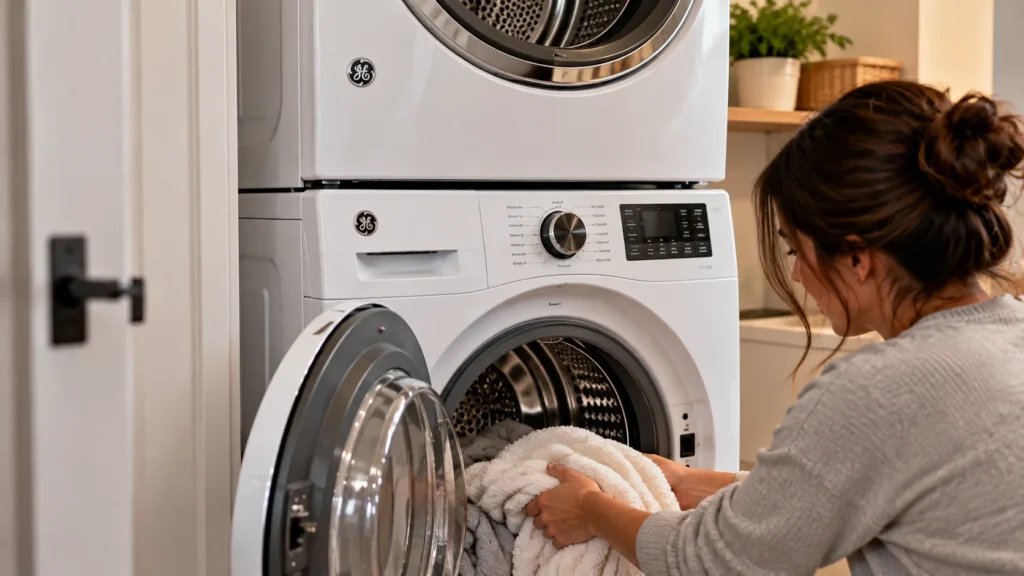
A GE set may be appropriate for a full-size laundry room, apartment laundry closet, or another constrained space depending on the model. The key is matching the appliance specifications to the physical and utility requirements of the installation area.
Whirlpool Stackable Washer and Dryer
A Whirlpool stackable washer and dryer can be configured as a vertically stacked front-load pair using an appropriate stacking kit. Whirlpool currently lists both gas and electric stackable laundry sets, with different capacities and feature combinations.
Whirlpool also distinguishes stackable pairs from laundry centers and towers. A stackable pair consists of two separate appliances, while a laundry center or tower is designed as a combined vertical appliance.
This distinction matters if you expect to move, remodel, or change the laundry-room layout later. Separate stackable machines can potentially be rearranged side by side when the manufacturer permits that configuration.
Samsung Stackable Washer and Dryer
A Samsung stackable washer and dryer can be considered by shoppers looking for front-load laundry appliances with modern controls and smart-home features. Samsung offers multiple washer and dryer configurations, but compatibility should always be checked for the specific models.
The major consideration is that a visually matching washer and dryer does not necessarily mean that the pair is approved for stacking. A compatible stacking system is necessary for a secure vertical installation.
Samsung models can also vary in capacity, dimensions, dryer type, and technology, so compare those specifications against the laundry room before purchasing.
Maytag, Electrolux, Frigidaire, Bosch, Miele, Kenmore, and Speed Queen Options
The stackable market includes many brands beyond LG, GE, and Whirlpool. Maytag stackable washer and dryer pairs may appeal to shoppers focused on traditional laundry features and larger-capacity options. Electrolux stackable washer and dryer models are available in front-load configurations and are included among the brands evaluated by Consumer Reports.
Frigidaire stackable washer and dryer options can be relevant for compact or space-conscious installations. Bosch and Miele are especially relevant when a shopper wants compact European-style laundry equipment, while Kenmore may appear among compatible washer and dryer options depending on the market.
Speed Queen stackable washer and dryer searches often come from shoppers interested in durability-oriented laundry equipment, but availability and stacking compatibility depend on the particular product line.
Rather than choosing a brand first, compare:
- Exact washer model
- Exact dryer model
- Width
- Depth
- Stacked height
- Washer capacity
- Dryer capacity
- Electric or gas dryer
- Vented or ventless operation
- Required stacking kit
- Electrical requirements
- Warranty
- Installation requirements
- Service availability
- Purchase price
- Long-term operating costs
Electric Stackable Washer and Dryer
An electric stackable washer and dryer is a common configuration because electric dryers are available in many full-size and compact models. The dryer still requires an appropriate electrical connection, and a vented electric dryer requires an external exhaust system.
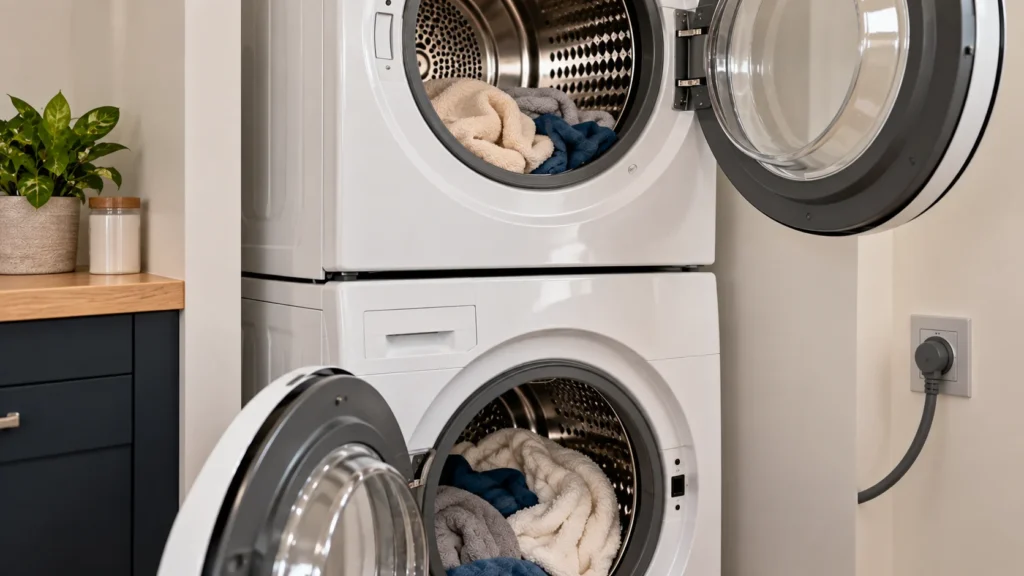
Some newer electric dryers use heat-pump technology and do not require a traditional external exhaust duct. LG, for example, offers ventless heat-pump dryers designed for more flexible installation.
A ventless design can be especially useful in apartments, closets, and spaces where installing a conventional dryer duct would be difficult. However, ventless dryers have their own installation requirements, and the manufacturer’s instructions should be followed carefully.
Gas Stackable Washer and Dryer
A gas stackable washer and dryer uses a gas dryer paired with a compatible front-load washer. Whirlpool currently lists stackable gas sets alongside electric configurations.
Gas dryers require an appropriate gas supply and electrical connection, and installation requirements vary by model and location. The dryer also generally requires proper exhaust ventilation unless the specific appliance is designed as a ventless system.
Because gas connections involve additional installation considerations, homeowners should follow the manufacturer’s instructions and applicable local requirements and use a qualified installer where required.
Ventless Stackable Washer and Dryer
A ventless stackable washer and dryer can be useful when the laundry area does not have a conventional dryer exhaust connection. Heat-pump and condenser technologies can remove moisture without sending dryer exhaust through an exterior duct.
LG describes its ventless heat-pump dryers as an option for installations without external ducts.
Ventless technology can make appliance placement more flexible, but it does not mean the machine can be installed anywhere without planning. Drainage, electrical power, airflow around the appliance, and manufacturer’s clearance requirements still matter.
For a small apartment laundry closet, ventless technology may eliminate one of the major installation limitations associated with traditional dryers.
Jump into Other Related Article
- How to Clean Stainless Steel Sink | Stains, Hard Water, Rust & Scratches
- How to Remove Avocado Stains | Easy Ways to Clean Clothes, Carpet & More
- How to Remove Dog Hair from Clothes | Easy Methods for Wash, Dryer & Home
Front-Load Stackable Washer and Dryer
A front-load stackable washer and dryer is the most common type of separate-appliance stacking configuration. The washer loads from the front, and the dryer sits directly above it.
Consumer Reports’ current stackable recommendations include full-size front-load washer and dryer pairs as well as compact front-load systems.
Front-load washers are also commonly associated with efficient water use and fabric care. Consumer Reports notes that front-load washers in its testing typically use about 10 gallons per load, although performance and consumption vary by model.
One consideration is access to the upper dryer. A tall stacked installation may place the dryer controls or drum higher than some users find comfortable. Check the height of the stacked control panel and dryer door before purchasing.
Stackable Washer and Dryer vs. Laundry Center
A stackable washer and dryer and a laundry center may look similar, but they are not necessarily the same type of appliance.
| Feature | Stackable Washer & Dryer | Laundry Center/Tower |
| Construction | Two separate appliances | Integrated vertical unit |
| Configuration | Usually stackable or side by side | Permanently vertical |
| Stacking kit | Usually required | Built into the design |
| Flexibility | Higher | Lower |
| Capacity choices | Often broader | Varies by model |
| Serviceability | Separate washer and dryer | Integrated system |
| Best for | Flexible laundry-room layouts | Tight, simple installations |
| Future relocation | Easier to reconfigure | Less flexible |
Whirlpool explains that stackable units can generally be separated and rearranged, whereas laundry centers and towers are built as unified appliances.
A laundry center can therefore make sense when simplicity and compactness are priorities. A separate stackable washer and dryer can make more sense when future flexibility, capacity, or model selection matters.
Best Stackable Washer and Dryer Buying Criteria
There is no single stackable washer and dryer that fits every household. Consumer Reports currently evaluates multiple stackable pairs across full-size and compact categories, including models from several major manufacturers.
The best set for one household may be too large, too expensive, or incorrectly configured for another. Start with the installation space, then compare capacity and features.
15 Factors for Choosing a Stackable Set
- Available width Measure the actual opening.
- Available height Stacked appliances commonly approach 78 inches.
- Available depth Include hoses and venting.
- Laundry capacity Match capacity to household size.
- Washer type Front-load is the common stacking configuration.
- Dryer type Compare electric, gas, and ventless choices.
- Stacking-kit compatibility Verify the exact kit.
- Door clearance Confirm both doors open comfortably.
- Control height Make sure controls are accessible.
- Energy efficiency Compare energy-use information.
- Water efficiency Important for frequent laundry.
- Cycle options Consider the fabrics and loads you wash.
- Noise level Especially important in apartments.
- Repair and service access Consider local support.
- Total ownership cost Include installation and accessories.
Stackable Washer and Dryer Sets for Different Spaces
| Space or Household | Configuration to Consider | Main Priority |
| Apartment | Compact stackable set | Small footprint |
| Small laundry closet | Compact or ventless set | Dimensions and ventilation |
| Family home | Full-size stackable pair | Capacity |
| Condo | Compact or full-size stackable | Space and installation |
| RV | Specialized compact laundry equipment | Weight and dimensions |
| Large laundry room | Full-size front-load pair | Capacity and features |
| No dryer duct | Ventless electric dryer | Installation flexibility |
| Gas-equipped home | Gas dryer pair | Existing gas connection |
| Tight vertical space | Shorter compact configuration | Total height |
| Future remodel | Separate stackable pair | Reconfiguration flexibility |
Stackable Washer and Dryer Price Considerations
The phrase cheap stackable washer and dryer can be misleading because the lowest purchase price is not necessarily the lowest total cost. A less expensive pair may require a separate stacking kit, installation accessories, new electrical work, venting, or other modifications.
A used stackable washer and dryer can reduce the upfront cost, but compatibility and condition become more important. With used appliances, verify the exact model numbers, stacking kit availability, operating condition, age, warranty status, and local repair support.
A sale can also make a new set more attractive than expected, but shoppers should compare the complete installed cost rather than looking only at the advertised appliance price.
For budget shopping, compare:
- Appliance price
- Stacking kit price
- Delivery charge
- Installation charge
- Venting materials
- Electrical modifications
- Gas installation if applicable
- Warranty coverage
- Expected operating costs
- Local service availability
Common Stackable Washer and Dryer Installation Mistakes
Stacking laundry appliances is not simply a matter of placing one machine on top of another. Manufacturers design specific kits and compatibility requirements for approved combinations.
LG specifically states that not all washer and dryer models can be stacked and requires the appropriate stacking kit for compatible models.
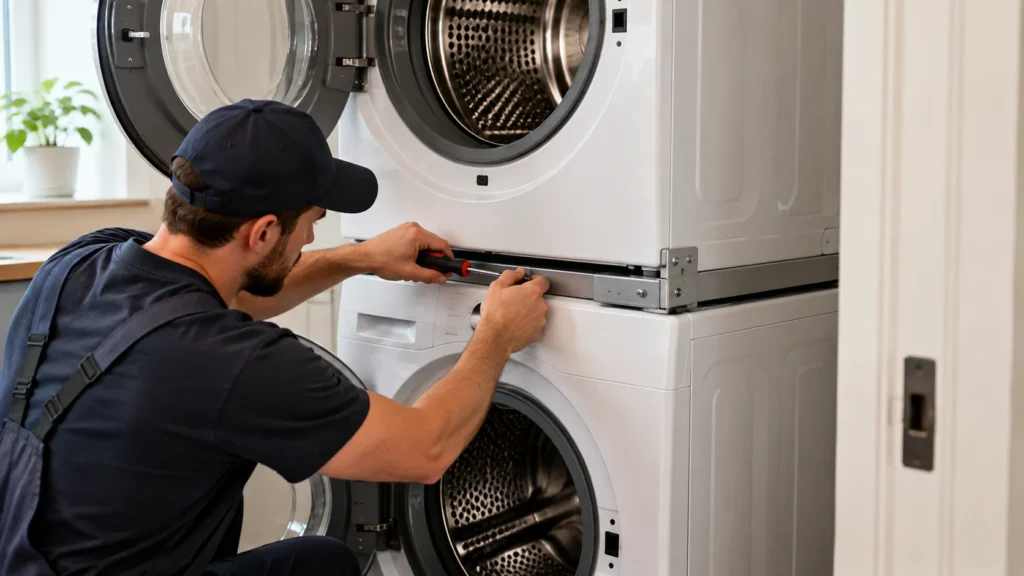
Avoid these common mistakes:
- Buying appliances before measuring the room
- Assuming every same-brand pair is stackable
- Using a generic or incompatible stacking method
- Ignoring total stacked height
- Forgetting rear clearance
- Blocking the washer door
- Forgetting dryer vent requirements
- Ignoring electrical requirements
- Installing on an uneven floor
- Attempting installation without adequate assistance
- Choosing capacity without considering household laundry volume
- Ignoring delivery-path measurements
- Buying a dryer that cannot match the washer’s dimensions
- Forgetting the cost of the stacking kit
- Placing the dryer too high for comfortable access
LG also warns against attempting the stacking procedure with only one person.
Stackable Washer and Dryer Maintenance
Regular maintenance helps keep both appliances working efficiently. Clean the washer door gasket according to the manufacturer’s instructions, inspect detergent buildup, and leave the washer door open when appropriate to allow the interior to dry.
Dryer maintenance is equally important. For vented dryers, the lint filter should be cleaned after loads and the exhaust system should be maintained according to manufacturer and safety guidance.
Ventless heat-pump dryers also require their specified filters and condenser-related maintenance. Follow the model’s manual rather than applying maintenance procedures from a different dryer type.
Because the dryer is positioned above the washer, service access should also be considered before installation. A very tight closet can make future maintenance much harder.
Final Stackable Washer and Dryer Checklist
Before purchasing any stackable washer and dryer set, confirm all of the following:
- The washer is approved for stacking.
- The dryer is approved for stacking.
- The exact models are compatible.
- The correct stacking kit is available.
- The width fits the opening.
- The depth fits with connections attached.
- The stacked height fits below the ceiling.
- The doors can open properly.
- The controls are accessible.
- The floor is solid and level.
- The electrical supply is suitable.
- Gas requirements are understood if applicable.
- Dryer ventilation requirements are satisfied.
- Delivery access has been measured.
- Installation costs have been included in the budget.
Conclusion
A stackable washer and dryer is a practical way to maximize laundry-room floor space without necessarily sacrificing the capacity and flexibility of separate washing and drying appliances. The configuration works particularly well for apartments, condos, laundry closets, small homes, and rooms where vertical space is available but horizontal space is limited.
The most important step is measuring the installation area before choosing a model. Full-size stackable pairs can be around 24–28 inches wide and approximately 78 inches tall when stacked, while compact systems can be closer to 24 inches wide, but exact dimensions vary by model.
Brand names such as LG, GE, Whirlpool, Samsung, Maytag, Electrolux, Frigidaire, Bosch, Miele, Kenmore, and Speed Queen provide different configurations, but brand alone should not determine the purchase. Check exact model compatibility, stacking-kit requirements, capacity, dryer type, ventilation, electrical requirements, and total installation cost.
For shoppers comparing full-size, apartment-size, 24-inch, electric, gas, ventless, front-load, cheap, used, or premium stackable washer and dryer sets, the right appliance is ultimately the one that fits both the physical laundry space and the household’s actual laundry requirements.
What is a stackable washer and dryer?
A stackable washer and dryer consists of two separate compatible appliances designed to be installed vertically, normally with the dryer positioned above the washer. A manufacturer-approved stacking kit is generally used to secure the two machines.
How tall is a stackable washer and dryer?
Many full-size front-load stackable pairs are around 78 inches tall when stacked, although the exact height depends on the washer, dryer, and stacking configuration. Whirlpool gives approximately 78 inches as a common combined height for many front-load pairs.
How wide is a stackable washer and dryer?
Many full-size models are approximately 24–28 inches wide, while compact systems can be around 24 inches wide. Exact dimensions vary, so the manufacturer’s specification sheet should be checked before purchase.
Can any washer and dryer be stacked?
No. Only models specifically designed or approved for stacking should be installed together. Compatibility must be confirmed, and the appropriate stacking kit should be used.
Can a top-load washer be stacked with a dryer?
Standard separate-appliance stacking is generally associated with compatible front-load washers and dryers. Top-load configurations are more commonly found in purpose-built stacked laundry centers rather than conventional two-appliance stacking systems.
Do stackable washer and dryer sets need a stacking kit?
Yes, separate stackable appliances normally require a compatible stacking kit. The kit is designed to secure the dryer to the washer and should be selected according to the exact appliance models.
Are stackable washers and dryers good for apartments?
They can be particularly useful in apartments because stacking reduces the floor footprint. Compact models can be especially helpful when the available laundry area is narrow, although apartment-specific electrical, venting, plumbing, and installation rules still need to be considered.
Are stackable washers and dryers available in full size?
Yes. Full-size front-load washers and dryers can be designed for stacking, and Consumer Reports currently evaluates full-size stackable pairs alongside compact models.
Are stackable dryers electric or gas?
Both configurations are available. Whirlpool, for example, currently lists both gas and electric stackable laundry sets.