
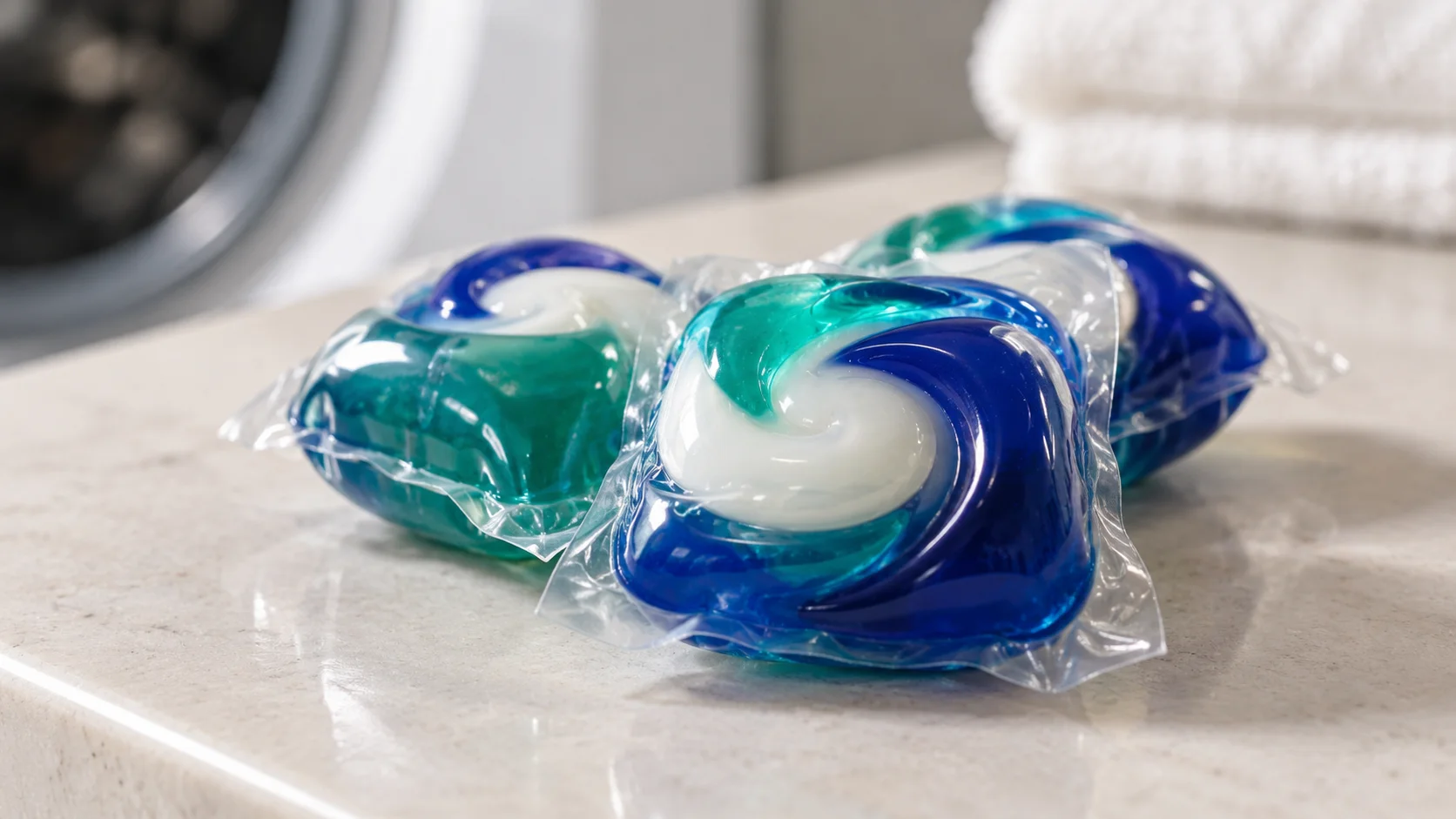
Laundry detergent pods are pre-measured doses of concentrated laundry detergent enclosed in a water-soluble film. Instead of measuring liquid or powder detergent for every load, you place the required pod directly into the washing-machine drum, add the clothes, select the appropriate cycle, and start the machine. Pods are available in many formulations, including stain-fighting, odor-removing, fragrance-free, free-and-gentle, and color-protecting options. Major brands such as Tide, Dropps, Molly’s Suds, and Clean People offer different pod formulas designed around different laundry preferences and cleaning needs.
The main attraction of pods is convenience, but convenience is only part of the decision. Laundry detergent pods vs liquid detergent involves differences in dosing, packaging, storage, flexibility, and how much control you have over the detergent amount. Pods also require special safety precautions because their concentrated contents can cause serious injury if swallowed or if the contents contact the eyes. Poison Control advises keeping laundry pods out of sight and reach of children and never cutting, tearing, or puncturing them.
What Are Laundry Detergent Pods?
Laundry detergent pods are single-dose laundry detergent packages containing concentrated cleaning ingredients inside a water-soluble film. When the pod encounters water during a wash cycle, the film dissolves and releases its contents into the wash.
The detergent inside can contain a combination of surfactants, enzymes, builders, polymers, fragrances, colorants, and other ingredients depending on the formulation. Tide explains that its detergent formulas use ingredients such as surfactants, enzymes, and polymers for stain removal, soil dispersion, and preventing redeposition.
A typical laundry pod offers several practical advantages:
- Pre-measured detergent dose
- Less measuring and pouring
- Convenient storage
- Less liquid spilling
- Easy handling
- Compact individual doses
- Multiple formulation choices
- Compatibility with many modern washing machines
However, not every pod contains the same ingredients or provides the same cleaning performance. Laundry detergent pods are a product category, not one universal formula.
How Do Laundry Detergent Pods Work?
The basic process behind pods laundry detergent is straightforward. The water-soluble outer film comes into contact with water, dissolves, and releases the concentrated detergent into the washing-machine drum.
The detergent then works through the same broad cleaning principles used by other laundry detergents. Surfactants help loosen and suspend oily soils, enzymes can break down particular types of stains, and other ingredients can help prevent removed soil from redepositing on clothing.
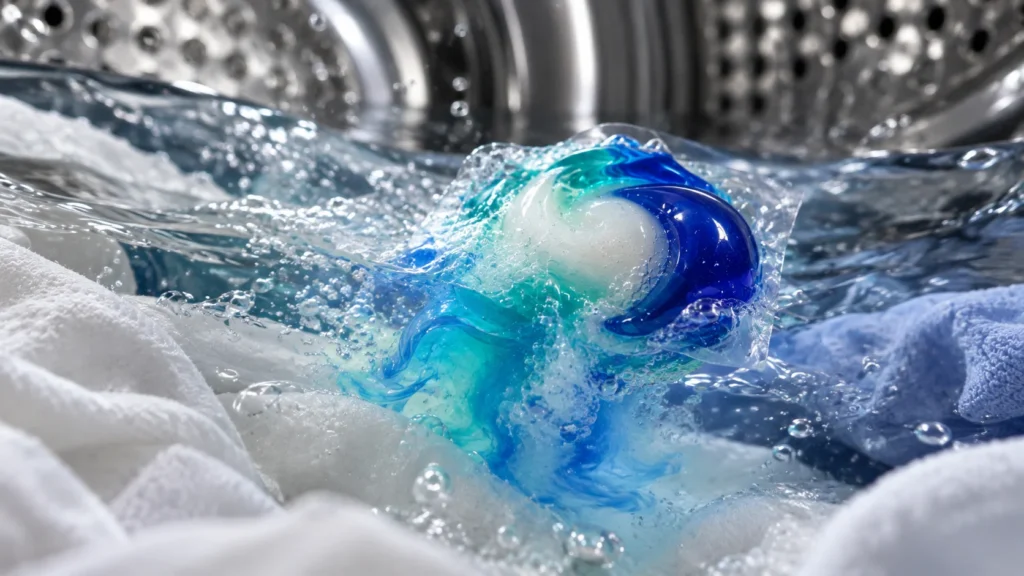
Tide explains that surfactants are central cleaning ingredients because they help break up greasy stains and food residues, while enzymes target particular stain types and polymers can help keep removed soils from settling back onto fabrics.
This means a pod is not simply soap in a packet. It is a concentrated formulation designed to deliver a specific dose of laundry-cleaning ingredients.
How to Use Laundry Detergent Pods
Knowing how to use laundry detergent pods correctly is important because the pod is already pre-measured and concentrated.
For most standard pod systems, the basic process is:
- Open the pod container according to the manufacturer’s instructions.
- Take out the required number of pods with dry hands.
- Place the pod directly into the empty washer drum.
- Add the laundry on top of the pod.
- Select the correct wash cycle.
- Start the machine.
- Close the pod container securely after removing the dose.
- Store the container somewhere inaccessible to children and pets.
Tide specifically instructs users to put its PODS directly into the empty drum rather than the detergent dispenser. It also recommends adjusting the number of pods according to load size.
Where Do Laundry Pods Go?
For products such as Tide PODS, the pod goes inside the empty washing-machine drum, not into the detergent drawer.
The general sequence is:
Pod → clothes → wash cycle
This allows the pod to come into direct contact with water at the beginning of the cycle.
However, always follow the instructions printed on your particular detergent package because formulations and machine recommendations can vary.
Jump into Other Related Article
- How to Remove Peanut Butter Stains
- Does Rayon Shrink?
- How to Remove Coffee Stains
- How to Clean Suede Shoes
- Best Stain Remover for Clothes
- How to Clean Stainless Steel
How Many Laundry Detergent Pods Should You Use?
The appropriate number of laundry detergent pods depends on the product and load size.
For example, Tide currently recommends:
- 1 pod for smaller loads
- 2 pods for standard loads
- 3 pods for larger loads
Tide also states that its POWER PODS contain more detergent per pod than original Tide PODS, so the dosing instructions for one product should not automatically be applied to another.
Using more pods than recommended is not a shortcut to cleaner clothes. Excess detergent can make rinsing more difficult and may leave unwanted residue.
The best rule is simple:
Follow the dosing instructions for the exact pod product you are using.
Are Laundry Detergent Pods Compatible With HE Washers?
Many modern laundry detergent pods are designed to work in high-efficiency washers.
Tide states that its PODS are compatible with HE machines and other machine types. Its instructions for both HE top-loaders and front-loaders recommend placing the pod directly into the empty drum.
The important distinction is that HE compatibility belongs to the specific product, not to every detergent pod automatically.
Before using a new pod:
- Check the package for HE compatibility.
- Follow the washer manufacturer’s instructions.
- Put the pod in the location specified by the detergent manufacturer.
- Do not place a pod in the dispenser unless the product instructions specifically say to do so.
Laundry Detergent Pods vs Liquid
The comparison between laundry detergent pods vs liquid usually comes down to convenience, dosing flexibility, packaging, and formulation.
| Feature | Laundry detergent pods | Liquid detergent |
| Dosing | Pre-measured | User measures |
| Spills | Lower risk of liquid spills | Possible |
| Adjusting dose | Limited | Easy |
| Storage | Compact individual doses | Larger bottle |
| Convenience | Very high | Moderate |
| Stain pretreatment | Product dependent | Liquid can be used for some pretreating |
| Formulation choices | Many | Many |
| Child safety concern | High because contents are concentrated | Still requires safe storage |
| Waste considerations | Depends on product and packaging | Depends on bottle and formulation |
Consumer Reports’ 2026 detergent testing notes that liquids, pods, and powders can perform differently and that performance varies substantially between individual products rather than simply by detergent format.
So the question are laundry pods better than liquid detergent? does not have one universal answer. The right comparison depends on cleaning performance, cost per load, ingredients, scent, dosing needs, and safety considerations.
Are Laundry Detergent Pods Better Than Liquid Detergent?
Laundry detergent pods are generally more convenient because they eliminate measuring.
Liquid detergent provides more dosing flexibility. If you need a smaller amount for a very small load, liquid detergent allows you to measure a reduced quantity according to its instructions. With pods, you normally choose between the available single-dose quantities.
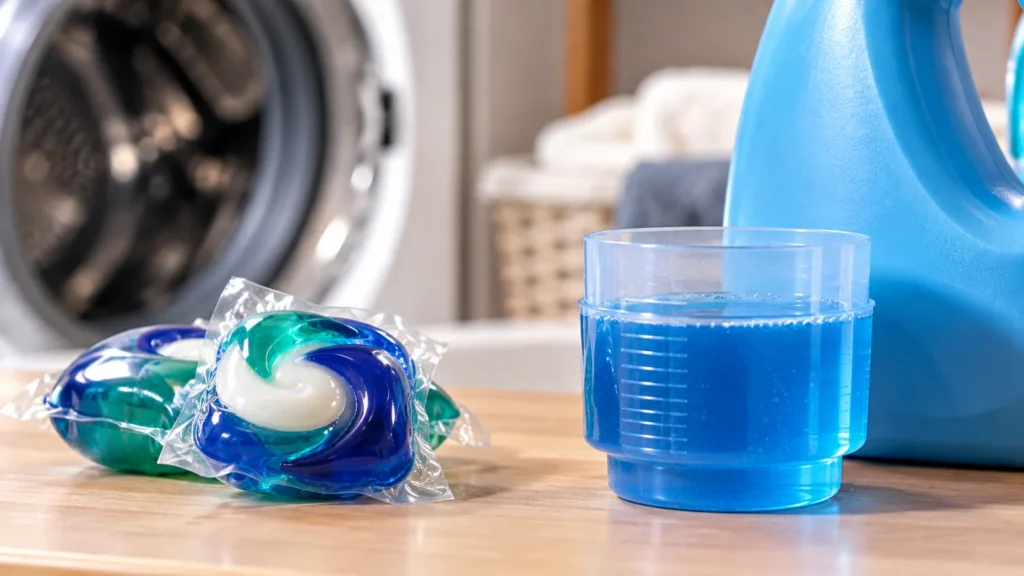
Consumer Reports’ current testing shows that detergent performance varies among individual products and formats. Its 2026 report evaluates liquids, pods, and powders rather than treating one format as automatically superior.
Consider pods when you value:
- Fast dosing
- Less measuring
- Compact storage
- Easy routine washing
- Pre-measured portions
Consider liquid when you value:
- Flexible dosing
- Pretreatment versatility
- More control over detergent quantity
- A familiar detergent format
Laundry Detergent Pods vs Liquid: Which Cleans Better?
Cleaning performance depends more on the specific detergent formulation than simply whether the detergent is a pod or liquid.
Consumer Reports’ 2026 testing found substantial variation among individual detergents, with top-performing liquids and pods both capable of removing common stains.
Important performance factors include:
- Surfactant system
- Enzymes
- Builders
- Water hardness
- Wash temperature
- Cycle selection
- Load size
- Stain type
- Detergent dosage
- Fabric type
- Washing-machine performance
Therefore, choosing a pod solely because it is a pod does not guarantee better cleaning.
What Are Laundry Detergent Pods Made Of?
There is no single ingredient list for all laundry detergent pods.
Different manufacturers use different formulations.
Common ingredient categories include:
- Surfactants
- Enzymes
- Builders
- Water conditioners
- Polymers
- Fragrance
- Preservatives
- Colorants in some formulas
- Chelating agents
- Water-soluble film
Tide explains that surfactants, enzymes, and polymers perform different cleaning functions in its detergents.
Clean People, for example, lists alcohol ethoxylate, alkyl polyglucoside, glycerin, tetrasodium glutamate diacetate, water, enzymes, and polyvinyl alcohol among the ingredients associated with its laundry pods.
Molly’s Suds takes a different formulation approach for its Ultra Concentrated Laundry Detergent Pods, listing sodium carbonate, sodium bicarbonate, magnesium sulfate, unrefined sea salt, PVOH, and organic peppermint oil for its peppermint-scented version.
These examples show why consumers should check the exact product’s ingredient disclosure rather than assuming all pods have identical chemistry.
What Is the Pod Wrapper Made Of?
The outer film on many laundry detergent pods is a water-soluble polymer, commonly polyvinyl alcohol or PVOH.
Dropps states that its pod film is PVOH and describes it as a water-soluble material that dissolves during the wash cycle.
The film is designed to release the detergent when exposed to water.
This is also why handling pods with wet hands is a bad idea: moisture can begin affecting the film before the pod is inside the washer.
Best handling practice
- Use completely dry hands.
- Do not cut the pod.
- Do not puncture the pod.
- Do not squeeze it.
- Do not unwrap it.
- Put it directly into the washer as instructed.
- Close the container immediately afterward.
Poison Control specifically advises against cutting, tearing, or puncturing laundry pods.
Tide Pods Laundry Detergent: What You Should Know
Tide PODS laundry detergent is one of the most recognizable pod product lines and includes multiple formulations.
Examples include:
- Tide PODS Original
- Tide PODS Free & Gentle
- Tide PODS Ultra Oxi
- Tide PODS Downy
- Tide POWER PODS
- Other specialized Tide pac formulations
The exact ingredients and cleaning features differ between products.
Tide describes its PODS as pre-measured doses and says certain formulations combine detergent, stain removers, and brightening or whitening functions.
This is why the phrase Tide pods laundry detergent can refer to several different formulas rather than one identical product.
Tide Original Pods Laundry Detergent
Tide Original Pods laundry detergent is designed around Tide’s conventional detergent formulation and pre-measured pac format.
The main convenience is that the detergent dose is already contained in the pod, reducing the need to measure liquid detergent.
For standard Tide PODS, Tide recommends putting the pod in the empty drum before adding clothing and adjusting the number of pods to load size.
If you are comparing Tide Original Pods with another Tide formula, examine:
- Stain-fighting claims
- Fragrance
- Ingredients
- Dose per load
- Intended laundry needs
- Free-and-gentle status
- Oxi or other added cleaning technologies
Tide Pods Ultra Oxi Laundry Detergent Pacs
Tide PODS Ultra Oxi laundry detergent pacs are formulated around additional stain-fighting chemistry compared with basic Tide PODS.
The exact formulation should be checked against the current product label because detergent formulas can change.
The term Oxi generally indicates oxygen-based stain-removing chemistry within the product formulation, but consumers should not assume that every product carrying Oxi has the same ingredient composition.
For accurate ingredient information, Tide provides its detergent ingredient database and product-specific information.
Tide Free Gentle Laundry Detergent Pods
Tide Free & Gentle laundry detergent pods are designed for consumers who want a detergent without dyes and perfumes.
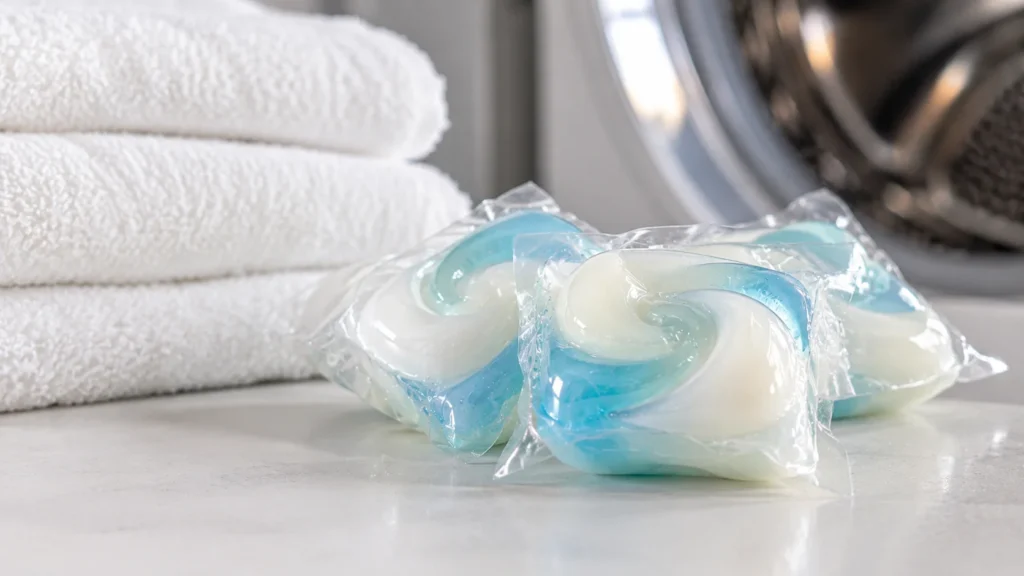
Tide describes its Free & Gentle PODS as:
- Free of dyes
- Free of perfumes
- Hypoallergenic
- Designed for sensitive-skin needs
- Suitable for cold-water washing
- Compatible with different washing-machine types
Tide also says the formula is recognized by the National Eczema Association and National Psoriasis Foundation.
That makes Tide Free & Gentle laundry detergent pods a distinct formulation rather than simply an unscented version of every other Tide pod.
Unscented Laundry Detergent Pods
Unscented laundry detergent pods can be useful for people who prefer to avoid added fragrance in their laundry products.
But unscented and fragrance-free should be checked carefully on the product label. Different brands can use different terminology.
Examples of fragrance-free or no-added-fragrance options include certain:
- Tide Free & Gentle products
- Dropps Free + Clear products
- Other free-and-clear pod formulations
Dropps states that its Free + Clear laundry formulas contain no added fragrance or dyes.
Tide similarly describes its Free & Gentle PODS as free from dyes and perfumes.
Dropps Free & Clear Laundry Detergent Pods
Dropps Free & Clear laundry detergent pods are marketed as fragrance-free and dye-free options.
Dropps says its laundry formulas are free from optical brighteners, phosphates, artificial dyes, chlorine bleach, parabens, and phthalates. The company also states that its formulas have certifications including Cradle to Cradle Material Health, National Psoriasis Foundation, and USDA Certified Biobased for its described product line.
The company provides ingredient disclosures for individual products, which is useful when comparing pod formulas rather than relying only on marketing descriptions.
Dropps Odor & Stain Laundry Detergent Pods
Dropps Odor & Stain laundry detergent pods are designed around removing stains and odors.
Dropps describes its stain-and-odor laundry pods as concentrated formulas designed to tackle stains, odors, and food residue. The company also highlights its packaging and third-party certifications.
When comparing odor-focused pods, look beyond the name and check:
- Enzymes
- Surfactants
- Fragrance
- Intended load size
- Stain claims
- Product directions
- Fabric compatibility
A detergent marketed for odor removal is not necessarily a disinfectant.
Molly’s Suds Laundry Detergent Pods
Molly’s Suds laundry detergent pods offer another formulation approach.
The company’s current product page says its Ultra Concentrated Laundry Detergent Pods contain a short list of ingredients, including:
- Sodium carbonate
- Sodium bicarbonate
- Magnesium sulfate
- Unrefined sea salt
- PVOH
- Organic peppermint oil in the peppermint version
Molly’s Suds states that the peppermint scent is the version containing organic peppermint oil.
This illustrates why consumers interested in ingredient transparency should compare individual products rather than assuming that every natural or free pod has the same chemistry.
Arm and Hammer Laundry Detergent Pods
Arm & Hammer laundry detergent pods are another widely recognized category of detergent pacs.
When evaluating Arm & Hammer pods—or any other detergent pod—check the current package for:
- Exact product name
- Number of loads
- Recommended dose
- Scent
- Stain-fighting claims
- HE compatibility
- Ingredient information
- Safety instructions
Product formulations can change, so an old online review may not accurately describe a current product.
Gain Laundry Detergent Pods
Gain laundry detergent pods are generally marketed around cleaning performance and fragrance.
If fragrance is important to you, compare the exact Gain pod formula with fragrance-free alternatives rather than treating all laundry pods as interchangeable.
For households where fragrance sensitivity is a concern, a free-and-gentle or fragrance-free formulation may be more appropriate than a strongly scented product.
Tide Power Pods Laundry Detergent Pacs
Tide Power Pods laundry detergent pacs are a higher-concentration Tide pod format.
Tide states that its POWER PODS contain 85% more Tide in each pod compared with original Tide PODS. Because this is a product-specific formulation, dosing should follow the POWER PODS package rather than the instructions for original Tide PODS.
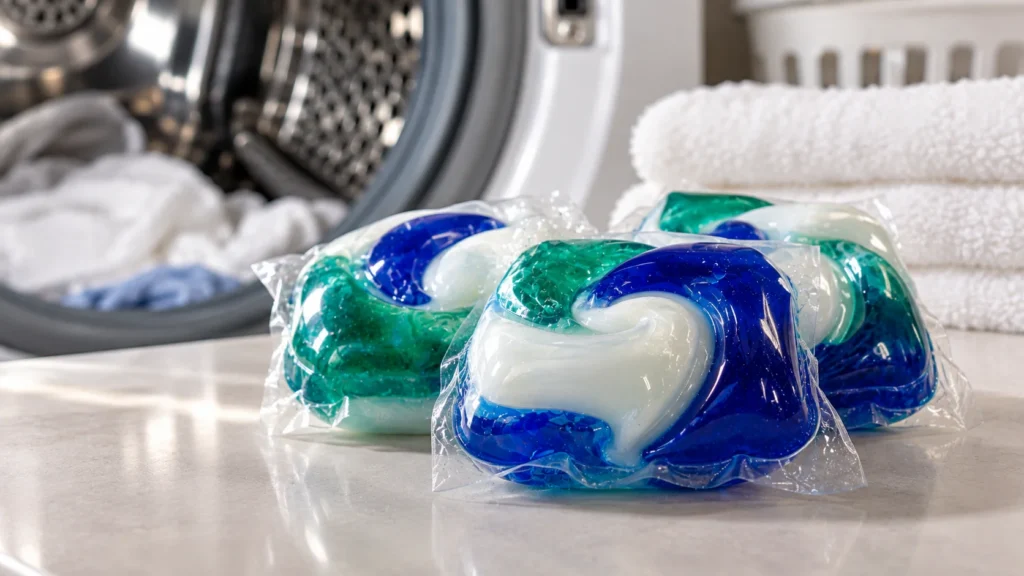
This is a useful example of why the number of pods alone does not tell you the detergent quantity.
Best Laundry Detergent Pods: How to Choose
There is no single best laundry detergent pods option for every household.
Consumer Reports’ 2026 testing demonstrates that cleaning performance varies across individual detergents and formats.
Instead of looking only for a product labeled best, compare the features that actually matter to you.
Consider these factors:
- Cleaning performance
- Stain-removal ability
- Odor removal
- Fragrance level
- Fragrance-free availability
- Dye-free formulation
- Ingredient disclosure
- Price per load
- Number of doses
- Washer compatibility
- Cold-water performance
- Fabric-care requirements
- Packaging
- Third-party certifications
- Child-safety features
A household with heavily stained work clothes may have different priorities from someone primarily washing lightly soiled everyday clothing.
Best Laundry Detergent Pods for Performance
If laundry detergent pods performance is your main concern, focus on measurable cleaning needs rather than brand popularity alone.
Consumer Reports’ 2026 testing evaluates detergents against stains including body oil, dirt, salad dressing, coffee, chocolate, grass, and blood. Its results show that some products perform much better than others.
When evaluating performance, consider:
- Common stains in your household
- Hard-water conditions
- Cold-water washing
- Soil level
- Load size
- Fragrance tolerance
- Fabric type
- Detergent concentration
A detergent that performs well against body oil may not be the same product that is ideal for every other laundry problem.
Laundry Detergent Sheets vs Pods
The comparison of laundry detergent sheets vs pods has become increasingly relevant.
Sheets are thin, lightweight detergent formats, while pods contain detergent inside a dissolvable film.
| Feature | Pods | Laundry sheets |
| Pre-measured | Usually | Usually |
| Packaging size | Compact | Very compact |
| Liquid handling | No | No |
| Water-soluble film | Usually | Product dependent |
| Dose flexibility | Limited | Product dependent |
| Cleaning performance | Product dependent | Product dependent |
| Storage | Easy | Very easy |
| Plastic reduction claims | Product dependent | Often marketed around reduced packaging |
Consumer Reports’ 2026 testing found that laundry sheets tested poorly in its evaluations compared with stronger-performing liquid and pod products. That is a test result from the products it evaluated, not proof that every laundry sheet on the market performs identically.
Laundry Detergent Pods Market and Global Trends
The laundry detergent pods market includes several regional categories, including North America, Europe, the UK, Canada, Australia, India, China, Japan, France, and Germany.
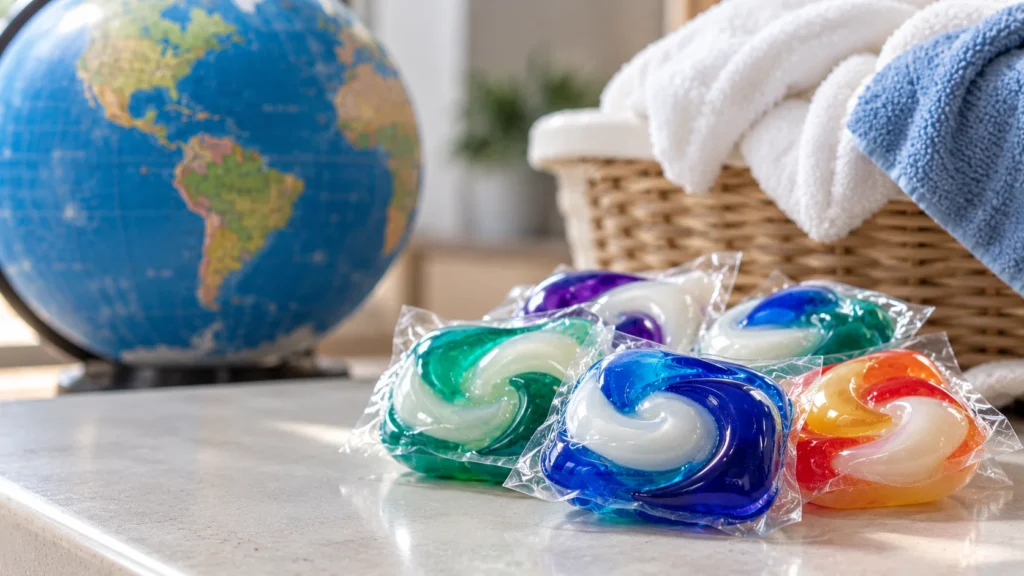
Consumer preferences can differ by region because of:
- Washing-machine types
- Water temperatures
- Detergent regulations
- Packaging preferences
- Household sizes
- Laundry habits
- Product availability
- Fragrance preferences
- Environmental expectations
Search terms such as India laundry detergent pods market, Europe laundry detergent pods market, Japan laundry detergent pods market, UK laundry detergent pods market, France laundry detergent pods market, and China laundry detergent pods market therefore describe distinct regional markets rather than one identical global consumer behavior.
For consumers, the practical issue is availability and formulation in their local market. A product sold in the United States may not have exactly the same formulation, package size, or instructions as a similarly named product sold elsewhere.
Are Laundry Detergent Pods Safe?
Laundry detergent pods are safe when used as directed, but they require stronger storage precautions than ordinary laundry products because their contents are highly concentrated.
Poison Control reports that biting into a laundry detergent pod can cause coughing, choking, breathing problems, vomiting, drowsiness, and other serious effects. The detergent can also irritate or burn the eyes and skin.
The CDC has documented serious health effects associated with laundry detergent pod exposures, particularly among young children.
Safe storage rules
- Keep pods out of children’s sight.
- Keep them out of children’s reach.
- Store them in their original container.
- Close the container immediately after use.
- Keep the container dry.
- Do not leave individual pods lying around.
- Never let children handle pods as toys.
- Do not cut or puncture pods.
- Do not squeeze pods.
- Use dry hands when handling them.
Tide itself emphasizes keeping its PODS closed, up, and safe, while Poison Control recommends storing pods where children cannot see or reach them.
What Happens If Someone Bites a Laundry Detergent Pod?
A damaged or swallowed pod should be treated as a potentially serious exposure.
Poison Control states that pod contents can cause vomiting, breathing difficulty, aspiration, burns, and other serious effects.
If a child bites into a pod:
- Remove the pod from the child’s mouth if it can be done safely.
- Wipe or rinse the mouth as appropriate.
- Do not induce vomiting unless specifically instructed by a medical professional or poison specialist.
- If the product contacts the eyes, rinse with gently running water as directed by poison experts.
- Contact your local poison center or emergency medical service for immediate guidance.
In the United States, Poison Control provides 1-800-222-1222 and its online webPOISONCONTROL service.
If you are outside the United States, use your country’s poison-control or emergency medical service.
Do Laundry Detergent Pods Expire?
People often ask do laundry detergent pods expire?
A pod does not necessarily become unusable on a single specific date, but detergent products can deteriorate with age, heat, humidity, and poor storage.
Moisture is particularly important because the pod film is designed to dissolve in water.
For best results:
- Keep the container tightly closed.
- Store pods in a cool, dry place.
- Avoid humid laundry-room locations when possible.
- Do not store them near water.
- Follow any date or storage guidance on the package.
- Do not use pods whose film has visibly deteriorated.
Tide specifically recommends closing its PODS container after each use and storing it in a cool, dry location.
Can You Use Laundry Detergent Pods in Cold Water?
Many modern detergent pods are specifically formulated to dissolve and clean in cold water.
Tide says its PODS are designed to dissolve in cold water, including its Free & Gentle formulation.
Cold-water washing can be useful for energy savings and for protecting fabrics from unnecessary heat, but the actual result depends on the detergent formulation, wash cycle, water conditions, and type of soil.
If a pod is not dissolving properly, check:
- Whether the product is intended for cold water.
- Whether the pod is being placed correctly.
- Whether the washer is overloaded.
- Whether the cycle supplies enough water.
- Whether the product has been exposed to moisture before use.
What If a Laundry Pod Does Not Dissolve?
A pod that does not dissolve completely can leave detergent residue on clothing or inside the washer.
Possible contributing factors include:
- Overloading the washer
- Incorrect pod placement
- Insufficient water contact
- Very short cycles
- Cold-water conditions
- A damaged or moisture-exposed pod
- Machine-specific operating issues
Tide advises placing its PODS directly into the empty drum and not overloading the washer so water and detergent can circulate properly.
If residue remains on clothing, follow the detergent manufacturer’s recommended rinsing or rewashing procedure.
How to Choose Between Free, Gentle, Oxi and Original Pods
Different pod types exist because laundry needs differ.
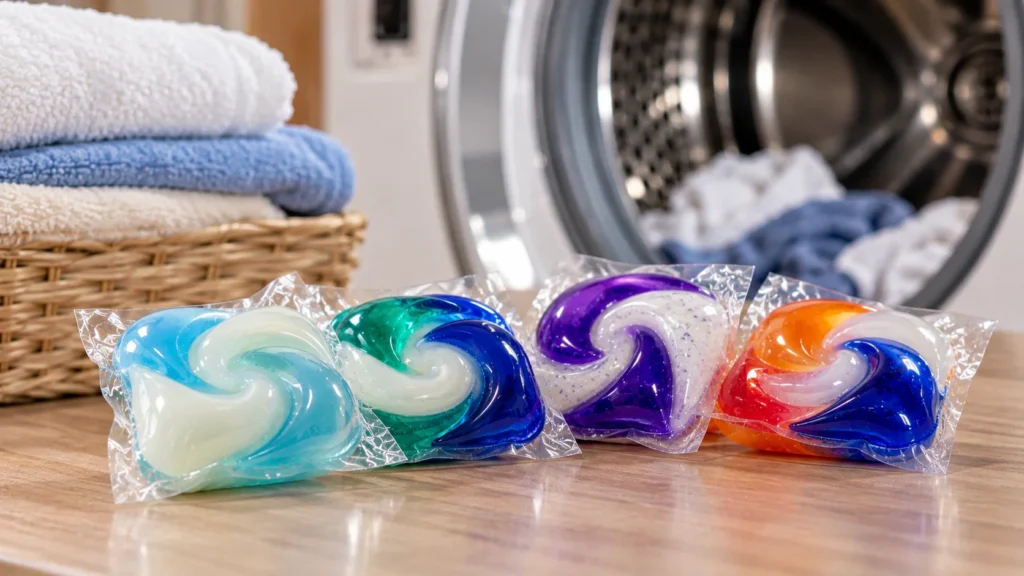
Original pods
Designed for everyday cleaning and general stain removal.
Free & Gentle pods
Designed without dyes and perfumes in products such as Tide Free & Gentle.
Oxi pods
Designed with additional oxygen-based stain-removing chemistry in certain formulations.
Odor-focused pods
Designed around odor and stain removal, such as certain Dropps formulations.
Unscented pods
Designed for consumers who prefer products without added fragrance, depending on the exact formulation.
The best choice depends on your laundry rather than the label alone.
Laundry Detergent Pods and Sensitive Skin
If skin sensitivity is a concern, look at the exact detergent formulation instead of assuming that every pod is equally suitable.
Useful product details to compare include:
- Fragrance
- Dyes
- Preservatives
- Enzymes
- Ingredient disclosures
- Third-party certifications
- Manufacturer’s sensitivity claims
Tide Free & Gentle PODS are marketed as hypoallergenic and free from dyes and perfumes. Dropps says its Free + Clear laundry formulas have no added fragrance or dyes.
These are product-specific claims, so they should not be generalized to all laundry pods.
Are Laundry Pods Environmentally Better?
Environmental performance depends on the entire product system rather than the word pod.
Consider:
- Packaging material
- Product concentration
- Shipping weight
- Number of loads
- Film composition
- Ingredient sourcing
- Manufacturing
- Disposal
- Product certifications
Dropps, for example, states that its laundry pods use PVOH film and paperboard packaging, while Clean People highlights its ingredient and packaging approach.
If environmental impact is important, look for specific evidence such as product certifications or transparent packaging and ingredient information rather than relying on broad eco-friendly language.
The EPA’s Safer Choice program is one official framework consumers can use to identify products that meet its criteria. EPA explains that products carrying the Safer Choice label undergo evaluation of their ingredients and formulation against the program’s health and environmental requirements.
Common Laundry Detergent Pod Mistakes
Avoid these common mistakes when using laundry detergent pods:
- Putting pods in the detergent drawer when the product says to use the drum.
- Handling pods with wet hands.
- Cutting or puncturing pods.
- Using more pods than recommended.
- Overloading the washer.
- Leaving the pod container open.
- Storing pods where children can reach them.
- Assuming all pods have identical ingredients.
- Assuming every pod is fragrance-free.
- Assuming every pod is hypoallergenic.
- Assuming Oxi products are identical across brands.
- Treating pods as automatically better than liquid detergent.
- Ignoring the garment care label.
- Assuming a pod can replace every other laundry additive.
- Using old or moisture-damaged pods.
A Practical Laundry Detergent Pods Buying Checklist
Before choosing a pod, check the following:
- Load size: Does the product offer a suitable dose?
- Cleaning needs: Do you need everyday cleaning, stain removal, or odor control?
- Fragrance: Do you prefer scented or fragrance-free?
- Dyes: Is a dye-free formulation important?
- Fabric: Does the detergent suit your regular laundry?
- Washer: Is it compatible with your machine?
- Water temperature: Does it dissolve effectively in your preferred cycle?
- Ingredients: Does the manufacturer provide transparent information?
- Safety: Does the package have secure storage features?
- Price: Compare cost per load rather than package price alone.
- Certifications: Are relevant third-party certifications available?
- Packaging: Does the packaging fit your storage needs?
- Dosage: Are instructions clear?
- Product type: Original, Free & Gentle, Oxi, odor-focused, or another formula?
- Household safety: Can you store concentrated pods securely away from children?
Conclusion
Laundry detergent pods offer a convenient, pre-measured alternative to liquid and powder detergents. Their concentrated formulas can contain surfactants, enzymes, polymers, builders, fragrances, and other ingredients, while the water-soluble film is designed to release the detergent during the wash. Tide, Dropps, Molly’s Suds, and Clean People illustrate how different manufacturers use substantially different formulations and product positioning, so consumers should evaluate the exact pod rather than assuming every laundry pac works the same way.
For everyday use, the most important practices are simple: put the pod where the manufacturer specifies, use the recommended number for the load, avoid overloading the washer, and store the pods securely in a cool, dry place. Pods deserve particular attention to safety because their concentrated contents can cause serious injury if swallowed or exposed to the eyes or skin. Poison Control and the CDC both emphasize keeping laundry detergent pods away from children and treating exposures seriously.
1. How do you use laundry detergent pods?
Place the recommended number of pods directly into the empty washing-machine drum, then add your clothes and select the appropriate cycle. Tide specifically recommends placing its PODS in the drum rather than the detergent drawer. Always follow the instructions for your particular product.
2. Are laundry detergent pods better than liquid detergent?
Neither format is automatically better for every household. Pods offer pre-measured convenience, while liquid detergent provides more control over the amount used. Consumer Reports’ 2026 testing found meaningful performance differences between individual detergents across both pod and liquid categories.
3. Are Tide Free & Gentle laundry detergent pods fragrance-free?
Tide states that its Tide PODS Free & Gentle formulation contains no dyes or perfumes and is marketed as hypoallergenic. It is designed for use in different washing-machine types, including cold-water washing.
4. Are laundry detergent pods safe around children?
Laundry detergent pods require secure storage because their concentrated contents can cause serious injury if swallowed or bitten. Poison Control recommends keeping them out of children’s sight and reach, keeping the container closed, and never cutting, tearing, or puncturing the pods.
5. Do laundry detergent pods expire?
Detergent pods can deteriorate when exposed to moisture, heat, or poor storage conditions. Keep them in their original, tightly closed container in a cool, dry location and follow the manufacturer’s storage or date guidance. Tide specifically recommends closing its PODS container after use and storing it in a cool, dry place.