
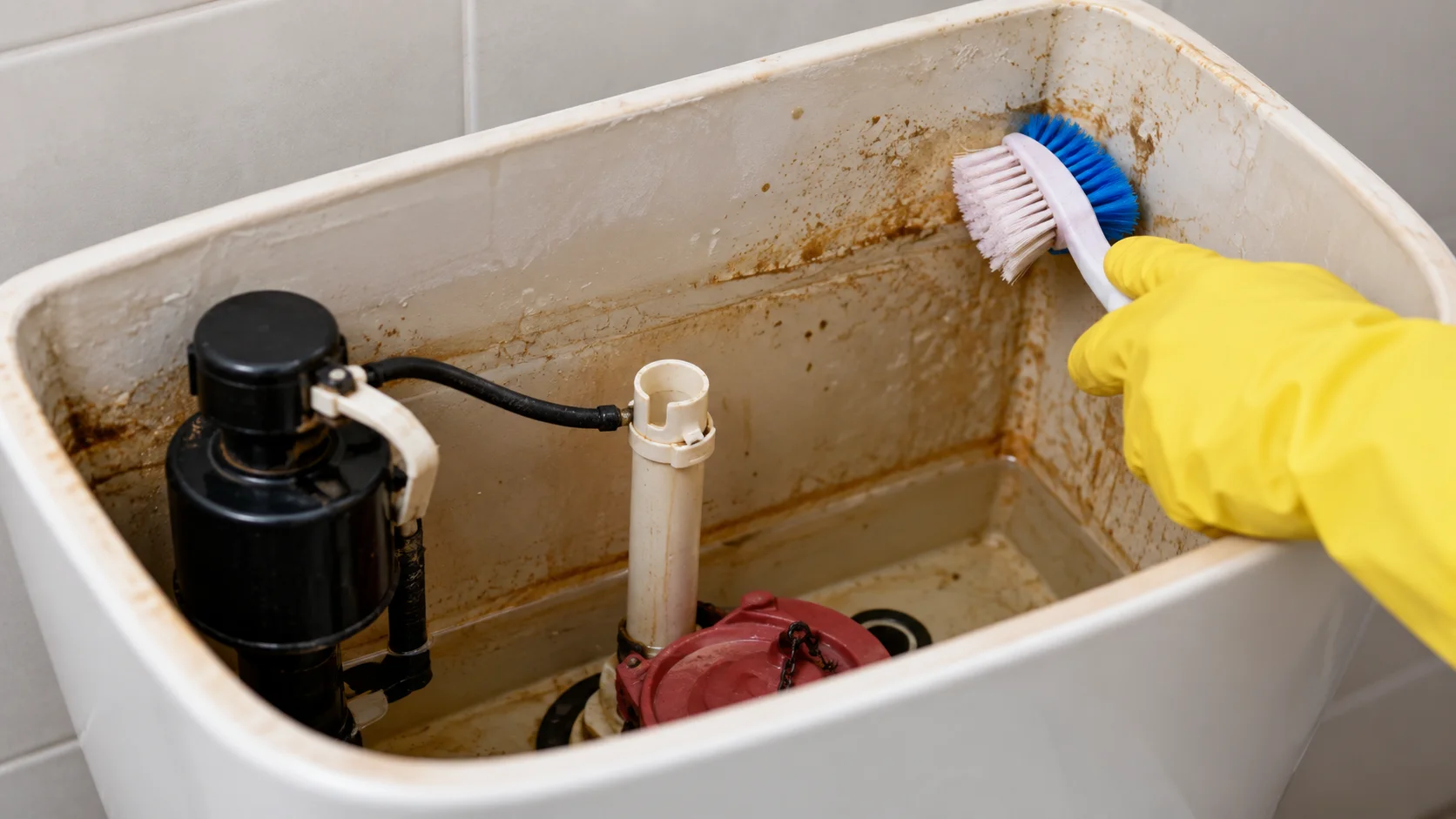
Learning how to clean a toilet tank is important because the tank can collect mineral deposits, rust, sediment, mold, and grime even when the toilet bowl looks clean. A dirty tank can also give you an opportunity to notice worn or problematic components such as the flapper, fill valve, or float before they become bigger plumbing issues. Lowe’s and Benjamin Franklin Plumbing both recommend inspecting the tank interior and its working components during cleaning.
For most routine cleaning, the safest approach is to turn off the water, drain the tank, inspect the buildup, clean with a product appropriate for the problem, scrub gently, and rinse thoroughly. The right method depends on whether you are dealing with ordinary grime, mineral buildup, mold, or rust.
How to Clean a Toilet Tank Step by Step
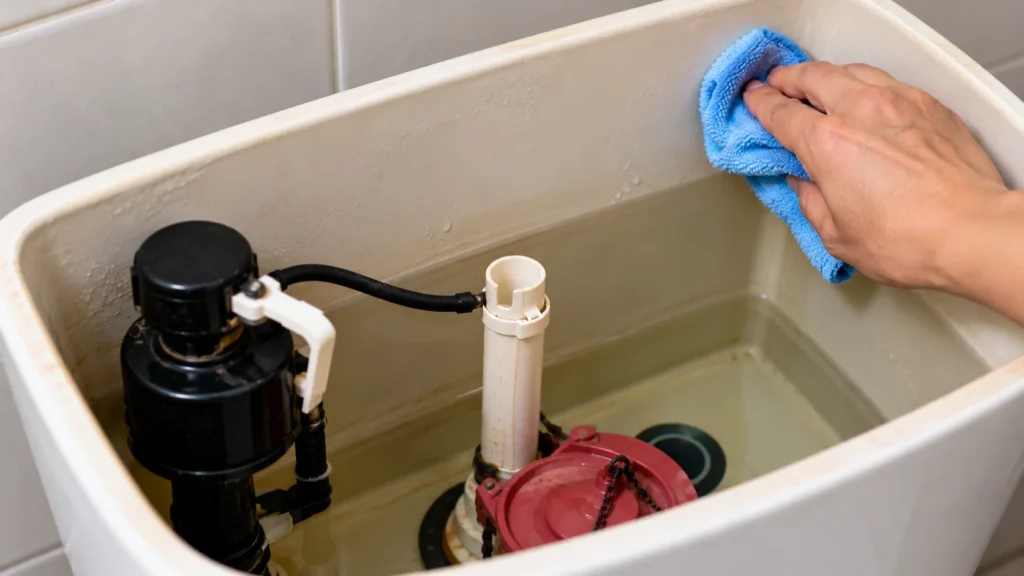
If you want to know how to clean a toilet tank without damaging its internal parts, start with a controlled deep-cleaning process. Draining the tank gives you much better access to the porcelain surfaces and prevents cleaning products from being excessively diluted. Lowe’s specifically recommends turning off the supply, draining the tank, inspecting the interior, applying an appropriate cleaner, scrubbing, and rinsing.
Before beginning, remove the lid carefully and place it somewhere secure because porcelain lids can crack if dropped. Wear gloves and, when the product label calls for them, eye protection and other protective equipment. Never combine different cleaning chemicals simply because they are each effective on their own.
15 Steps for Cleaning the Inside of a Toilet Tank
This basic sequence works as a starting point for routine tank cleaning and can be adapted to the type of buildup you find.
- Turn off the water supply using the shut-off valve near the toilet.
- Remove the tank lid carefully and place it on a stable, protected surface.
- Flush the toilet to empty most of the water from the tank.
- Remove remaining water with a sponge or suitable container if necessary.
- Inspect the tank interior for mold, rust, mineral deposits, sediment, and discoloration.
- Check the flapper for visible deterioration, cracking, or heavy buildup.
- Inspect the fill valve and float for mineral deposits or debris.
- Choose one suitable cleaner based on the type of buildup present.
- Apply the cleaner according to its label rather than guessing a concentration.
- Use a soft or nylon brush to loosen ordinary grime and deposits.
- Work carefully around mechanical components instead of forcing or bending them.
- Rinse the tank thoroughly after the cleaning treatment.
- Turn the water supply back on and allow the tank to refill.
- Flush several times when necessary to remove remaining cleaning solution.
- Check the toilet’s operation and make sure the tank refills and the flapper closes normally.
For heavy rust or mold staining, Clorox recommends a more specific process involving pre-cleaning, separate treatment of rust and mold, and thorough rinsing between products.
How to Clean Toilet Tank Without Draining
The search how to clean toilet tank without draining is common, but there is an important limitation: a tank full of water dilutes many cleaning products. Clorox specifically notes that cleaning severe mold or rust without draining is less effective because the water reduces the concentration of the cleaner.
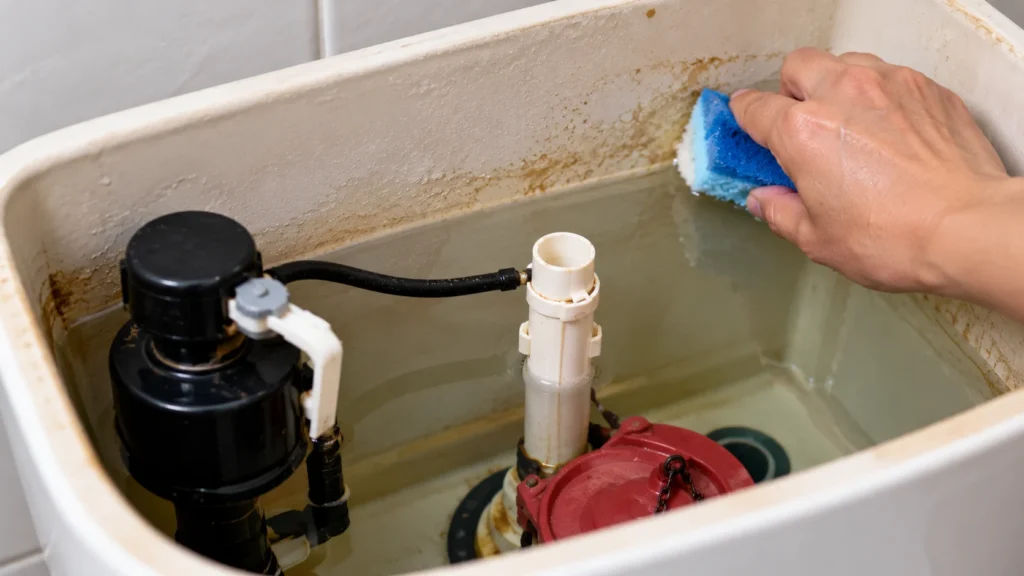
For light surface grime, you may be able to wipe accessible areas while the tank contains water, but this is not the best method for serious buildup. If the tank has significant mold, rust, or mineral deposits, turning off the supply and draining it allows you to see and treat the affected surfaces properly.
If you only need routine maintenance, you can inspect the tank periodically and address small deposits before they become difficult to remove.
How to Clean Toilet Tank With Vinegar
White vinegar is commonly used for how to clean a toilet tank with vinegar because its acidity can help loosen some mineral deposits. Benjamin Franklin Plumbing recommends white vinegar as a household option for mineral deposits, while This Old House describes draining the tank and allowing vinegar to sit before scrubbing.
For a deeper vinegar treatment, turn off the water supply and drain the tank first. Apply vinegar to compatible mineral deposits and allow adequate contact time according to the method you are following, then scrub gently and rinse thoroughly. This approach is more useful for mineral buildup than for every type of stain.
Do not assume vinegar is appropriate for every toilet component or finish. More importantly, never combine vinegar or another acid with bleach, because hazardous chlorine-containing fumes can result. Clorox explicitly warns against mixing bleach with vinegar, acids, ammonia, or other cleaners.
How to Clean Toilet Tank With Vinegar and Baking Soda
Many homeowners search for how to clean toilet tank with vinegar and baking soda because both are common household cleaning ingredients. Baking soda can provide mild abrasive action, while vinegar is acidic and can help with some mineral deposits.
However, combining them produces a rapid fizzing reaction that consumes much of the acid and alkaline ingredients. It is therefore more sensible to use them for different purposes rather than assuming that more fizz means more cleaning power. Benjamin Franklin Plumbing recommends baking soda as a mild abrasive and warns against adding large quantities of vinegar and baking soda together.
For light grime, a small amount of baking soda with water can help loosen residue before rinsing. For mineral scale, vinegar can be used separately when appropriate.
How to Clean Mold From Toilet Tank
If you are searching how to clean mold from toilet tank, begin by determining how extensive the growth is. Mold or mildew can develop in the damp, enclosed environment of a toilet tank, especially when the bathroom has persistent moisture.
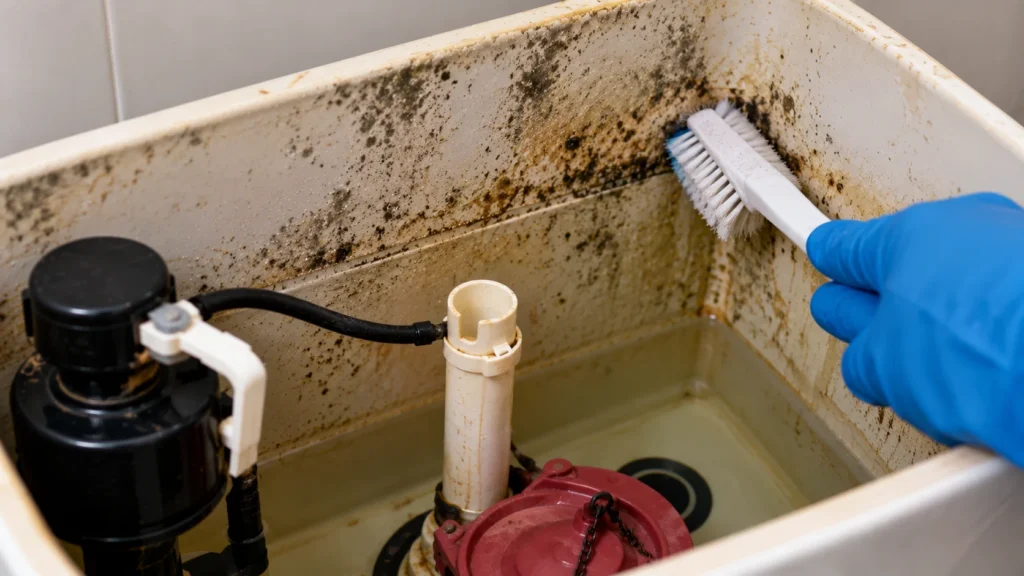
For significant mold staining, Clorox recommends draining and pre-cleaning the tank before applying its specified bleach solution. Its instructions call for keeping the solution wet on the tank surface for the specified contact period, then thoroughly rinsing and flushing the toilet.
Do not improvise bleach concentrations or mix bleach with vinegar, rust removers, acids, ammonia, or other cleaners. If rust and mold are both present, Clorox recommends treating the rust first and rinsing thoroughly before any bleach treatment.
How to Clean Toilet Tank Rust and Calcium Buildup
Rust and calcium buildup require different approaches, so identifying the stain before choosing a cleaner is important. Orange or reddish-brown staining can be associated with iron in the water supply, while whitish or chalky deposits are commonly associated with mineral buildup.
For severe rust, Clorox recommends using a dedicated rust remover according to its instructions and thoroughly rinsing afterward. Its guidance also emphasizes checking that the tank water has returned to an appropriate pH after rust-remover treatment.
For calcium buildup in toilet tank, an appropriate mild acid such as vinegar may help loosen deposits when compatible with the toilet and its components. For particularly heavy deposits, follow the instructions of a product specifically designed for the application.
Avoid sharp tools or aggressive scraping because they can scratch surfaces or damage components.
Jump into Other Related Article
- How to Remove Peanut Butter Stains | Easy Ways to Clean Clothes, Fabric & More
- How to Remove Coffee Stains | Easy Methods for Clothes, Teeth, Carpet & More
- Toilet Bowl Cleaner | Types, Uses, Safety, Tablets & How to Choose One
Can You Use Bleach to Clean a Toilet Tank?
Bleach requires extra caution because recommendations can differ depending on the toilet components and manufacturer. Clorox provides instructions for using a diluted bleach solution to clean an empty toilet tank when used as directed.
However, this does not mean that bleach-containing drop-in tablets are universally safe for toilet tanks. Fluidmaster explicitly warns against in-tank drop-in toilet bowl cleaners containing bleach or chlorine because they can damage tank components and potentially cause flooding or property damage.
Therefore, always check your toilet and component manufacturer’s instructions before using bleach or an automatic tank cleaner.
How to Clean Toilet Tank Without Scrubbing
If you want to clean toilet tank without scrubbing, soaking can reduce the amount of manual work required. A suitable tank cleaner may loosen mineral deposits or grime when allowed to work for the manufacturer’s recommended contact time.
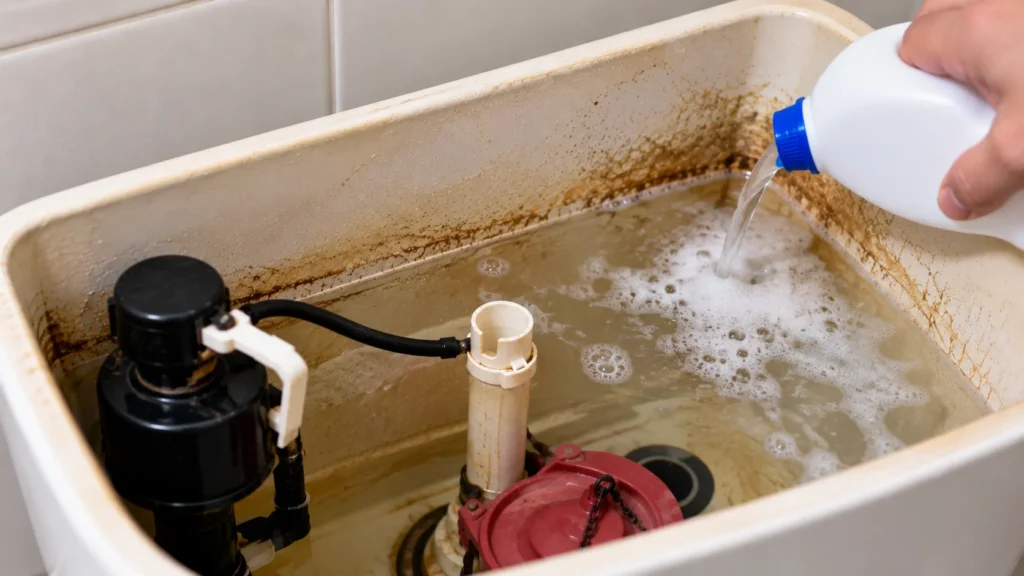
Lowe’s describes a toilet-tank-cleaner approach in which the product is added according to its instructions, allowed to sit for several hours or overnight when specified, and then flushed and rinsed.
However, “without scrubbing” does not mean every stain will disappear automatically. Heavy rust, hardened mineral scale, and established mold may still require controlled mechanical cleaning after the appropriate treatment.
How to Keep Your Toilet Tank Clean
Regular maintenance is easier than waiting until the tank develops heavy buildup. Benjamin Franklin Plumbing recommends cleaning approximately every six months, while This Old House also recommends twice-yearly cleaning and suggests increasing the frequency when hard water or persistent odors are problems.
A simple maintenance routine includes inspecting the tank, looking for sediment or discoloration, checking the mechanical parts, and dealing with small deposits early. If your water is particularly hard, buildup may return sooner.
Be cautious with automatic tank tablets. Some toilet-component manufacturers specifically warn that bleach or chlorine drop-in cleaners can damage internal parts.
Common Toilet Tank Cleaning Mistakes
The biggest problems usually come from using the wrong chemical, skipping rinsing, or treating the tank like the toilet bowl. Toilet bowl cleaners are formulated for the bowl and should not automatically be poured into the tank; Clorox specifically advises against using regular toilet bowl cleaner inside the tank.
Avoid mixing products, especially bleach with acids or ammonia. Never assume that a stronger concentration will produce a better result. Also avoid aggressive scrubbing around delicate valves, flappers, chains, and other mechanisms.
If cleaning reveals a cracked component, persistent leak, continuously running toilet, or serious corrosion, repair or replacement may be more appropriate than repeated cleaning.
Conclusion
Knowing how to clean a toilet tank helps you remove mold, rust, mineral deposits, sediment, and grime while giving you a chance to inspect the toilet’s working components. For most deep cleaning, turn off the water, drain the tank, identify the buildup, use one suitable cleaner, scrub gently, and rinse thoroughly.
Vinegar can be useful for some mineral deposits, while specialized products may be more appropriate for heavy rust or other stubborn stains. Bleach should only be used when compatible with your toilet and according to the product and manufacturer instructions, and bleach or chlorine drop-in cleaners should not be assumed to be safe for every toilet system.
How often should you clean a toilet tank?
A practical starting point is about twice a year, with more frequent inspection or cleaning if you have hard water, recurring odors, visible mold, rust, or mineral buildup.
Can I clean a toilet tank with vinegar?
Yes, vinegar can help loosen certain mineral deposits when used appropriately. Drain the tank first for a deeper treatment, follow a suitable method, and rinse thoroughly afterward.
Can I put baking soda in a toilet tank?
Baking soda can be used as a mild abrasive for some cleaning tasks, but it should not be treated as a universal tank cleaner. Avoid combining large amounts of baking soda and vinegar because the reaction consumes both ingredients.
How do I clean black mold in a toilet tank?
For significant mold staining, drain and pre-clean the tank, then use a compatible mold treatment according to its instructions. If using bleach, never mix it with vinegar, rust remover, acids, ammonia, or other cleaners.
How do I remove rust from a toilet tank?
For heavy rust, use a rust-removal product specifically suitable for the application and follow its label. Thorough rinsing is essential, and rust remover should never be mixed with bleach.
Is it safe to use bleach tablets in a toilet tank?
Not necessarily. Some manufacturers, including Fluidmaster, explicitly warn against in-tank drop-in cleaners containing bleach or chlorine because they can damage tank components. Check the instructions for your specific toilet and components before using any tablet.