
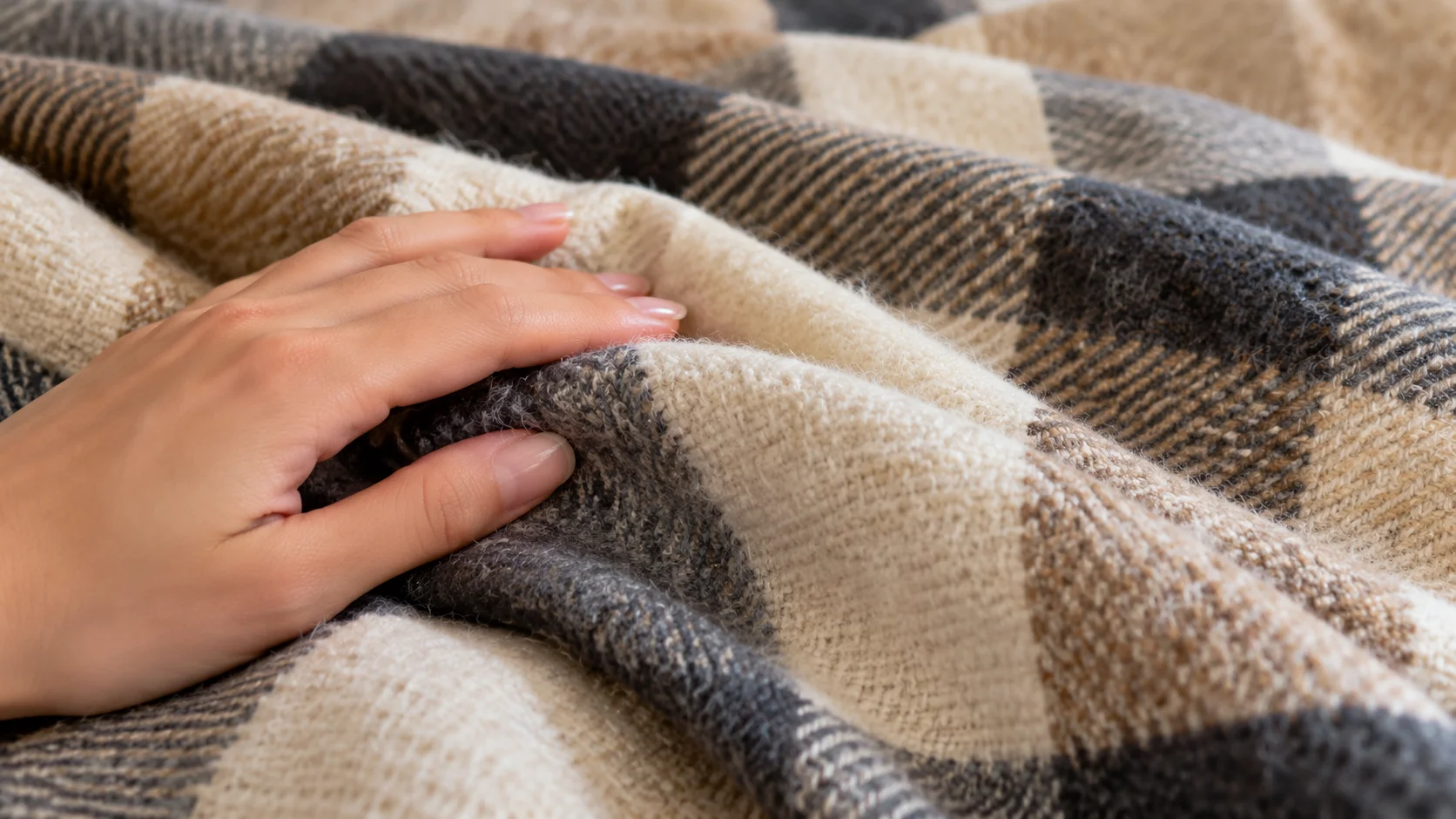
Knowing how to wash wool blankets properly is important because wool behaves differently from cotton, polyester, and many other household fabrics. Wool fibers can tolerate careful cleaning, but heat, excessive agitation, unsuitable detergent, and incorrect drying can cause shrinking, felting, stiffness, distortion, or changes in texture. The safest starting point is always the blanket’s care label because a wool blanket is not necessarily washable in the same way as another wool blanket. The Woolmark Company specifically advises checking care instructions and notes that some wool products are designed for machine washing while others require different treatment.
If you’re searching for how to wash a wool blanket without shrinking it, the key is to control temperature, movement, detergent, and drying. Some washable wool blankets can be cleaned in a washing machine using a gentle wool cycle and cold water, while traditional or delicate blankets may need hand washing or professional cleaning. Pendleton, for example, says its traditional wool blankets should generally be dry cleaned unless their care label specifically identifies them as washable, while its specially treated Eco-Wise Wool blankets are designed to be washed.
Can You Wash a Wool Blanket?
Yes, some wool blankets can be washed, but you should never assume that every wool blanket is machine washable.
The care label is the deciding factor. Woolmark explains that some wool products carry machine-washable instructions, while others may be labeled hand wash, do not wash, or require professional dry cleaning.
Before washing, identify:
- Whether the blanket is 100% wool or a blend
- Whether it is woven, knitted, or crocheted
- Whether it has a special washable finish
- Whether it is vintage or antique
- Whether the care label permits machine washing
- Whether the manufacturer recommends dry cleaning
- Whether the blanket has decorative edging, fringe, or other delicate details
A blanket made from 100% wool is not automatically more or less washable than a wool blend. Construction and finishing can make a major difference.
For example, Pendleton states that traditional wool blankets should generally be dry cleaned, while its Eco-Wise Wool bedding has been specially treated to be washable and resist felting.
What Makes Wool Blankets Shrink?
Understanding why wool shrinks helps explain why washing instructions matter.
Wool fibers have a scaly outer structure. When wool is exposed to a combination of moisture, heat, and mechanical agitation, the fibers can move against one another and become increasingly interlocked. This process is commonly associated with felting, which can permanently change the blanket’s dimensions and texture.
That means the biggest risks usually come from:
- Hot water
- Strong agitation
- Aggressive washing cycles
- High dryer temperatures
- Excessive friction
- Twisting or wringing
- Incorrect detergent
- Rapid temperature changes
- Drying a blanket incorrectly
Pendleton specifically warns that washing traditional wool blankets can cause shrinkage and damage, while its product-care guidance notes that repeated washing of wool products not designed for washing can cause significant shrinkage and permanent changes in feel.
This is why how to wash a wool blanket without shrinking it is primarily about following the correct care method rather than finding a single magic washing temperature.
How to Wash Wool Blanket Step by Step
If your wool blanket is clearly labeled machine washable, you can generally follow a gentle process similar to the one below. Always give the manufacturer’s instructions priority if they differ.
1. Check the Care Label
Read the entire care label before doing anything else.
Look for instructions such as:
- Machine wash
- Wool cycle
- Cold wash
- Hand wash
- Do not wash
- Dry clean only
- Do not tumble dry
- Low-temperature tumble dry
Woolmark explains that a machine-washable wool care symbol indicates reduced mechanical treatment and recommends a wool or delicate cycle for such products.
2. Inspect the Blanket
Spread the blanket out and check it carefully.
Look for:
- Loose threads
- Open seams
- Holes
- Weak edges
- Loose fringe
- Decorative stitching
- Heavy stains
- Areas that have already felted
If a blanket is fragile or damaged, machine washing may make the problem worse.
3. Air and Brush It First
A wool blanket may not need a full wash simply because it has been stored or used for a while.
Woolmark recommends airing wool blankets outdoors in good airflow and gently brushing them with a soft-bristle brush to remove surface dust and soil.
This can be a useful first step when the blanket has:
- Light dust
- Mild odors
- Surface dirt
- No major stains
- No visible soiling requiring deeper cleaning
Because wool naturally resists odors and stains to some extent, frequent washing is not always necessary.
4. Treat Small Stains Before Washing
If there is a small liquid stain, avoid immediately putting the entire blanket through a wash.
Woolmark recommends treating liquid stains promptly with warm water and mild detergent, then gently blotting rather than aggressively scrubbing the fabric.
Avoid vigorous rubbing because friction can disturb the surface fibers.
5. Choose a Wool-Safe Detergent
A mild, neutral wool detergent is generally the appropriate choice for washable wool.
Woolmark advises using a mild or neutral wool detergent and avoiding heavy-duty detergents, enzyme-containing biological detergents, and bleach.
Avoid:
- Chlorine bleach
- Oxygen bleach unless specifically approved
- Heavy-duty detergent
- Strong enzyme detergents
- Excessive fabric softener
- Harsh stain removers
More detergent does not mean a cleaner blanket. Excess detergent can also make rinsing more difficult.
6. Select Cold Water and a Gentle Cycle
If your blanket is machine washable, use the temperature and cycle specified on its label.
For washable wool blankets, Woolmark recommends a gentle wool wash cycle and cold water.
The goal is to minimize:
- Heat
- Agitation
- Friction
- Mechanical stress
Avoid a normal heavy-duty cycle unless the manufacturer specifically instructs you to use it.
7. Don’t Overload the Washer
A large wool blanket needs enough space to move through the water without being tightly compressed.
An oversized blanket may also become extremely heavy when wet. If your home washing machine is too small, a larger commercial machine may be more suitable but only if the blanket’s care instructions permit machine washing.
Never force a large blanket into a washer simply because you can physically fit it inside.
8. Remove It Carefully After Washing
Wet wool can be heavy. Avoid grabbing one corner and allowing the entire blanket to hang from that point.
Support the blanket as evenly as possible when moving it to the drying area.
Do not twist or wring it.
How to Wash Wool Blanket in Washing Machine
If you’re specifically searching for how to wash wool blanket in washing machine, the most important distinction is whether the blanket is actually labeled machine washable.
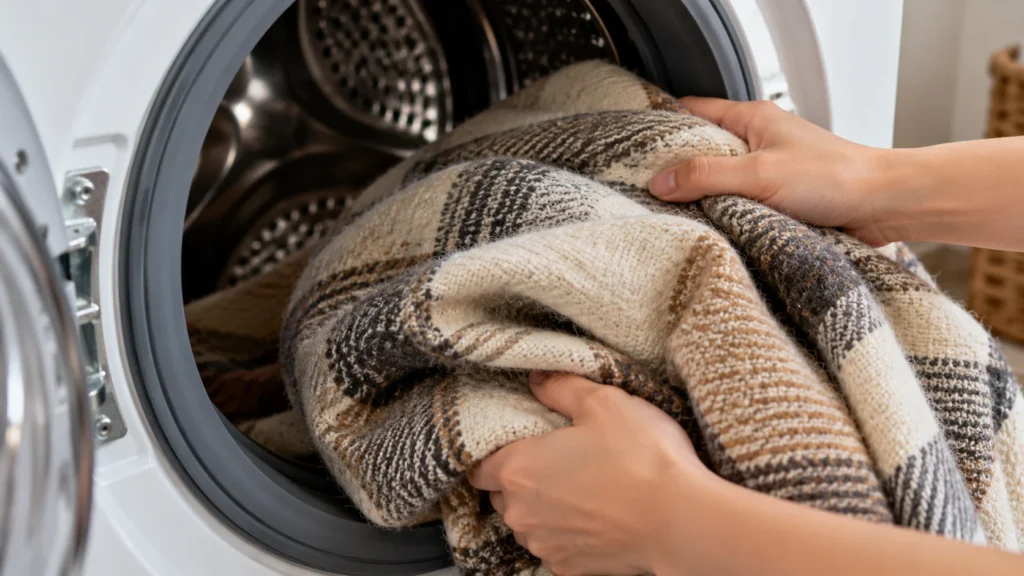
For a machine-washable wool blanket, a safe general sequence is:
- Check the care label.
- Remove loose dirt and dust.
- Treat small stains gently.
- Place the blanket into a sufficiently large washer.
- Add a small amount of wool-safe detergent.
- Select the wool or delicate cycle.
- Use cold water if the label permits.
- Avoid bleach.
- Avoid aggressive spin or agitation settings.
- Remove the blanket promptly after the cycle.
- Dry according to the care instructions.
Woolmark’s washing guidance emphasizes reduced mechanical treatment for machine-washable wool products.
Can You Machine Wash a 100% Wool Blanket?
A 100% wool blanket can sometimes be machine washed, but the fiber percentage alone does not determine whether it is safe.
Some 100% wool blankets are specially finished to improve dimensional stability and machine washability. Woolmark describes machine-washable wool as wool that has been specially processed to allow domestic machine washing with reduced risk of excessive shrinkage, felting, or distortion.
Other 100% wool blankets are not designed for machine washing.
Therefore, if the label says dry clean only, don’t machine wash it just because another 100% wool blanket is washable.
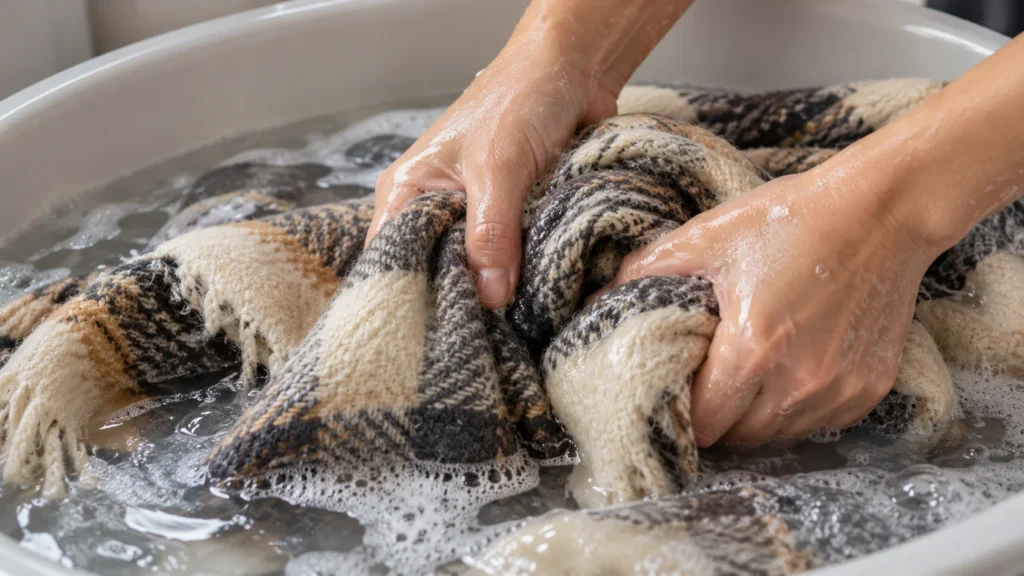
How to Hand Wash Wool Blanket
Hand washing a wool blanket can be appropriate when the care label specifically allows hand washing.
A bathtub or large clean basin can provide enough space for a blanket that would be too large for a sink.
Hand-Washing Method
- Clean the bathtub thoroughly.
- Fill it with cool or lukewarm water according to the care label.
- Add a small amount of wool-safe detergent.
- Mix the detergent into the water before adding the blanket.
- Lower the blanket into the water.
- Gently press the blanket under the water.
- Allow the detergent solution to move through the fibers without aggressive scrubbing.
- Drain the dirty water.
- Refill with clean water.
- Press the blanket gently to release detergent.
- Repeat rinsing until the water is clear.
- Avoid twisting or wringing.
- Support the blanket evenly while removing it from the tub.
Woolmark’s hand-wash guidance advises gentle agitation and specifically says not to rub, pull, or wring wool.
For a large blanket, the hardest part may actually be removing the water safely. A very wet blanket can become heavy enough that lifting it from one corner stretches the fabric.
How to Wash a Wool Blanket Without Shrinking It
If your main concern is how to wash a wool blanket without shrinking it, focus on five things:
Keep the Temperature Low
Hot water can increase the risk of shrinkage and felting. Follow the label, and when a machine-washable wool blanket specifies cold water, use cold water.
Reduce Agitation
Gentle washing is essential. Strong agitation creates more mechanical action between fibers.
Use Wool Detergent
A mild, neutral detergent is preferable to heavy-duty or enzyme-based detergent for wool. Woolmark specifically recommends mild wool detergents and advises against bleach.
Avoid High Heat
Do not assume that a wool blanket can go into a hot dryer.
Woolmark recommends flat drying wool where appropriate and says wool products should be tumble dried only when the care claim specifically permits it.
Don’t Wring It
Twisting a wet wool blanket can distort its shape and stress the fibers.
How to Wash and Dry a Wool Blanket
Drying is just as important as washing.
For many wool blankets, air drying is the safest approach when the care label permits it.
Woolmark recommends drying wool blankets flat or in a way that supports their weight, while keeping them away from direct sunlight. Its blanket-specific guidance advises avoiding the dryer because heat can damage the softness and shape of some wool blankets.
The Best Way to Dry a Wool Blanket
After washing:
- Remove excess water carefully.
- Do not wring.
- Support the blanket evenly.
- Lay it flat where possible.
- Use good airflow.
- Keep it away from direct heat.
- Avoid direct, strong sunlight.
- Reshape it while damp.
- Allow it to dry completely before storing or using it.
For large blankets, a clean drying rack or another method that supports the blanket’s weight can be preferable to hanging a saturated blanket from a narrow point.
Woolmark’s general drying guidance also warns against direct heat and says knitted wool should generally be dried flat unless its care claim permits tumble drying.
Can You Put a Wool Blanket in the Dryer?
Only if the blanket’s care label specifically allows tumble drying.
Some specially treated washable wool products are designed for dryer use. Pendleton’s Eco-Wise wool bedding is an example of a wool product with a washable-care system, while traditional Pendleton wool blankets generally have different care instructions.
Never assume that machine washable automatically means dryer safe.
How to Wash a Pendleton Wool Blanket
If you’re searching for how to wash Pendleton wool blanket, the answer depends on the specific Pendleton blanket.
Pendleton states that some blankets require dry cleaning while others are washable. Its current product guidance says that unless a blanket’s label specifically identifies it as washable, it should be dry cleaned. For machine-washable Pendleton wool blankets, the company recommends cold washing on a gentle cycle and hanging them to dry.
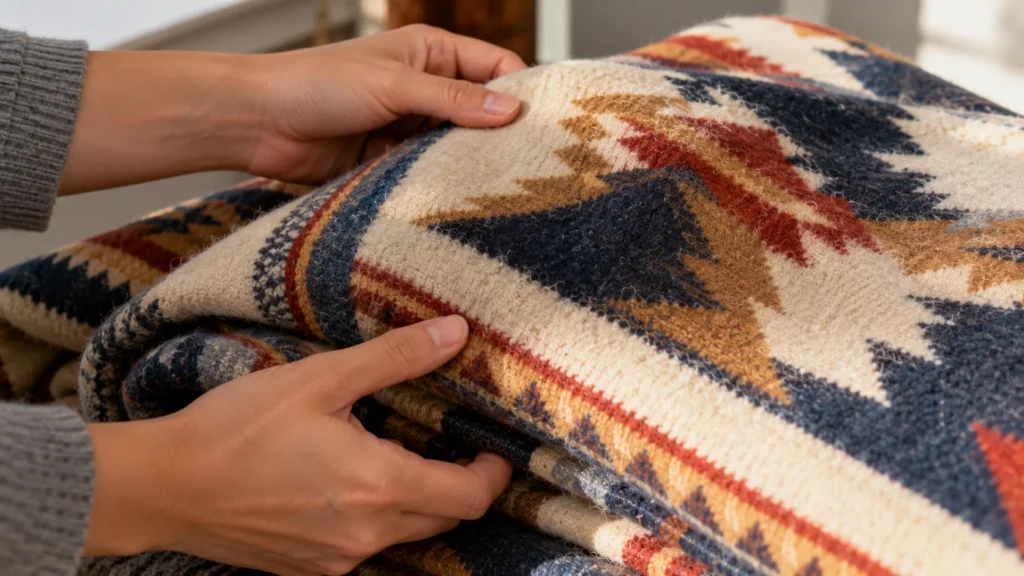
Pendleton also has an Eco-Wise Wool line designed for easier care. These blankets have been treated to resist felting and are intended to be washable.
So, for how to wash a Pendleton wool blanket, use this rule:
Follow the care tag for the exact Pendleton blanket rather than applying a generic wool-washing method.
This is especially important for valuable, vintage, or traditional Pendleton blankets.
How to Wash an Old or Vintage Wool Blanket
An old wool blanket deserves extra caution.
Age can weaken fibers, seams, bindings, fringe, and dyes. A vintage blanket may also have no surviving care label, making its original cleaning requirements uncertain.
Before attempting to wash an old wool blanket:
- Inspect the seams.
- Check for holes.
- Look for fragile fringe.
- Test for loose fibers.
- Examine the colors for potential bleeding.
- Check whether the blanket has a label.
- Consider professional cleaning if it is valuable or historically important.
Pendleton recommends dry cleaning vintage items that lack care tags rather than assuming they are washable.
If the blanket is an heirloom, antique, collectible, or particularly valuable piece, professional textile care is safer than experimenting with a home washing method.
How to Wash a Military Wool Blanket
Military and army blankets can vary considerably in fiber composition, age, construction, and finishing.
If you have a military wool blanket, wool army blanket, or army wool blanket, check its original label if available.
If there is no label:
- Inspect the blanket carefully.
- Identify the approximate material composition if possible.
- Look for signs of fragile fibers.
- Avoid hot water.
- Avoid aggressive washing.
- Avoid bleach.
- Consider professional cleaning if the blanket is vintage or collectible.
A military blanket should not automatically be treated as a modern machine-washable blanket simply because it is made from wool.
How to Wash an Alpaca Wool Blanket
Alpaca wool blankets require attention to the manufacturer’s care instructions because alpaca fibers and blanket construction vary.
If the label permits washing, use a gentle method with an appropriate wool-safe detergent and avoid aggressive agitation.
For how to wash alpaca wool blanket:
- Check the label first.
- Use cool water when instructed.
- Use mild detergent.
- Avoid bleach.
- Avoid vigorous rubbing.
- Do not wring.
- Reshape while damp.
- Dry gently away from direct heat.
If the blanket is labeled dry clean only, follow that instruction.
How to Wash a Merino Wool Blanket
Merino wool is a type of wool fiber, but not every Merino blanket has identical care requirements.
For how to wash a Merino wool blanket, check whether the blanket has a machine-washable treatment.
Woolmark explains that some machine-washable wool products have been engineered to improve shrink resistance and dimensional stability.
If washable:
- Select the wool or delicate cycle.
- Use the specified temperature.
- Use mild wool detergent.
- Avoid bleach.
- Minimize agitation.
- Follow the label for drying.
If the blanket is not machine washable, use its specified hand-wash or professional-cleaning method.
How to Wash a Knitted or Crochet Wool Blanket
Knitted and crochet blankets can be more vulnerable to stretching because the structure contains loops rather than a tightly woven surface.
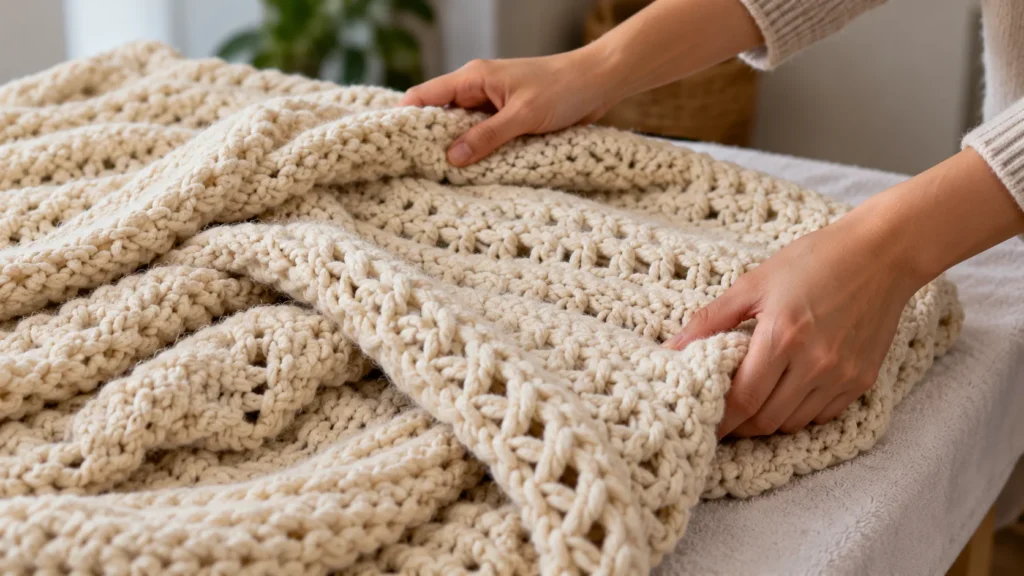
For how to wash a wool crochet blanket or knitted wool blanket:
- Check the label first.
- Avoid hot water.
- Avoid aggressive agitation.
- Do not wring.
- Support the entire blanket while wet.
- Reshape it carefully.
- Dry it flat when instructed.
Do not hang a heavy, saturated knitted blanket from one end. Its own weight can distort the shape.
How Often to Wash Wool Blanket
The answer to how often to wash wool blanket is not necessarily every week or every month.
Woolmark states that wool blankets do not need frequent washing and notes that some guidelines recommend washing wool blankets around once every three months.
Actual frequency depends on:
- How often the blanket is used
- Whether it touches bare skin
- Whether it is used as a decorative layer
- Whether pets use it
- Whether it becomes visibly dirty
- Whether spills occur
- Whether you use a washable cover
- Manufacturer instructions
Between deeper washes, airing and gentle brushing can help refresh a wool blanket. Woolmark specifically recommends ventilation and brushing for routine blanket care.
How to Clean Wool Blanket Without Washing It
You do not always need to wash wool to freshen it.
For routine maintenance:
- Take the blanket outdoors.
- Shake it gently.
- Let it air in good ventilation.
- Brush the surface with a soft-bristle brush.
- Spot-clean small spills.
- Allow damp areas to dry naturally.
- Store it only when completely dry.
Woolmark recommends airing and brushing wool blankets as part of routine care and describes wool as naturally resistant to stains and odors.
This approach can reduce unnecessary washing and help preserve the blanket’s original texture.
Jump into Other Related Article
- How to Remove Peanut Butter Stains | Easy Ways to Clean Clothes, Fabric & More
- Does Rayon Shrink? What Happens in the Washer and Dryer
- How to Remove Coffee Stains | Easy Methods for Clothes, Teeth, Carpet & More
- How to Clean Suede Shoes | Easy Ways to Clean Suede at Home
What Detergent Should You Use for a Wool Blanket?
A mild, neutral wool detergent is the safest general choice for washable wool.
Woolmark specifically recommends mild or neutral detergents suitable for wool and advises avoiding heavy-duty detergents, biological detergents containing enzymes, and bleach.
When choosing a detergent, look for wording such as:
- Wool wash
- Wool-safe
- Delicate detergent
- Neutral detergent
- Suitable for wool
Avoid assuming that a detergent labeled gentle for general laundry is automatically appropriate for wool.
What Not to Do When Washing a Wool Blanket
Avoid these common mistakes:
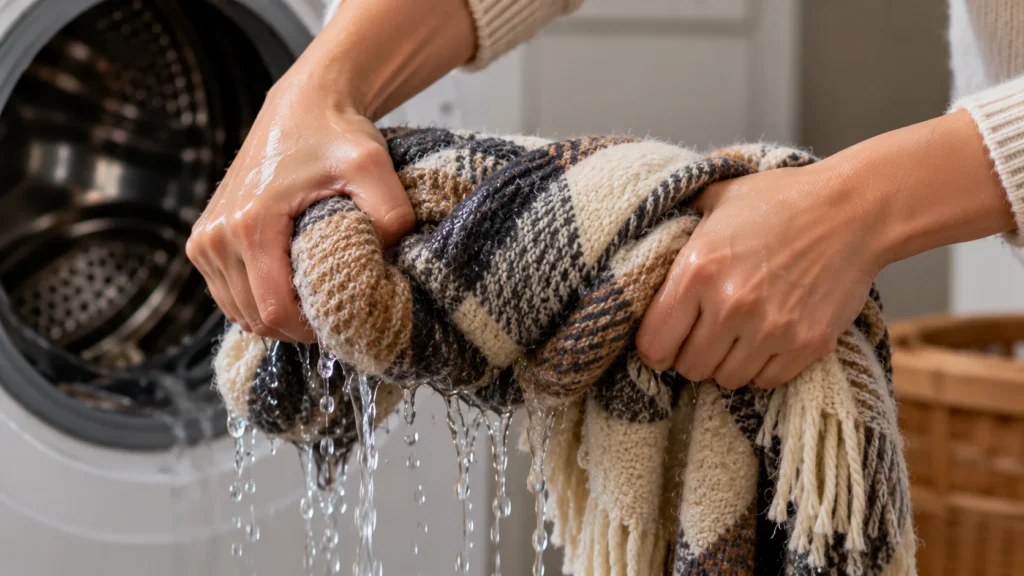
- Don’t use hot water unless the care label specifically says to.
- Don’t use bleach.
- Don’t use an aggressive wash cycle.
- Don’t scrub wool vigorously.
- Don’t wring or twist a wet blanket.
- Don’t use high dryer heat.
- Don’t machine wash a dry-clean-only blanket.
- Don’t overload the washing machine.
- Don’t hang a saturated heavy blanket from one small point.
- Don’t store the blanket while damp.
- Don’t experiment with a valuable vintage blanket.
Woolmark and Pendleton both emphasize that correct care instructions should take priority because wool products differ in their washing suitability.
How to Store a Wool Blanket After Washing
A wool blanket should be completely dry before long-term storage.
Pendleton recommends storing clean, dry wool blankets in an airtight bag or sealed container in a cool, dry, dark location and checking periodically for fabric pests.
For storage:
- Make sure the blanket is completely dry.
- Fold it loosely.
- Avoid compressing it unnecessarily.
- Use a clean storage container.
- Keep it in a cool, dry area.
- Protect it from prolonged moisture.
- Check periodically for moth or pest activity.
Do not store a damp wool blanket in a sealed plastic container. Trapped moisture can create an unsuitable environment for the textile.
Quick Wool Blanket Washing Checklist
Before you start, use this simple checklist:
- Care label checked: Yes
- Machine washable: Confirmed
- Stains treated: Yes
- Wool-safe detergent: Ready
- Water temperature: Correct for the label
- Gentle/wool cycle: Selected
- Bleach: Not used
- High heat: Avoided
- Wringing: Avoided
- Drying method: Confirmed
- Blanket completely dry: Checked before storage
If the blanket fails the first test meaning the label says dry clean only or do not wash—stop there and follow that instruction.
Conclusion
The safest answer to how to wash wool blanket is to start with the care label and then use the gentlest method the manufacturer permits. A washable wool blanket can often be cleaned using cold water, a wool or delicate cycle, mild wool detergent, minimal agitation, and careful drying. Woolmark recommends gentle wool washing and appropriate wool detergents, while its blanket-care guidance emphasizes airing, brushing, careful stain treatment, and avoiding unnecessary washing.
If your goal is how to wash a wool blanket without shrinking it, avoid treating wool like ordinary cotton bedding. Heat, friction, agitation, harsh detergents, and improper drying can change its dimensions and texture. Traditional Pendleton blankets, vintage wool blankets, military blankets, and other valuable pieces may require professional cleaning, while specially treated washable blankets can have very different instructions. When in doubt, the manufacturer’s care label is more reliable than a generic washing recipe.
Can you wash a wool blanket in the washing machine?
Yes, if the blanket is labeled machine washable. Use the specified temperature and a wool or delicate cycle. Woolmark recommends cold water and a gentle wool cycle for machine-washable wool blankets.
How do you wash a wool blanket without shrinking it?
Use the manufacturer’s recommended method, avoid unnecessary heat and agitation, use a mild wool detergent, and avoid high-heat drying. If the label says dry clean only, do not machine wash it.
Can you wash a 100% wool blanket?
Some 100% wool blankets are washable and others are not. Fiber content alone does not determine washing suitability. Check the care label and manufacturer instructions.
Can you machine wash a wool blanket?
Only when the blanket is specifically labeled machine washable. If approved, use a gentle wool cycle, appropriate temperature, mild wool detergent, and the recommended drying method.
Can you put a wool blanket in the dryer?
Only if the care label permits tumble drying. Some specially treated wool products can be tumble dried on an appropriate low-temperature setting, while other wool blankets should be air dried.
How do you wash a Pendleton wool blanket?
Check the exact blanket’s care tag. Pendleton says traditional wool blankets generally require dry cleaning unless specifically labeled washable. Its machine-washable wool blankets should be washed cold on a gentle cycle and hung dry.
Can you wash an old wool blanket?
Possibly, but an old or vintage blanket deserves extra care. Check its condition and care label first. If it is valuable, fragile, or missing care instructions, professional cleaning is a safer option.
How do you wash a military wool blanket?
First check the label and material. If it is washable, use a gentle wool-safe method with low-temperature water and minimal agitation. For vintage or collectible military blankets without care information, consider professional textile cleaning.
How do you wash an alpaca wool blanket?
Follow the manufacturer’s instructions. If washing is permitted, use cool water, mild wool detergent, gentle handling, and careful air drying. Avoid high heat and aggressive agitation.
How do you wash a Merino wool blanket?
Check whether the Merino blanket has a machine-washable finish. If it does, use the specified wool cycle and temperature with a mild wool detergent. If it is labeled hand wash or dry clean, follow that instruction instead.
How do you hand wash a wool blanket?
Use cool or lukewarm water according to the care label, add mild wool detergent, gently press the blanket through the water, rinse thoroughly, and remove excess water without twisting or wringing. Woolmark advises against rubbing, pulling, and wringing wool during hand washing.
How often should you wash a wool blanket?
Wool blankets generally do not need frequent washing. Woolmark notes that some care guidance recommends washing wool blankets about once every three months, while airing and brushing can help refresh them between washes.
What detergent should you use to wash a wool blanket?
Use a mild, neutral detergent specifically suitable for wool. Woolmark recommends wool-safe detergents and advises avoiding heavy-duty detergents, enzyme-based biological detergents, and bleach.
Why did my wool blanket shrink after washing?
Shrinkage can occur when wool experiences excessive heat, moisture, agitation, or unsuitable drying. The fibers can become more tightly interlocked, changing the blanket’s dimensions and texture.
How do you wash a wool blanket in a washing machine without damaging it?
Confirm that the blanket is machine washable, use a large enough washer, select the wool or delicate cycle, use the specified low temperature, choose wool-safe detergent, avoid bleach, and follow the manufacturer’s drying instructions.
How do you dry a wool blanket after washing?
When permitted, support the wet blanket evenly and dry it away from direct heat and strong sunlight. Woolmark recommends careful drying and notes that many wool blankets are best dried without a conventional high-heat dryer.