

A hard water stain remover is designed to tackle the white, cloudy, chalky, or crusty deposits left behind when mineral-rich water evaporates. These marks are commonly associated with calcium, lime, magnesium deposits, and sometimes rust. They can appear on shower doors, windows, faucets, toilets, sinks, tile, car glass, and other surfaces that regularly come into contact with water.
The right product depends on both the type of deposit and the surface being cleaned. Acidic calcium-and-lime removers can dissolve mineral buildup, while abrasive products such as Bio-Clean work differently by mechanically loosening deposits. That distinction matters because a product suitable for glass or porcelain may be inappropriate for natural stone, painted finishes, or other sensitive materials.
What Is a Hard Water Stain Remover?
A hard water stain remover is a cleaning product or treatment intended to remove mineral deposits created by hard water. These deposits can contain calcium and lime, while reddish or brown marks may involve iron or rust. Over time, repeated evaporation can leave a thicker layer that ordinary bathroom cleaners may not remove effectively.
Commercial products generally work in one of two ways. Acidic descalers chemically dissolve mineral deposits, while mildly abrasive formulas physically loosen deposits from compatible hard surfaces. For example, CLR states that its Calcium, Lime & Rust Remover dissolves calcium and lime deposits, whereas Bio-Clean describes its product as abrasive-based.
That means there is no single universally best hard water stain remover. The appropriate choice depends on the surface, severity of buildup, and product instructions.
How to Choose the Best Hard Water Stain Remover
Choosing a remover based only on how powerful it sounds can create problems. A strong acidic cleaner may be effective against mineral scale but unsuitable for natural stone or certain metals. Similarly, an abrasive cleaner can work well on compatible glass or porcelain but may damage a surface that should not be scrubbed.
Before purchasing a commercial hard water stain remover, identify the surface and read the manufacturer’s restrictions. CLR, for example, specifically warns against using its household Calcium, Lime & Rust Remover on natural stone, brass, copper, aluminum, wood, carpeting, clothing, and painted or sealed surfaces.
For particularly stubborn deposits, also consider whether the mark is actually mineral buildup or whether the surface has become etched. CLR notes that severe deposits on glass can become embedded or etched into the glass, producing a cloudy appearance that may not behave like an ordinary removable spot.
15 Things to Check Before Using a Hard Water Stain Remover
- 1. Identify the surface before selecting a product.
- 2. Determine whether the mark is mineral buildup or permanent surface damage.
- 3. Read the product label completely.
- 4. Check the manufacturer’s surface restrictions.
- 5. Test the product in an inconspicuous location.
- 6. Wear the protective equipment specified on the label.
- 7. Keep the area properly ventilated.
- 8. Never mix different cleaning chemicals.
- 9. Never mix acidic cleaners with bleach.
- 10. Follow the stated contact time.
- 11. Do not allow a cleaner to dry on the surface.
- 12. Rinse thoroughly after treatment.
- 13. Avoid aggressive scrubbing on delicate finishes.
- 14. Repeat the manufacturer’s recommended treatment rather than improvising stronger mixtures.
- 15. Use professional restoration when deposits have etched or damaged the surface.
These precautions are particularly important with acidic calcium, lime, and rust removers, which manufacturers instruct users to rinse promptly and not mix with other household cleaners.
Bio-Clean Hard Water Stain Remover
Bio-Clean Hard Water Stain Remover is one of the products frequently searched for when people need to clean shower doors, glass, windows, porcelain, chrome, tile, and other hard surfaces. The manufacturer’s current 40-ounce product page describes the formula as abrasive-based and says it is designed to remove water spots, mineral deposits, soap scum, rust, oxidation deposits, and other buildup.
Bio-Clean’s instructions are different from those of an acid-based descaler. The company says to first clean away dirt and grime, apply the product with a dry cloth, sponge, soft-bristled brush, or suitable buffer, and work with a circular rubbing motion. It then recommends rinsing until residue-free and drying the surface.
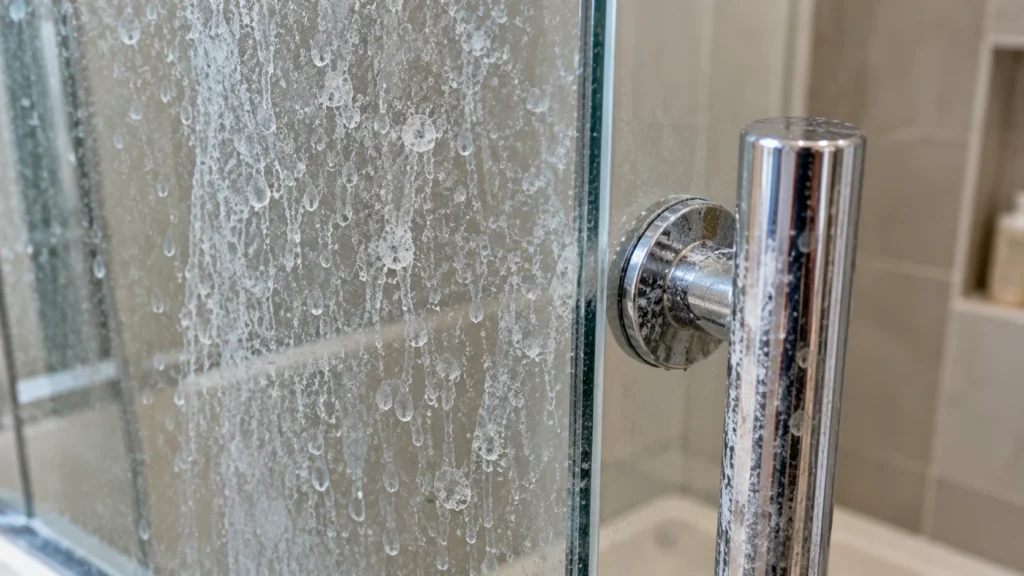
This makes Bio-Clean hard water stain remover particularly relevant to people dealing with established deposits on compatible hard surfaces. However, it is still an abrasive product, so it should only be used on surfaces that the manufacturer says can tolerate mild abrasives.
Bio-Clean Hard Water Stain Remover Reviews
Current reviews provide mixed but generally positive consumer experiences rather than proving that Bio-Clean is universally superior. On Bio-Clean’s own 40-ounce page, 64 reviews are displayed, with 70% rated five stars and 16% rated one star at the time checked.
Retailer reviews also show that results can depend on the deposit and the amount of rubbing required. For example, some reviewers report noticeable improvement after repeated applications, while others describe needing substantial physical effort.
So when considering bio clean hard water stain remover reviews, look beyond star ratings and consider the surface, stain age, and application method.
Hard Water Stain Remover for Glass and Shower Doors
Glass shower doors are among the most common places for hard water deposits. A hard water stain remover for glass needs to address mineral buildup without unnecessarily damaging the glass or surrounding hardware.
Bio-Clean’s manufacturer lists shower doors, windows, glass, windshields, porcelain, tile, and other hard surfaces among its uses. Its instructions recommend cleaning away loose dirt first and using an appropriate non-abrasive pad where specified.
CLR also provides specific instructions for hard water deposits on drinking glasses: its household product is diluted 50/50 with warm water, applied to the affected area, left for two minutes, and then rinsed thoroughly with cold clean water. The company warns that severe calcium deposits can actually etch glass.
For a best hard water stain remover for shower glass, therefore, surface compatibility and deposit severity are more important than simply choosing the strongest formula.
Hard Water Stain Remover for Toilets
Toilet bowls can develop mineral rings and deposits when hard water repeatedly evaporates or remains around the waterline. A toilet hard water stain remover should be specifically compatible with the toilet’s surface and used according to its label.
CLR states that its Calcium, Lime & Rust Remover can be used for mineral buildup in toilet bowls and provides a dedicated guide for hard water stains in toilets.
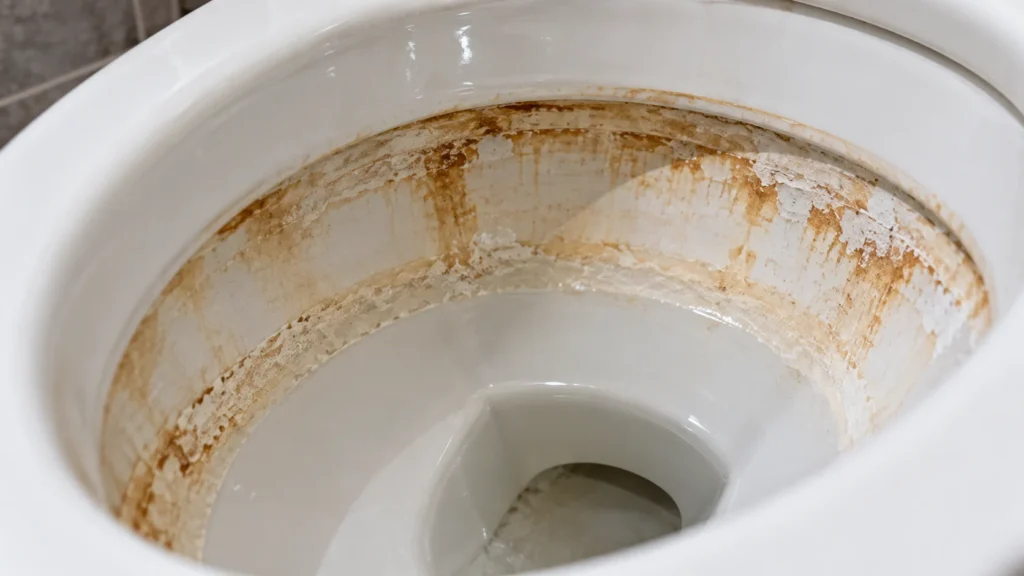
Zep’s concentrated Calcium, Lime & Rust Stain Remover is another commercial option marketed for porcelain toilets, sinks, tubs, glass, tile, and fiberglass. Zep instructs users to dilute the product 50/50 with warm water for tubs, toilet bowls, and sinks and rinse within 60 seconds.
For severe toilet deposits, avoid scraping porcelain aggressively with metal tools. A compatible descaling product and controlled treatment are safer starting points.
DIY Hard Water Stain Remover
A DIY hard water stain remover is often made with acidic household ingredients such as white vinegar because acids can help loosen some mineral deposits. However, DIY solutions are not appropriate for every surface.
Vinegar can be useful for some mineral deposits, but it should not be treated as a universal solution for every shower, tile, countertop, or fixture. Natural stone is especially important to consider because acidic cleaners can damage certain stone surfaces.
For light buildup, a practical approach is to use an appropriate diluted vinegar solution on a surface known to tolerate it, allow a controlled contact period, gently wipe, and rinse thoroughly. Always check the surface manufacturer’s care guidance first.
For thick, established mineral deposits, a purpose-made hard water stain remover may be more appropriate because commercial products provide specific concentrations, surface directions, and contact times.
CLR Hard Water Stain Remover
CLR Calcium, Lime & Rust Remover is formulated specifically for calcium, lime, and surface rust deposits. CLR lists applications including bathtubs, toilet bowls, sinks, glass, chrome, fiberglass, stainless steel, shower heads, and other household surfaces. It is also EPA Safer Choice recognized and phosphate-free.
The manufacturer instructs users to work in a ventilated area, mix equal parts CLR and warm water for its household product, test a hidden area, apply the solution, leave it for no more than two minutes, and rinse promptly with cold water. It specifically says not to mix the product with bleach or other household cleaners.
This makes CLR a useful example of why following the exact product instructions matters: another hard-water remover may have a completely different application method.
Zep Hard Water Stain Remover
Zep’s concentrated Calcium, Lime & Rust Stain Remover is a professional-grade acidic cleaner marketed for calcium, lime scale, rust, and hard water buildup. Zep lists porcelain, glass, tile, and fiberglass among its compatible surfaces and recommends it for tubs, sinks, toilets, and shower fixtures.
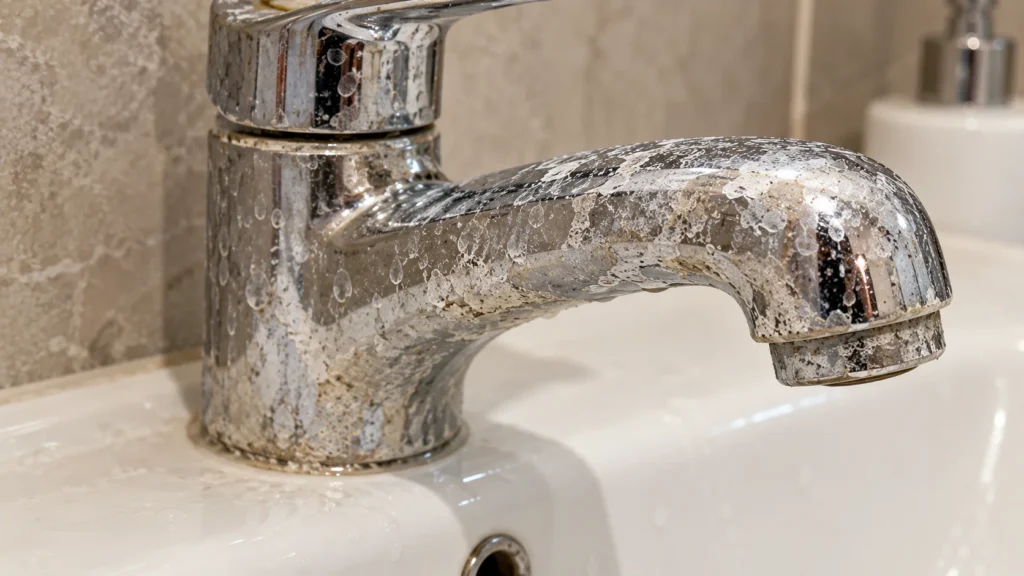
For tubs, toilets, and sinks, Zep currently instructs users to mix the concentrate 50/50 with warm water and rinse within 60 seconds. Tougher stains may receive a full-strength application, but the company still emphasizes prompt rinsing.
Because this is an acidic product, it should not be treated as interchangeable with abrasive products such as Bio-Clean.
Titan Labs A1 Hard Water Stain Remover
Titan Labs A-1 Hardwater Stain Remover takes a different approach. Titan Labs describes A-1 as a non-acid product containing an engineered abrasive intended to remove hard water spots and stains from glass, ceramic, steel, porcelain, fiberglass, and tile. It is also marketed for mineral deposits, scale, lime, corrosion, and rust.
This distinction is useful when comparing Titan Labs A1 hard water stain remover with acidic products. A-1’s manufacturer specifically promotes it for hard surfaces where an abrasive restoration approach is appropriate.
As always, follow Titan Labs’ own instructions and confirm compatibility before applying it to a valuable or sensitive surface.
Jump into Other Related Article
- How to Clean Stainless Steel Sink | Stains, Hard Water, Rust & Scratches
- How to Remove Coffee Stains | Easy Methods for Clothes, Teeth, Carpet & More
- How to Remove Chocolate Stains | Clothes, Carpet, Couch & More
Sörbo Hard Water Stain Remover
Sörbo Hard Water Stain Remover is available as a 5-ounce concentrated powder treatment. Sörbo says it is formulated to remove mineral deposits and bonded residue from glass and tile, including hard water stains, sprinkler overspray, and building runoff.
The manufacturer’s directions call for starting with a clean, wet surface and applying the product with a damp sponge or white non-abrasive pad. The affected area is worked in circular motions, followed by thorough rinsing and normal cleaning.
This makes Sörbo particularly relevant to window, shower-door, and professional glass-cleaning applications.
Hard Water Stain Remover for Cars and Windows
Hard water deposits can also appear on car windows, windshields, windows, and exterior glass after water evaporates. Sprinkler overspray can be particularly troublesome because mineral-rich droplets repeatedly dry on the same surface.
Bio-Clean lists windshields and windows among its applications, while Sörbo specifically identifies windows and shower doors as suitable applications.

For automotive glass, use only a product that specifically permits automotive glass or the particular surface you are treating. Do not assume that a bathroom limescale cleaner is suitable for vehicle paint, trim, coatings, or windshield treatments.
Natural and Eco-Friendly Hard Water Stain Remover Options
People searching for a natural hard water stain remover or Bio-Clean eco friendly hard water stain remover should distinguish marketing language from actual product characteristics.
Bio-Clean describes its hard water remover as abrasive-based and made from a non-chemical compound on its product page, while its safety information still identifies potential eye and skin irritation and instructs users to avoid ingestion and contact with eyes and skin.
CLR, meanwhile, says its household Calcium, Lime & Rust Remover is EPA Safer Choice recognized and phosphate-free. That does not mean every cleaning situation is automatically safe; the product’s surface restrictions and directions still apply.
The safest choice is therefore based on surface compatibility, intended use, ingredients, and directions, rather than the word natural or eco-friendly alone.
Common Mistakes When Removing Hard Water Stains
Hard water deposits become harder to remove when cleaning methods damage the surface or allow deposits to accumulate repeatedly. Using an overly abrasive pad can scratch or dull a finish, while leaving an acidic product on too long can damage some surfaces.
Another mistake is assuming that every cloudy area is removable mineral buildup. Some glass deposits can become etched into the surface, meaning cleaning alone may not restore the original appearance.
Avoid these mistakes:
- Using an incompatible acidic cleaner.
- Using abrasive pads on delicate finishes.
- Leaving products on longer than directed.
- Mixing cleaners together.
- Mixing acidic cleaners with bleach.
- Skipping a hidden-area test.
- Ignoring ventilation requirements.
- Failing to wear recommended gloves or eye protection.
- Using a bathroom descaler on natural stone.
- Scraping glass aggressively with metal.
- Assuming every cloudy glass mark is removable.
- Using a product intended for one surface on another.
- Allowing the cleaner to dry on the surface.
- Failing to rinse thoroughly.
- Repeatedly treating an etched surface as though it were ordinary buildup.
Conclusion
The right hard water stain remover depends on the surface and the type of mineral deposit. Bio-Clean uses an abrasive approach, CLR and Zep use calcium/lime/rust-removal chemistry, Titan Labs A-1 uses an engineered non-acid abrasive, and Sörbo offers a concentrated powder designed for glass and tile deposits.
For shower glass, toilets, windows, cars, and other surfaces, always confirm compatibility before cleaning. Start with the manufacturer’s recommended method, use the stated contact time, rinse thoroughly, and remember that heavily etched or permanently damaged surfaces may not be restorable with a stain remover alone.
What is the best hard water stain remover?
There is no single best product for every surface. Bio-Clean is an abrasive option, while CLR and Zep are calcium/lime/rust removers with acidic formulations. The appropriate choice depends on the surface and the type of deposit.
What is the best hard water stain remover for glass?
Choose a product specifically approved for glass. Bio-Clean and Sörbo both list glass-related applications, while CLR also provides instructions for hard water deposits on glass.
Can Bio-Clean remove hard water stains?
Yes. Bio-Clean states that its product is designed to remove water spots and mineral deposits from compatible hard surfaces, including shower doors, windows, glass, porcelain, tile, and chrome.
Can CLR remove hard water stains from a toilet?
CLR specifically markets its Calcium, Lime & Rust Remover for calcium and lime buildup and provides instructions for removing hard water stains from toilet bowls.
Can vinegar remove hard water stains?
Vinegar can help with some light mineral deposits, but it is not suitable for every surface. Avoid using acidic DIY cleaners on surfaces that can be damaged by acids, such as certain natural stones.
What is the best hard water stain remover for shower glass?
Use a product specifically labeled for glass and compatible with the shower-door material. Bio-Clean, Sörbo, and certain CLR products have manufacturer-documented glass applications.